
In my extensive practice within the investment casting process, I have consistently observed that the production of high-integrity aluminum alloy castings is frequently challenged by the occurrence of porosity defects. The investment casting process, renowned for its ability to produce complex, near-net-shape components with excellent dimensional accuracy and surface finish, is particularly sensitive to such defects due to the intricate interplay of metallurgical, process, and environmental factors. Porosity not only detrimentally affects the mechanical properties—reducing strength, fatigue life, and toughness—but also serves as a critical failure initiator. This article, drawn from my first-hand experience, provides a comprehensive analysis of porosity formation mechanisms and outlines robust preventive strategies, integrating theoretical principles with practical shop-floor solutions. The focus will remain squarely on the investment casting process for aluminum alloys, a field where meticulous control is paramount.
The fundamental advantage of the investment casting process lies in its use of a sacrificial pattern, around which a ceramic shell is built. This shell, once fired, provides a single, seamless mold cavity with exceptional reproduction fidelity. However, this very process creates multiple opportunities for gas entrapment or generation. Based on their origin, porosity defects in aluminum alloy investment castings can be classified into three primary categories: precipitated porosity, reactive porosity, and entrapped porosity. Each type exhibits distinct morphological characteristics and root causes, necessitating targeted countermeasures.
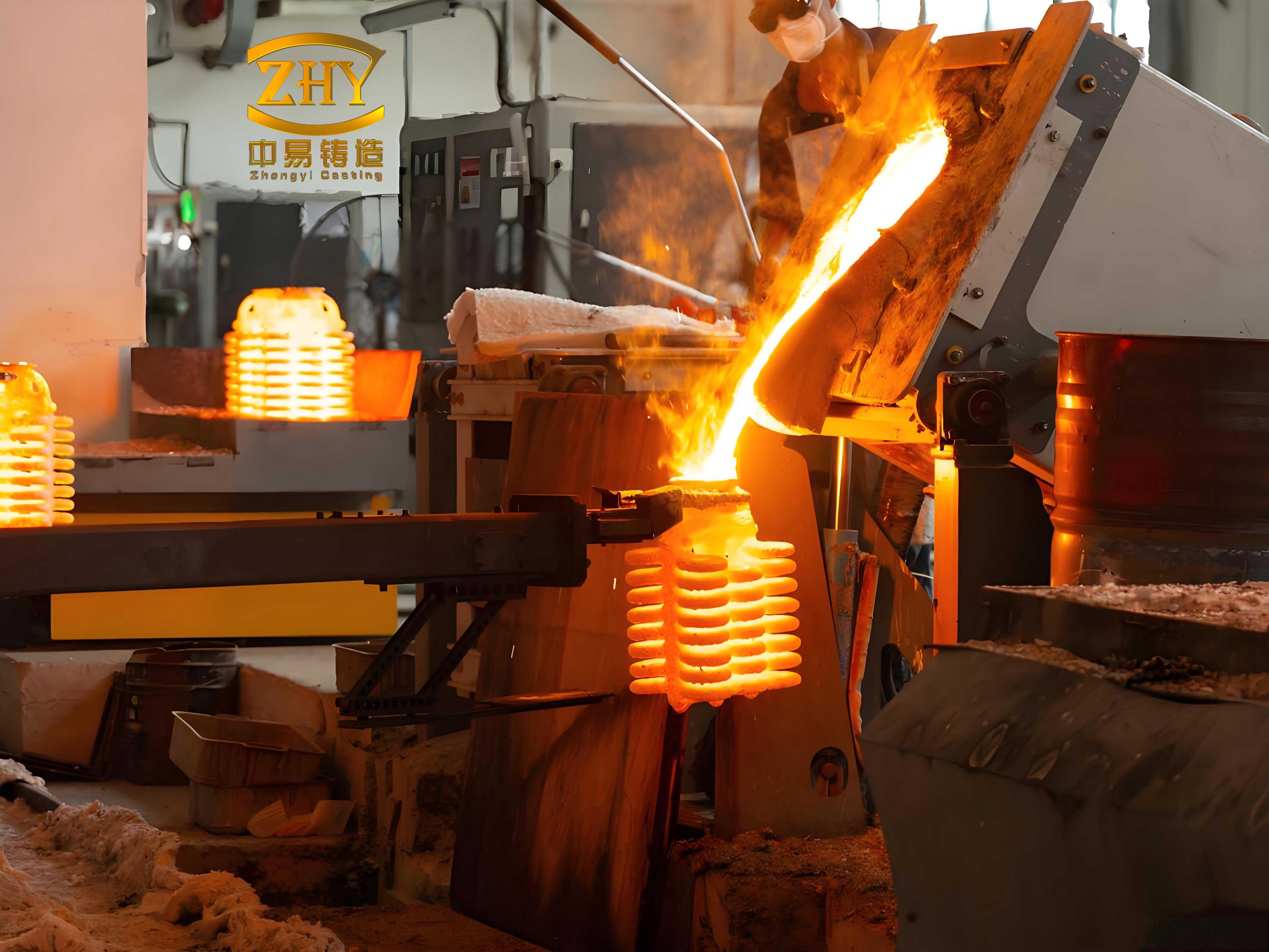
Precipitated porosity, often termed “pinholing,” is characterized by a multitude of fine, often microscopic cavities distributed uniformly or locally within the casting cross-section, frequently coexisting with micro-shrinkage. In the investment casting process, this defect predominantly arises from the precipitation of dissolved hydrogen during solidification. Aluminum has a high affinity for hydrogen, and its solubility in the liquid metal decreases dramatically upon solidification. The governing relationship for hydrogen solubility can be expressed as:
$$ S_L = S_0 \cdot \exp\left(-\frac{\Delta H}{R T}\right) $$
where \( S_L \) is the solubility in the liquid, \( S_0 \) is a pre-exponential factor, \( \Delta H \) is the heat of solution, \( R \) is the universal gas constant, and \( T \) is the absolute temperature. During cooling and solidification, as the temperature \( T \) decreases, the equilibrium solubility \( S_L \) plummets. If the initial hydrogen content \( C_0 \) exceeds the local solubility at the solidification front, hydrogen atoms diffuse and coalesce to form bubbles. The critical condition for pore nucleation is given by the supersaturation ratio:
$$ \frac{C_0}{S_S} > 1 $$
where \( S_S \) is the solubility in the solid. A slow solidification rate, common in thick sections or hot spots of an investment casting, provides ample time for diffusion, bubble growth, and retention within the solidified structure. My observations confirm that an entire heat or batch of castings often exhibits this defect if the melt treatment is inadequate. Therefore, control within the investment casting process hinges on a dual strategy: minimizing hydrogen pickup during melting and holding, and accelerating heat extraction during casting solidification to outrun hydrogen diffusion.
| Primary Cause Category | Specific Process Factors | Preventive Actions | Key Parameter Control |
|---|---|---|---|
| Melt Preparation & Handling | High melting/superheat temperature | Limit melt temperature to ≤ 760°C; use calibrated thermocouples. | \( T_{melt} \leq 760^\circ C \) |
| Prolonged holding time | Optimize furnace scheduling to minimize melt exposure. | \( t_{hold} \rightarrow \text{min} \) | |
| Ineffective degassing | Implement rotary degassing with inert gas (Ar/N2); use flux tablets; perform reduced pressure test (RPT). | RPT bubble count < threshold | |
| Solidification Control | Slow cooling in heavy sections | Employ exothermic/insulating toppings; use chills in shell mold design; backfill with steel shot post-pour. | \( G \cdot R \) (Thermal Gradient × Rate) → max |
| Poor thermal management of shell | Control preheat temperature of shell; optimize shell thickness and conductivity. | \( T_{shell\,preheat} \approx 800-1000^\circ C \) |
Reactive porosity manifests as clusters of fine pores located just beneath the casting surface (typically 1-3 mm deep), often becoming visible only after heat treatment or shot blasting. This defect is intrinsically linked to the ceramic shell environment in the investment casting process. At high temperatures, molten aluminum reacts with residual moisture, binders, or contaminants within the shell mold. The principal chemical reaction is:
$$ 2\text{Al}_{(l)} + 3\text{H}_2\text{O}_{(g/v)} \rightarrow \text{Al}_2\text{O}_{3(s)} + 3\text{H}_{2(g)} \uparrow $$
The nascent alumina (\( \text{Al}_2\text{O}_3 \)) films act as potent substrates for hydrogen bubble nucleation, effectively trapping the gas. The rate of this reaction is influenced by the partial pressure of water vapor and temperature. The driving force can be conceptualized through the Gibbs free energy change:
$$ \Delta G = \Delta G^\circ + RT \ln(Q) $$
where \( Q \) is the reaction quotient dependent on \( P_{H_2O} \). High shell moisture or low firing temperature drastically increases \( P_{H_2O} \) at the metal-mold interface, making \( \Delta G \) more negative and favoring the reaction. In my work, I have traced such defects to inadequate shell dewaxing, insufficient firing, ingress of atmospheric humidity into stored shells, or contamination from handling. Therefore, stringent control over the “shell-making” and “shell-handling” sub-processes within the overall investment casting process is non-negotiable.
| Potential Source | Mechanism | Prevention Protocol | Verification Method |
|---|---|---|---|
| Incomplete dewaxing | Trapped wax/ polymer steam reacts with metal. | Optimize autoclave parameters (pressure, temperature, time); implement visual and weight-loss checks. | Shell weight post-dewax < specified limit |
| Insufficient shell firing | Residual chemically bound water in ceramic binder. | Ensure furnace profile reaches > 1000°C for sufficient soak time; monitor furnace atmosphere. | Pyrometric cone equivalents or data logger records |
| Shell contamination | Dust, loose sand, or organics in cavity. | Post-firing, inspect and clean cavity with dry air; use alcohol swabs if needed; handle with gloves. | Visual inspection under bright light |
| Tooling moisture | Ladles, skimmers, thermocouple sheaths not fully dried. | Pre-heat all tools to 400-500°C for >2 hours prior to use; store in warm cabinets. | Tool temperature check before contact with metal |
Entrapped porosity, in contrast, presents as larger, isolated pores often with a smooth, oxidized interior surface, located randomly within the casting volume or near the surface. This defect is primarily a hydrodynamic issue within the investment casting process. It occurs when air or gas from the gating system or mold cavity is physically engulfed by the advancing molten metal front and fails to escape before the metal solidifies. The conditions favoring entrapment include turbulent filling, premature filling of upper sections, and inadequate venting pathways. The fundamental fluid dynamics can be described by the Bernoulli principle and the continuity equation, where a high velocity \( v \) in narrow sections leads to pressure drops that can draw in air. More pragmatically, the dimensionless Reynolds number \( Re = \frac{\rho v D}{\mu} \) indicates flow regime; a high \( Re \) promotes turbulence. In gating design for the investment casting process, the goal is to maintain laminar flow (\( Re < 2000 \)). Furthermore, the back-pressure from gases trapped in blind pockets of the shell must be vented; otherwise, the metal will solidify around the pocket. My experience has repeatedly shown that seemingly minor misalignments in gating or shell orientation during pouring can lead to catastrophic entrapped pores.
The prevention strategy is rooted in meticulous gating and venting design, and disciplined pouring practice. The basic principle is to ensure a positive, progressive solidification gradient towards the feed heads, while simultaneously providing low-resistance escape routes for displaced air. This often requires strategic placement of vents or permeable ceramic filter inserts. The flow rate \( Q \) through a vent of area \( A_v \) can be approximated by:
$$ Q = C_d \cdot A_v \cdot \sqrt{\frac{2 \Delta P}{\rho_{gas}}} $$
where \( C_d \) is the discharge coefficient and \( \Delta P \) is the pressure differential. Ensuring sufficient total vent area \( \sum A_v \) is critical for the success of the investment casting process for complex parts.
| Aspect | Problem | Solution | Design Principle |
|---|---|---|---|
| Gating Design | Turbulent metal entry; jetting. | Use tapered sprue, enlarged pour cup, and choke at sprue base. Employ tangential or step gating. | Maintain \( v_{metal} \) below critical threshold; fill from bottom-up. |
| In-Gate Orientation | Upper gates open early, trapping air below. | Angle in-gates upward 20-30° from horizontal; use pencil gates or staggered heights. | Delay metal entry from top gates until cavity is partially filled from bottom. |
| Venting | Insufficient escape for cavity air. | Add explicit vent waxes to pattern at high points; use shell permeability; incorporate vent slots in core prints. | \( \sum A_{vent} \propto V_{cavity} / t_{fill} \) |
| Pouring Practice | Pouring from height; interrupted stream. | Keep ladle nozzle close to pour cup; maintain a constant, full sprue; use pour boxes for stability. | Minimize free-fall distance; ensure smooth, laminar metal transfer. |
| Shell Positioning | Shell tilting causes air pockets. | Use precision fixtures in sand fill to ensure shell remains vertical; check alignment before pouring. | Align vent paths vertically with thermal gradient. |
To illustrate the integrated application of these principles, I will discuss a representative case from my involvement with the investment casting process. A particular aluminum alloy structural component, characterized by a large, flat upper plate and deep reinforcing ribs, was suffering from an unacceptably high scrap rate due to porosity concentrated at the junction of the plate and ribs. Initial analysis, structured via a cause-and-effect diagram (Ishikawa/fishbone), scrutinized Man, Machine, Material, Method, Measurement, and Environment factors. Four root causes were isolated: (1) residual ceramic debris in the shell cavity acting as a source for reactive porosity, (2) a gating system that caused metal to prematurely flow over the large plate, trapping air beneath (entrapped porosity), (3) insufficient venting from the plate’s lower surface, and (4) slow solidification of the massive plate section promoting hydrogen precipitation.
The corrective actions were multi-faceted. First, a stringent shell cleaning protocol was instituted, involving post-firing inspection under high-intensity lamps and blowing out cavities with dry, oil-free air. Second, the gating system was radically redesigned. The original single-tier entry was replaced with a staggered, bottom-feed system. A new, dedicated venting sprue was added directly to the highest point of the plate geometry. Furthermore, the primary in-gates were angled to delay metal flow over the plate until the lower ribs were filled. The modified gating layout significantly improved the pressure gradient and air evacuation path. Third, the pouring practice was standardized: operators were trained to maintain the shell in a perfectly vertical orientation using alignment jigs within the backing sand, and to employ a slow-pour, fast-fill technique to minimize turbulence. Finally, to address solidification control, the practice of immediately backfilling the pouring flask with loose, dry steel shot after pour completion was adopted. This drastic increase in cooling rate for the entire casting, especially the thick plate, suppressed the time available for hydrogen bubble nucleation and growth.
The results were transformative. The scrap rate due to porosity fell dramatically, validating the systemic approach. This case underscores a critical lesson in the investment casting process: porosity defects are seldom due to a single factor. They are the product of interactions between melt quality, shell condition, gating hydraulics, and thermal dynamics. A holistic view, encompassing the entire process chain from pattern to heat treatment, is essential for consistent quality.
In conclusion, mastering the mitigation of porosity in aluminum alloy investment casting requires a deep understanding of its varied origins and a disciplined implementation of preventive controls. The investment casting process offers exceptional geometric freedom but demands commensurate attention to detail. For precipitated porosity, the pillars of defense are rigorous melt degassing and accelerated solidification. The governing metallurgical principles, such as the temperature dependence of gas solubility, must guide practice. For reactive porosity, the integrity and dryness of the ceramic shell system are paramount; every step from slurry formulation to mold firing must be controlled to prevent metal-mold reactions. For entrapped porosity, the focus shifts to fluid mechanics and mold venting; gating design must prioritize laminar, bottom-up filling and provide explicit, low-resistance escape paths for air. As demonstrated in the case study, effective solutions often involve synergistic adjustments across multiple process parameters. Continuous monitoring via techniques like reduced pressure testing for melt quality, shell weight checks, and radiographic inspection of castings is indispensable for feedback and control. By adhering to these scientifically grounded and practically proven strategies, foundries can significantly enhance the reliability and performance of aluminum components produced through the investment casting process, meeting the stringent demands of aerospace, defense, and other high-technology sectors.