
In my extensive experience within the foundry industry, addressing defects that compromise casting integrity is paramount. Among these, porosity in casting stands as a persistent and costly challenge. This article delves into the intricate relationship between gating system design, metal flow dynamics, and the formation of gas-related defects. I will share insights gained from practical applications, particularly focusing on the “large ingate” or “large orifice filling” technology and the profound impact of the initial metal stream—often termed the “first flow”—on defect generation. The manifestation of porosity in casting is not merely a surface irregularity; it is a volumetric flaw that can severely undermine mechanical properties and pressure tightness. Through detailed analysis, supported by empirical data, formulas, and systematic tables, I aim to elucidate the mechanisms behind this defect and present effective mitigation strategies that we have developed and refined over years of production.
The foundational principle of the large ingate technology revolves around redefining traditional gating ratios. Conventional handbook recommendations often prescribe specific proportional relationships between the sprue, runner, and ingate cross-sectional areas. However, in applications such as engine cylinder blocks, which require rapid filling to manage thermal gradients and minimize mistruns, these standard ratios can be insufficient. The core innovation lies in employing a substantially larger cross-sectional area for the main horizontal runner. This design philosophy directly counters issues like mold wall movement (swelling), mold lift, and sand erosion that are exacerbated by high pouring speeds. The enlarged runner acts as a buffer and distribution manifold, stabilizing the metal flow and reducing turbulence before it enters the mold cavity through the ingates. This approach is particularly effective in combating certain forms of porosity in casting that arise from turbulent entrainment of gases and sand.
For complex castings like cylinder blocks, a step-gating system is frequently employed. Our practice has shown that the flow distribution between the upper and lower tiers of ingates is critical. An optimal balance ensures sequential filling from the bottom upward, promoting favorable temperature gradients. The data from several cylinder block production runs are summarized below, showing the area ratio between lower and upper ingates.
| Cylinder Block Model | Lower Ingate Area, ΣFinner-lower (cm²) | Upper Ingate Area, ΣFinner-upper (cm²) | Ratio ΣFinner-lower : ΣFinner-upper |
|---|---|---|---|
| CA6102 | 8.88 | 12.60 | 40 : 60 |
| YC6105 | 9.60 | 11.52 | 45 : 55 |
| NN4102 | 5.76 | 8.34 | 40 : 60 |
| N485 | 4.80 | 5.60 | 46 : 54 |
| N385 | 3.84 | 4.48 | 46 : 54 |
The general principle we adhere to is maintaining the ratio within the range of (45–40) for the lower ingates to (55–60) for the upper ingates. This ratio is derived from empirical optimization to control the filling pattern and reduce the potential for porosity in casting that can form in isolated sections of the mold. The accompanying gating system schematic typically features a sprue, a main runner, upper and lower transverse runners connected via transition channels, and finally the ingates. Proper venting is integrated, often using edge-feeding risers that also serve as effective vents.
Venting design is inseparable from the large ingate philosophy. To accommodate the rapid displacement of air, the total cross-sectional area of vents and open risers (ΣFvent) must be significantly large. Our production evidence suggests a specific relationship with the choke area (often at the sprue base or a filter transition, denoted ΣFchoke). The recommended ratio is:
$$ \frac{\Sigma F_{vent}}{\Sigma F_{choke}} = 1.3 \text{ to } 1.8 $$
Data for different cylinder blocks confirm this range, as shown in the following table. Inadequate venting is a direct contributor to backpressure and gas entrapment, leading to gross porosity in casting.
| Cylinder Block Model | Total Vent Area, ΣFvent (cm²) | ΣFvent / ΣFchoke |
|---|---|---|
| CA6102 | 33.65 | 1.63 |
| YC6105 | 29.07 | 1.41 |
| NN4102 | 18.34 | 1.35 |
| N485 | 15.20 | 1.53 |
| N385 | 12.90 | 1.58 |
Edge-fed risers are particularly advantageous. They provide a large, open surface for gas escape, can trap slag and loose sand, offer some feeding for localized hot spots, and help prevent “burns” or eruptions caused by rapid gas generation during pouring. This multi-functionality makes them a cornerstone of our strategy to prevent porosity in casting.
However, even with an optimized gating and venting system, a specific type of porosity in casting can persist. This defect typically manifests as isolated, irregularly shaped cavities, 3–6 mm in diameter, located on the bottom or side surfaces farthest from the sprue. They are often revealed only during machining, and sometimes contain granular or powdery slag inclusions. Critically, this defect occurs irrespective of the mold type—green, skin-dried, or fully dry—pointing to a cause inherent to the metal stream itself. Through prolonged observation and analysis, we have identified the culprit: the initial, or “first,” flow of molten metal entering the mold.
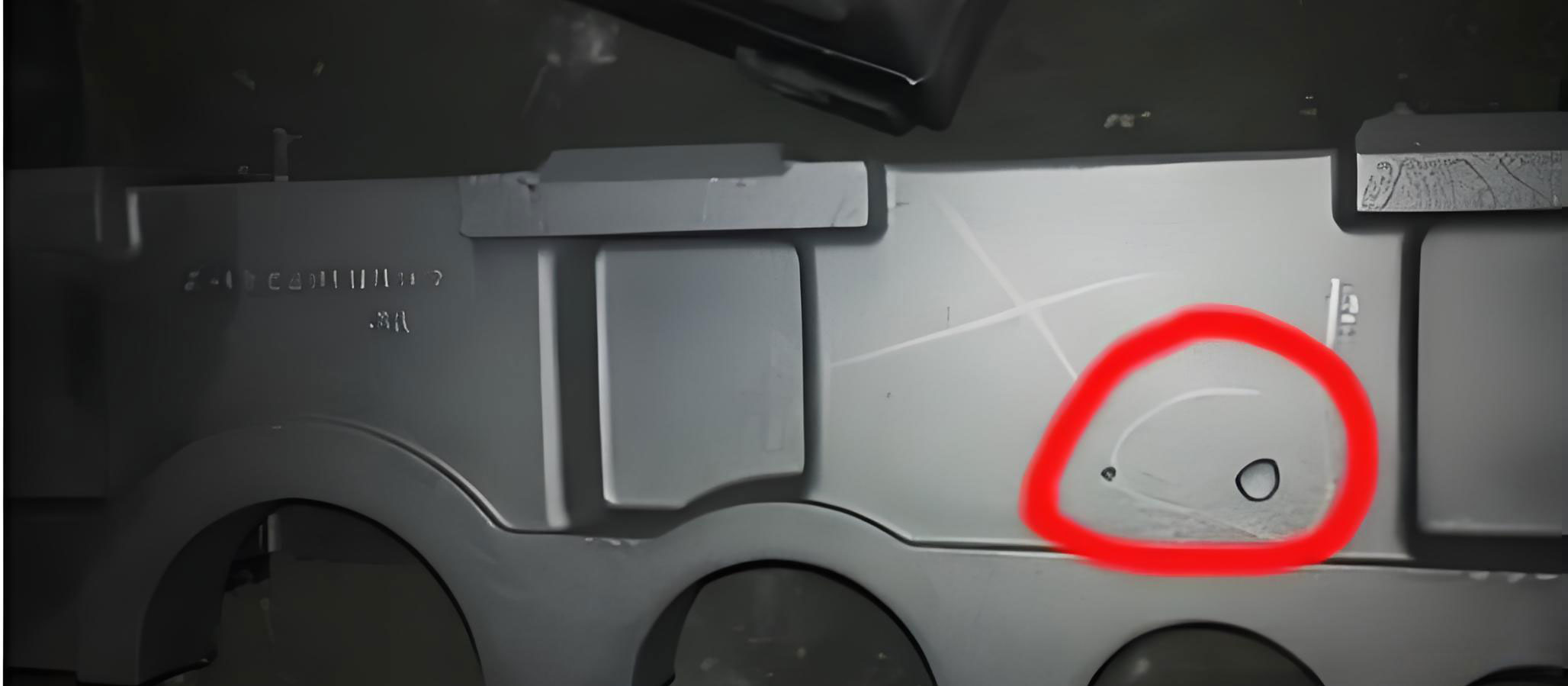
The first flow is often laden with oxides, slag, and other low-melting-point inclusions that accumulate in the ladle or furnace tap hole. When this contaminated metal enters the mold cavity, it possesses higher viscosity and poorer fluidity. As it stagnates in remote corners of the mold, chemical reactions during solidification can generate gas. A primary reaction involves iron oxide and carbon present in the melt:
$$ \text{FeO} + \text{C} \rightarrow \text{Fe} + \text{CO} \uparrow $$
The generated carbon monoxide gas cannot escape through the already solidifying metal skin, leading to the formation of pinholes or larger cavities. These reaction-induced pores often have a smooth, shiny metallic surface. Another contributing reaction involves sulfur and manganese. With high S and Mn contents in the charge, iron sulfide can form and subsequently react with manganese:
$$ \text{FeS} + \text{Mn} \rightarrow \text{Fe} + \text{MnS} + \Delta H $$
where $\Delta H$ represents the exothermic heat release. The resulting manganese sulfide, especially when dissolved in a slag rich in FeO and MnO, can lower the slag’s melting point below the eutectic temperature of cast iron. This slag is carried by the first flow into the cavity. During solidification, this slag-metal interface facilitates further gas-generating reactions, resulting in porosity in casting that contains visible slag particles.
To quantify the gating system design for preventing first-flow-related defects, we employ specific calculations. For a given casting, the total ingate area ($\Sigma F_{inner}$) is determined by:
$$ \Sigma F_{inner} = n \cdot K \sqrt{G} $$
where $n$ is the number of castings per mold, $G$ is the weight of a single casting in kilograms, and $K$ is a coefficient dependent on the desired pouring speed. For rapid pouring, which helps flush out contaminants, $K$ is chosen between 0.8 and 1.1. Once $\Sigma F_{inner}$ is established, the runner ($\Sigma F_{cross}$) and sprue ($F_{vertical}$) areas are sized using a modified ratio, such as:
$$ \Sigma F_{inner} : \Sigma F_{cross} : F_{vertical} = 1 : 1.85 : 1.05 $$
This ratio ensures the runner has ample capacity to handle the first flow and reduce its velocity before it reaches the ingates. However, the most effective measure is to prevent the contaminated first flow from entering the casting cavity altogether. This is achieved by incorporating slag traps or enlarged runner extensions at strategic locations.
Several case studies illustrate the effectiveness of this approach. For a machine tool slide casting weighing 32 kg, the original process used a single-side gating with a riser, resulting in a scrap rate due to porosity in casting exceeding 40%. The revised design incorporated a large, elongated slag collector at the end of the runner opposite the ingates. This collector’s purpose is to capture and retain the initial, contaminated metal stream. The subsequent, cleaner metal then proceeds to fill the cavity through the ingates. After this modification, the scrap rate attributed to porosity in casting dropped to around 9%. The key was providing a dedicated, low-pressure zone for the first flow to settle.
For a larger tool holder casting (100 kg), a two-stage trapping system was implemented. The first flow from the sprue enters a lower runner and is directed into a primary slag trap. The following metal rises through a vertical connection to fill an upper runner, where secondary traps at its ends capture any remaining initial contamination. Only then does metal enter the cavity through well-positioned ingates. This system reduced the incidence of porosity in casting from about 24% to below 2.5%. The design principle is visualized in the schematic where the runner end is significantly enlarged to act as a reservoir for the first flow.
In the production of a heavy machine bed (780 kg) using a shower-type gating system, porosity in casting frequently appeared at the end farthest from the sprue. The solution was to enlarge the cross-section of the horizontal runner at its very end—the last segment before the final ingate. This enlarged section acts as a “dump” for the initial cold and dirty metal, preventing it from reversing flow and entering the casting. This simple change brought the overall scrap rate for this defect down to approximately 3% of the total rejections.
The following table summarizes the impact of implementing first-flow diversion strategies on the scrap rate due to porosity in casting for different components.
| Casting Component | Original Scrap Rate (%) | Modified Scrap Rate (%) | Key Modification |
|---|---|---|---|
| Machine Slide | 44.0 | 9.3 | Large end-runner slag collector |
| Tool Holder | 24.8 | 2.4 | Two-stage runner with slag traps |
| Machine Bed | ~33.0 (for defect) | ~3.0 (of total scrap) | Enlarged runner terminal section |
Beyond gating design, melt quality plays a crucial role in mitigating porosity in casting. We have found that minimizing the manganese addition, as long as mechanical specifications permit, reduces the potential for MnS-related slag formation. The reaction propensity is tied to composition. Furthermore, increasing the pouring temperature within allowable limits improves fluidity, helps slags float out in the ladle or basin, and can reduce the viscosity of the first flow, making it less likely to trap gas. The relationship between temperature, fluidity, and defect formation is complex, but a higher superheat generally promotes a cleaner metal stream entering the mold.
From a chemical kinetics perspective, the rate of the gas-generating reaction $ \text{FeO} + \text{C} \rightarrow \text{Fe} + \text{CO} $ can be influenced by the concentration of reactants. If we denote the concentration of FeO as $[FeO]$ and of carbon as $[C]$, a simplified rate equation might be expressed as:
$$ r = k [FeO]^a [C]^b $$
where $r$ is the reaction rate, $k$ is the rate constant (temperature-dependent via the Arrhenius equation $k = A e^{-E_a/(RT)}$), and $a$ and $b$ are reaction orders. By controlling melt oxidation (reducing $[FeO]$) through proper furnace practice and covering fluxes, we can slow this reaction, giving gases more time to escape before solidification seals the surface. This is another layer of defense against reaction-induced porosity in casting.
The interplay between fluid dynamics and thermodynamics is central to understanding porosity in casting. The Bernoulli principle governs flow in the gating system. For an incompressible fluid, neglecting friction, the relationship between pressure ($P$), velocity ($v$), and height ($h$) at two points in the system is:
$$ P_1 + \frac{1}{2} \rho v_1^2 + \rho g h_1 = P_2 + \frac{1}{2} \rho v_2^2 + \rho g h_2 $$
where $\rho$ is density and $g$ is gravity. A large runner cross-section ($A_2$) reduces velocity ($v_2 = Q/A_2$, where $Q$ is volumetric flow rate), thereby increasing static pressure and reducing turbulence that can entrain air and cause mold erosion. Reduced erosion means less sand incorporated into the metal, which is another source of nucleation sites for porosity in casting. The goal is to achieve laminar or controlled turbulent flow (Reynolds number below a critical threshold) within the cavity. The Reynolds number $Re$ is given by:
$$ Re = \frac{\rho v D_h}{\mu} $$
where $D_h$ is the hydraulic diameter and $\mu$ is the dynamic viscosity. By designing runners and ingates to keep $Re$ relatively low, we minimize the energy available for gas entrainment and oxide film folding, both precursors to porosity in casting.
In summary, combating porosity in casting requires a multifaceted approach. The large ingate technology provides a robust framework for managing high-speed pouring by stabilizing flow through oversized runners and carefully balanced step-gating. This addresses defects related to mold erosion and gas entrapment from turbulent filling. However, the insidious problem of first-flow-induced porosity in casting demands specific countermeasures. The evidence clearly shows that this defect is metallurgical and hydrodynamic in origin, not merely a mold sand issue. The most effective solution is to engineer the gating system to deliberately capture and isolate the initial, contaminated portion of the pour. This can be done through strategically placed and sized slag traps, enlarged runner ends, or multi-stage runner systems that act as “first-flow filters.”
Furthermore, complementary practices such as maximizing venting capacity, using edge-fed risers for combined venting and feeding, controlling melt chemistry to minimize low-melting-point slag formers, and optimizing pouring temperature all contribute to a comprehensive defense against porosity in casting. The economic impact is significant, as demonstrated by the drastic reduction in scrap rates—from over 40% to single digits—in the cases presented. Continuous monitoring and adaptation of these principles to specific casting geometries and alloys remain essential. The fight against porosity in casting is a testament to the intricate dance between foundry engineering, metallurgy, and process control, where each adjustment in the gating diagram or furnace log can mean the difference between sound castings and costly rejects.