
As a foundry engineer and researcher, I have encountered numerous instances where the integrity and performance of a cast component were compromised by internal voids known as porosity. The occurrence of porosity in casting is one of the most prevalent and challenging defects to control, leading to significant economic losses due to scrap, rework, and in-service failures. This article aims to provide an in-depth, first-person perspective analysis of the causes, mechanisms, and mitigation strategies for porosity in castings. Drawing upon fundamental principles and practical case studies, I will explore the complex interplay of factors that lead to gas entrapment and shrinkage cavities, providing a comprehensive guide for understanding and combating this defect. The following discussion will extend far beyond a single example to cover the broad landscape of porosity formation in various casting processes and alloys.
The fundamental issue of porosity in casting arises from the entrapment of gas within the solidifying metal or from the volumetric contraction that occurs during the phase change from liquid to solid. These two primary sources give rise to the main classifications: gas porosity and shrinkage porosity. While they can sometimes appear similar, their formation mechanisms, location, and morphology differ significantly. Understanding this distinction is the first critical step in effective diagnosis and remedy. Gas pores are typically spherical or elongated with smooth, shiny walls, often located near the cope surface or uniformly distributed. In contrast, shrinkage porosity tends to be irregular, dendritic, or interconnected with rough walls, and is commonly found in thermal centers, hot spots, or regions of heavy sections where feeding is inadequate.
The morphology and classification of internal voids can be summarized in the following table:
| Type of Porosity | Primary Cause | Typical Morphology | Common Location | Wall Appearance |
|---|---|---|---|---|
| Gas Porosity | Entrapment of gases (H₂, N₂, O₂) from mold, atmosphere, or charge materials. | Spherical, elliptical, or elongated smooth cavities. | Sub-surface, uniform distribution, near cope. | Smooth, shiny, often oxidized. |
| Macro-Shrinkage | Inadequate liquid metal feeding to compensate for solidification contraction. | Large, irregular cavities or pipes. | Thermal centers, hot spots, last-to-freeze areas. | Rough, dendritic, jagged. |
| Micro-Shrinkage (Microporosity) | Interdendritic feeding restriction during final stages of solidification. | Small, interconnected pores within the dendrite mesh. | Throughout mushy zone, especially in wide freezing range alloys. | Irregular, interconnected. |
| Pinhole Porosity | Primarily hydrogen gas evolution during solidification, often in steels and copper alloys. | Small, cylindrical pores perpendicular to the casting surface. | Just beneath the casting skin. | Smooth. |
To quantitatively understand the driving force behind gas porosity, one must consider the solubility of gases in molten metals. Hydrogen is particularly notorious in aluminum and steel castings. The solubility of a diatomic gas like hydrogen in molten metal is described by Sieverts’ Law, which states that the solubility is proportional to the square root of the partial pressure of the gas above the melt:
$$ S = k \sqrt{P_{H_2}} $$
where \( S \) is the solubility, \( k \) is the Sieverts’ constant (dependent on temperature and alloy), and \( P_{H_2} \) is the partial pressure of hydrogen. Crucially, the solubility of gas decreases dramatically as the metal solidifies. For hydrogen in aluminum, the solubility in the liquid state can be over ten times that in the solid state. This abrupt drop forces the excess gas to precipitate out in the form of bubbles, which may become trapped if the solidification front advances too rapidly. The relationship between temperature and solubility can be expressed as:
$$ \log S = A – \frac{B}{T} $$
where \( A \) and \( B \) are constants for a given metal-gas system, and \( T \) is the absolute temperature. This inverse relationship with temperature is a key factor in the formation of porosity in casting during cooling.
Shrinkage porosity, on the other hand, is a consequence of the physical laws governing phase change. Most metals contract upon solidification. The total volumetric shrinkage that must be compensated for by feeding from risers can be significant. If the feeding path is blocked by a solidified skin or a tortuous dendrite network, internal porosity forms. The famous Chvorinov’s Rule helps predict the local solidification time, which is critical for designing feeding systems:
$$ t_s = B \left( \frac{V}{A} \right)^n $$
where \( t_s \) is the solidification time, \( V \) is the volume of the casting section, \( A \) is its surface area, \( B \) is a mold constant, and \( n \) is an exponent (often ~2). Sections with a high \( V/A \) ratio (like thick junctions) solidify last and are most prone to shrinkage-related porosity in casting. The pressure drop in the interdendritic liquid feeding the shrinkage can be estimated using Darcy’s law for flow through a porous medium, and when this pressure falls below a critical value, pore nucleation occurs.
Detailed Analysis of a Foundry Case: The Role of Mold Atmosphere and Chills
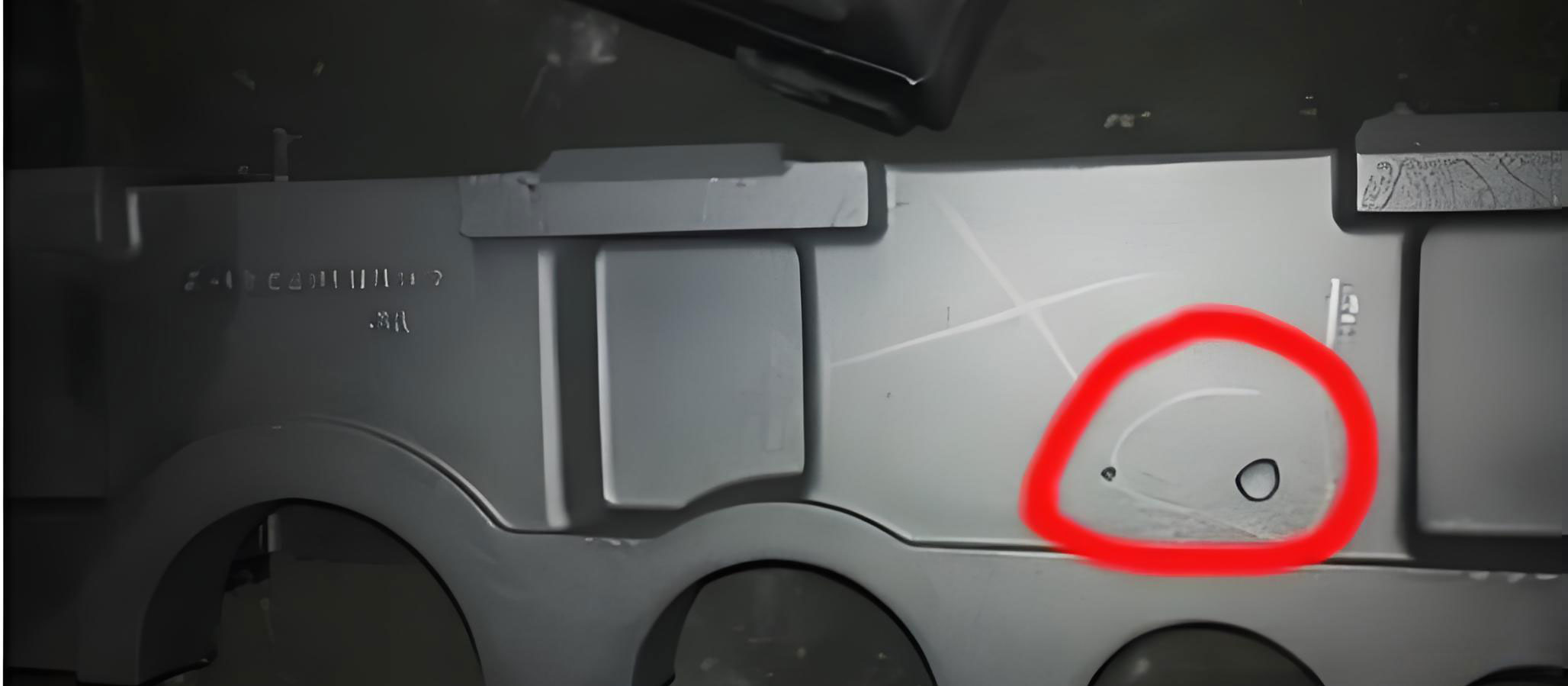
In my experience, a significant proportion of porosity defects in steel castings, particularly those of carbon and low-alloy grades, stem from improper use of molding materials and external cooling aids. I recall a detailed investigation into a series of heavy-section blocks, which served as internal chills for larger castings. The material was a standard cast carbon steel, analogous to ZG 230-450. The primary defect observed was a high density of subsurface spherical pores, with the frequency decreasing towards the center of the block. This is a classic signature of gas-driven porosity.
A multi-faceted analytical approach was employed. Macroscopic examination revealed that the pores were predominantly located in the outer regions. Crucially, upon sectioning, it was found that pre-inserted steel chills within the mold cavity showed poor fusion with the base metal. The interfaces were sites for pore and micro-shrinkage clusters. This immediately pointed to the surfaces of these chills as potential gas sources. The chemical composition of the base casting and the internal chills was analyzed and is summarized below:
| Element (wt.%) | Base Casting | Internal Chill A | Internal Chill B |
|---|---|---|---|
| C | 0.29 | – | – |
| Si | 0.22 | – | – |
| Mn | 0.61 | 0.81 | 0.66 |
| Cr | 0.14 | 0.33 | 0.19 |
| Ni | 0.28 | 0.33 | 0.31 |
| Mo | 0.02 | 0.04 | 0.05 |
| Cu | 0.13 | 0.13 | 0.15 |
| Fe | Balance | Balance | Balance |
The compositional analysis confirmed that the chill materials were similar to the base metal, ruling out major metallurgical incompatibility as the root cause. The microstructural examination revealed a typical as-cast structure of pearlite and ferrite with some Widmanstätten morphology, confirming the cast blocks had not been heat-treated. The presence of this structure did not directly cause the porosity but indicated a normal solidification cooling rate for the section size.
The root cause analysis converged on two main process-related factors. First, the molding sand used was a sodium silicate (water glass)-bonded system. While excellent for achieving high strength and dimensional accuracy, these molds are hygroscopic. If not used promptly after production or if stored in a humid environment, they can absorb significant moisture from the atmosphere. During pouring, this moisture vaporizes instantly upon contact with the molten steel, generating large volumes of steam:
$$ \text{H}_2\text{O}_{(l/s)} + \text{Heat} \rightarrow \text{Steam}_{(g)} $$
The steam can dissociate at high temperatures, providing a source of hydrogen and oxygen gas, which can dissolve into the metal and later precipitate as porosity. The reaction is:
$$ 2\text{H}_2\text{O}_{(g)} \rightarrow 2\text{H}_2_{(g)} + \text{O}_2_{(g)} $$
Secondly, and critically, the surfaces of the internal chills were found to have traces of rust (hydrated iron oxides) and organic contaminants. Rust decomposes under heat, releasing water vapor. Oil, grease, or other hydrocarbons undergo pyrolysis and combustion, producing a complex mixture of gases including hydrogen, carbon monoxide, and carbon dioxide. The sequence of events leading to porosity in this specific casting scenario can be modeled as follows:
- Gas Generation: Moisture from the mold and decomposition products from chill surface contaminants create a high-pressure gas zone at the metal-mold/chill interface.
- Gas Dissolution & Bubble Nucleation: At the molten metal interface, gases like hydrogen dissolve locally. As solidification progresses inward, the solubility drops, causing supersaturation and bubble nucleation at favorable sites, such as the non-fusing chill surface.
- Pore Growth and Entrapment: Bubbles grow by diffusion of gas from the surrounding supersaturated liquid and by coalescence. The advancing solidification front eventually traps these bubbles, forming permanent gas porosity, particularly severe in the regions surrounding the chills and near the casting surface.
The combined effect created a perfect storm for severe gas porosity. The water-based binder contributed a bulk source of gas, while the contaminated chills acted as potent, localized nucleation sites, explaining the poor fusion and concentrated defects around them. This case underscores that the problem of porosity in casting is often not a single-factor event but a system failure involving materials, process control, and atmospheric conditions.
Expanded Discussion on Contributing Factors to Porosity
Beyond the specific case, the formation of porosity in casting is influenced by a vast matrix of variables. A systematic breakdown is essential for any foundry practitioner. We can categorize the major influencing factors as follows:
| Factor Category | Specific Elements | Effect on Porosity | Primary Mechanism |
|---|---|---|---|
| Metal/Melt Factors | Gas Content (H₂, N₂, O₂) | Directly increases gas porosity. | Supersaturation and bubble nucleation upon solidification. |
| Alloy Composition & Freezing Range | Wide freezing range alloys (e.g., Al-Cu) promote microporosity. | Long mushy zone impedes interdendritic feeding and traps gas bubbles. | |
| Oxide Inclusions | Act as nucleation sites for both gas and shrinkage pores. | Reduce the energy required for pore formation (heterogeneous nucleation). | |
| Mold & Core Factors | Sand Binder Type (Green Sand, Resin, Silicate) | Different gas generation volumes and rates. | Organic binders pyrolyze; silicate binders release moisture. |
| Mold & Core Moisture/Dryness | High moisture leads to gross gas defects, blowholes. | Water vapor generation and dissociation at metal interface. | |
| Mold Permeability | Low permeability traps generated gases, forcing them into metal. | Inability of mold gases to escape freely to the atmosphere. | |
| Mold Coatings | Can reduce gas generation or act as a barrier. | Prevents direct metal-sand contact and associated reactions. | |
| Process & Gating Factors | Pouring Temperature | Excessive temperature increases gas solubility and metal-mold reaction. | Higher initial gas pickup, more severe shrinkage cavity. |
| Pouring Speed & Turbulence | High turbulence entraps air and mold gases into the melt. | Mechanical entrapment of air bubbles in the liquid stream. | |
| Gating & Riser Design | Poor design leads to air aspiration and inadequate feeding. | Bernoulli’s effect draws in air; insufficient pressure head for feeding. | |
| Geometry & Cooling Factors | Section Thickness & Junctions | Thick sections and hot spots promote shrinkage porosity. | Long local solidification time creates feeding difficulties. |
| Use of Chills & Cooling Aids | Improper use can create thermal stresses and trap gases at interfaces. | Contaminated surfaces become gas sources; rapid solidification can trap bubbles. |
The interaction between gas and shrinkage is particularly important. They are not mutually exclusive. In fact, gas pores can nucleate more easily in regions under tension from shrinkage, effectively “inflating” shrinkage cavities. The combined pore volume \( V_{total} \) can be conceptually represented as the sum of the gas-evolved volume and the unfed shrinkage volume, minus any overlap:
$$ V_{total} \approx V_{gas} + V_{shrinkage} – V_{nucleation\_synergy} $$
Where \( V_{gas} \) is related to the amount of excess gas and \( V_{shrinkage} \) is related to the feeding efficiency. The synergy term acknowledges that gas bubbles often nucleate and grow within the shrinkage-susceptible regions.
Systematic Control and Prevention Strategies
Preventing porosity in casting requires a holistic, system-wide approach targeting each stage of the process. Based on the mechanisms discussed, I propose the following integrated strategy, which expands significantly on the basic conclusions of the earlier case study.
1. Melt Preparation and Treatment:
The first line of defense is to minimize the gas content in the molten metal. This involves:
– Charge Material Control: Using clean, dry, and degreased charge materials.
– Fluxing and Degassing: Employing active degassing techniques. For aluminum, rotary degassing with inert gases (Ar, N₂) or specialized tablets is common. The efficiency of rotary degassing can be related to the bubble surface area flux. For steel, vacuum degassing or argon stirring in the ladle are effective methods to reduce hydrogen and nitrogen.
– Solubility Control: In aluminum, adding elements like strontium (for eutectic modification) can increase the porosity in casting tendency by altering the solidification morphology and hydrogen solubility. This must be carefully balanced against the required metallurgical properties.
– Inclusion Control: Effective slag removal and filtration using ceramic foam filters reduce heterogeneous nucleation sites for pores.
2. Mold and Core Process Control:
Since the mold is a major gas source, its management is paramount.
– Binder Selection and Curing: Ensure complete curing of resin-bonded sands. For silicate-bonded sands, use CO₂ gassing or ester hardening protocols correctly to minimize residual moisture. Consider the use of low-moisture, low-gas-generating binder systems for critical castings.
– Drying and Storage: Cores, and especially large molds, should be thoroughly dried and stored in a low-humidity environment. The maximum allowable holding time between mold completion and pouring should be strictly defined and enforced, often as short as 3-4 hours for susceptible alloys in humid conditions.
– Permeability Optimization: Adjust sand grain size distribution and compaction to achieve adequate permeability for gas escape without compromising mold strength.
– Protective Coatings: Apply mold and core washes effectively. These refractory coatings act as a barrier, reducing metal penetration and, crucially, preventing direct contact between the molten metal and the gas-generating sand binder.
3. Rigorous Preparation of Chills, Chaplets, and Inserts:
The case study highlights the critical importance of this step. Any metal object placed in the mold cavity must be treated as a potential defect source.
– Surface Preparation: All chills, inserts, and chaplets must be thoroughly cleaned to remove all rust, scale, oil, and moisture. Methods include shot blasting, grit blasting, or chemical pickling.
– Preheating: Preheating chills to 150-300°C (depending on size and alloy) serves two purposes: it drives off any adsorbed moisture and reduces the thermal shock at the interface, promoting better fusion and reducing the risk of creating a gap that can fill with gas.
– Coating/Plating: For long-term storage, chills can be coated with a protective layer (e.g., tin plating) to prevent rust formation. This coating must be compatible with the base metal and not become a gas source itself.
– Timing: Prepared chills should be placed in the mold as close to the pouring time as possible to minimize re-absorption of atmospheric moisture.
4. Process Engineering and Design Optimization:
The geometry and physics of the filling and solidification process must be engineered to minimize porosity.
– Gating System Design: Design systems that minimize turbulence and air entrainment. Use tapered sprue, properly sized runners, and filters. Bernoulli’s principle dictates that areas of high velocity have low pressure, which can draw air into the stream. The goal is to maintain a non-turbulent, laminar flow front. The critical velocity for the transition to turbulent flow can be estimated using the Reynolds number:
$$ Re = \frac{\rho v D}{\mu} $$
where \( \rho \) is density, \( v \) is velocity, \( D \) is hydraulic diameter, and \( \mu \) is dynamic viscosity. Keeping \( Re \) below a critical threshold (often around 2000 for enclosed flows) is a key objective.
– Risering and Feeding: Employ proven methods like the modulus method or simulation software to design adequate risers that provide sufficient feed metal under the correct pressure head until the casting section solidifies. Use exothermic or insulating riser sleeves to increase feeding efficiency. The required riser volume \( V_r \) can be related to the casting shrinkage volume \( V_c \) and the riser yield \( \eta \):
$$ V_r \geq \frac{V_c}{\eta} $$
where \( V_c = \beta \cdot V_{casting} \) and \( \beta \) is the volumetric shrinkage coefficient of the alloy.
– Solidification Direction Control: Use chills (properly prepared) and cooling fins to promote directional solidification towards the risers, eliminating isolated hot spots. Employ insulating or exothermic materials to slow down cooling in riser necks to keep them open for feeding longer.
– Pouring Practice: Control pouring temperature to the lower end of the acceptable range to reduce total gas solubility and shrinkage volume, while ensuring complete mold filling. Maintain a consistent pour to keep the sprue full, preventing vortex formation and air aspiration.
5. Process Monitoring and Verification:
Implement quality checks at critical control points.
– Melt Quality Tests: Use reduced pressure tests (RPT) for aluminum or vacuum solidification tests for steels to assess the melt’s gas content before pouring.
– Sand Property Tests: Regularly monitor sand moisture, permeability, and strength.
– Non-Destructive Testing (NDT): Use X-ray radiography or ultrasonic testing on sample castings or production lots to verify the internal soundness and detect the presence, type, and distribution of porosity in casting. This provides feedback for process adjustment.
In conclusion, the battle against porosity in casting is fought on multiple fronts. It requires a deep understanding of the underlying physical and chemical principles—from gas solubility laws and fluid dynamics to heat transfer and solidification kinetics. As demonstrated in the detailed case analysis, seemingly minor oversights, like a rusty chill or a mold left in a humid environment, can be the primary drivers for significant defects. Therefore, a rigorous, disciplined, and holistic approach encompassing melt treatment, mold/core management, meticulous preparation of all inserted materials, and optimized casting design is non-negotiable for producing high-integrity, sound castings free from detrimental porosity. Continuous education, process monitoring, and the strategic use of simulation tools are indispensable for modern foundries aiming to minimize this pervasive and costly defect.