
In my extensive experience within the foundry industry, addressing defects to ensure component integrity is a paramount concern. Among these defects, porosity in casting stands as a persistent and challenging issue, particularly in low pressure casting processes. This article synthesizes my practical knowledge and theoretical understanding to provide a comprehensive analysis of physical porosity in low pressure castings, outlining its root causes and presenting actionable mitigation strategies. The focus will remain steadfastly on physical porosity—those voids formed by gases already present in the system prior to or during filling, as opposed to those generated by chemical reactions during solidification.
The fundamental principle for achieving sound, high-quality low pressure castings is the establishment of a strong, directional solidification pattern. This requires a thermal gradient within the mold, progressing from the top (or farthest point from the gate) downwards towards the feed system. Mathematically, this ideal thermal condition can be represented as a gradient where temperature decreases with height:
$$ \frac{dT}{dz} > 0 $$
where \( T \) is temperature and \( z \) is the vertical coordinate from the gate upwards. This gradient promotes sequential freezing, allowing the continuous feeding of liquid metal to compensate for shrinkage and facilitating the upward escape of entrapped gases before the metal skin forms. Any deviation from this ideal condition can exacerbate the formation of porosity in casting.
Physical porosity primarily originates from four key sources: gases dissolved in the molten alloy, air entrainment due to turbulent filling, gases present in the mold cavity, and gases released from sand cores or molds. The mechanisms of entrainment and trapping are critical to understand. When the molten metal front advances turbulently, it can fold over itself, trapping pockets of air or mold gas. The likelihood of such entrainment is often related to the fluid dynamics of the filling process, which can be assessed using dimensionless numbers. For instance, the Reynolds number (Re) indicates the flow regime:
$$ Re = \frac{\rho v D}{\mu} $$
where \( \rho \) is density, \( v \) is velocity, \( D \) is hydraulic diameter, and \( \mu \) is dynamic viscosity. A high Re signifies turbulent flow, which increases the risk of air entrainment and subsequent porosity in casting. Conversely, the Weber number (We) relates inertial forces to surface tension, indicating the potential for droplet or bubble formation:
$$ We = \frac{\rho v^2 L}{\sigma} $$
where \( \sigma \) is surface tension and \( L \) is a characteristic length.
1. Porosity Induced by Casting Process Parameters
The filling profile, or pressurization curve, is the most direct tool a process engineer has to influence metal flow and minimize gas entrapment. An improperly designed curve is a primary cause of process-induced porosity in casting.
1.1 Root Cause Analysis
During counter-gravity filling, molten metal travels upward from the furnace, through the stalk tube and gate, into the mold cavity. Turbulence at any stage—particularly during the initial rapid rise in the stalk or during the final filling of complex sections—can vortex and encapsulate air from the mold atmosphere. This entrapped air, if not vented out before the metal skin solidifies, remains as a void. The problem is compounded if the filling speed is too high during the cavity fill stage, not allowing the air ahead of the metal front to be peacefully displaced through vents.
1.2 Mitigation Strategy: Optimized Filling Profile
The key is to profile the pressure to ensure a laminar, wave-like advance of the metal front. A standard profile includes stages for mold pressurization, slow fill, fast fill, and intensification. The critical improvement for reducing porosity in casting lies in the “slow fill” segment. After the metal reaches the gate (point b in a typical curve), the filling speed is drastically reduced. This allows the metal to advance smoothly into the main cavity, pushing air without turbulence towards the vents at the top of the mold. Once the cavity is nearly full (point c), a brief holding period allows the last pockets of air to escape and the top surface to form a thin shell. Finally, intensification pressure is applied to feed shrinkage. The improved curve can be conceptually described by a piecewise function for pressure (P) over time (t):
$$ P(t) =
\begin{cases}
P_{min} + k_1 t & \text{for } 0 \leq t < t_1 \text{ (Pressurization)} \\
P_1 + k_2 (t – t_1) & \text{for } t_1 \leq t < t_2 \text{ (Slow Fill), with } k_2 \text{ very small} \\
P_2 + k_3 (t – t_2) & \text{for } t_2 \leq t < t_3 \text{ (Fast Fill)} \\
P_3 & \text{for } t_3 \leq t < t_4 \text{ (Hold)} \\
P_3 + k_4 (t – t_4) & \text{for } t_4 \leq t \text{ (Intensification)}
\end{cases} $$
where \( k_1, k_2, k_3, k_4 \) are pressure ramp rates. The minimization of \( k_2 \) is crucial for air displacement. This approach may require a slight increase in pouring temperature to avoid mist runs, which must be balanced against the risk of shrinkage defects.
| Process Parameter | Typical Problem | Effect on Porosity | Corrective Action |
|---|---|---|---|
| Filling Speed (Stage 2) | Too High | Turbulent entrainment of air | Reduce speed/ramp rate (k₂) |
| Pouring Temperature | Too Low | Premature freezing blocks vent paths | Increase moderately (20-30°C) |
| Intensification Pressure/Timing | Too Late | Gas pores expand before feeding pressure is applied | Apply intensification earlier (reduce t₄) |
| Mold/Vent Temperature | Too Low at Top | Top vents freeze shut prematurely | Ensure thermal gradient; focus heating on upper mold |
2. Porosity Originating from Product and Mold Design
Even with an optimal process, poor design can create natural traps for gas, leading to persistent porosity in casting. These are often localized and predictable.
2.1 Root Cause Analysis
Three common design-related issues are prevalent:
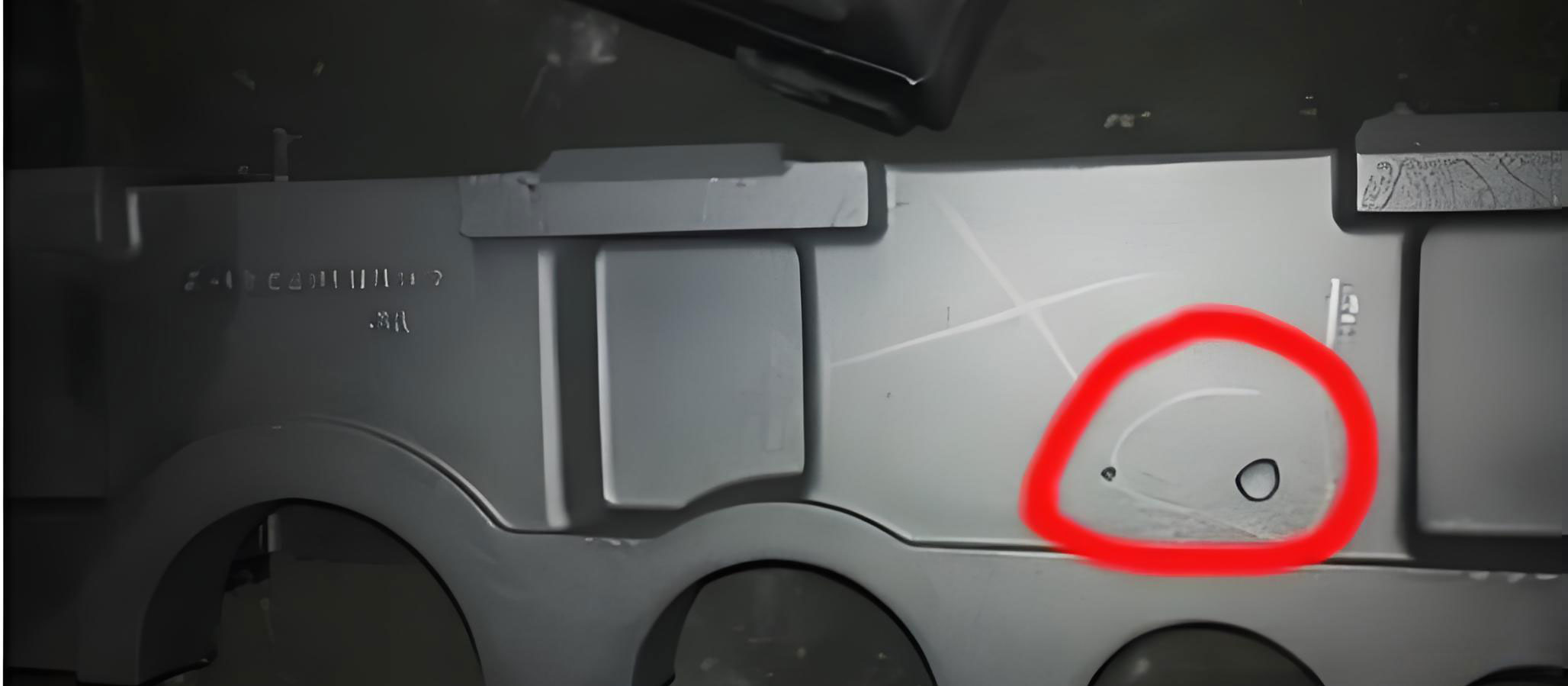
- Ejector Pin Face Porosity: This appears as smooth, concave depressions on casting surfaces corresponding to ejector pin locations. The causes are threefold: a) The pin face is not vented, acting as a gas pocket. b) The fit clearance between the pin and the mold block is too large. Molten metal can infiltrate this clearance first, sealing off the only escape path for the gas compressed in the blind hole behind the pin. c) The ejector pin, often cooled by the mold body, has a lower temperature. Gas compressed against this cold surface rapidly expands as it heats, creating a larger pore just as the metal skin forms.
- Large Flat Surface Porosity: Extensive horizontal areas at the top of the mold create a scenario where air must travel a long distance to reach a vent. The advancing metal front can easily seal off sections of this large area, trapping air underneath.
- Junction or Corner Porosity: Thick sections, such as rib junctions or corner bosses, have a high thermal mass and solidify last. Gas released from the mold or alloy tends to float and accumulate in these hot spots. This type of porosity in casting is frequently accompanied by micro-shrinkage.
The temperature distribution confirmed by thermal simulation often shows the coldest spots at ejector pin locations, directly correlating with porosity sites. The gas pressure (\(P_g\)) trapped in a blind pocket can be estimated using the ideal gas law as the metal seals the exit:
$$ P_g = \frac{nRT}{V} $$
where the volume \(V\) decreases and temperature \(T\) increases rapidly upon contact with molten metal, leading to a significant pressure rise that can exceed local metallostatic pressure and force the gas into the solidifying metal.
2.2 Mitigation Strategies
2.2.1 Ejector Pin Modifications: The goal is to provide a dedicated, robust venting path for the gas behind the pin.
- Face Grinding: Machine radial vent grooves (e.g., 0.5mm deep, 60° included angle, 3-6 grooves) on the pin’s contact face. This provides channels for gas to escape even if the pin face is sealed by metal.
- Axial Grinding: Machine axial grooves along the pin’s length, connecting the blind rear to the vented face or the mold exterior.
- Rear Venting: Ensure the back of the ejector plate/board has a clear path to atmosphere, preventing gas buildup in the ejector housing.
The total effective vent area (\(A_{v}\)) from these modifications should be sufficient to allow gas escape before metal invasion. A simple check is to ensure \(A_v\) is greater than the clearance gap area (\(A_c\)) around the pin to prioritize venting over sealing.
2.2.2 Casting Surface Modification – Adding a Pattern: For large flat surfaces, adding a raised grid or serrated pattern (e.g., 1mm high, 3mm pitch) is highly effective. This serves two purposes: it breaks up the large, stagnant air volume into smaller, manageable pockets, and it increases the surface area for coating, which itself can absorb and transport some gas. The pattern also improves metal flow and feeding.
2.2.3 Wall Thickness Uniformity: Collaborating with product designers is essential. Adding lightening pockets or slots to thick sections reduces the thermal mass, promotes more uniform cooling, and minimizes the late-solidifying hot spots that attract gas. The solidification time for a section can be approximated using Chvorinov’s rule:
$$ t_s = B \left( \frac{V}{A} \right)^n $$
where \(t_s\) is solidification time, \(V\) is volume, \(A\) is surface area, \(B\) is a mold constant, and \(n\) is an exponent (~1.5-2). Reducing the Volume-to-Surface Area (\(V/A\)) ratio of a thick junction directly reduces its solidification time, bringing it closer to that of the surrounding walls and reducing the window for gas accumulation.
| Design Feature | Porosity Mechanism | Key Mitigation | Design Principle |
|---|---|---|---|
| Ejector Pins | Gas compression in blind hole | Face/Axial vent grooves, ensure rear venting | Provide dedicated, high-conductance vent path |
| Large Flat Top Surface | Long venting path, air entrapment | Add raised grid/serration pattern | Segment large gas volumes, increase surface area |
| Thick Junctions/Corner Bosses | Gas buoyancy to hot spot | Add lightening slots, core-out, modify geometry | Minimize (V/A) ratio, promote uniform cooling |
| Horizontal Blind Cavities | Air pocket with single escape path | Add vertical vent ribs or overflow connections | Create high-point venting or overflow |
3. Porosity Caused by Sand Core Design
While much attention is given to the permanent mold, sand cores can be a significant and overlooked source of physical porosity in casting. The issue is not just about core gas generation from binders, but about the physical trapping of air within the core’s own geometry.
3.1 Root Cause Analysis: The “Inverted Chimney” Effect
Consider a core that creates an inverted, cup-like cavity in the casting. As molten metal rises from below, it first seals the bottom opening of this cavity. The metal continues to rise on the outside of the core feature. Meanwhile, the air trapped inside the core’s internal cavity is heated rapidly. This heated air expands and seeks escape. Its only path is downwards, through the now-sealed bottom, forcing its way into the still-liquid metal below. As this bubble of hot air rises through the liquid metal, it can break into smaller bubbles. By the time these bubbles attempt to reach the top of the casting, the upper surface may have already solidified, permanently trapping the cluster of pores within the wall. This results in the characteristic internal cluster porosity in casting often found near complex core features.
The pressure buildup inside such a trapped core cavity can be significant. Assuming the cavity is sealed isothermally at the moment of metal seal (often a conservative estimate), the pressure increase is directly proportional to the absolute temperature increase:
$$ \frac{P_2}{P_1} = \frac{T_2}{T_1} $$
where \(P_1, T_1\) are initial pressure and temperature (ambient), and \(P_2, T_2\) are the pressure and temperature after heating by the molten metal. For aluminum casting at ~700°C, \(T_2/T_1\) can be ~3-4, implying a potential pressure increase of 3-4 atmospheres inside the trapped cavity, providing a strong driving force for gas injection into the casting.
3.2 Mitigation Strategy: Core Venting and Geometry Change
The solution requires close collaboration between foundry and product design engineers. The primary goal is to eliminate the “inverted chimney” or blind cavity within the core.
- Vertical Venting (Best Practice): Modify the product design to allow a small vertical opening at the highest point of the core-created cavity. This transforms the cavity from a trap into an open chimney. As metal fills from below, the displaced air simply exits upwards through this opening, often into an overflow or riser. This is the most effective method to eliminate this source of porosity in casting.
- Lateral Venting (Secondary Option): If a vertical exit is impossible, a lateral vent channel connecting the trapped cavity to the mold exterior or a venting sand core can be designed. The effectiveness depends on the vent’s size and path length; it must offer less flow resistance to the escaping gas than the path through the liquid metal.
- Core Print Venting: Ensure the core prints themselves are designed to allow gas from the core body to escape into the mold’s main venting system, not into the casting cavity.
The required vent area (\(A_{vent}\)) can be estimated based on the volume of gas to be displaced and the time available. A basic relation from fluid flow suggests:
$$ A_{vent} \propto \frac{V_{gas}}{t_{vent} \cdot v_{gas}} $$
where \(V_{gas}\) is the volume of air in the cavity, \(t_{vent}\) is the time available for venting before metal seal, and \(v_{gas}\) is the velocity of the escaping gas, which is driven by the pressure differential.
| Core Gas Issue Type | Description | Primary Strategy | Key Consideration |
|---|---|---|---|
| Physically Trapped Air | Air in core cavities sealed by metal | Eliminate blind cavities; add vertical vents | Vent must be at the absolute highest point of the cavity |
| Core Gas Generation | Gas from binder decomposition | Optimize core sand formulation, baking | Gas permeability of core sand is critical (Darcy’s Law) |
| Core Print Leakage | Gas from core enters cavity via print | Design seals/lands on core print; ensure print venting to exterior | Balance sealing against metal penetration vs. allowing gas escape from core body |
4. Conclusion and Integrated Approach
Mitigating physical porosity in casting in low pressure casting is not a task for a single solution but requires a systematic, multi-faceted approach. The problem must be attacked simultaneously from the perspectives of process, mold design, and core design.
First, the casting process must be optimized to promote laminar filling and effective cavity venting. This is achieved through a carefully profiled pressure curve that emphasizes a slow, controlled fill stage. Second, the mold and product design must be scrutinized to eliminate natural gas traps. This involves detailed design features such as vented ejector pins, patterned surfaces, and uniform wall thickness to facilitate directional solidification and gas escape. Third, sand cores must be designed with venting as a primary consideration, avoiding geometries that create sealed air pockets and ensuring all core gases have a clear, easy path to the mold exterior that does not go through the casting itself.
The interplay between these factors can be conceptualized. The overall susceptibility to porosity in casting (\(S\)) might be considered as a function of multiple variables:
$$ S \approx f(Re_{fill}, \nabla T, A_{vent}/V_{cavity}, t_{fill}, t_{solid}) $$
where minimizing the Reynolds number during fill (\(Re_{fill}\)), maximizing the thermal gradient (\(\nabla T\)), maximizing the vent area to cavity volume ratio (\(A_{vent}/V_{cavity}\)), and optimizing fill and solidification times are all crucial.
In my practice, applying this structured framework—systematically analyzing the origin of porosity as process-induced, mold-induced, or core-induced, and then implementing the targeted countermeasures—has consistently led to significant improvements in casting soundness. The fight against porosity in casting is a fundamental aspect of foundry engineering, and a deep understanding of its physical origins is the most powerful tool for achieving durable, high-integrity low pressure castings.