
In the casting industry, three-dimensional models have become indispensable tools, revolutionizing processes from initial design reviews to final inspection. As an experienced practitioner in this field, I have extensively utilized 3D modeling for various applications, including casting process evaluation, three-dimensional process design, MAGMA simulation, mold fabrication, machining programming, and subsequent three-dimensional marking inspection. The adoption of 3D modeling has significantly enhanced accuracy and efficiency, particularly for complex components like machine tool castings. These large-scale components require meticulous attention to detail, and 3D models facilitate a comprehensive approach to design and manufacturing.
One of the primary software tools I rely on is Siemens NX 8.0, a powerful computer-aided design (CAD) application. This software excels not only in 2D drafting but also in robust 3D modeling capabilities. Its integrated environment supports finite element analysis, dynamic simulation, and kinematic studies, which greatly improve process reliability. Furthermore, NX 8.0 can generate numerical control (NC) code directly from 3D models, enabling seamless transition to manufacturing. This versatility makes it one of the most widely used CAD systems globally, especially for developing machine tool castings. The software’s ability to handle complex geometries and large assemblies is crucial for managing the intricate structures typical of machine tool castings.
When building 3D models for large machine tool castings, the process begins with a thorough structural analysis of the provided drawings. The first step involves segmenting the main body of the casting. If the primary structure is uniform, it can be modeled as a single unit. However, for machine tool castings with varying sections, the main body must be divided into segments. This segmentation allows for more manageable modeling and ensures accuracy in capturing dimensional changes. For instance, a machine tool casting might be split into left and right regions based on structural differences.
After segmentation, the next step is to identify cross-sectional views for each segment. These sections, such as A-A, B-B, or C-C views, provide critical geometric information. Using NX 8.0, I extract these views to define the contour lines for each segment. The contour lines must form closed curves to ensure the generation of solid bodies during extrusion. For example, the left segment might be defined by B-B and C-C cross-sections, while the right segment uses the A-A section. The accuracy of these contours is vital, as they directly influence the final geometry of the machine tool casting.
Once the contour lines are established, the extrusion function in NX 8.0 is employed to create the 3D solid model. Extrusion involves extending a curve along a specified direction and distance. If the curve is closed, the result is a solid body; open curves produce surfaces. The extrusion distances are derived from the length dimensions in the drawings. For instance, the closed contours from the left and right segments are extruded to their respective lengths, forming the primary body of the machine tool casting. Additional features, such as mounting holes or internal cavities, are then incorporated. The wall thicknesses, often specified in sectional views like F-F or K-K, are applied to complete the main structure.
To illustrate the extrusion process mathematically, consider a contour curve defined in the XY-plane. The extrusion along the Z-axis by a distance $d$ can be represented as:
$$ \text{Solid} = \left\{ (x, y, z) \mid (x, y) \in C, 0 \leq z \leq d \right\} $$
where $C$ is the closed contour. For complex shapes, multiple extrusions or revolves may be combined. The volume $V$ of the extruded body can be calculated using the integral:
$$ V = \int_{0}^{d} A(z) dz $$
where $A(z)$ is the cross-sectional area at height $z$. This is particularly relevant for machine tool castings with tapered or varying sections.
After constructing the main body, auxiliary structures are added. Each structure is treated independently, with its relationship to the main body defined by reference planes. The principle of “long alignment, high leveling, and width equality” from orthographic projection ensures consistency. For example, a rib or boss on the casting surface is modeled by first identifying its projection views (e.g., front, top, and side views) to determine dimensions. The contact surface with the main body serves as the datum plane. A contour is sketched based on the primary view, trimmed according to width dimensions, and then extruded or revolved to form the feature.
The following table summarizes the key steps in building 3D models for machine tool castings:
| Step | Description | Tools/Functions |
|---|---|---|
| 1. Segmentation | Divide the main body into segments based on structural variations. | Structural Analysis |
| 2. Cross-Section Identification | Extract sectional views (e.g., A-A, B-B) for each segment. | Drawing Interpretation |
| 3. Contour Drawing | Create closed contour curves from cross-sections. | Sketch Tools in NX 8.0 |
| 4. Extrusion | Extrude contours to form 3D solids using length dimensions. | Extrude Command |
| 5. Feature Addition | Add external and internal structures (e.g., ribs, holes). | Boolean Operations, Trim |
| 6. Verification | Compare the 3D model with 2D drawings for completeness. | Measurement Tools |
In practice, the order of operations is critical: external features are added before internal cavities, and holes are created after walls and ribs. Establishing datum planes for length, width, and height directions early on simplifies the placement of secondary structures. For instance, a mounting bracket might require a contour sketched on the main body’s surface, then extruded to a specified thickness. The dimensions are validated against multiple views to ensure accuracy.
The development of machine tool castings often involves optimizing material distribution and minimizing defects. The modulus method, used in casting design, can be applied to calculate the solidification time $t$ for a section:
$$ t = k \left( \frac{V}{A} \right)^2 $$
where $V$ is the volume, $A$ is the surface area, and $k$ is a constant dependent on the material. This formula helps in designing ribs and walls to achieve uniform cooling. For example, increasing the modulus $\left( \frac{V}{A} \right)$ in thick sections of a machine tool casting can prevent shrinkage porosity.
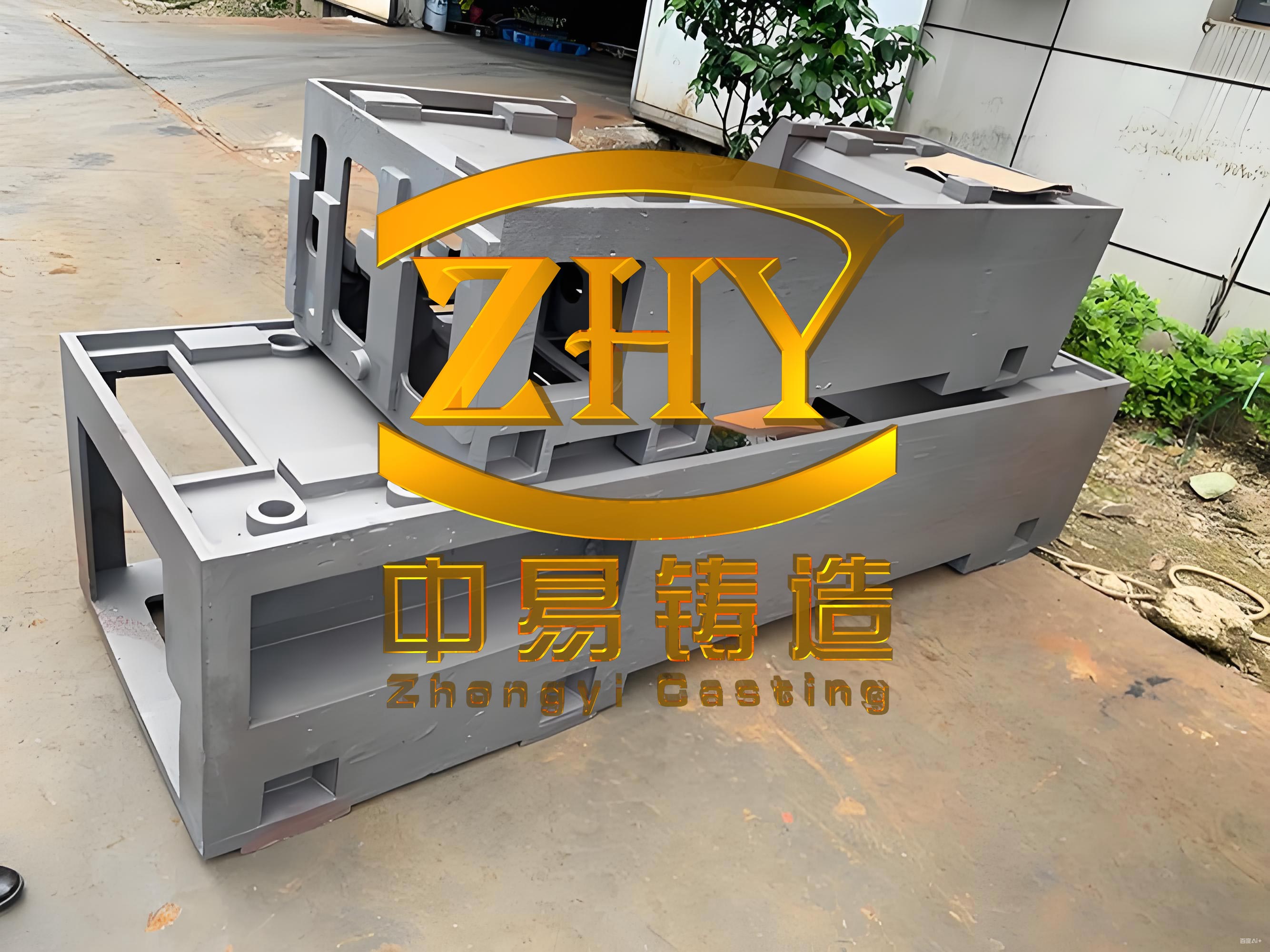
Another important aspect is the integration of simulation tools. In NX 8.0, finite element analysis (FEA) can be performed to assess stress distribution under load. The basic equation for linear static analysis is:
$$ \mathbf{K} \mathbf{u} = \mathbf{F} $$
where $\mathbf{K}$ is the stiffness matrix, $\mathbf{u}$ is the displacement vector, and $\mathbf{F}$ is the force vector. This analysis is crucial for machine tool castings, which must withstand operational forces without deformation. By simulating loads, potential weak points can be identified and reinforced early in the design phase.
When adding complex features, such as curved surfaces or angled ribs, trigonometric functions may be used to define geometries. For example, the height $h$ of a rib with an angle $\theta$ and base length $l$ can be expressed as:
$$ h = l \tan \theta $$
This ensures precise modeling in NX 8.0 by deriving dimensions from angular specifications in the drawings.
The following table compares common challenges and solutions in modeling machine tool castings:
| Challenge | Solution | Relevance to Machine Tool Castings |
|---|---|---|
| Large Size and Complexity | Segment the model and use reference planes. | Facilitates manageable modeling of bulky components. |
| Varying Wall Thickness | Apply sectional views and extrusion with variable distances. | Ensures accurate representation of structural changes. |
| Internal Cavities and Cores | Use Boolean operations to subtract volumes. | Creates hollow sections for weight reduction. |
| Draft Angles and Fillets | Incorporate draft and fillet features during sketching. | Improves moldability and reduces stress concentrations. |
Throughout the modeling process, verification is essential. I consistently cross-check the 3D model against the original 2D drawings, ensuring all dimensions and features are accurately represented. This iterative approach minimizes errors and reduces the need for physical prototypes. For machine tool castings, which often have tight tolerances, this step is critical to achieving functional and durable components.
In conclusion, the methodology for building 3D models of machine tool castings involves a systematic approach: starting with the main body, adding external structures, modifying internal cavities, and finally incorporating details like holes and fillets. Mastery of CAD software like Siemens NX 8.0, combined with strong visualization skills, enables efficient and accurate model creation. While techniques may vary, the fundamental principles of segmentation, cross-section analysis, and extrusion remain consistent. This practical framework, refined through years of experience, ensures high-quality results for a wide range of machine tool castings, contributing to advancements in casting technology and manufacturing efficiency.