
In my extensive work with precision investment casting, I have focused on producing high-integrity shell castings for demanding applications. Shell castings, such as those used in transducer housings, require meticulous control over dimensions, surface finish, and internal soundness. This article details my first-hand experience and methodologies in optimizing the entire process for complex shell castings, leveraging data, formulas, and systematic approaches to overcome challenges like distortion, shrinkage, and surface defects.
The specific shell casting in discussion is a transducer housing with stringent requirements: an external surface roughness between Ra 6.3 to 3.2 μm and dimensional tolerances not exceeding ±0.3 mm. The material is a precipitation-hardening stainless steel, 0Cr17Ni4Cu4Nb, which poses additional challenges due to its solidification characteristics. The success in producing such shell castings hinges on a holistic approach encompassing mold design, gating, pattern making, shell building, and melting practices.
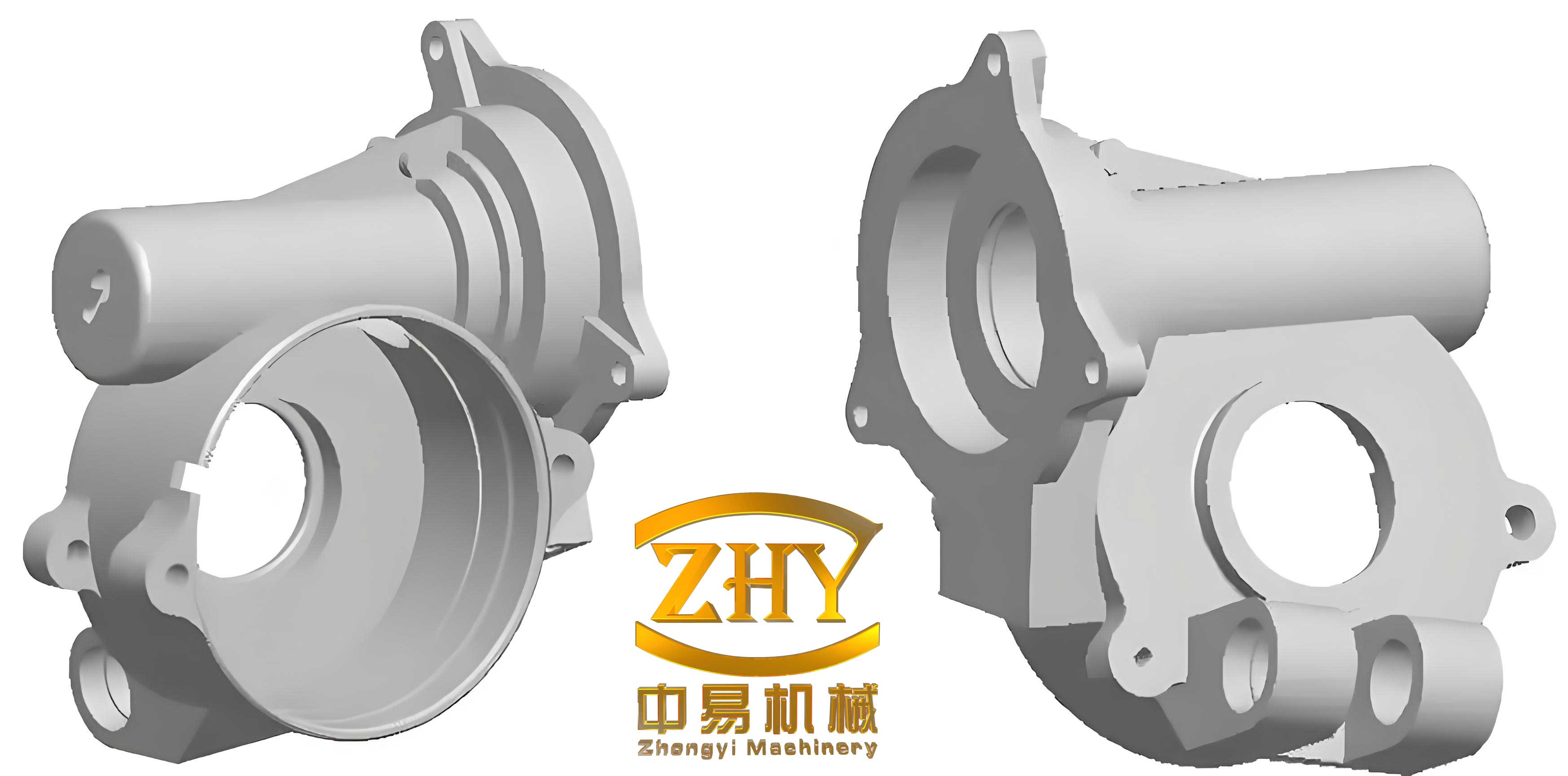
The foundation of producing accurate shell castings lies in precise mold design. The total contraction allowance must account for multiple factors: alloy shrinkage, pattern material shrinkage, and shell expansion during firing. In my practice, I use the following comprehensive formula to determine the overall scaling factor for the mold:
$$ \text{Scaling Factor} = 1 + \left( \epsilon_a + \epsilon_p – \epsilon_s \right) $$
where $\epsilon_a$ is the linear shrinkage of the alloy, $\epsilon_p$ is the linear shrinkage of the pattern material (wax), and $\epsilon_s$ is the linear expansion of the ceramic shell. For the 0Cr17Ni4Cu4Nb alloy, $\epsilon_a$ is typically 1.8%. The pattern shrinkage $\epsilon_p$ depends on the wax composition, and for low-shrinkage blends, it can be as low as 0.5%. Shell expansion $\epsilon_s$ for high-alumina systems is approximately 0.2-0.3%. Therefore, the total calculated shrinkage compensation often ranges between 2.0% to 2.1%. Mold manufacturing tolerances are held to one-sixth of the casting tolerance, with cavity tolerances strictly controlled within ±0.03 mm to ensure the final shell castings meet specifications.
| Factor | Symbol | Typical Value | Remarks for Shell Castings |
|---|---|---|---|
| Alloy Linear Shrinkage | $\epsilon_a$ | 1.8% | Material-dependent; critical for shell castings geometry. |
| Pattern (Wax) Linear Shrinkage | $\epsilon_p$ | 0.5% – 0.7% | Lower is better for dimensional stability of shell castings. |
| Shell Thermal Expansion | $\epsilon_s$ | 0.2% – 0.3% | Counteracts shrinkage; must be precisely characterized. |
| Total Scaling Factor | $SF$ | ~2.05% | Applied to mold dimensions for net-shape shell castings. |
| Mold Cavity Tolerance | — | ±0.03 mm | Ensures precision in shell castings production. |
The gating and feeding system is paramount for producing sound shell castings free from shrinkage porosity and distortion. Initial designs often fail to account for thermal gradients and feeding distances. I employ the modulus method and feeding distance rules to design effective systems. The feeding distance $L_f$ for a section of a shell casting can be estimated using:
$$ L_f = k \cdot M $$
where $M$ is the modulus (volume-to-surface area ratio) of the casting section, and $k$ is an empirical constant dependent on alloy and cooling conditions. For steel shell castings, $k$ often ranges from 4 to 6. My initial design for these shell castings featured a combined sprue/runner with a square cross-section acting as a feeder, with two ingates attached symmetrically. This led to significant distortion and out-of-tolerance ovality in the shell castings due to uneven cooling and inadequate feeding pressure.
A revised design proved successful for these thin-walled shell castings. It incorporated a flat plate runner placed below the pouring cup. Four wax patterns of the shell castings were attached symmetrically to both sides of this plate. This plate acts simultaneously as a sprue, runner, and a feeding reservoir. The ingates are distributed uniformly around the perimeter of each shell casting to ensure balanced filling and feeding. The effectiveness of this design is summarized in the comparison table below.
| Design Feature | Initial Design (Failed) | Optimized Design (Successful) |
|---|---|---|
| Main Runner/Feeder Shape | Inverted square prism | Flat plate |
| Number of Shell Castings per Cluster | 2 | 4 |
| Ingate Configuration | Two symmetric points | Multiple, uniformly distributed |
| Primary Function | Feeding only | Feeding, flow distribution, and heat sink |
| Result on Shell Castings | Severe distortion, ovality | Minimal distortion, within tolerance |
| Feeding Efficiency for Shell Castings | Low (inadequate pressure) | High (maintained thermal gradient) |
The modulus of the feeding plate $M_{plate}$ must be greater than the modulus of the heaviest section of the shell casting $M_{casting}$ to ensure directional solidification towards the feeder. This is expressed as:
$$ M_{plate} > M_{casting} $$
For the shell castings in question, calculating the moduli of different sections and designing the plate accordingly was key to eliminating shrinkage defects.
Producing dimensionally stable wax patterns is the first physical step in realizing precise shell castings. I use a tailored, low-shrinkage pattern material formulated from a base of 50% wax-based compounds and 50% resin-based polymers. This blend minimizes $\epsilon_p$, ensuring the wax replica of the shell castings is accurate. New material is always used for the patterns of the critical shell castings themselves, while reclaimed material can be utilized for the gating system components. The injection parameters—temperature, pressure, and cycle time—are rigorously controlled. The pattern yield stress $\sigma_p$ during handling must be sufficient to prevent deformation, which is a function of temperature $T$:
$$ \sigma_p = A e^{-B T} $$
where $A$ and $B$ are material constants. Maintaining a workshop temperature of 20-22°C is crucial for handling these patterns for shell castings before assembly into clusters.
The ceramic shell is the negative mold that defines the surface quality of the final shell castings. I employ a hybrid shell system for these high-quality shell castings. The prime coats are critical for surface finish. They consist of a slurry of fused alumina (Al$_2$O$_3$ content ≥ 98%) and colloidal silica binder. The refractory flour size distribution follows a packing model to maximize density and minimize porosity in the shell for shell castings. The particle size distribution can be modeled using the Andreasen equation:
$$ P(d) = \left( \frac{d}{d_{\text{max}}} \right)^q $$
where $P(d)$ is the cumulative fraction smaller than size $d$, $d_{\text{max}}$ is the maximum particle size, and $q$ is a distribution modulus (typically ~0.37 for dense packing). The first layer is stuccoed with fine fused alumina sand and dried under controlled humidity. Subsequent backup coats use a mullite-based (Al$_2$O$_3$-SiO$_2$) refractory with an ethyl silicate binder. The shell thickness $t_s$ is built up to withstand the metallostatic pressure during pouring of the shell castings and is a function of the number of coats $n$ and the average coat thickness $t_c$:
$$ t_s = n \cdot t_c $$
Typically, 6 to 8 coats are applied for steel shell castings, resulting in a shell thickness of 10-14 mm. Each layer is dried thoroughly to achieve sufficient green strength. The final shell is fired at high temperature (e.g., 1100°C) to develop strength and remove residual pattern material. The fired shell strength $\sigma_{\text{shell}}$ is essential for containing the molten metal for shell castings and can be related to firing temperature $T_f$ by an Arrhenius-type relationship:
$$ \sigma_{\text{shell}} = C \cdot \exp\left(-\frac{E_a}{R T_f}\right) $$
where $C$ is a constant, $E_a$ is the activation energy for sintering, and $R$ is the universal gas constant.
| Shell Layer | Refractory Material | Binder | Stucco Material | Function for Shell Castings |
|---|---|---|---|---|
| Prime Coats (1-2) | Fused Alumina (≥98% Al$_2$O$_3$) | Colloidal Silica | Fine Fused Alumina | Defines surface finish of shell castings. |
| Backup Coats (3-8) | Mullite (Al$_2$O$_3$-SiO$_2$) | Ethyl Silicate | Coarse Mullite | Provides structural strength for shell castings mold. |
| Seal Coat (Optional) | Fine Alumina Slurry | Colloidal Silica | None | Seals surface for shell castings. |
Melting and pouring are the final critical steps that determine the metallurgical quality of the shell castings. I utilize a duplex melting practice. The master alloy is first prepared and homogenized in a medium-frequency induction furnace. This ensures precise chemistry control, which is vital for the corrosion resistance and mechanical properties of the final shell castings. The molten metal is then transferred to a tilt-pour induction furnace with a melting rate of 2 to 5 kg/min for casting. This furnace allows for precise temperature control and a quiet, non-turbulent pour. The pouring temperature $T_p$ is superheated above the liquidus temperature $T_l$ of the alloy:
$$ \Delta T_{\text{superheat}} = T_p – T_l $$
For these stainless steel shell castings, a superheat of 80-100°C is typically maintained to ensure fluidity while minimizing gas absorption and excessive thermal shock to the ceramic shell. The pouring time $t_p$ for a cluster of shell castings is governed by Bernoulli’s principle adapted for investment casting:
$$ t_p = \frac{V}{\mu A \sqrt{2gH}} $$
where $V$ is the total volume of metal for the shell castings cluster, $A$ is the choke area (usually the ingate cross-section), $H$ is the effective metallostatic head, $g$ is gravity, and $\mu$ is a discharge coefficient accounting for friction and viscosity. A controlled, rapid pour is essential to fill the thin sections of the shell castings before premature solidification begins.
Post-solidification, the shell is removed via mechanical vibration and high-pressure water blasting. The shell castings are then cut from the runner system. Heat treatment is performed according to the specifications for 0Cr17Ni4Cu4Nb to achieve the desired precipitation-hardened microstructure. Each shell casting undergoes non-destructive testing, including dimensional inspection and penetrant testing, to validate quality.
In conclusion, the successful production of high-precision shell castings via investment casting is a multidisciplinary exercise requiring integrated control over every process parameter. From the calculated mold scaling and optimized gating design to the engineered ceramic shell and controlled melting, each step contributes to the dimensional accuracy, surface finish, and internal integrity of the final shell castings. The methodologies and principles outlined here, supported by empirical formulas and systematic data, form a robust framework for manufacturing complex shell castings for critical applications. Continuous refinement of these parameters, especially through statistical process control, remains key to advancing the state-of-the-art in shell castings production.
Further research could focus on modeling the thermal stresses during solidification of shell castings to predict distortion more accurately, or on developing even lower-shrinkage pattern materials. The integration of simulation software with real-time process data holds great promise for further optimizing the investment casting process for shell castings, reducing trial-and-error, and achieving near-zero defect rates.