
The relentless pursuit of enhanced performance in aerospace vehicles necessitates continuous advancements in both materials and manufacturing technologies for critical structural components. Titanium alloys, renowned for their low density, high specific strength, exceptional corrosion resistance, and good elevated-temperature capabilities, have become indispensable in this sector. However, the inherent challenges in machining titanium, such as high cutting forces and rapid tool wear leading to low efficiency and high cost, have historically limited its broader application. The investment casting process emerges as a pivotal solution, enabling the near-net-shape fabrication of large, thin-walled, and intricately complex titanium structures in a single piece, thereby significantly reducing manufacturing cost and lead time.
Originating from ancient lost-wax techniques, the modern investment casting process for reactive metals like titanium was pioneered in the 1960s. Initially, titanium castings were relegated to non-critical, static components like engine covers and ducts. Decades of refinement have transformed the technology, allowing titanium investment castings to now serve as primary load-bearing structures in advanced airframes and engines. Today, over 90% of titanium castings in aerospace are produced via the investment casting process. This review synthesizes recent progress in titanium alloy investment casting for aerospace, focusing on key aspects of the investment casting process, the development of high-temperature casting alloys, and the application of resultant components. It concludes by identifying prevailing challenges and suggesting future directions to enhance the competitiveness and adoption of this vital manufacturing route.
Evolution of the Titanium Investment Casting Process
The production of a titanium investment casting is a multi-step sequence where precision at each stage dictates the final quality. The core investment casting process involves: pattern creation, shell building, melting & pouring, and post-casting treatments. Recent trends push towards structural integration, precision forming, and intelligent process control. A generalized flow is presented below:
Controlling dimensional accuracy and internal soundness are the paramount challenges. Titanium’s high reactivity at elevated temperatures necessitates inert mold materials to prevent gas pick-up and surface contamination. Dimensional control is a chain of accumulative tolerances across wax injection, shell sintering, metal solidification, and post-processing. The relationship can be conceptually described by the total dimensional deviation $$D_{total}$$:
$$D_{total} = f(\Delta_{die-wax}, \Delta_{wax-shell}, \Delta_{shell-metal}, \Delta_{HIP}, \Delta_{weld})$$
where each $$\Delta$$ term represents the dimensional change contribution from the die-to-wax, wax-to-shell, shell-to-metal, hot isostatic pressing, and welding steps, respectively.
1. Pattern Manufacturing
The pattern is the foundational element of the investment casting process. Its quality directly governs the final casting’s dimensions and surface finish. The dimensional propagation through the investment casting process can be visualized as a series of transformations from the master die to the final metal part. Traditionally, patterns are made by injecting molten wax or polymer blends into precision metal dies. The wax composition is critical; typical systems are based on paraffin, with additives like stearic acid, modified rosin, and polyethylene (e.g., PE1000) to optimize properties like strength, softening point, and homogeneity. For instance, a blend with 5 wt.% modified rosin and 5 wt.% polyethylene can significantly improve flexural strength and dimensional stability.
The advent of Additive Manufacturing (AM) has revolutionized rapid prototyping and low-volume production within the investment casting process. AM enables direct fabrication of patterns from CAD models, eliminating the need for expensive hard tooling and drastically shortening lead times for new part development. Several AM technologies are employed, each with distinct advantages for the investment casting process:
| AM Technology | Advantages for Investment Casting | Disadvantages for Investment Casting |
|---|---|---|
| Stereolithography (SLA) | Excellent surface finish, high accuracy, good shell-building performance. | Materials are expensive, often require supports, and may need post-curing. |
| Selective Laser Sintering (SLS) | Wide material choice, no support structures needed for complex geometries. | Relatively rough surface finish, may require infiltration (e.g., with wax) for handling. |
| Three-Dimensional Printing (3DP) | Fast process, low material cost. | Parts are often porous and fragile; surface quality is poor, requiring sealing. |
| Laminated Object Manufacturing (LOM) | Fast build rates for large parts, no phase-change stress. | Limited geometric complexity, manual decubing required, paper-based materials may warp. |
For aerospace components, SLA and material jetting processes are prevalent due to their superior surface quality and accuracy, which are crucial for subsequent shell-building steps in the investment casting process.
2. Shell Building
The ceramic shell is the heart of the investment casting process for titanium, as it must withstand extreme thermal shock while being chemically inert. The facecoat, which contacts the molten metal (~1600°C+), is most critical. Refractory oxides like $$ZrO_2$$ and $$Y_2O_3$$ are standard due to their high melting points and relatively low reactivity with molten titanium. The choice involves a trade-off between cost, reactivity, and thermo-mechanical properties.
| Shell Type | Facecoat Material | Advantages | Disadvantages |
|---|---|---|---|
| Fused Model | $$ZrO_2$$ | Low thermal expansion, established process, cost-effective. | Can form a noticeable reaction layer on casting surface. |
| $$Y_2O_3$$ | Excellent inertness, minimal reaction layer, high strength. | High material cost, complex processing, poor thermal shock resistance. | |
| $$Al_2O_3$$ | Good thermal shock resistance, low cost. | Forms a relatively thick reaction layer with Ti. | |
| Graphite | Graphite | High refractoriness, low thermal expansion. | Causes carbon contamination (alpha-case), poor chemical inertness. |
| Metal | Tungsten / Cast Iron | Reusable, high melting point (W). | High thermal conductivity causes chilling defects, poor permeability. |
The ideal shell for the titanium investment casting process must balance several properties: high refractoriness ($$T_{melt} >> T_{pour}$$), chemical inertness (low Gibbs free energy of oxide formation), adequate permeability, and controlled strength to allow for mold collapse during cooling to reduce casting stress. The thermal shock resistance $$R$$ can be approximated by:
$$R = \frac{\sigma_f (1-\nu)}{\alpha E}$$
where $$\sigma_f$$ is the fracture strength, $$\nu$$ is Poisson’s ratio, $$\alpha$$ is the coefficient of thermal expansion, and $$E$$ is Young’s modulus. This highlights why materials like $$Y_2O_3$$, despite high strength, can suffer from poor thermal shock due to high $$E$$ and potentially high $$\alpha$$ gradients.
3. Melting and Pouring
Melting and pouring within the investment casting process for titanium must be conducted under high vacuum or inert atmosphere to prevent contamination. Several furnace technologies are employed:
- Vacuum Arc Skull Melting (VASM): The most common industrial method. A consumable electrode is arc-melted into a water-cooled copper crucible (the “skull”), which freezes a layer of titanium, acting as its own crucible. The melt is then tilted for pouring.
- Induction Skull Melting (ISM): Uses electromagnetic induction to melt charge in a segmented, water-cooled copper crucible. The electromagnetic field provides stirring, improving homogeneity, and the “skull” effect remains.
- Cold Crucible Induction Melting (CCIM) / Levitation Melting: An advanced form of ISM with stronger magnetic confinement, effectively levitating the melt away from the crucible walls, yielding ultra-high purity.
- Electron Beam Melting (EBM) & Plasma Arc Melting: Used in cold hearth furnaces for primary melting to remove high-density inclusions, often followed by VASM for casting.
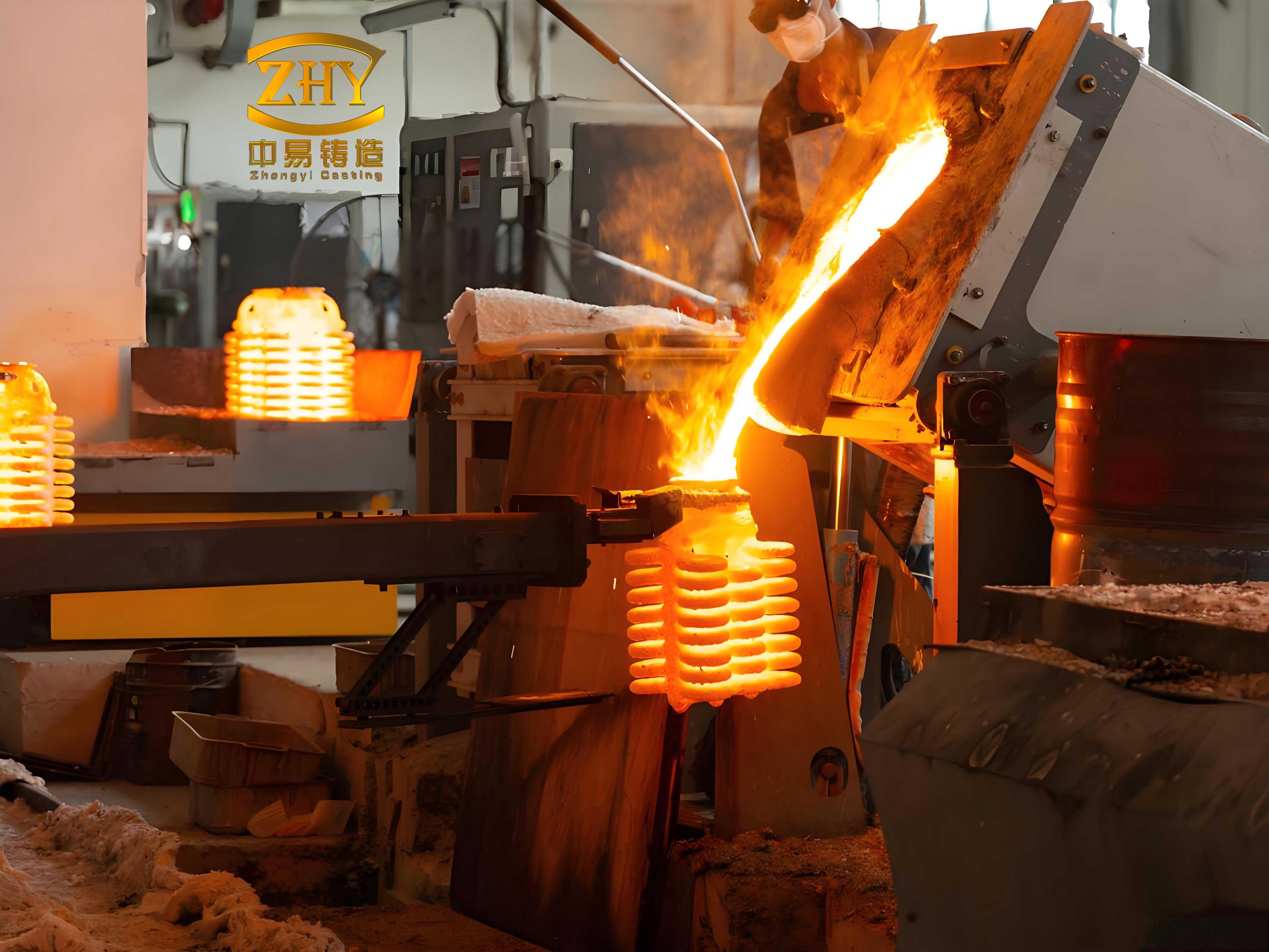
Pouring is typically done via gravity or centrifugal methods. Gravity pouring is simpler but may require higher superheat to fill thin sections. Centrifugal casting, where the mold is spun during pouring, improves mold filling for intricate, thin-walled designs by increasing the effective pressure head, described by $$P_c = \rho \omega^2 r$$, where $$\rho$$ is melt density, $$\omega$$ is angular velocity, and $$r$$ is radius. This allows for lower pouring temperatures, yielding finer microstructures. Process simulation software (e.g., ProCAST, FLOW-3D) is indispensable for optimizing the investment casting process. Simulations of fluid flow, heat transfer, and solidification predict defects like misruns, shrinkage porosity, and hot spots, guiding the design of gating systems and process parameters before costly trial pours.
4. Post-Casting Treatments
Post-casting treatments are integral to the investment casting process to achieve required properties and quality standards.
Hot Isostatic Pressing (HIP) is almost universally applied to aerospace castings. It subjects the casting to high temperature (typically 0.8-0.95 of the $$\beta$$-transus) and high isostatic gas pressure (100-150 MPa) for several hours. This process eliminates internal microporosity and shrinkage cavities by promoting creep deformation and diffusion bonding. The densification kinetics can be modeled by power-law creep equations. HIP typically enhances ductility and fatigue life, often with a minor trade-off in strength.
Heat Treatment is used for stress relief or to tailor microstructure and properties. For $$\alpha+\beta$$ alloys like ZTC4, annealing in the high $$\alpha+\beta$$ phase field (e.g., 700-800°C) stabilizes the microstructure. Solution treatment and aging can be applied to some alloys to enhance strength.
Welding & Repair is a critical step to salvage castings with surface imperfections revealed after HIP. Gas Tungsten Arc Welding (GTAW) is common. The weldability of titanium alloys is highly composition-dependent. Elements like Sn and Zr are benign, while high Al, Si, or Nb content can promote formation of brittle phases or increase cracking susceptibility in the fusion and heat-affected zones. Strict control of shielding atmosphere (Ar/He) and cleanliness is paramount to prevent embrittlement by oxygen, nitrogen, or hydrogen pickup.
Development of Casting Titanium Alloys
The evolution of the investment casting process is inextricably linked to the development of alloys designed for castability alongside performance. The goal is to optimize composition for good fluidity, low shrinkage, and reduced hot-tearing tendency while maintaining target mechanical properties.
1. Conventional Casting Titanium Alloys
The workhorses of the industry are $$\alpha+\beta$$ and near-$$\alpha$$ alloys. ZTC4 (cast equivalent of Ti-6Al-4V) dominates the market, offering an excellent balance of strength, ductility, and weldability. ZTA15 (based on Russian BT20, Ti-6.5Al-2Zr-1Mo-1V) is a common near-$$\alpha$$ alloy for moderately elevated temperatures (~500°C). Their properties are summarized below:
| Alloy | Type | Typical Room Temp. Tensile Properties | Useful Temperature |
|---|---|---|---|
| ZTC4 | $$\alpha+\beta$$ | $$R_m \approx 890 \, \text{MPa}$$, $$R_{p0.2} \approx 820 \, \text{MPa}$$, $$A \approx 5\%$$ | ~400°C |
| ZTA15 | Near-$$\alpha$$ | $$R_m \approx 880 \, \text{MPa}$$, $$R_{p0.2} \approx 780 \, \text{MPa}$$, $$A \approx 5\%$$ | ~500°C |
The influence of key alloying elements on castability and service performance is multifaceted:
| Element | Primary Effect on Service Performance | Primary Effect on Castability/Processability |
|---|---|---|
| Al | $$\alpha$$ stabilizer, solid solution strengthener. | Lowers melting point, can increase fluidity but may promote shrinkage. |
| Mo, V, Nb | $$\beta$$ stabilizers, improve hardenability, strength. | Can reduce fluidity. Nb/Ta/W can form high-melting point clusters. |
| Sn, Zr | Neutral strengtheners, improve stability. | Generally improve weldability. |
| Si | Enhances creep resistance via solid solution and silicide precipitation. | Markedly improves fluidity; a critical additive for cast high-temperature alloys. |
| C, O, N | Interstitial strengtheners, but drastically reduce ductility if excessive. | Strictly controlled as impurities. Trace C can refine grains. |
| B, Y | Grain refiners (B), oxide dispersion formers (Y). | B can improve fluidity; both can alter solidification path. |
For higher temperature applications (550-650°C), near-$$\alpha$$ alloys like ZTi55 (Ti-5.5Al-4Sn-2Zr-1Mo-0.25Si-1Nd) and ZTi60 (Ti-5.8Al-4Sn-3.5Zr-0.5Mo-0.4Si-1Nd) have been developed, leveraging Si and rare earth additions (Nd, Y) for creep resistance and microstructural stability.
2. Alloys for Service Above 600°C
Pushing beyond 600°C requires moving to more advanced materials with lower density than nickel-based superalloys. Two main intermetallic-based systems are of great interest for the investment casting process.
Cast TiAl Alloys: These gamma titanium aluminides ($$\gamma$$-TiAl) offer densities around 4.0 g/cm³ and excellent specific properties at 700-900°C. Second-generation alloys like Ti-48Al-2Cr-2Nb (4822) and Ti-45Al-2Mn-2Nb-1B (45XD) are commercially cast for low-pressure turbine blades. However, their castability is challenging due to low fluidity, high melting point, high solidification shrinkage (~2-3%, double that of ZTC4), and susceptibility to cold shuts and hot tearing. The solidification shrinkage for a simple shape can be estimated as: $$L_c = L_0 \times (1 + \alpha \times \Delta T)$$, where $$L_c$$ is casting length, $$L_0$$ is mold cavity length, $$\alpha$$ is the linear shrinkage coefficient, and $$\Delta T$$ is the temperature drop from solidus to room temperature. The high $$\alpha$$ for TiAl necessitates meticulous pattern and mold design compensation in the investment casting process. Chemically inert mold facecoats based on $$Y_2O_3$$ are essential.
Ti2AlNb-based Alloys: Based on the orthorhombic (O) phase, these alloys offer a compelling combination of ductility, toughness, and high-temperature strength up to ~750°C. They are significantly more forgeable than TiAl alloys. Their use in cast form is still embryonic due to even higher melting points and potential segregation issues. Research focuses on overcoming these castability hurdles within the investment casting process to unlock their potential for large, complex components.
| Alloy System | Exemplary Composition | Density (g/cm³) | Target Service Temp. | Key Casting Challenge |
|---|---|---|---|---|
| High-Temp Near-$$\alpha$$ | ZTi65 (Ti-Al-Sn-Zr-Mo-Si-Nd-W-Ta) | ~4.5 | 650°C | Welding crack sensitivity, high-temperature strength vs. castability balance. |
| $$\gamma$$-TiAl | Ti-48Al-2Cr-2Nb | ~3.9 | 750-850°C | Low fluidity, high shrinkage, hot tearing, reactive melt. |
| Ti2AlNb-based | Ti-22Al-25Nb (at.%) | ~5.0 | 700-800°C | Very high melting point, fluidity, control of O-phase structure. |
Applications in Aerospace Vehicles
The investment casting process enables the production of large, integrated components that reduce part count, weight, and assembly cost. In commercial and military aircraft, complex titanium castings are used for critical airframe structures such as wing carry-through fittings, landing gear supports, pylons, and door frames. In jet engines, the application of the investment casting process is extensive:
- Static Structures: Fan & compressor intermediate cases, compressor rear frames, diffuser cases, and various mounts and housings. These are often large (exceeding 1500 mm in diameter), thin-walled structures ideally suited for the investment casting process.
- Rotating Components: Impellers, blisks (bladed disks), and in some cases, low-pressure turbine blades (using TiAl alloys).
- Other: Fuel system components, hydraulic housings, and heat shields.
The success story of TiAl investment castings in the GE GEnx engine, where 4th and 5th stage low-pressure turbine blades replaced nickel alloys, saving ~180 kg per engine, is a testament to the maturity of the investment casting process for advanced intermetallics. In spacecraft and missiles, titanium investment castings are used for lightweight frames, brackets, housings, and nozzle components, benefiting from the material’s strength at cryogenic temperatures and non-magnetic properties.
Conclusions and Future Perspectives
The titanium alloy investment casting process has matured into a cornerstone technology for aerospace manufacturing, enabling lightweight, complex geometries that are otherwise unattainable or prohibitively expensive. While conventional alloys like ZTC4 dominate, significant progress has been made in developing and casting high-temperature near-$$\alpha$$, TiAl, and Ti2AlNb-based alloys for more demanding applications.
However, several challenges persist to further advance and democratize this technology:
- Material Database Development: There is a critical need for comprehensive, shared databases linking alloy composition to fundamental casting parameters (e.g., fluidity function $$f(T)$$, shrinkage factors, hot-tearing susceptibility) and final mechanical properties. Integrating computational thermodynamics, high-throughput testing, and machine learning can accelerate the design of new casting-specific alloys.
- Cost Reduction through Digitalization: The investment casting process remains capital and material-intensive. Wider adoption of digital thread and digital twin concepts can optimize yield. This involves instrumenting the process chain to collect real-time data on wax, shell, and casting dimensions and properties, using this data to feed AI-driven process models for predictive control and rapid first-time-right process development for new parts.
- Advancement of Foundry Simulation Software: Although simulation is used, its predictive accuracy, especially for defect formation in novel alloys, needs improvement. This requires better physical models (e.g., for oxide film entrainment in titanium) and more accurate thermophysical property data for molten and solidifying titanium alloys. Development of domestic, high-fidelity simulation packages is crucial.
- Competition and Synergy with Additive Manufacturing (AM): AM presents a competing near-net-shape technology, particularly for high-complexity, low-to-medium volume parts. The future likely lies in hybrid approaches, where AM is used for fabricating intricate ceramic cores or even direct shell printing for the investment casting process, or where investment casting is used for volume production of parts initially prototyped via AM.
Addressing these challenges will strengthen the entire ecosystem for titanium investment casting, ensuring its continued vital role in producing the advanced aerospace structures of the future.