
In the development of large-scale launch vehicles, high-performance, high-thrust, and pollution-free rocket engines are essential. Critical components such as the volute casing for oxygen pumps, which operate under extreme temperatures and pressures, demand advanced manufacturing techniques. The volute, with its intricate geometry featuring a spiral flow channel and significant wall thickness variations, presents formidable challenges in casting due to the propensity for defects like shrinkage porosity and voids. This article details a comprehensive study on the precision lost wax casting process for K4169 alloy volutes, leveraging innovative core-making and gating system designs to achieve defect-free castings that meet stringent technical specifications. Throughout this exploration, the principles of precision lost wax casting are emphasized as the cornerstone for producing complex, high-integrity aerospace components.
The precision lost wax casting process, also known as investment casting, is a versatile method for creating near-net-shape metal parts with excellent dimensional accuracy and surface finish. It involves creating a wax pattern of the desired part, building a ceramic shell around it, melting out the wax, and then pouring molten metal into the resulting cavity. For components like the volute, where internal passages are complex and external contours are precise, this method offers unparalleled advantages. However, the success of precision lost wax casting hinges on meticulous control over every step, from pattern making to solidification. In this work, we systematically address the unique hurdles posed by the volute’s design, employing computational simulations and experimental validation to optimize the process. The repeated application of precision lost wax casting techniques ensures that each stage—from soluble core fabrication to final heat treatment—is calibrated for maximum reliability and quality.
The K4169 alloy, a high-strength iron-nickel based superalloy analogous to Inconel 718C, was selected for its exceptional mechanical properties across a broad temperature range (-253°C to 650°C), including high strength, ductility, weldability, and resistance to hydrogen embrittlement. These attributes make it ideal for aerospace structures such as rocket engine turbopumps and pressure vessels. The chemical composition of the alloy used in this study is summarized in Table 1. The alloy was initially melted in a vacuum induction furnace to produce master ingots, which were subsequently remelted in a smaller vacuum induction furnace for casting. This dual vacuum melting approach minimizes impurities and ensures consistent material properties, a critical aspect in precision lost wax casting where material homogeneity directly impacts casting integrity.
| Element | Content |
|---|---|
| C | 0.054 |
| Co | 0.050 |
| Ni | 52.78 |
| Cr | 19.09 |
| Mo | 3.09 |
| Al | 0.47 |
| Ti | 0.95 |
| B | 0.0026 |
| Zr | 0.025 |
| Nb | 5.07 |
| Cu | 0.0012 |
| Si | 0.087 |
| Mn | 0.0042 |
| Fe | Balance |
The first critical step in precision lost wax casting for the volute was the fabrication of the wax pattern. The spiral flow channel, with its revolving cavity, necessitated an internal core. Traditional metal cores or ceramic cores were deemed impractical due to the complexity of extraction or surface quality issues. Instead, a soluble core approach using urea was adopted. Urea cores can be easily molded, offer good surface finish, and are rapidly dissolved in water after wax pattern formation, eliminating the need for mechanical extraction. This choice underscores the flexibility of precision lost wax casting in accommodating intricate internal geometries. The urea cores were inspected for defects such as cracks or deformations and meticulously finished to ensure precise fit within the wax pattern die.
To mitigate wax shrinkage—a common issue in precision lost wax casting that can lead to dimensional inaccuracies and surface sinks—a cold wax block technique was employed for the thick inlet flange section. Wax shrinkage is influenced by pattern geometry and thickness, with thicker sections exhibiting higher linear shrinkage rates, often exceeding 1%. The relationship can be approximated by: $$ \epsilon_w = \alpha_w \cdot \Delta T + \beta_w \cdot t $$ where $\epsilon_w$ is the wax linear shrinkage, $\alpha_w$ is the thermal contraction coefficient, $\Delta T$ is the temperature drop during solidification, and $\beta_w$ is a factor accounting for section thickness $t$. By pre-forming a cold wax insert for the flange, the effective wall thickness during injection was reduced, thereby minimizing shrinkage and preventing sink marks. The wax injection parameters were optimized as follows: injection temperature of 60°C, injection pressure of 2.5 MPa, injection time of 60 s, and holding time of 60 s. The resulting integral wax pattern, after urea core dissolution, exhibited excellent surface quality without defects like wrinkles or blisters. Dimensional verification via coordinate measuring machine confirmed adherence to tolerances, achieving CT5 grade accuracy as per casting standards. This stage highlights how precision lost wax casting relies on precise pattern engineering to achieve final part dimensions.
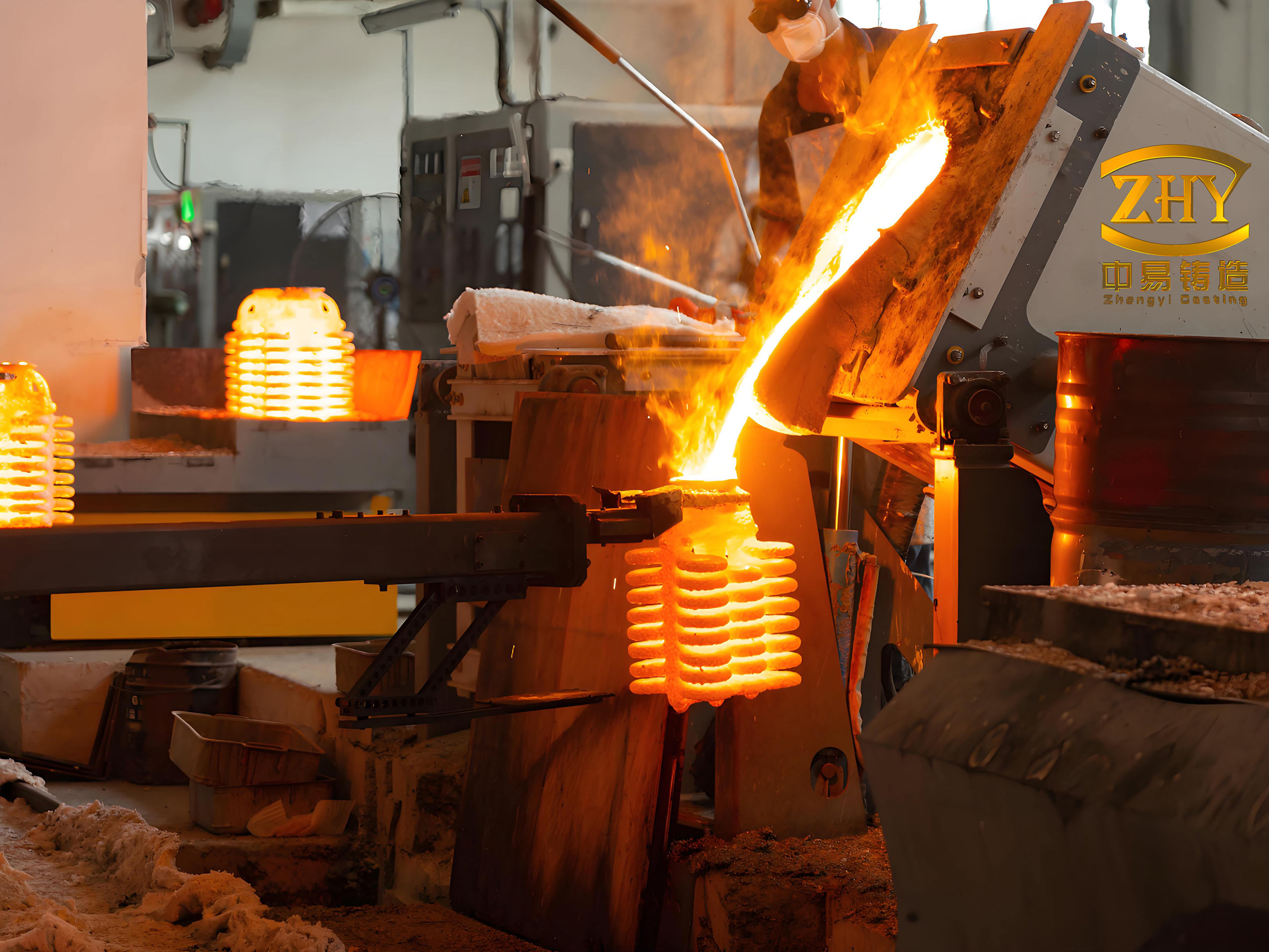
Following pattern assembly with the gating system, the ceramic shell was built using a silica sol binder system. In precision lost wax casting, the shell must withstand thermal and mechanical stresses during dewaxing, sintering, and pouring while providing a smooth casting surface. The shell consisted of a face coat and multiple backup layers. The face coat, critical for surface finish, comprised silica sol binder with 325-mesh zircon flour as refractory, stuccoed with 100-mesh alumina sand. Two face coats were applied to ensure integrity. The backup layers, providing structural strength, used silica sol with calcined clay (coal gangue powder) as filler, stuccoed with progressively coarser coal gangue sand from 40-60 mesh to 16-24 mesh. A total of 7-8 layers were built. The narrow entrance of the spiral flow channel posed challenges for slurry coating and drying; extended drying times and careful removal of loose sand were implemented to ensure adequate shell strength in these areas. The shell-making process in precision lost wax casting is a delicate balance between permeability and strength, governed by factors like slurry viscosity and drying kinetics. The drying process can be modeled using Fick’s law of diffusion: $$ \frac{\partial \rho}{\partial t} = D \nabla^2 \rho $$ where $\rho$ is the moisture concentration, $t$ is time, and $D$ is the diffusion coefficient, which depends on temperature and humidity. Controlling these parameters is essential to prevent shell cracking or inadequate bonding.
The gating system design is pivotal in precision lost wax casting to ensure smooth filling, effective feeding, and directional solidification. For the volute, a bottom-gating system was designed, featuring a large pouring cup to quickly establish metallostatic pressure, multiple ingates near thick sections (especially the outlet flange) for feeding, and extended feeders to promote sequential solidification. This design aims to minimize turbulence and shrinkage defects. Computational fluid dynamics (CFD) simulations using ProCAST software were conducted to optimize the system. The filling simulation showed that molten metal ascended steadily from the bottom, with simultaneous filling of ingates and feeders, completing the cavity before the gating system itself filled (see simulation snapshots). The solidification simulation revealed that the thin spiral sections solidified first, followed by the thicker flanges, with feeders remaining liquid longest to compensate for shrinkage. The solidification time $t_s$ for a given section can be estimated using Chvorinov’s rule: $$ t_s = B \left( \frac{V}{A} \right)^n $$ where $V$ is volume, $A$ is surface area, $B$ is a mold constant, and $n$ is an exponent typically around 2. For the volute, the modulus $\left( \frac{V}{A} \right)$ varies significantly, explaining the differential solidification rates. The simulation results guided the placement of feeders to ensure thermal gradients conducive to feeding.
| Section | Volume (cm³) | Surface Area (cm²) | Modulus (V/A) (cm) | Estimated Solidification Time (s) |
|---|---|---|---|---|
| Spiral Flow Channel | ~150 | ~300 | 0.5 | 15-20 |
| Inlet Flange | ~300 | ~200 | 1.5 | 40-50 |
| Outlet Flange | ~280 | ~180 | 1.56 | 45-55 |
| Feeder | ~500 | ~250 | 2.0 | 60-70 |
Pouring parameters—namely pouring temperature and mold temperature—profoundly influence casting quality in precision lost wax casting. To determine the optimal set, nine combinations of pouring temperature (ranging from 1420°C to 1480°C) and mold temperature (800°C to 900°C) were simulated. The analysis indicated that while filling time remained largely unchanged, solidification time increased with higher temperatures, and the tendency for microporosity first decreased then increased. A combination of 1450°C pouring temperature and 850°C mold temperature minimized microporosity while keeping solidification time relatively short. This optimal set was derived by evaluating a porosity index $P$ defined as: $$ P = \int_{0}^{t_s} \left( \frac{\partial g}{\partial t} \right) dt $$ where $g$ is the fraction solid, and the integral captures the vulnerable period for pore formation. The selected parameters balance fluidity and feeding requirements. The actual pouring was conducted in a vacuum induction furnace to prevent oxidation and gas entrapment, a standard practice in precision lost wax casting for reactive alloys like K4169.
After casting, the components underwent standard post-processing: shell removal, cutting of gates, grinding, and heat treatment. The heat treatment typically involves solution treatment and aging to precipitate strengthening phases like γ” and γ’. For K4169, a common cycle is: solution treatment at 950-980°C followed by air cooling, and aging at 720°C for 8 hours, furnace cooling to 620°C, holding for 8-10 hours, then air cooling. This treatment enhances mechanical properties by optimizing the microstructure. The castings were then inspected non-destructively using fluorescent penetrant testing (FPT) and X-ray radiography. Acceptance criteria required defects like pores or inclusions to be ≤2.0 mm in diameter and ≤1.0 mm in depth, and microporosity area fraction ≤6% on examined sections. Metallographic samples were extracted from typical locations—inlet flange, outlet flange, and spiral channel—and prepared using electrolytic etching with a solution of 16 g Cr₂O₃, 10 ml H₂SO₄, and 170 ml H₃PO₄ at 5-6 V for 10-20 seconds. Microscopic examination revealed no significant microporosity; all sections rated below level 1 according to comparative standards. Additionally, mechanical test bars cast alongside the volutes exhibited stress rupture properties at 650°C and 620 MPa exceeding 100 hours with elongation of 3.16% and reduction of area 16.82%, meeting design requirements. These results validate the efficacy of the precision lost wax casting process for such demanding applications.
The success of this project underscores several key insights for precision lost wax casting of complex superalloy components. First, the use of soluble cores for intricate internal features simplifies tooling and improves accuracy compared to traditional methods. Second, cold wax techniques effectively counteract shrinkage in thick sections, maintaining dimensional precision. Third, systematic gating design supported by computational simulation ensures proper feeding and minimizes defects. Fourth, optimized pouring parameters derived from simulation reduce trial-and-error iterations. These elements collectively enhance the robustness of precision lost wax casting. Moreover, the process demonstrates scalability for large components; the volute weighed several kilograms, yet the principles apply to both smaller and larger parts. The integration of simulation tools with experimental practice represents a modern approach to precision lost wax casting, where digital twins predict outcomes before physical trials, saving time and resources.
Looking forward, there are opportunities to further refine precision lost wax casting for aerospace components. Advances in additive manufacturing could enable direct printing of ceramic cores with even more complex geometries, potentially eliminating the need for soluble cores in some cases. Additionally, real-time monitoring of shell drying and sintering using sensors could improve process control. The development of new binder systems or refractory materials might enhance shell performance at higher temperatures, allowing for casting of alloys with even higher melting points. Furthermore, machine learning algorithms could be trained on simulation and inspection data to predict defect formation and automatically adjust process parameters. These innovations will continue to push the boundaries of precision lost wax casting, making it even more indispensable for manufacturing critical parts like rocket engine components.
In conclusion, the precision lost wax casting process, when meticulously engineered, is capable of producing high-integrity K4169 alloy volutes that meet stringent aerospace standards. Through the adoption of soluble urea cores, cold wax block techniques, optimized silica sol shells, bottom-gating systems, and simulation-validated pouring parameters, we achieved castings with excellent dimensional accuracy (CT5 grade), surface quality, and mechanical properties. The repeated emphasis on precision lost wax casting throughout this study highlights its centrality in overcoming the challenges posed by complex geometries and demanding material properties. This work not only demonstrates a viable manufacturing route for critical rocket engine components but also contributes to the broader knowledge base of precision lost wax casting technology, offering guidelines that can be adapted for similar superalloy castings in aerospace, energy, and other high-performance industries. The fusion of traditional craftsmanship with modern computational tools epitomizes the evolution of precision lost wax casting into a highly reliable and advanced manufacturing paradigm.