
In my extensive experience with precision lost wax casting, I have encountered numerous challenges, but one of the most persistent and critical defects is hot tearing. This issue is particularly prevalent in complex geometries, such as frame-like or elongated components, where thermal stresses during solidification can lead to catastrophic failures. The precision lost wax casting process, while excellent for producing intricate, high-tolerance parts, is susceptible to hot tears if not meticulously controlled. These cracks typically manifest in areas opposite or near the ingates, as well as at small, unsupplied hot spots in the casting. Through years of hands-on practice and systematic analysis, I have developed and refined a suite of strategies to effectively eliminate hot tears, ensuring the reliability and quality of precision lost wax castings.
Hot tearing occurs within a narrow temperature range, closely associated with the alloy’s solidus line. In precision lost wax casting, when the casting design is complex or the gating system induces uneven cooling, certain sections may experience delayed solidification. As the rest of the casting solidifies and contracts, these lagging regions remain in a semi-solid state with negligible strength, making them vulnerable to tensile stresses generated by constrained contraction. The fundamental mechanism can be described by the stress-strain relationship at elevated temperatures: $$ \sigma = E \cdot \epsilon $$ where $\sigma$ is the thermal stress, $E$ is the modulus of elasticity (which drops significantly near the solidus), and $\epsilon$ is the strain due to contraction. When $\sigma$ exceeds the material’s high-temperature strength, hot tears initiate. This is especially critical in precision lost wax casting, where the ceramic shell’s behavior also plays a pivotal role.
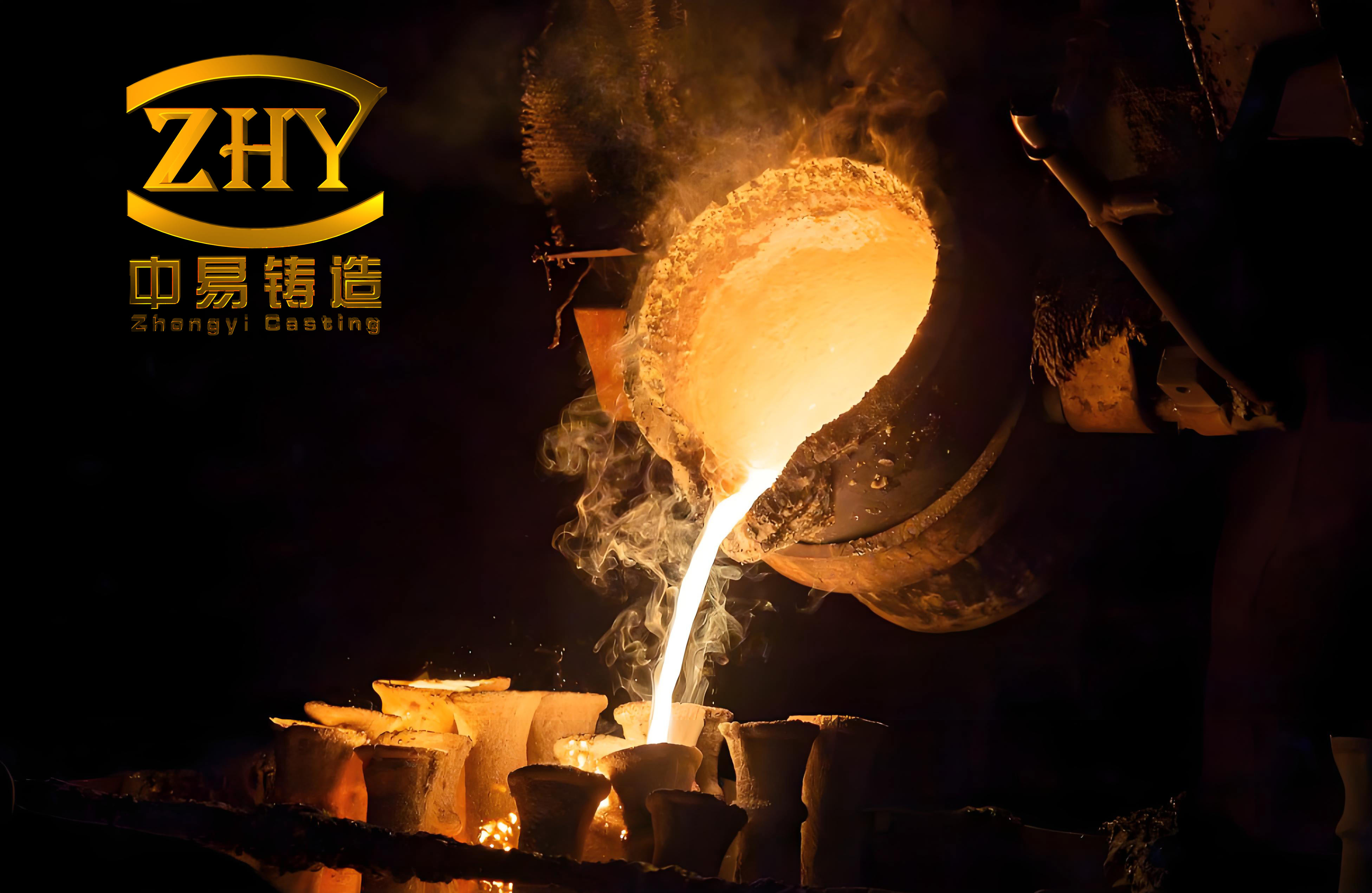
One of the most effective countermeasures I have implemented involves the shell baking and pouring protocol. In precision lost wax casting using sodium silicate-bonded shells, the presence of Na₂O and residual SiO₂ can lead to deleterious phase transformations at high temperatures. Specifically, at around 1000°C, a solid-state reaction occurs, forming low-melting eutectics: $$ \text{Na}_2\text{O} + \text{SiO}_2 \rightarrow \text{Na}_2\text{O} \cdot \text{SiO}_2 \quad \text{(eutectic)} $$ This liquid phase, dispersed throughout the shell, drastically reduces its high-temperature strength, often approaching zero at 1000°C. To mitigate this, I adopt a sand-backed shell baking approach, where the molds are embedded in sand during baking and then poured immediately after exiting the furnace at temperatures exceeding 1000°C. This ensures the entire shell is softened, minimizing resistance to casting contraction. Additionally, the sand backing slows heat dissipation, promoting uniform cooling and reducing thermal gradients. The effectiveness of this method is summarized in the table below, comparing different shell handling techniques in precision lost wax casting:
| Shell Handling Method | Baking Temperature | Shell Strength at 1000°C | Cooling Rate | Hot Tear Incidence |
|---|---|---|---|---|
| Sand-backed, high-temperature pour | >1000°C | Near zero | Slow and uniform | Low |
| Unbacked, high-temperature pour | >1000°C | Low | Fast and uneven | Moderate |
| Sand-backed, low-temperature pour | <900°C | Moderate | Slow but non-uniform | High |
| Unbacked, low-temperature pour | <900°C | High | Fast and uneven | Very High |
However, while this sand-backed approach is highly effective, it introduces operational complexities. Therefore, I often complement it with gating system modifications. In precision lost wax casting, the ingate design is crucial; many hot tears originate near or opposite ingates due to localized overheating and delayed solidification. By altering the ingate geometry and placement, heat distribution can be optimized. For instance, extending ingates into thin, elongated sections or using multiple dispersed ingates helps spread thermal input, reducing hot spots. The thermal impact can be modeled using Fourier’s law of heat conduction: $$ q = -k \nabla T $$ where $q$ is the heat flux, $k$ is the thermal conductivity, and $\nabla T$ is the temperature gradient. By increasing the ingate surface area, $q$ is distributed, lowering $\nabla T$ in critical zones. Below is a table illustrating common ingate modifications I apply in precision lost wax casting to prevent hot tears:
| Original Ingate Design | Modified Ingate Design | Thermal Profile Improvement | Hot Tear Reduction |
|---|---|---|---|
| Short, concentrated circular ingate | Long, thin rectangular ingate | Flattens temperature peak near ingate | >70% |
| Single central ingate | Multiple peripheral ingates | Distributes heat more evenly | >60% |
| Ingate at thick section | Ingate at thin section with chill | Accelerates cooling in lagging areas | >80% |
Another vital aspect is casting design optimization. In precision lost wax casting, part geometry must be reviewed to eliminate abrupt thickness changes and unsupplied hot spots. Whenever possible, I advocate for design alterations that promote uniform wall thickness, such as adding fillets or strategic ribs. This reduces stress concentration factors, which can be expressed as: $$ K_t = 1 + 2\sqrt{\frac{a}{\rho}} $$ where $K_t$ is the stress concentration factor, $a$ is the crack or notch depth, and $\rho$ is the radius of curvature. By increasing $\rho$ through design changes, $K_t$ decreases, lowering the risk of tear initiation. However, any modifications must be validated with the client to ensure functional integrity, a key consideration in precision lost wax casting for high-value components.
Metallurgical control is equally paramount. In precision lost wax casting of steel, tramp elements like sulfur and phosphorus can severely compromise high-temperature ductility. These elements form low-melting eutectics, such as FeS and Fe₃P, which segregate to grain boundaries, creating a continuous liquid film that weakens the material. The eutectic reactions can be represented as: $$ \text{Fe} + \text{S} \rightarrow \text{FeS} \quad (\text{melting point} \approx 1190^\circ\text{C}) $$ $$ 3\text{Fe} + \text{P} \rightarrow \text{Fe}_3\text{P} \quad (\text{melting point} \approx 1166^\circ\text{C}) $$ To counteract this, I meticulously control melt chemistry, minimizing S and P levels while elevating manganese content. Manganese reacts with sulfur to form high-melting MnS inclusions: $$ \text{Mn} + \text{S} \rightarrow \text{MnS} \quad (\text{melting point} > 1600^\circ\text{C}) $$ This removes the liquid grain-boundary phase, enhancing cohesion. The relationship between composition and hot tear susceptibility can be quantified using a hot tearing index, $I_{HT}$, which I often approximate as: $$ I_{HT} = \frac{[\text{S}] + [\text{P}]}{[\text{Mn}]} $$ where lower values indicate better resistance. In precision lost wax casting, maintaining $I_{HT} < 0.02$ is a target I strive for through careful charge selection and deoxidation practices, such as using aluminum or silicon for deoxidation to reduce non-metallic inclusions.
To integrate these strategies, I have developed a holistic process flowchart for precision lost wax casting, incorporating preventive measures at each stage. The flowchart emphasizes iterative feedback from non-destructive testing, such as dye penetrant inspection, to refine parameters. Moreover, advanced simulation tools are invaluable; I use finite element analysis (FEA) to model thermal stresses during solidification. The governing equation for transient heat transfer and stress is: $$ \rho C_p \frac{\partial T}{\partial t} = \nabla \cdot (k \nabla T) + Q $$ $$ \nabla \cdot \boldsymbol{\sigma} + \mathbf{f} = 0 $$ where $\rho$ is density, $C_p$ is specific heat, $T$ is temperature, $t$ is time, $Q$ is heat source, $\boldsymbol{\sigma}$ is stress tensor, and $\mathbf{f}$ is body force. By simulating different gating designs and baking conditions, I can predict hot tear risks before actual production, saving time and resources in precision lost wax casting projects.
In practice, the synergy of these methods is essential. For example, in a recent precision lost wax casting project for an aerospace bracket, initial prototypes exhibited hot tears at the ingate junctions. By combining sand-backed baking at 1050°C, redesigning ingates into fan-shaped distributors, and adjusting the melt to achieve 0.015% S, 0.020% P, and 0.80% Mn, the defect was eliminated entirely. The table below summarizes a multi-faceted approach I recommend for precision lost wax casting to mitigate hot tears:
| Strategy Category | Specific Actions | Key Parameters | Expected Outcome |
|---|---|---|---|
| Shell Management | Sand-backed baking; high-temperature pouring | Baking temp: >1000°C; Pouring delay: <2 min | Shell softness reduces contraction resistance |
| Gating Design | Extended thin ingates; multiple ingates | Aspect ratio >5; number of ingates: 3-4 | Uniform heat distribution; lower thermal gradients |
| Casting Geometry | Add fillets (R≥3mm); avoid thickness jumps | Wall thickness variation <50% | Reduced stress concentration |
| Metallurgy | Control S, P; increase Mn; use deoxidizers | S<0.02%, P<0.03%, Mn>0.6%; deoxidation with Al | Higher grain boundary strength |
| Process Simulation | FEA for thermal stress; solidification modeling | Mesh size <1mm; boundary conditions from experiments | Predictive insight; optimize parameters |
Furthermore, the role of cooling rate cannot be overstated. In precision lost wax casting, the cooling curve directly influences the solidification morphology. A slower cooling rate allows for more dendritic growth, which can entrap liquid and exacerbate hot tearing. I often analyze cooling curves using empirical data, fitting them to the Newtonian cooling model: $$ T(t) = T_{\text{env}} + (T_{\text{pour}} – T_{\text{env}}) e^{-ht} $$ where $T_{\text{env}}$ is the environment temperature, $T_{\text{pour}}$ is the pouring temperature, and $h$ is the heat transfer coefficient. By adjusting $h$ through shell thickness or backing material, I can tailor cooling to minimize thermal stresses. For steel castings in precision lost wax casting, I aim for cooling rates between 10-50°C/min in the solidification range, which balances integrity and productivity.
Another often-overlooked factor is the influence of mold material properties. In precision lost wax casting, the ceramic shell’s thermal expansion coefficient must match that of the metal to avoid excessive strain. The mismatch strain $\epsilon_m$ can be estimated as: $$ \epsilon_m = \int_{T_{\text{room}}}^{T_{\text{solidus}}} (\alpha_m – \alpha_s) dT $$ where $\alpha_m$ and $\alpha_s$ are the coefficients of thermal expansion for metal and shell, respectively. For steel ($\alpha_m \approx 12 \times 10^{-6} /^\circ\text{C}$) and silica-based shells ($\alpha_s \approx 0.5 \times 10^{-6} /^\circ\text{C}$), $\epsilon_m$ is significant, contributing to contraction resistance. Therefore, I experiment with shell compositions, such as adding zirconia to adjust $\alpha_s$, though this requires careful cost-benefit analysis in precision lost wax casting.
In conclusion, hot tear elimination in precision lost wax casting demands a comprehensive, multi-disciplinary approach. From shell engineering and gating design to metallurgical precision and simulation-driven optimization, each element interlocks to ensure defect-free components. My journey in precision lost wax casting has taught me that proactive prevention, rooted in deep understanding of material science and process dynamics, is far more effective than reactive fixes. By continuously refining these strategies and embracing technological advancements, I am confident that the challenges of hot tearing can be consistently overcome, upholding the high standards expected in precision lost wax casting for critical applications across industries.