
In the manufacturing of high-precision heavy-duty machine tools, the quality of rotary table castings is critical, as these components serve as the foundational elements in machining operations. As a casting engineer with extensive experience in producing large-scale machine tool castings, I have encountered numerous challenges in eliminating defects such as shrinkage porosity and voids in rotary table castings. These defects often arise due to the complex geometry of machine tool castings, which feature significant variations in wall thickness, large planar surfaces, and critical functional areas like guide rails and working surfaces. In this article, I will delve into the preventive measures and elimination strategies for defects in machine tool castings, focusing on three key aspects: the gating system, riser design, and melting process. Through detailed analysis, including the use of computational simulations and practical adjustments, I aim to provide a comprehensive guide for producing defect-free machine tool castings, particularly for rotary tables. The insights shared here are based on years of hands-on experience and iterative improvements in foundry practices.
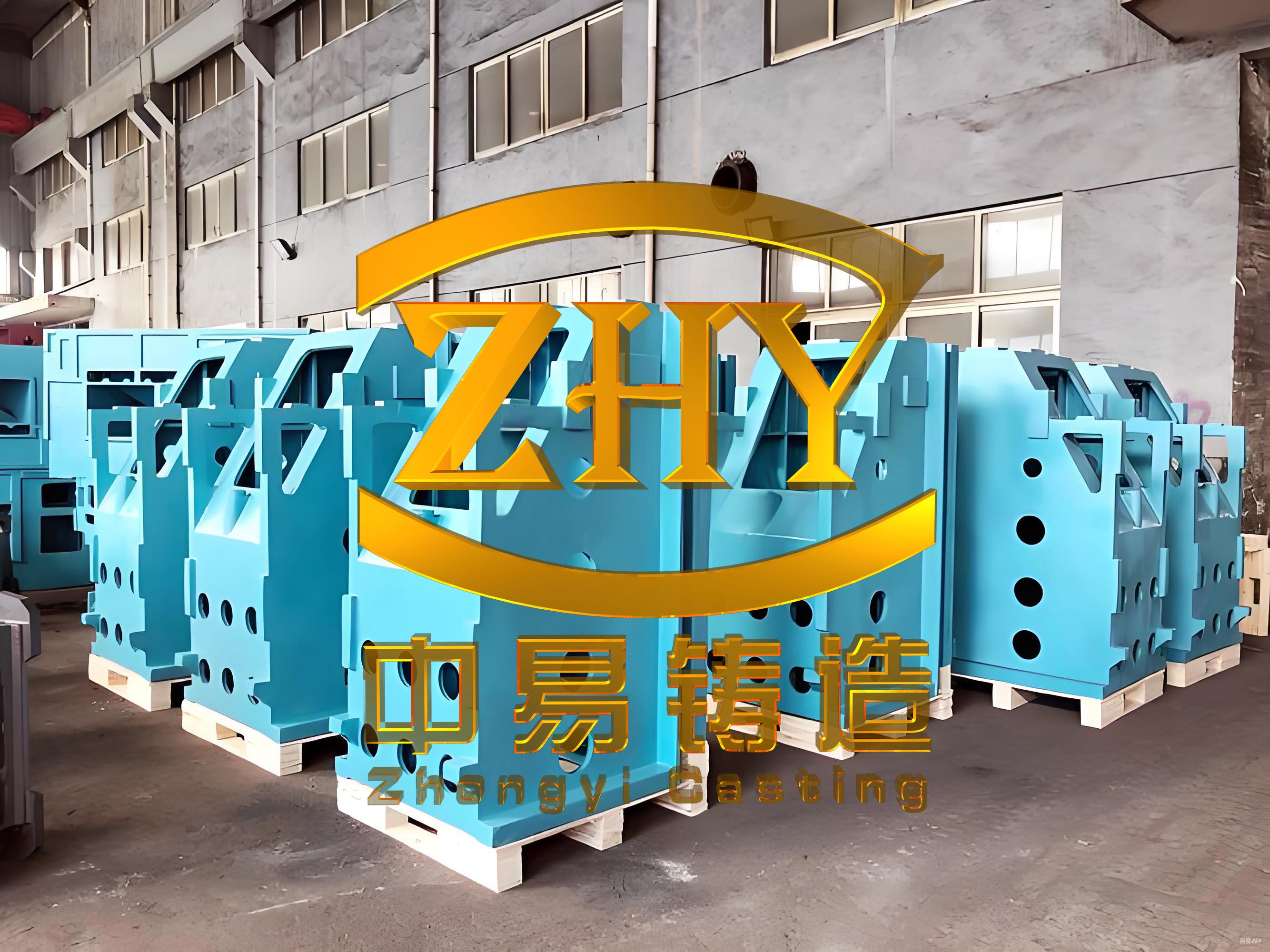
Machine tool castings, especially rotary tables, are characterized by their substantial mass and intricate design, which include thick sections like guide rails and working surfaces juxtaposed with thinner walls. For instance, a typical rotary table in a machine tool casting might have a working surface thickness of 130 mm, increasing to 150 mm after machining, while the guide rail sections exhibit thermal diameters of up to 235 mm. This disparity in wall thickness often leads to localized hot spots, making machine tool castings prone to shrinkage defects if not properly addressed. Additionally, functional requirements demand that surfaces like guide rails and T-slots remain free of any imperfections, as they directly impact the precision and longevity of the machine tool. In my work, I have found that a holistic approach—integrating gating design, riser optimization, and melting controls—is essential for achieving high-quality machine tool castings. This article will explore each of these elements in depth, supported by formulas, tables, and empirical data to illustrate effective strategies.
Gating System Design for Machine Tool Castings
The gating system plays a pivotal role in ensuring the uniform and tranquil filling of the mold cavity, which is crucial for minimizing oxide slag formation and turbulence-related defects in machine tool castings. For semi-circular rotary table castings, I recommend employing a fully enclosed, semi-circular gating system that follows the contour of the casting. This design enhances slag trapping efficiency and promotes a steady flow of molten metal. In practice, for large machine tool castings like an 11-meter diameter rotary table, a two-point gating arrangement is often utilized due to constraints in handling equipment and foundry space. This involves positioning gates at opposite ends of the casting to distribute metal evenly. The horizontal runners are segmented to improve yield, and multiple ingates—such as ten ceramic tubes with a diameter of 50 mm—are spaced uniformly to facilitate rapid mold filling. Computational fluid dynamics (CFD) simulations have been instrumental in validating this approach, showing that it reduces oxidative losses and ensures a homogeneous temperature distribution, which is vital for the integrity of machine tool castings.
To quantify the gating system parameters, I often use the following relationship for the total cross-sectional area of ingates (A_ingate) based on the pouring rate (Q) and the nominal thickness of the casting (T_nom): $$ A_{\text{ingate}} = k \times Q \times T_{\text{nom}} $$ where k is an empirical coefficient typically ranging from 0.8 to 1.2 for machine tool castings, depending on the alloy and geometry. For ductile iron castings like QT600-3, a higher k value may be adopted to account for the fluidity and solidification characteristics. The table below summarizes typical gating system dimensions for large rotary table machine tool castings, derived from simulation and production data:
| Component | Diameter (mm) | Number | Cross-Sectional Area (cm²) |
|---|---|---|---|
| Ingate (Ceramic Tube) | 50 | 10 | 19.6 |
| Horizontal Runner | 80 | 2 segments | 50.3 |
| Vertical Sprue | 100 | 1 per point | 78.5 |
This gating configuration not only mitigates defects but also aligns with the goal of achieving high yield and consistency in machine tool castings. By integrating simulation tools, we can iteratively refine the design to address specific challenges, such as minimizing temperature gradients that exacerbate shrinkage in thick sections.
Riser Design and Optimization for Machine Tool Castings
Risers are critical for supplying liquid metal to compensate for shrinkage during the solidification of machine tool castings. However, the design of risers for ductile iron castings, such as those used in rotary tables, requires careful consideration due to the graphitization expansion that occurs in the later stages of solidification. This expansion can lead to self-feeding, but if not managed properly, it may result in riser-induced defects. Based on my experience, using large-diameter risers with small-diameter and tall riser necks proves most effective for machine tool castings. Specifically, the riser diameter (D_r) should be approximately 0.85 times the thickness of the section being fed (T_section) for initial designs, but further optimization often leads to a ratio of 1.3 times the thermal diameter (D_thermal) of hot spots like guide rails. The riser neck dimensions are equally important; a diameter not exceeding 30 mm and a height of at least 50 mm are essential to ensure adequate liquid feeding while preventing back-feeding during graphitization.
The mathematical relationship for riser sizing can be expressed as: $$ D_r = \alpha \times D_{\text{thermal}} $$ where α is a factor derived from experimental data, typically between 0.8 and 1.3 for machine tool castings. For instance, in a rotary table with a thermal diameter of 230 mm at the guide rail, the riser diameter would be calculated as: $$ D_r = 1.3 \times 230 = 299 \text{ mm} $$ In practice, we round this to 300 mm for standardization. The riser neck area (A_neck) is then determined by: $$ A_{\text{neck}} = \pi \times \left( \frac{d_{\text{neck}}}{2} \right)^2 $$ where d_neck ≤ 30 mm, and the height h_neck ≥ 50 mm. This design promotes directional solidification and reduces the risk of shrinkage porosity in critical areas of machine tool castings. The table below illustrates typical riser parameters for various sections of a rotary table casting:
| Section | Thermal Diameter (mm) | Riser Diameter (mm) | Riser Neck Diameter (mm) | Riser Neck Height (mm) |
|---|---|---|---|---|
| Guide Rail | 235 | 300 | 30 | 50 |
| Working Surface | 150 | 200 | 25 | 50 |
| T-Slot Junction | 110 | 140 | 20 | 50 |
Through CAE simulations, I have validated that this riser configuration, combined with strategic chilling, effectively eliminates shrinkage defects in machine tool castings. The use of tall riser necks facilitates the separation of the riser from the casting during the graphitization phase, thereby harnessing the expansion for self-feeding without compromising the integrity of the casting.
Melting and Pouring Process for Machine Tool Castings
The melting process is a cornerstone in producing high-quality machine tool castings, as it directly influences the metallurgical properties and defect formation. For ductile iron castings like QT600-3, which are commonly used in rotary tables, I employ a 20-ton medium-frequency induction furnace to achieve precise control over composition and temperature. The target chemical composition is critical for ensuring the desired mechanical properties and minimizing shrinkage tendencies. Based on extensive trials, the optimal composition for machine tool castings includes controlled levels of carbon, silicon, manganese, and trace elements such as magnesium and copper to enhance strength and graphitization. The table below outlines the typical chemical composition range for QT600-3 in machine tool castings:
| Element | Composition Range (%) |
|---|---|
| C | 3.45–3.55 |
| Si | 1.8–2.1 |
| Mn | 0.5–0.6 |
| P | <0.055 |
| S | <0.01 |
| Mg | 0.05–0.07 |
| Cu | 0.5–0.6 |
| Sb | 0.005–0.010 |
| Sn | <0.007 |
In addition to composition, the pouring temperature and inoculation practice are vital. I recommend a pouring temperature of 1330–1360°C for machine tool castings to balance fluidity and shrinkage behavior. To enhance graphitization and reduce chilling, multiple-stage inoculation is employed: first at the furnace spout, then in the ladle (bottom, middle, and top), and finally during pouring as a stream inoculation. This approach ensures a uniform matrix and minimizes the risk of carbides and micro-shrinkage in thick sections of machine tool castings. The inoculation effect can be modeled using the equation: $$ I_{\text{effect}} = I_0 \times e^{-k t} $$ where I_effect is the potency of inoculation over time t, I_0 is the initial inoculation intensity, and k is a decay constant specific to the alloy. By optimizing these parameters, we achieve consistent mechanical properties, with tensile strengths of 682–820 MPa, hardness of 255–275 HB, and elongation of 4.62–5.50% in test bars, while the casting itself maintains a hardness of 180–220 HB.
Improvement Measures Based on Simulation and Practice
Despite initial design efforts, defects such as subsurface shrinkage in riser zones and T-slot areas may persist in machine tool castings. Through iterative CAE simulations, I identified that insufficient riser feeding and inadequate chilling were the primary culprits. For example, in rotary table castings, the junction of cross ribs and the bottom surface often forms hot spots that lead to shrinkage porosity in T-slots. To address this, I increased the thickness of chills from 60 mm to 100 mm in working surfaces and from 80 mm to 110 mm in guide rails. However, chills alone are not sufficient due to their limited effectiveness during the contraction phase. Therefore, I focused on modifying the riser design by adopting larger diameters with constrained neck dimensions. This adjustment ensures that liquid metal is available for feeding during the critical liquid contraction stage, while the narrow neck isolates the riser during graphitization expansion.
The relationship between chill thickness (T_chill) and the section thickness (T_section) can be approximated by: $$ T_{\text{chill}} = \beta \times T_{\text{section}} $$ where β is typically 0.5 to 0.8 for machine tool castings, depending on the cooling rate required. For instance, in a 150 mm thick section, a chill thickness of 100 mm (β ≈ 0.67) provides adequate heat extraction. Furthermore, the optimal riser neck dimensions were refined through production trials, leading to the formula: $$ d_{\text{neck}} \leq 30 \text{ mm}, \quad h_{\text{neck}} \geq 50 \text{ mm} $$ This combination, when applied to machine tool castings, has proven to eliminate defects consistently. The integration of simulation tools allows for pre-emptive adjustments, reducing the need for costly repairs and ensuring timely delivery of high-integrity machine tool castings.
Conclusion
In summary, the prevention and elimination of defects in machine tool castings, particularly rotary tables, require a synergistic approach that encompasses gating system design, riser optimization, and precise melting controls. Through first-hand experience, I have demonstrated that using large-diameter risers with small, tall necks—coupled with simulation-validated gating and targeted chilling—can effectively mitigate shrinkage and porosity in these complex castings. The chemical composition and pouring parameters must be meticulously controlled to support the solidification behavior of ductile iron. By adhering to these principles, foundries can produce defect-free machine tool castings that meet the stringent demands of precision engineering. As the industry continues to evolve, ongoing research and adaptation of these strategies will further enhance the quality and reliability of machine tool castings, solidifying their role in advanced manufacturing.