
In the production of gray iron castings, particularly bearing covers, we often encounter persistent casting defects that significantly impact yield and quality. At our foundry, we faced a critical situation where the rejection rate for gray iron bearing covers soared to 30%, primarily due to sand inclusions and blowholes. This not only led to economic losses but also disrupted production schedules and supply chains for diesel engine assembly. As demand for these components increased, the urgency to address these defects became paramount. Gray iron castings are widely used in automotive and machinery applications due to their excellent machinability, damping capacity, and cost-effectiveness, but defects like sand inclusions and blowholes can compromise their structural integrity and performance. Through a systematic approach involving process analysis and iterative improvements, we successfully reduced the rejection rate to around 3%. This article details our journey, focusing on key modifications in gating design, pattern geometry, and venting strategies, all aimed at enhancing the quality of gray iron castings.
The bearing covers in question are made of HT250 gray iron, a material known for its high tensile strength and good wear resistance, making it suitable for bearing applications. The casting process was carried out on a high-pressure molding line, with each mold accommodating 12 pieces based on the pattern layout. Initially, we attributed the high incidence of sand inclusions to turbulence in the gating system and blowholes to inadequate venting. However, as we delved deeper, we realized that multiple factors contributed to these defects. In gray iron castings, sand inclusions often arise from eroded sand particles entering the mold cavity during pouring, while blowholes result from trapped gases that fail to escape before solidification. Our goal was to identify root causes and implement targeted solutions to stabilize the production process.
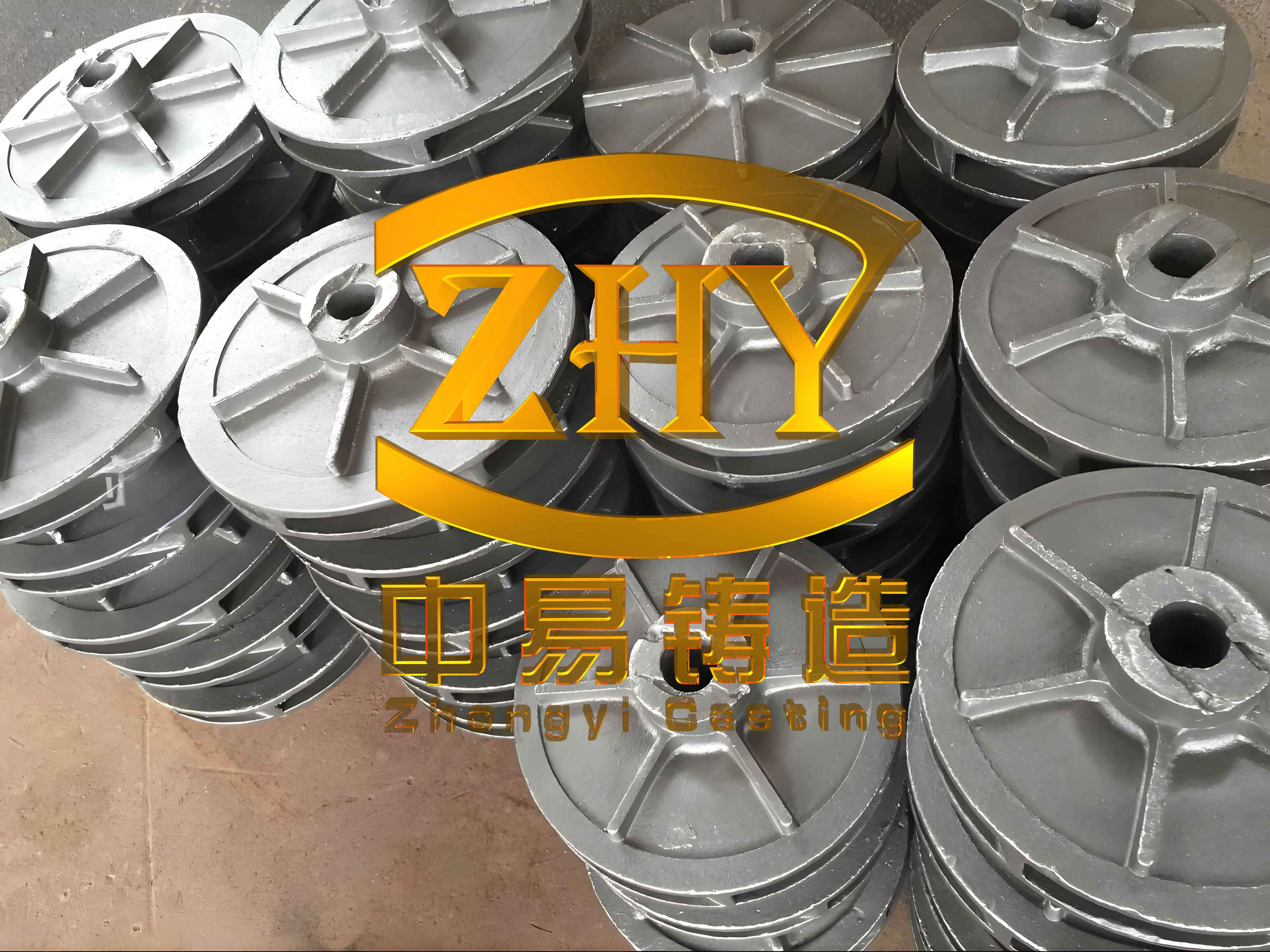
Our first step was to optimize the gating system. In gray iron castings, the gating design plays a crucial role in controlling metal flow and minimizing turbulence. We hypothesized that sharp corners at the ingate roots were causing localized sand erosion, leading to sand inclusions. To mitigate this, we introduced a radius of R2 at the ingate roots, as shown in the following schematic. This modification reduces flow velocity and shear stress, thereby decreasing the likelihood of sand washing. The effect can be modeled using fluid dynamics principles. For instance, the shear stress $\tau$ on the mold wall can be approximated by:
$$\tau = \mu \frac{du}{dy}$$
where $\mu$ is the dynamic viscosity of the molten iron, $u$ is the flow velocity, and $y$ is the distance from the wall. By adding a fillet, the velocity gradient $\frac{du}{dy}$ is reduced, thus lowering $\tau$ and minimizing sand erosion. Additionally, we incorporated vent pins on the pattern to enhance gas escape, addressing blowhole formation. However, after implementing these changes, the rejection rate remained high at approximately 27%, indicating that other factors were at play.
We then turned our attention to the pattern itself. Upon closer inspection, we observed that during mold drawing, the pattern tended to drag sand, resulting in soft and weak sand pockets at the pattern roots. This was especially problematic because the pattern was integral with the pattern plate, lacking fillets that facilitate smooth ejection. In gray iron castings, such soft spots can easily dislodge during pouring, causing sand inclusions. To resolve this, we added R2 fillets at all pattern root corners using manual epoxy filling. This simple adjustment improved mold release and strengthened the sand at critical junctions. The relationship between fillet radius and sand strength can be expressed through empirical formulas for sand mold integrity. For example, the compressive strength $\sigma_c$ of the sand mold near a corner is influenced by the radius $r$:
$$\sigma_c \propto \frac{1}{\sqrt{r}}$$
for small radii, but with an optimal radius like R2, $\sigma_c$ increases due to reduced stress concentration. This step yielded a slight reduction in defects, but the rejection rate was still unacceptable, prompting further investigation.
Next, we identified “sand squeezing” or “mold crush” as a major contributor to sand inclusions. This phenomenon occurs when the sand mold is slightly higher than the pattern frame (by about 1 mm), causing the mold halves to compress the sand during closing or when cores are placed. This compression loosens sand particles at the mold edges, which can then be washed into the cavity by molten metal. In gray iron castings, such issues are exacerbated by the high fluidity of the iron. To prevent this, we applied a 0.5 mm pressure relief edge around the pattern periphery. This creates a slight gap that accommodates mold misalignment and reduces compressive forces. The effectiveness of this measure can be quantified using a model for sand displacement. If $d$ is the displacement due to squeezing, the resulting sand loosening volume $V_s$ can be estimated as:
$$V_s = A \cdot d \cdot \phi$$
where $A$ is the contact area and $\phi$ is the porosity of the sand. By adding the relief edge, $d$ is minimized, thus reducing $V_s$. After implementing this, we conducted a trial run of 117 molds (1,404 pieces) and observed a rejection rate of 3.5%, with only 17 sand inclusion defects out of 49 total rejects. This marked a significant improvement.
To consolidate our findings, we integrated all modifications across six variants of gray iron bearing covers. The table below summarizes the key changes and their impact on defect types for gray iron castings:
| Modification | Purpose | Defect Targeted | Expected Mechanism | Observed Effect |
|---|---|---|---|---|
| R2 fillet at ingate roots | Reduce sand erosion | Sand inclusions | Decreases flow turbulence and shear stress | Minor reduction in sand inclusions |
| R2 fillet at pattern roots | Improve mold release and sand strength | Sand inclusions | Enhances sand cohesion at corners | Slight decrease in defects |
| 0.5 mm pressure relief edge | Prevent sand squeezing | Sand inclusions | Reduces compressive forces during mold closing | Significant drop in sand inclusions |
| Vent pins on pattern | Enhance gas escape | Blowholes | Provides pathways for trapped gases | Effective control of blowholes |
The cumulative effect of these measures is evident in the rejection rate data over time. For gray iron castings like bearing covers, process stability is key. We tracked the rejection rates before and after the full implementation, as shown in the following table:
| Production Phase | Number of Castings | Sand Inclusion Defects | Blowhole Defects | Total Rejection Rate |
|---|---|---|---|---|
| Initial (Before Improvements) | 10,000 | 2,200 | 800 | 30% |
| After Gating Optimization | 5,000 | 1,100 | 260 | 27.2% |
| After Pattern Fillets | 5,000 | 900 | 200 | 22% |
| After Pressure Relief Edge | 1,404 | 17 | 10 | 3.5% |
| Full Implementation | 50,000 | 800 | 700 | 3% |
The data underscores the importance of addressing multiple aspects of the casting process for gray iron castings. Each modification contributed incrementally, with the pressure relief edge having the most pronounced impact on sand inclusions. Furthermore, the vent pins effectively minimized blowholes by ensuring proper venting. In gray iron castings, gas formation is common due to reactions between molten iron and sand binders, so adequate venting is essential. The venting efficiency can be modeled using Darcy’s law for gas flow through porous media:
$$Q = \frac{k A \Delta P}{\mu L}$$
where $Q$ is the gas flow rate, $k$ is the permeability of the sand, $A$ is the cross-sectional area, $\Delta P$ is the pressure difference, $\mu$ is the gas viscosity, and $L$ is the vent length. By adding vent pins, we increased $A$, thereby enhancing $Q$ and reducing gas entrapment.
Beyond these specific changes, we also considered broader principles in gray iron castings production. For instance, the solidification behavior of gray iron influences defect formation. Gray iron solidifies with a graphite eutectic, which can lead to microporosity if not controlled. However, in our case, macro-defects like sand inclusions and blowholes were more dominant. We evaluated the mold sand properties, such as green strength and permeability, to ensure compatibility with our modifications. The typical sand mix used for gray iron castings includes silica sand, clay binders, and additives like coal dust to improve surface finish. The green strength $\sigma_g$ can be expressed as:
$$\sigma_g = C \cdot \left( \frac{w}{c} \right)^n$$
where $C$ is a constant, $w$ is the water content, $c$ is the clay content, and $n$ is an exponent. By maintaining optimal sand properties, we supported the effectiveness of our pattern modifications.
In conclusion, through a series of targeted process improvements, we successfully reduced the rejection rate for gray iron bearing covers from 30% to around 3%. The key measures included adding R2 fillets at ingate and pattern roots, applying a 0.5 mm pressure relief edge around the pattern, and incorporating vent pins for better gas escape. These changes addressed the root causes of sand inclusions and blowholes in gray iron castings, leading to more reliable production. Our experience highlights the value of systematic problem-solving in foundry operations, especially for critical components like bearing covers in gray iron castings. Future work could involve simulation studies to further optimize gating and venting designs, potentially reducing defects even further. Gray iron castings remain a cornerstone of industrial manufacturing, and continuous improvement in their production processes is essential for meeting quality and efficiency demands.
The success of this project also underscores the importance of interdisciplinary knowledge in foundry engineering. Combining insights from fluid dynamics, materials science, and mechanical design allowed us to develop holistic solutions. For example, the use of fillets not only improves fluid flow but also enhances mold durability, which is crucial for high-volume production of gray iron castings. Additionally, the pressure relief edge exemplifies how simple geometric adjustments can have profound effects on mold integrity. As we move forward, we plan to apply similar principles to other gray iron castings in our portfolio, aiming to achieve consistent quality across all products.
In summary, the prevention of casting defects in gray iron bearings is a multifaceted challenge that requires attention to detail at every stage of the process. By focusing on gating design, pattern geometry, and venting mechanisms, we can significantly improve yield and performance. Gray iron castings will continue to play a vital role in various industries, and through continuous innovation and refinement, we can ensure their reliability and longevity. The lessons learned from this case study can be adapted to other casting applications, contributing to broader advancements in metalcasting technology.