
High manganese steel casting is widely recognized for its excellent mechanical properties, particularly its ability to harden rapidly under intense impact and compression conditions. This characteristic allows the surface layer to develop a hardened structure while the core retains the toughness and plasticity of austenite, resulting in superior wear resistance. As a result, high manganese steel casting is extensively used in industries such as rail transportation, mining machinery, military equipment, and agricultural machinery. However, during the production process, defects like oxide films can arise, compromising surface quality and leading to internal cracks. In this article, I will explore the causes of oxide film defects in high manganese steel casting and detail the preventive measures we have implemented, supported by tables, formulas, and empirical data.
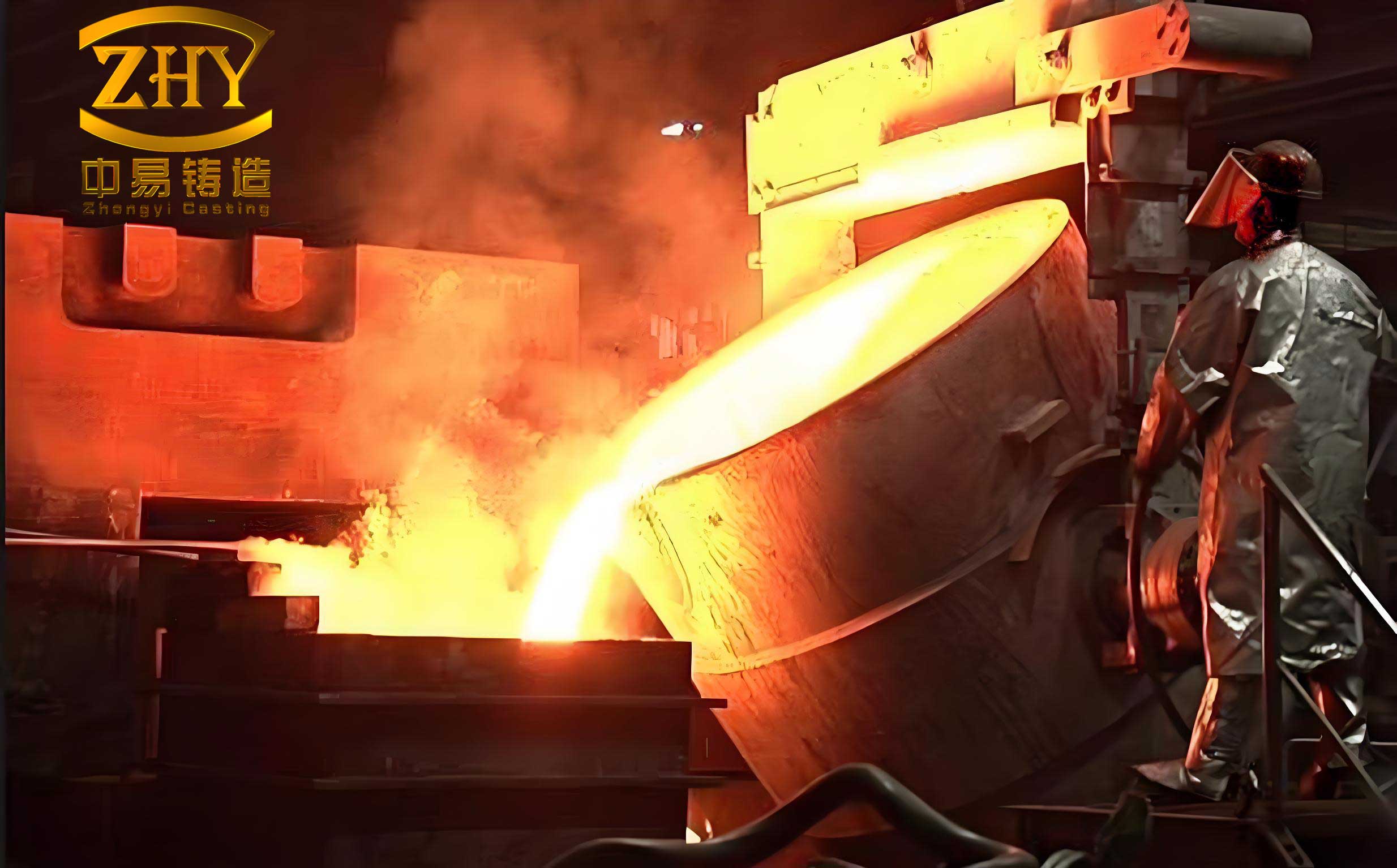
The occurrence of oxide film defects in high manganese steel casting often manifests as surface “wrinkles” or folds, particularly in thinner sections like ear plates and wing rail tops. These defects, which can range from less than 1 mm to 2–3 mm in depth, are challenging to remove through grinding and significantly affect the product’s integrity. Our analysis indicates that these issues stem from the oxidation of molten steel during pouring, where elements like iron (Fe) and manganese (Mn) react with oxygen (O2) in the air, forming metal oxides that adhere to the mold surface. This not only deteriorates surface quality but also induces stress concentrations and microcracks, potentially leading to failure in service. Therefore, addressing oxide film defects is crucial for enhancing the reliability and durability of high manganese steel casting components.
To understand the root causes, we must first examine the casting process involved in high manganese steel casting. The mold is typically made using forsterite sand, sodium silicate, and organic ester hardeners, with carbon dioxide (CO2) used for curing. The pouring process employs an inclined method with dual ingates at one end, with an angle of approximately 5 degrees, depending on the product length. The pouring temperature is maintained at around 1470°C, accompanied by 2–3 supplementary pours to ensure completeness. After casting, the components undergo heat treatment and water toughening to achieve the desired microstructure. However, this process exposes the molten high manganese steel casting to atmospheric oxygen, facilitating oxidation. Scanning electron microscopy (SEM) and energy-dispersive X-ray spectroscopy (EDS) analyses of defect sites reveal high concentrations of Fe, Mn, and O, confirming oxidation as the primary mechanism. The formation of oxide films can be modeled using reaction kinetics; for instance, the oxidation of manganese can be represented as:
$$ \text{2Mn} + \text{O}_2 \rightarrow \text{2MnO} $$
Similarly, iron oxidation follows:
$$ \text{2Fe} + \text{O}_2 \rightarrow \text{2FeO} $$
These reactions occur rapidly at high temperatures, and the resulting oxide films are dispersed by the turbulent flow of molten metal during inclined pouring, adhering to the mold walls and forming wrinkles upon solidification. The thermodynamic driving force for such reactions can be described by the Gibbs free energy equation:
$$ \Delta G = \Delta H – T \Delta S $$
where $\Delta G$ is the change in Gibbs free energy, $\Delta H$ is the enthalpy change, $T$ is the temperature in Kelvin, and $\Delta S$ is the entropy change. For oxidation reactions in high manganese steel casting, $\Delta G$ is typically negative, indicating spontaneity. To quantify the extent of oxidation, we can use the oxidation rate equation:
$$ \frac{d[O]}{dt} = k \cdot [O_2] \cdot A $$
where $\frac{d[O]}{dt}$ is the rate of oxygen uptake, $k$ is the rate constant, $[O_2]$ is the oxygen concentration, and $A$ is the surface area exposed. This highlights the importance of minimizing oxygen contact during pouring.
In our facility, we produce high manganese steel casting components, such as railway frogs, with an annual capacity of nearly 20,000 tons. Historically, oxide film defects led to a scrap rate of up to 27%, emphasizing the need for effective countermeasures. Our approach focuses on eliminating oxygen from the mold cavity to prevent oxidation. One key method involves applying a phenolic resin-based coating, specifically an alcohol-based paint, to critical areas like the bottom plate and curved sections. Upon contact with molten high manganese steel casting, the resin decomposes rapidly at high temperatures, producing hydrocarbons that combust and consume oxygen in the mold. This reaction can be summarized as:
$$ \text{C}_n\text{H}_{2n+2} + \text{O}_2 \rightarrow \text{CO}_2 + \text{H}_2\text{O} $$
Additionally, any residual oxygen is reduced by hydrogen generated from the decomposition, further inhibiting oxide formation. However, this process generates significant gases, necessitating enhanced venting. We optimized the vent channels by spacing them 100–150 mm apart with dimensions of 10 mm in width and depth, and added vertical vents to act as chimneys, stabilizing internal pressure and preventing mold lifting. Furthermore, preheating the mold with natural gas flames helps volatilize the alcohol carrier, reducing gas-related defects like porosity. The effectiveness of these measures is evident in the dramatic reduction of oxide film defects in high manganese steel casting, as shown in the following tables and analyses.
To provide a comprehensive overview, Table 1 summarizes the elemental composition at defect sites in high manganese steel casting, based on EDS analysis. This data underscores the prevalence of oxygen in affected areas, reinforcing the oxidation hypothesis.
| Element | Weight Percentage (%) in Defect Area | Weight Percentage (%) in Non-Defect Area |
|---|---|---|
| Fe | 65.2 | 72.5 |
| Mn | 18.7 | 20.1 |
| O | 12.4 | 2.1 |
| Others | 3.7 | 5.3 |
As seen, the oxygen content in defect areas is significantly higher, indicating substantial oxidation. This aligns with the microscopic observations, where oxide films act as stress concentrators, leading to crack initiation. The relationship between oxide thickness and crack propensity can be modeled using fracture mechanics. For instance, the stress intensity factor $K$ for a surface crack in high manganese steel casting can be expressed as:
$$ K = Y \sigma \sqrt{\pi a} $$
where $Y$ is a geometric factor, $\sigma$ is the applied stress, and $a$ is the crack depth. Thicker oxide films increase $a$, raising the risk of failure.
In terms of process parameters, Table 2 compares key variables before and after implementing preventive measures in high manganese steel casting production. This highlights the optimizations made to mitigate oxide film defects.
| Parameter | Before Improvement | After Improvement |
|---|---|---|
| Pouring Temperature (°C) | 1470 | 1470 |
| Inclination Angle (degrees) | 5 | 5 |
| Resin Coating Application | None | Applied to critical areas |
| Vent Spacing (mm) | 200–250 | 100–150 |
| Mold Preheating | Not performed | Performed with natural gas |
| Defect Rate (%) | 27 | 0 |
The data clearly shows that resin coating and enhanced venting, combined with mold preheating, eliminated oxide film defects without introducing new issues like gas porosity or sand inclusions. The improvement in high manganese steel casting quality is further supported by statistical analysis. For example, the reduction in defect rate can be described using a reliability function:
$$ R(t) = e^{-\lambda t} $$
where $R(t)$ is the reliability over time $t$, and $\lambda$ is the failure rate. With $\lambda$ approaching zero post-improvement, $R(t)$ nears 1, indicating high product reliability.
Another aspect to consider is the role of fluid dynamics in high manganese steel casting. During inclined pouring, the Reynolds number $Re$ determines the flow regime:
$$ Re = \frac{\rho v L}{\mu} $$
where $\rho$ is the density of molten steel, $v$ is the flow velocity, $L$ is the characteristic length, and $\mu$ is the dynamic viscosity. Turbulent flow ($Re > 4000$) promotes oxide dispersion, so controlling pouring speed is critical. However, for large castings like railway frogs, increasing pouring velocity is impractical; thus, oxygen elimination remains the preferred strategy. The resin coating method effectively creates a reducing atmosphere, as the hydrocarbon combustion consumes oxygen, lowering the partial pressure $P_{O_2}$ below the threshold for oxide formation. The equilibrium constant $K_p$ for the oxidation reaction is given by:
$$ K_p = \frac{P_{\text{MnO}}^2}{P_{\text{O}_2} \cdot P_{\text{Mn}}^2} $$
By reducing $P_{O_2}$, $K_p$ shifts, suppressing oxidation.
In our production trials, we conducted small-batch tests to validate these measures for high manganese steel casting. Visual inspections and microscopic analyses confirmed that surfaces became smooth and free of wrinkles, even in previously problematic areas. For instance, ear plates and guard rails showed no signs of oxide films, and internal examinations revealed no microcracks. This success was scaled to mass production, resulting in a sustained defect rate of 0%. Importantly, other common casting defects, such as gas holes, sand inclusions, and insufficient pours, did not increase, demonstrating the robustness of our approach. The economic impact is substantial, as reducing scrap rates lowers production costs and enhances competitiveness in markets reliant on high manganese steel casting.
To further optimize the process, we explored the kinetics of resin decomposition. The rate of gas generation $G$ can be modeled as:
$$ G = A e^{-E_a / RT} $$
where $A$ is the pre-exponential factor, $E_a$ is the activation energy, $R$ is the gas constant, and $T$ is the temperature. By preheating the mold, we accelerate alcohol evaporation, minimizing sudden gas release. This is crucial for maintaining dimensional stability in high manganese steel casting. Additionally, we monitor the cooling curve to ensure proper solidification, as described by the Fourier heat equation:
$$ \frac{\partial T}{\partial t} = \alpha \nabla^2 T $$
where $\alpha$ is the thermal diffusivity. Uniform cooling prevents thermal stresses that could exacerbate defects.
In conclusion, the prevention of oxide film defects in high manganese steel casting requires a multifaceted approach centered on reducing oxygen exposure during pouring. Through the application of resin coatings, enhanced venting, and mold preheating, we have successfully eliminated these defects, achieving a zero scrap rate in mass production. This not only improves surface quality but also enhances the mechanical performance and longevity of high manganese steel casting components. Future work may involve refining the resin composition or exploring alternative oxygen-scavenging methods to further optimize the process. The lessons learned here can be applied to other casting alloys, contributing to broader advancements in metallurgical engineering.
Overall, the integration of chemical, thermal, and mechanical strategies has proven highly effective for high manganese steel casting. By leveraging principles from reaction kinetics, fluid dynamics, and materials science, we have developed a reliable manufacturing process that meets the demanding requirements of industries such as rail and mining. As we continue to innovate, the focus will remain on sustainability and efficiency, ensuring that high manganese steel casting remains a cornerstone of modern engineering applications.