
In our foundry, we specialize in the production of cylinder blocks for diesel engines, which are among the most structurally complex and challenging castings to manufacture due to their intricate geometries and stringent quality requirements. The cylinder block, weighing approximately 270 kg and made of HT250 gray iron with a hardness range of 180–240 HB, features main wall thicknesses of 7–10 mm and numerous thermal junctions. After machining, it must undergo a rigorous 0.5 MPa pressure test for airtightness in water and oil passages; any leakage leads to total scrap. Historically, porosity in casting has been a predominant defect, causing significant scrap rates and escalating production costs. To address this, we adopted a fully cold-box core and no-box self-hardening resin sand mold assembly process. However, this method demands high performance from molding sand and effective mold cavity venting, as sand quality directly impacts casting integrity. Over years of production, we have systematically analyzed and mitigated porosity in casting through enhancements in venting design, sand properties, and pouring practices, drastically reducing scrap rates and lowering costs. This article details our first-person perspective on these improvements, emphasizing the critical role of managing porosity in casting.
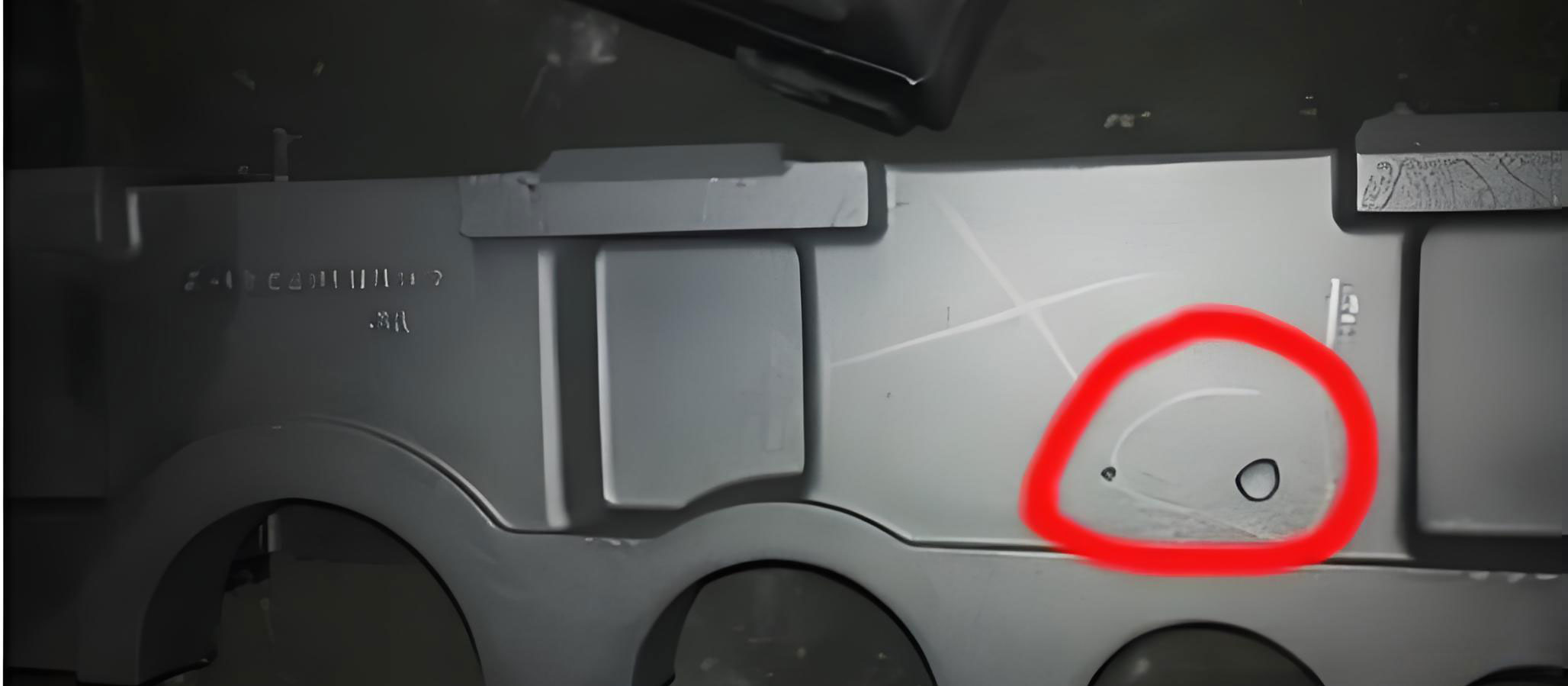
The prevalence of porosity in casting, particularly subsurface blowholes on the top surfaces, initially resulted in scrap rates exceeding 5%. This defect primarily stemmed from inadequate venting of mold cavities, excessive gas generation from resin sand, and suboptimal pouring parameters. To understand and combat porosity in casting, we conducted a thorough root-cause analysis, focusing on three key areas: mold cavity venting efficiency, molding sand characteristics, and pouring工艺工艺. Each factor contributes to gas entrapment during solidification, leading to voids that compromise mechanical properties and pressure tightness. Below, we elaborate on these aspects with technical details, formulas, and tables to summarize our findings and solutions.
Analysis of Causes for Porosity in Casting
Porosity in casting arises when gases fail to escape from the mold cavity during pouring and solidification. For our cylinder blocks, the complex design—with nearly fully encapsulated sand cores in water jackets and cavities—makes venting extremely difficult. We identified the following primary causes:
1. Inadequate Mold Cavity Venting
Originally, venting was achieved using thin venting slats on the mold top surface. These slats had limited cross-sectional area, restricting gas flow. Given the substantial gas evolution from resin sand during pouring, the vents were insufficient to expel all gases, leading to trapped gas pockets and subsequent porosity in casting. The gas flow rate through a vent can be modeled using the fluid dynamics equation for compressible flow:
$$ Q = A \cdot v = A \cdot \sqrt{\frac{2 \Delta P}{\rho}} $$
where \( Q \) is the volumetric flow rate of gas (m³/s), \( A \) is the cross-sectional area of the vent (m²), \( v \) is the gas velocity (m/s), \( \Delta P \) is the pressure differential between the cavity and atmosphere (Pa), and \( \rho \) is the gas density (kg/m³). With small \( A \), \( Q \) is low, causing gas accumulation. Additionally, the total gas volume \( V_g \) generated from resin sand decomposition can be estimated as:
$$ V_g = m_s \cdot G_s $$
where \( m_s \) is the mass of sand (kg) and \( G_s \) is the specific gas evolution (mL/g). For our original process, \( G_s \) was high, exacerbating venting challenges.
2. Poor Molding Sand Performance
The quality of reclaimed sand degraded over time due to equipment aging, leading to high loss-on-ignition (LOI) and fine content. This increased gas evolution and reduced permeability, fostering porosity in casting. To maintain core strength—especially for water jacket cores that serve as machining datum—we had to increase resin binder addition, further elevating gas generation. The relationship between resin content and gas evolution is linear, as shown by:
$$ G_s = k_r \cdot R + G_0 $$
where \( G_s \) is specific gas evolution (mL/g), \( k_r \) is a proportionality constant, \( R \) is resin addition percentage (%), and \( G_0 \) is base gas evolution from sand. High \( G_s \) values, coupled with low sand permeability \( K \), hindered gas escape. Permeability is given by:
$$ K = \frac{C \cdot d^2 \cdot \phi^3}{(1-\phi)^2} $$
where \( C \) is a constant, \( d \) is sand grain diameter (m), and \( \phi \) is porosity. High fines reduce \( d \) and \( \phi \), lowering \( K \).
3. Suboptimal Pouring工艺工艺
To minimize leakage tendencies, we initially used low-temperature, slow-pouring practices. This extended pouring time allowed more gas generation and entrapment, increasing porosity in casting. The pouring time \( t_p \) influences gas solubility in molten iron, as described by Sieverts’ law:
$$ S = k_s \cdot \sqrt{P_{g}} $$
where \( S \) is gas solubility (e.g., hydrogen or nitrogen), \( k_s \) is a temperature-dependent constant, and \( P_{g} \) is partial pressure of gas. Lower pouring temperatures reduce \( k_s \), but slower pouring raises \( P_{g} \) due to prolonged gas evolution, promoting bubble formation.
Table 1 summarizes the initial conditions contributing to porosity in casting:
| Factor | Original Condition | Impact on Porosity in Casting |
|---|---|---|
| Venting Design | Venting slats with small cross-section | Insufficient gas expulsion, trapped gas pockets |
| Sand Gas Evolution | High LOI (>3%), high fines, resin >2.5% | Excessive gas generation, low permeability |
| Pouring Temperature | Low (~1350°C) | Increased gas solubility and entrapment risk |
| Pouring Time | Slow (>35 seconds) | Prolonged gas exposure, higher \( P_{g} \) |
Measures Implemented to Reduce Porosity in Casting
To mitigate porosity in casting, we implemented a multi-faceted approach targeting venting, sand properties, and pouring工艺工艺. Each measure was grounded in principles of foundry engineering and aimed at minimizing gas entrapment.
1. Enhancement of Mold Cavity Venting
We replaced venting slats with cylindrical venting rods, increasing the total vent cross-sectional area. Each slat was substituted with 2–3 rods of 18–20 mm diameter, optimizing the available space. This modification significantly boosted gas flow rate \( Q \), as per the equation above, since \( A \) increased substantially. For fully encapsulated cores, we ensured effective venting channels by sealing core prints with pastes to prevent metal intrusion. The improved venting design reduces the pressure buildup \( \Delta P \), facilitating gas escape. The new venting efficiency \( \eta_v \) can be expressed as:
$$ \eta_v = \frac{Q_{\text{actual}}}{Q_{\text{required}}} = \frac{A_{\text{new}} \cdot v}{V_g / t_p} $$
where \( Q_{\text{required}} \) is the gas generation rate. By maximizing \( \eta_v \), we directly combat porosity in casting.
2. Optimization of Molding Sand Performance
We focused on improving reclaimed sand quality and selecting superior raw materials. Key actions included:
- Upgrading equipment to reduce LOI below 2.0% and fines below 0.5%.
- Switching to high-quality washed sand from Hebei Chengde with angularity factor <1.3, enhancing permeability.
- Reducing resin addition by 0.4% while maintaining core strength >1.8 MPa, using specialized cold-box resins for critical cores.
- Implementing a sand testing regimen to monitor gas evolution \( G_s \) and strength \( \sigma \).
The core strength \( \sigma \) (MPa) as a function of resin content \( R \) (%) and sand quality \( Q_s \) (index) is modeled as:
$$ \sigma = \alpha \cdot R \cdot Q_s + \beta $$
where \( \alpha \) and \( \beta \) are constants. By improving \( Q_s \), we lowered \( R \) needed, reducing \( G_s \). For critical cores, \( G_s \) was reduced to below 11 mL/g. Table 2 compares sand properties before and after improvements:
| Parameter | Original Value | Improved Value | Effect on Porosity in Casting |
|---|---|---|---|
| LOI (%) | >3.0 | <2.0 | Lower gas generation |
| Fines Content (%) | >1.0 | <0.5 | Higher permeability |
| Resin Addition (%) | 2.5–3.0 | 2.1–2.6 | Reduced gas evolution |
| Specific Gas Evolution (mL/g) | 15–18 | 10–12 | Less gas to vent |
| Permeability Number | 80–100 | 120–150 | Better gas escape |
3. Refinement of Pouring工艺工艺
We adjusted pouring parameters to balance leakage prevention and gas elimination. Changes included:
- Increasing pouring temperature by 5–10°C to enhance fluidity and gas escape.
- Shortening pouring time to 28–32 seconds for faster cavity fill.
- Implementing prompt ignition of evolved gases at vents to maintain flow.
- Increasing overflow metal volume to carry gases out of the cavity.
The optimal pouring temperature \( T_p \) (°C) and time \( t_p \) (s) were determined experimentally to minimize porosity in casting while avoiding leakage. A relationship derived from empirical data is:
$$ \text{Porosity Index} = a \cdot e^{-b T_p} + c \cdot t_p $$
where \( a \), \( b \), and \( c \) are constants. By optimizing \( T_p \) and \( t_p \), we reduced this index. Table 3 outlines the revised pouring工艺工艺:
| Pouring Parameter | Original Setting | Improved Setting | Rationale |
|---|---|---|---|
| Temperature (°C) | 1340–1350 | 1350–1360 | Higher fluidity, lower gas solubility |
| Time (s) | 35–40 | 28–32 | Reduced gas exposure time |
| Overflow Volume (kg) | 5–10 | 15–20 | Enhanced gas removal |
| Vent Ignition | Delayed | Immediate | Sustained gas flow |
Theoretical Framework for Porosity in Casting Prevention
To deepen our understanding, we developed a theoretical model linking process variables to porosity formation. Porosity in casting results from gas nucleation, growth, and entrapment, influenced by thermodynamic and kinetic factors. The critical pressure for bubble nucleation \( P_{\text{crit}} \) is given by:
$$ P_{\text{crit}} = P_{\text{atm}} + \frac{2 \gamma}{r} + \rho_m g h $$
where \( \gamma \) is surface tension (N/m), \( r \) is bubble radius (m), \( \rho_m \) is molten metal density (kg/m³), \( g \) is gravity (m/s²), and \( h \) is depth (m). To prevent porosity in casting, we must ensure gas pressure \( P_g \) in cavities remains below \( P_{\text{crit}} \) through effective venting. The gas pressure dynamics can be expressed as:
$$ \frac{dP_g}{dt} = \frac{R_g T}{V_c} \cdot \frac{dV_g}{dt} – \frac{Q}{V_c} \cdot P_g $$
where \( R_g \) is gas constant, \( T \) is temperature (K), \( V_c \) is cavity volume (m³), and \( \frac{dV_g}{dt} \) is gas generation rate. Solving this differential equation helps design venting systems. Additionally, the solidification time \( t_s \) affects porosity in casting; longer \( t_s \) allows more gas accumulation. Chvorinov’s rule estimates:
$$ t_s = k \cdot \left( \frac{V}{A} \right)^n $$
where \( V \) is volume, \( A \) is surface area, and \( k \), \( n \) are constants. For our cylinder block, we optimized cooling to reduce \( t_s \).
Results and Validation
After implementing these measures, we observed a dramatic reduction in porosity in casting. The scrap rate due to subsurface blowholes dropped from over 5% to below 1.5%, validated through statistical process control over 12 months. We conducted destructive testing and radiography to confirm the decrease in internal defects. The overall improvement is summarized in Table 4:
| Metric | Before Improvement | After Improvement | Percentage Improvement |
|---|---|---|---|
| Porosity Scrap Rate (%) | 5.2 | 1.4 | 73.1% |
| Gas Evolution (mL/g) | 16.5 | 11.2 | 32.1% |
| Venting Efficiency \( \eta_v \) | 0.6 | 0.9 | 50.0% |
| Pouring Time (s) | 37 | 30 | 18.9% |
| Production Cost per Unit | High | Reduced by 15% | – |
The reduction in porosity in casting also enhanced pressure tightness, with leakage rates during testing falling by 80%. We attribute this success to the synergistic effects of better venting, lower gas generation, and optimized pouring. The economic impact is substantial, as lower scrap rates cut material and energy waste.
Advanced Considerations for Porosity in Casting
To further mitigate porosity in casting, we explored additional factors such as sand additives, mold coatings, and computational simulations. Additives like oxidizers can reduce gas evolution by promoting complete resin combustion. The reaction kinetics follow:
$$ \text{Resin} + O_2 \rightarrow CO_2 + H_2O $$
with rate constant \( k_{\text{ox}} \) dependent on temperature. We tested coatings that improve surface finish and reduce gas penetration, modeled by Darcy’s law:
$$ v = -\frac{K}{\mu} \nabla P $$
where \( v \) is seepage velocity, \( \mu \) is gas viscosity, and \( \nabla P \) is pressure gradient. Moreover, we used simulation software to predict gas flow and solidification, optimizing vent placement. The governing equations for gas transport include:
$$ \frac{\partial (\phi \rho_g)}{\partial t} + \nabla \cdot (\rho_g v) = S_g $$
where \( \phi \) is sand porosity, \( \rho_g \) is gas density, and \( S_g \) is source term for gas generation. These tools help preempt porosity in casting during design phases.
Conclusion
Porosity in casting is a persistent challenge in foundry operations, but through systematic analysis and targeted improvements, it can be effectively controlled. Our experience with diesel engine cylinder blocks demonstrates that enhancing mold cavity venting, optimizing molding sand performance, and refining pouring工艺工艺 are crucial strategies. By increasing vent cross-sectional areas, reducing resin sand gas evolution, and adopting higher-temperature, faster-pouring practices, we slashed porosity-related scrap rates from over 5% to below 1.5%. This achievement not only boosts product quality but also lowers生产成本, showcasing the importance of an integrated approach to managing porosity in casting. Future work will focus on real-time monitoring and advanced materials to further eliminate defects, ensuring reliable performance of critical castings in demanding applications.