
In my extensive experience within the foundry industry, specializing in the production of critical components for rail transportation, I have dedicated significant effort to mastering the batch production of ductile cast iron brake discs. The shift towards disc braking systems in modern rail vehicles demands materials that can withstand extreme thermal and mechanical stresses. While traditional gray iron offers good damping capacity and thermal conductivity, and conventional ductile cast iron provides superior strength and ductility, a specialized material known as vermicular or compacted graphite cast iron has emerged as an optimal solution. This material, which I often classify under the broader umbrella of high-performance ductile cast iron variants, uniquely combines high strength, good thermal fatigue resistance, and excellent castability. The production of such ductile cast iron brake discs, however, presents formidable challenges, necessitating precise and rigorous control over every stage of the molten metal processing to ensure consistent quality, performance, and safety.
The operational environment for a brake disc is exceptionally harsh. During braking events, the disc experiences rapid temperature surges, potentially exceeding several hundred degrees Celsius in seconds, followed by intense convective cooling. This thermal cycling induces significant thermal stresses, leading to risks of thermal cracking, excessive wear, and distortion. Therefore, the ductile cast iron used must exhibit not only high tensile strength and toughness but also exceptional thermal stability, thermal fatigue resistance, and stable frictional properties. The quest for a reliable ductile cast iron brake disc led to the adoption of an alloyed vermicular graphite iron, a material whose graphite morphology is intermediate between the flakes of gray iron and the spheres of fully nodular ductile cast iron. Achieving and maintaining this specific graphite structure—the vermicular form—is the cornerstone of the entire production process and represents the most sensitive control parameter.
The foundation of producing high-quality ductile cast iron lies in the meticulous selection and control of raw materials. The charge makeup typically consists of pig iron, steel scrap, returns, and various ferroalloys. For producing the specific grade of ductile cast iron required for brake discs, we select high-purity pig iron (e.g., Q10 or Q15 grades) with stringent limits on deleterious elements: Sulfur (S) must be ≤0.03% and Phosphorus (P) ≤0.05%. The combined total of trace elements (Cr, Sn, Sb, Pb, Bi, etc.) is kept below 1%, and anti-nodularizing elements like Titanium (Ti) are restricted to ≤0.05%. Steel scrap must be clean, uncoated, and with minimal rust. Returns are meticulously sorted by grade to prevent contamination and are shot-blasted prior to use to remove sand and oxides. The chemical composition is the blueprint for the final material’s properties. After numerous trials, we have established the following composition range, which is critical for achieving the target microstructure and mechanical properties in this ductile cast iron.
| Element | Target Range (wt.%) | Primary Function |
|---|---|---|
| Carbon (C) | 3.3 – 3.8 | Ensures fluidity, influences graphite amount and matrix. |
| Silicon (Si) | 2.2 – 2.8 | Promotes graphitization, strengthens ferrite. |
| Manganese (Mn) | 0.4 – 0.9 | Strengthens and refines pearlite. |
| Phosphorus (P) | ≤ 0.07 | Kept low to avoid phosphide eutectic and brittleness. |
| Sulfur (S) | ≤ 0.05 | Critical for successful vermicularization; base S must be low and stable. |
| Molybdenum (Mo) | 0.2 – 0.4 | Enhances high-temperature strength and thermal stability. |
| Copper (Cu) | 0.4 – 0.8 | Increases strength, hardness, wear resistance, and reduces section sensitivity. |
| Nickel (Ni) | 0.5 – 1.0 | Promotes matrix uniformity and refines microstructure. |
The Carbon Equivalent (CE) is a paramount parameter for this ductile cast iron, as it directly affects the casting characteristics and mechanical properties. We aim for a CE near the eutectic point to optimize fluidity and feeding while minimizing shrinkage porosity. The CE is calculated using a standard formula:
$$CE = C + \frac{Si + P}{3}$$
For our target composition, the CE typically ranges between 4.2 and 4.5. Maintaining this range is crucial; a lower CE increases the risk of chilling and poor fluidity, while a higher CE can promote excessive graphite formation and reduce strength. The alloying elements Mn, Cu, Mo, and Ni are carefully balanced to achieve a matrix structure of 35-55% pearlite in the as-cast condition, which provides an optimal blend of strength and thermal conductivity for this ductile cast iron brake disc.
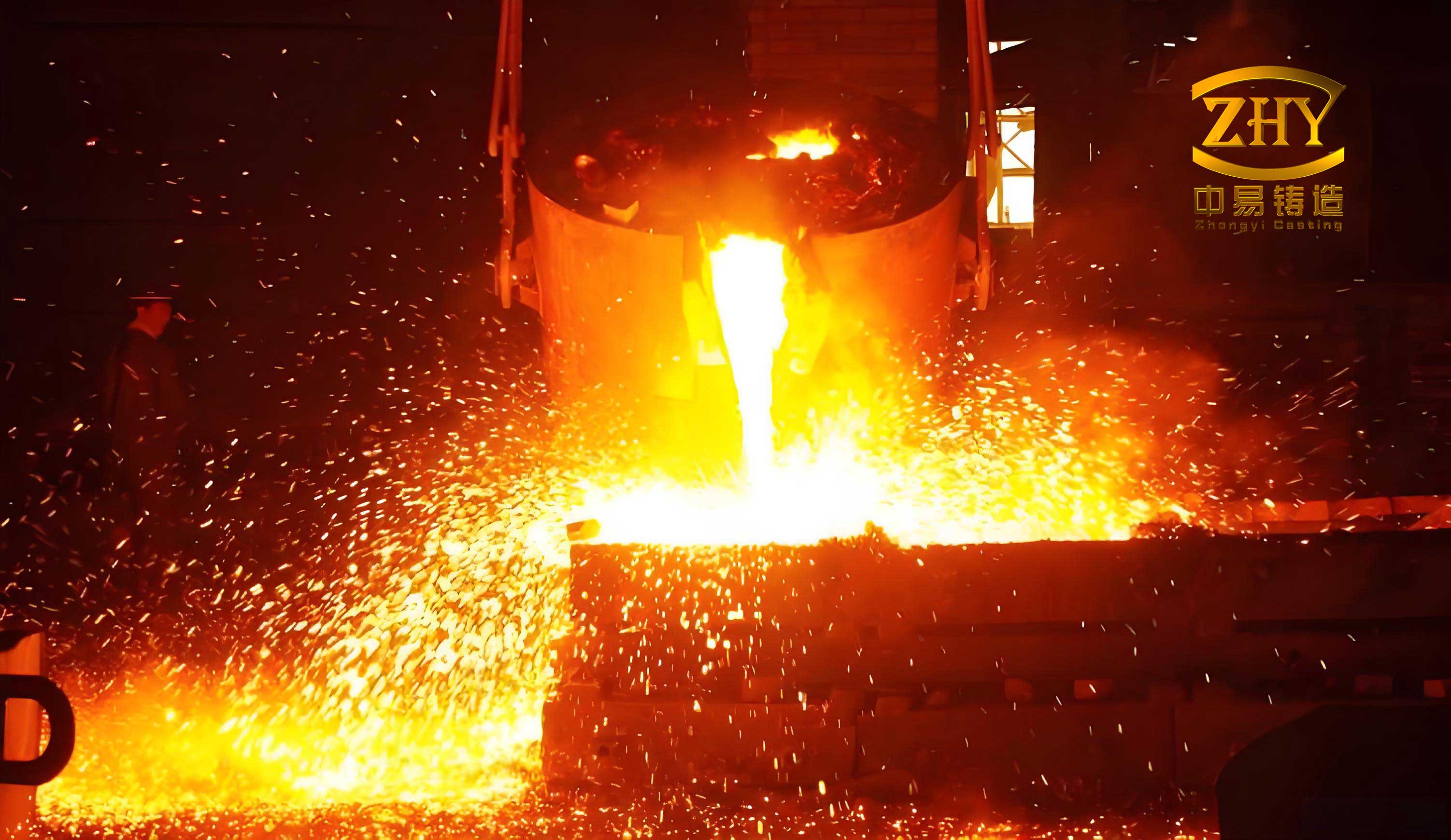
The heart of the operation is the melting and treatment process. We utilize a medium-frequency induction furnace with a capacity of 5 tons. The charged materials are melted under a controlled power ramp. Once the charge is fully molten, slag is removed using a fluxing agent, and a sample is taken for spectroscopic analysis. The key to consistent ductile cast iron production is the tight control of the base iron composition before treatment. Upon confirming the chemistry is within the specified range, the molten iron is tapped into a pre-prepared treatment ladle. This tapping operation is one of the most critical steps in producing vermicular graphite ductile cast iron. The exact amount of iron tapped must be controlled with extreme precision—for a standard batch, we target 1500 kg with a tolerance of merely ±5 kg. This precision is vital because the subsequent vermicularizing treatment is highly sensitive to the metal-to-treatment agent ratio. An excess of iron leads to under-treatment, resulting in flake graphite (gray iron structure), while a deficit causes over-treatment, producing a fully nodular ductile cast iron structure. Neither is acceptable for the brake disc application.
The treatment ladle is engineered with a well or pocket at the bottom. Into this pocket, a precisely weighed amount of vermicularizing agent (typically a Mg-Fe-Si alloy containing rare earth elements) and primary inoculant are placed, covered with a layer of steel punchings or a covering compound. The treatment process, known as the sandwich or pocket method, is illustrated conceptually below. The hot metal is then poured into the ladle, initiating a violent but controlled reaction. The Mg and rare earths in the treatment agent react with sulfur and oxygen in the iron, modifying the graphite growth morphology from flake to vermicular. The inoculation process simultaneously promotes graphite nucleation. The reaction must be brisk but not excessively turbulent to ensure good recovery of the treatment elements and avoid magnesium fade. The temperature during tapping is another tightly controlled variable, maintained at 1500°C ±10°C. The treatment process can be modeled by considering the reaction kinetics, where the critical factor is the residual magnesium content, which must be in a narrow window to promote vermicular graphite. A simplified relationship for target residual Mg (Mg_res) can be expressed as:
$$Mg_{res} = k_1 \cdot \frac{W_{agent}}{W_{iron}} – k_2 \cdot [S]_{initial}$$
where $k_1$ and $k_2$ are constants dependent on the agent type and process conditions, $W_{agent}$ is the weight of treatment alloy, $W_{iron}$ is the tapped iron weight, and $[S]_{initial}$ is the initial sulfur content. For our ductile cast iron, we aim for a residual Mg level typically between 0.010% and 0.020%.
Following the treatment, the ladle is thoroughly stirred to homogenize the melt and ensure even distribution of the inoculant. After slag removal, the metal is transferred to pouring ladles. To combat inoculation fade and further refine the graphite structure, we often employ a late or stream inoculation process during pouring, where a small amount of fine-grained inoculant is added to the metal stream as it enters the mold. The entire pouring process for a given ladle is completed within 10 minutes to prevent significant temperature drop and treatment fade. The molds, designed for the specific brake disc geometry, are then left to cool naturally in the shakeout area until the temperature falls below 300°C before being processed.
The definitive measure of success for this ductile cast iron is the achieved vermicularization rate and matrix structure. The vermicular rate (VG%) is defined as the percentage of graphite particles that exhibit the characteristic worm-like or coral-like morphology, as opposed to spheroidal or flake forms. Our process control aims for a stable VG% between 70% and 90%, with the balance being nodular graphite. A lower VG% (more nodules) increases strength and ductility but can reduce thermal conductivity and damping capacity. A higher VG% (more vermicular graphite) enhances thermal properties but may slightly lower ductility. The matrix is targeted to be 35-55% pearlite in the as-cast state, with the remainder being ferrite, and absolutely free of primary carbides. This structure ensures the required balance of strength, thermal fatigue resistance, and machinability for the ductile cast iron brake disc. The final mechanical properties typically meet or exceed: Tensile Strength > 450 MPa, Yield Strength > 350 MPa, Elongation > 3%, and Hardness between 180-220 HB.
| Process Parameter | Target Value / Range | Control Method & Importance |
|---|---|---|
| Tapping Weight | 1500 kg ±5 kg | Electronic scale with shock absorption; critical for treatment agent efficiency. |
| Tapping Temperature | 1500°C ±10°C | Optical pyrometer and thermocouple; affects reaction vigor and final microstructure. |
| Base Iron Sulfur | ≤ 0.03% | Spectroscopic analysis; low and stable S is prerequisite for consistent treatment. |
| Treatment Agent Addition | 1.2 – 1.6% of Fe weight | Pre-weighed based on iron weight and S analysis; determines residual Mg. |
| Post-Inoculation | 0.1 – 0.3% FeSi | Stream inoculator; ensures fine graphite distribution, prevents chilling. |
| Pouring Time | < 10 min per ladle | Process timing; minimizes temperature loss and inoculation fade. |
| Vermicular Rate (VG%) | 70% – 90% | Metallographic analysis of cast samples; key quality indicator. |
| Pearlite Content | 35% – 55% | Metallographic analysis; controlled via alloying (Cu, Mn) and cooling rate. |
Over the years, continuous process improvement has been essential for cost-effective and reliable batch production of this ductile cast iron. One significant area was increasing the use of internal returns. Through careful management and characterization, we successfully increased the return ratio in the charge from 20% to over 50%. This includes not only returns from the same ductile cast iron grade but also controlled amounts of other cast iron grades like regular ductile iron and gray iron, after proper preparation. This drastically reduced the consumption of primary pig iron and steel scrap, leading to substantial cost savings without compromising the quality of the final ductile cast iron brake disc.
Refractory lining practices for both the furnace and ladles were another focus. For the induction furnace, we implemented automated ramming and baking procedures, extending the average campaign life to over 300 heats. For the treatment and pouring ladles, we shifted from traditional brick linings to monolithic refractory linings installed using vibration techniques. This change increased the average ladle life from around 80 pours to over 400 pours. The smooth, monolithic lining reduces slag adherence, minimizes the risk of exogenous inclusions in the ductile cast iron, and significantly lowers refractory and labor costs. Furthermore, the consistent geometry of the ladle’s treatment pocket ensures reproducible reaction conditions, a critical factor for stable vermicularization in this ductile cast iron.
Operator skill and rapid on-the-spot judgment remain indispensable, even with advanced instrumentation like direct reading spectrometers and thermal analysis units. We have cultivated the ability to make quick assessments based on the appearance of the molten metal, the spark test pattern, and the fracture and surface appearance of chill wedges (wedge samples). These empirical methods, when correlated with instrumental data, allow for immediate corrective actions. For instance, the shape and color of the chill wedge fracture can give a reliable initial indication of the vermicularization level, helping to decide if a batch needs adjustment before pouring. This human expertise is a vital layer of control in the sophisticated production of ductile cast iron.
The inoculation process was also optimized. Manual addition of inoculant to the stream was replaced by a semi-automatic feeder, ensuring precise and consistent addition rates for late inoculation. This improved the reproducibility of graphite nucleation, reduced the total amount of inoculant required (as efficiency increased), and created a cleaner working environment. The relationship between inoculation efficiency, final graphite count, and mechanical properties in ductile cast iron can be complex. A higher graphite count generally leads to finer matrix structure and improved properties. The number of graphite particles per unit area (N_A) can be influenced by the inoculation practice and is a key microstructural parameter.
From a holistic perspective, several core principles have emerged as non-negotiable for the batch production of high-integrity ductile cast iron brake discs. First, the stability of raw materials is more important than absolute purity. A consistent supply of charge materials with predictable levels of trace elements allows for fine-tuning the treatment process, which is more effective than frequently switching between “purer” but variable sources. Second, the heart of the process is the vermicularizing treatment itself. Its success hinges on three pillars: a stable and low base iron sulfur content, an exceptionally precise and repeatable tapping weight, and a calm yet complete reaction in the ladle. Any deviation in these areas immediately risks shifting the graphite morphology outside the acceptable window for this specialized ductile cast iron. Third, a rational alloy design is crucial. The carbon equivalent must be optimized for castability, and the alloying elements must be balanced to achieve the target as-cast matrix without requiring a costly and distortive heat treatment. The synergy between Cu, Mo, and Ni in this ductile cast iron formulation is particularly effective in promoting a fine, stable pearlitic-ferritic matrix that resists softening under thermal cycling.
Furthermore, robust process monitoring and feedback systems are essential. Every heat is logged with its key parameters: charge makeup, melting profile, pre-treatment chemistry, tapping weight and temperature, treatment agent batch, post-treatment results (spectral analysis, wedge test), and final casting quality data (dimensional checks, NDT results, mechanical tests from separately cast samples). This data is analyzed statistically to identify trends and enable predictive adjustments, ensuring the long-term stability of the ductile cast iron production process. The goal of zero defects in critical areas like the braking surfaces is pursued relentlessly. Each finished brake disc undergoes non-destructive testing, including ultrasonic inspection for internal shrinkage or inclusions and magnetic particle inspection for surface cracks, ensuring that every piece of ductile cast iron meets the stringent safety standards.
In conclusion, the batch production of high-performance brake discs from ductile cast iron, specifically the vermicular graphite variant, is a demanding yet masterable endeavor. It requires a deep integration of metallurgical science, precise engineering controls, and seasoned operational expertise. Through systematic control of raw materials, meticulous management of the melting and treatment processes, and continuous incremental improvements, we have achieved a stable production system. The yield rate for these critical ductile cast iron castings consistently exceeds 95%, with melt-related defects accounting for less than 1%. The process delivers a material whose unique microstructure—a controlled dispersion of vermicular graphite in a strengthened matrix—provides an ideal combination of mechanical and thermal properties for the severe service conditions of rail braking. This journey underscores that advanced ductile cast iron is not merely a material specification but the result of a perfectly controlled and understood manufacturing symphony.