
In the realm of aero-engine manufacturing, the demand for high-integrity, leak-tight components is paramount. My focus is on the production of critical thin-wall aluminum alloy shell castings that serve as core housings within fuel metering and control systems. These shell castings are not merely structural enclosures; they are pressure vessels that must withstand rigorous proof testing and exhibit zero leakage under operational conditions. Consequently, achieving a casting free from shrinkage porosity, gas entrapment, and other metallurgical defects is the primary objective of any process design. The structural complexity, characterized by thin sections and internal cavities, presents a significant foundry challenge. This document details my first-person engineering journey in designing, simulating, and optimizing the casting process for such a demanding shell casting component, leveraging numerical simulation as a core tool for decision-making.
The specific shell casting in question is produced from ZL101 (A356 equivalent) aluminum alloy, chosen for its excellent castability, strength-to-weight ratio, and corrosion resistance. The part is characterized by its enveloping shape with a flat, plate-like section and an internal cavity, necessitating the use of a core. Key dimensions and requirements are summarized below:
| Parameter | Value / Specification |
|---|---|
| Material | ZL101 (Al-7Si-0.4Mg) |
| Approximate Mass | 3.9 kg |
| Key Dimensions | 254 mm × 147 mm × 48 mm |
| Minimum Wall Thickness | 5 mm |
| Primary Quality Requirement | Pressure-tightness (0.3 MPa for 5 min) |
| Heat Treatment | T6 (Solutionized and Artificially Aged) |
My initial analysis centered on the feeding and gating strategy. For shell castings of this geometry, two primary gravity-fed metal mold processes were considered: a conventional top-gating system and a tilt-pour process. The fundamental difference lies in the dynamics of mold filling, which critically influences defect formation.
Scheme 1: Conventional Top-Pour Gravity Casting. This approach employs a vertical sprue leading directly into the mold cavity, often via a horn gate. The primary advantage is the establishment of a strong thermal gradient, beneficial for directional solidification towards the riser. The fill time $t_{fill}$ for such a system can be approximated by considering the height of the metal head $h$ and the effective gating area $A_g$:
$$ t_{fill} \propto \frac{V_{cavity}}{A_g \cdot \sqrt{2 g h}} $$
where $V_{cavity}$ is the cavity volume and $g$ is gravitational acceleration. To achieve a practical fill time (e.g., ~8 seconds), a certain sprue diameter is required, leading to high initial metal velocity upon entry into the cavity.
Scheme 2: Tilt-Pour Gravity Casting. In this method, the mold starts in a horizontal position and is rotated to vertical during pouring. The metal enters the cavity slowly from a pouring basin as the tilt angle increases. The fill is controlled not just by gravity but by the programmed rotational speed $\omega(\theta)$ of the mold, where $\theta$ is the tilt angle. The instantaneous metal flow rate is a function of this speed and the geometry of the basin-to-cavity connection.
The core of my process development involved using AnyCasting simulation software to analyze these two schemes. Identical thermophysical parameters were assigned to ensure a fair comparison, as shown in the following table:
| Component | Material / Parameter | Value / Note |
|---|---|---|
| Alloy | ZL101 | – |
| Mold | H13 Tool Steel | Preheated to 300°C |
| Coating | Zirconia-based | ~200 μm thickness |
| Core | RCS9101 Resin-Coated Sand | Preheated to 150°C |
| Pour Temperature | Aluminum Melt | 720°C |
For the tilt-pour simulation, the rotation was segmented into phases with different angular velocities to control the fill profile:
| Tilt Phase | Angle Range (θ) | Angular Velocity | Purpose |
|---|---|---|---|
| Initial Pour | 70° to 90° (from horizontal) | Slow (-350 units/min) | Gentle start, prevent splashing |
| Rapid Fill | 55° to 70° | Fast (-450 units/min) | Fill bulk of cavity quickly to avoid cold shuts |
| Final Fill & Settle | 35° to 55° | Slow (-350 units/min) | Complete fill smoothly, dampen inertial flow |
The simulation results provided critical insights. For the conventional top-pour scheme, the velocity field analysis revealed a major concern. The metal jet entering the cavity maintained velocities consistently above 50 cm/s, and in many regions exceeded 100 cm/s. According to widely accepted fluid dynamics criteria for casting (often attributed to Campbell’s work), a critical velocity threshold $v_{crit}$ exists, approximately 0.5 m/s for aluminum alloys, beyond which the free surface becomes turbulent, dramatically increasing the risk of bifilm and oxide entrainment, which act as nuclei for porosity and cracks. The flow in Scheme 1 violated this principle throughout filling, predicting a high probability of dispersed microporosity throughout the shell castings.
In contrast, the tilt-pour simulation showed a markedly different velocity profile. The metal front advanced placidly, with peak velocities only briefly approaching 60 cm/s during the mid-fill phase and dropping significantly thereafter. The governing flow behavior in this quasi-planned fill can be modeled more as a creeping rise than a turbulent impingement. The reduced kinetic energy $E_k$ of the melt stream, where $E_k = \frac{1}{2} \rho v^2$, directly correlates with a lower propensity for surface turbulence and gas entrapment. This was the first major point in favor of tilt pouring for these quality-critical shell castings.
The temperature field and solidification analysis were equally important. Both schemes showed favorable thermal gradients directing solidification fronts towards the risers placed at the top of the mold (which becomes the last area to fill in the tilt process). The Niyama criterion $G/\sqrt{\dot{T}}$, a common metric for predicting shrinkage porosity, was calculated locally. Regions with values below a critical threshold indicate potential for microporosity. The simulations for both schemes showed that the main body of the shell castings remained above this threshold, with isolated hot spots effectively fed by the risers. Therefore, from a pure thermal shrinkage perspective, both gating designs were deemed adequate. The predicted shrinkage defect maps confirmed this, showing no significant porosity in the casting body for either case.
The decisive factor, therefore, was defect prevention related to filling turbulence. While simulation software cannot directly “predict” gas pores from first principles, the velocity field is an excellent proxy. Based on the clear superiority of the tilt-pour method in achieving laminar fill conditions, it was selected as the optimal process for these thin-wall shell castings.
The practical implementation involved designing a robust metal mold equipped with precision tilt axes. The core, made from high-strength, low-expansion resin-coated sand, was carefully located using integral core prints in the mold halves. The defined tilt schedule was programmed into the tilt-pour machine controller. Key process parameters were strictly controlled and can be summarized by the following relationship that guides defect-free production of shell castings:
$$ Q_{defect} \propto \left[ \frac{v_{fill}}{v_{crit}} \right]^2 \cdot \left[ \frac{\Delta T_{superheat}}{\tau_{solid}} \right] $$
Where:
$Q_{defect}$ is a qualitative indicator of defect propensity,
$v_{fill}$ is the characteristic filling velocity,
$v_{crit}$ is the critical velocity for turbulence onset,
$\Delta T_{superheat}$ is the melt superheat,
$\tau_{solid}$ is the local solidification time.
The tilt-pour process minimizes the first term by keeping $v_{fill}$ low, while proper thermal control of the mold manages the second term.
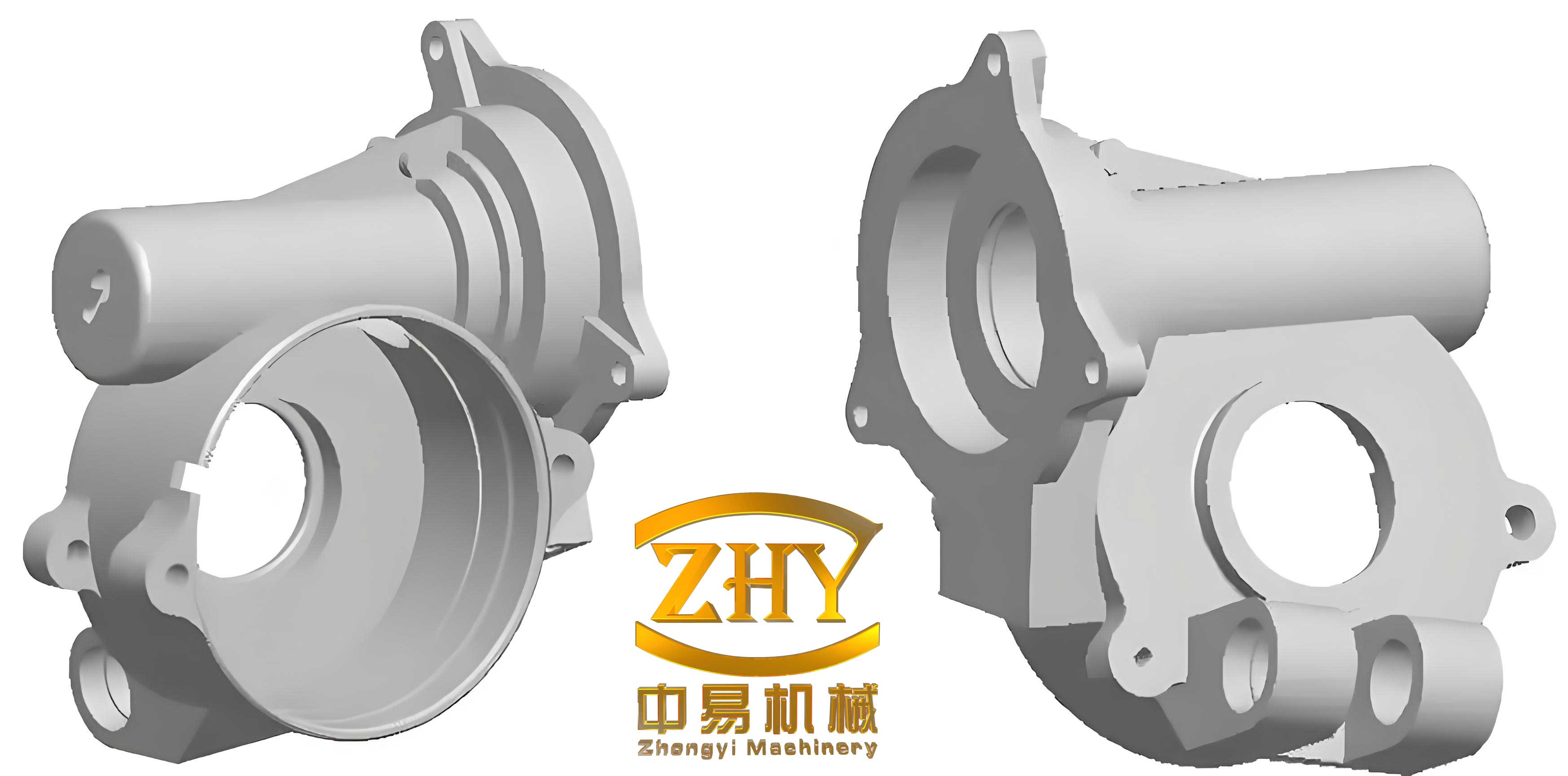
Production trials validated the simulation-driven design. The cast shell components exhibited excellent surface finish with no visible filling-related defects. Non-destructive evaluation via X-ray radiography confirmed sound internal integrity with no shrinkage cavities or significant porosity in the pressure walls. The as-cast yield was high, and after machining, 100% of the shell castings passed the stringent pressure proof test of 0.3 MPa for 5 minutes. The success of this project underscores a critical methodology: for complex, high-reliability shell castings, numerical simulation of filling dynamics is not just an optional step but a necessity. It moves the process development from empirical trial-and-error to a science-based optimization, saving significant cost and time. The tilt-pour process parameters established here—particularly the phased angular velocity profile—provide a validated template for the development of similar thin-wall, quality-intensive shell castings across aerospace applications.