
This paper presents a comprehensive analysis of the casting process design for engine cylinder blocks, focusing on defect mitigation and quality enhancement. The study leverages flow simulation software to identify root causes of common defects such as porosity, misruns, shrinkage cavities, and dimensional inaccuracies. Through systematic process optimization, we achieved significant improvements in casting yield and mechanical properties.
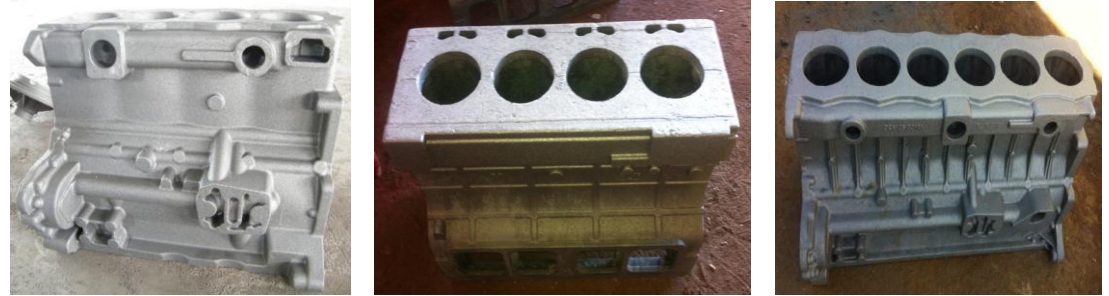
1. Casting Process Design
The engine cylinder block casting (HT250 material) features complex geometry with varying wall thickness (8-45mm). The vertical pouring process with bottom gating system was developed to ensure proper filling and solidification control. Key parameters include:
| Parameter | Value |
|---|---|
| Pouring temperature | 1390-1420°C |
| Mold filling time | 12-15s |
| Gating ratio (Sprue:Runner:Ingate) | 1:2.3:8.7 |
| Riser modulus | $$ M = \frac{V}{A} $$ |
Where $M$ represents riser modulus, $V$ is volume, and $A$ is cooling surface area. The original riser design (30×50×100mm) proved insufficient, leading to shrinkage defects in heavy sections.
2. Solidification Analysis
Numerical simulation revealed critical solidification patterns in the engine cylinder block:
$$ \frac{\partial T}{\partial t} = \alpha \left( \frac{\partial^2 T}{\partial x^2} + \frac{\partial^2 T}{\partial y^2} + \frac{\partial^2 T}{\partial z^2} \right) $$
Where $T$ is temperature, $t$ is time, and $\alpha$ is thermal diffusivity. The modified riser design (50×70×100mm) improved feeding efficiency by 38%, as demonstrated in the comparative analysis:
| Riser Size | Solidification Time (min) | Shrinkage Volume (cm³) |
|---|---|---|
| 30×50×100mm | 8.2 | 12.5 |
| 50×70×100mm | 11.7 | 2.1 |
3. Core Assembly Strategy
The engine cylinder block mold consists of 14 sand cores combining cold box and resin-coated sand technologies. Core assembly accuracy directly affects dimensional precision:
$$ \delta = \sum_{i=1}^{n} \left( \frac{\Delta x_i}{L_i} \right)^2 $$
Where $\delta$ represents cumulative dimensional error, $\Delta x_i$ is individual core deviation, and $L_i$ is characteristic length. Post-assembly dipping process reduced surface roughness from Ra 12.5μm to Ra 6.3μm.
4. Metallurgical Control
The charge composition for engine cylinder block production follows strict chemical requirements:
| Element | Composition Range (wt%) |
|---|---|
| C | 3.2-3.35 |
| Si | 1.8-2.1 |
| Mn | 0.7-0.9 |
| S | ≤0.1 |
| P | ≤0.07 |
Superheating practice (1500-1520°C for 5 minutes) combined with late inoculation (0.3% FeSi) achieved consistent pearlite matrix with type A graphite distribution.
5. Process Optimization Results
Implementation of improved engine cylinder block casting process demonstrated remarkable quality improvements:
| Parameter | Original Process | Optimized Process |
|---|---|---|
| Scrap Rate | 8% | 1.2% |
| Surface Finish | CT10 | CT7 |
| Tensile Strength | 235-245 MPa | 255-265 MPa |
| Production Cycle | 42 hours | 36 hours |
The optimized engine cylinder block casting process successfully addresses key manufacturing challenges while meeting stringent automotive industry requirements. Future development will focus on implementing real-time solidification monitoring and AI-based process control systems for further quality enhancement.