
Abstract
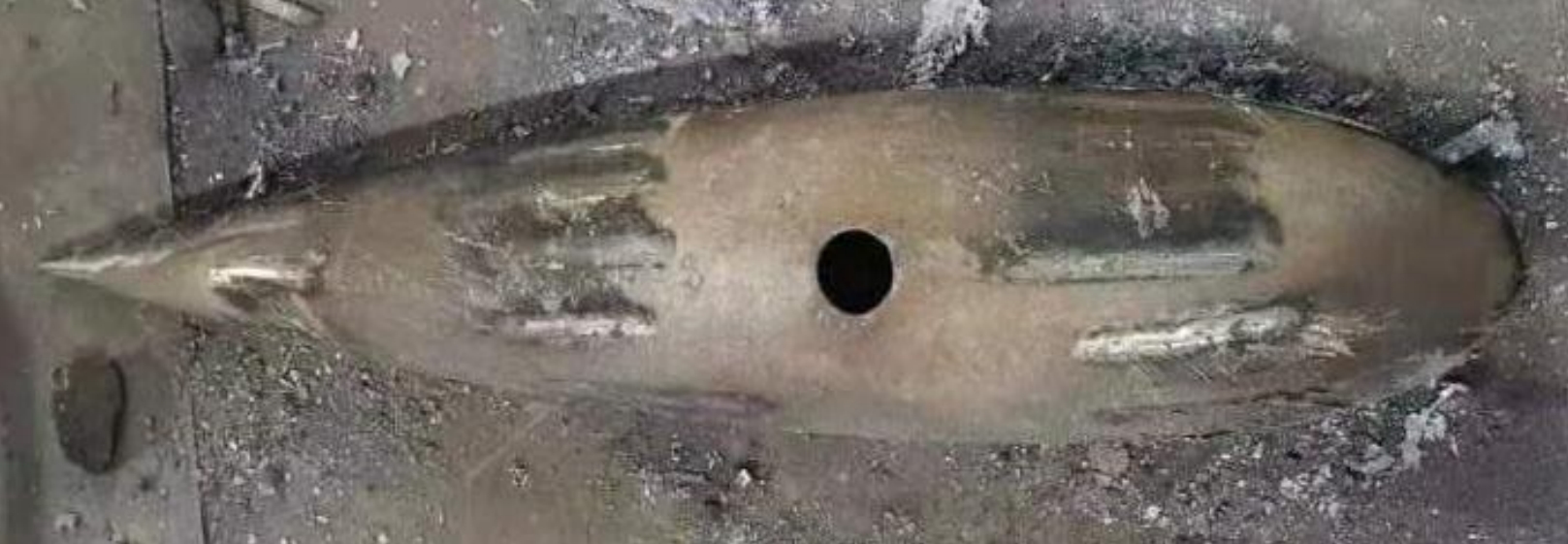
The process design and optimization of a steel casting with a streamline structure. This streamline structural casting is a product with an irregular shape and thin walls. The casting needs to ensure its external streamline shape. Combining the experience of foundry engineers and simulation software results, the process design for this new product casting was completed. Based on the results of the first trial production, the process was optimized to address the issues identified during the trial.
1. Process Design
1.1 Orientation of the Casting
Our company employs gravity water-glass sand mold casting. The orientation of the casting affects its solidification sequence, so the process design must first confirm the orientation of the casting. Since the streamline structural casting needs to maintain its external streamline shape, and there are holes at the bottom of the rib plates, if the streamline surface faces upwards, it is difficult to design a rising for feeding. The shape of the streamline surface is irregular, and subsequent grinding and repair of the streamline surface are less efficient. Therefore, we chose to have the bottom plane facing upwards.
| Casting Feature | Description |
|---|---|
| Shape | Irregular, thin-walled |
| Orientation | Bottom plane upwards |
| Key Area | Streamline surface, rib plate holes |
1.2 Determination of Hot Spots and Riser Design
Hot spots are typically located in thick sections, corners, intersections, and other positions of the casting. Risers are generally placed near these hot spots. When a hot spot cannot accommodate a riser, cold iron or additional subsidies can be used to adjust the hot spot area. To determine the location and size of the riser, the hot spot location and modulus of the casting must first be identified. A 3D model of the casting was created and imported into simulation software for solidification simulation. By setting the required parameters in the software, the simulation results were obtained. The simulation results of shrinkage defect locations. The purple areas that differ from the casting represent the locations where shrinkage occurs in the hot spots of the casting.
According to the modulus method, the relationship between the riser modulus (Mr) and the casting modulus (Mc) is Mr = f * Mc, where Mr is the riser modulus, Mc is the modulus of the part of the casting to be fed, and f is the modulus enlargement coefficient (f = 1.1~1.2, with f = 1.2 for open risers and f = 1.1 for blind risers). Which shows the modulus simulation results, the size of the required riser can be initially calculated. It can be seen that the hot spots are mainly distributed at the junction of the rib plates and the main body, as well as in the thick sections at the front and rear ends, allowing for the preliminary confirmation of the riser locations. Through calculations and simulations, the following process plan was ultimately derived.
Table 1. Summary of Hot Spot and Riser Design
| Component | Description | Simulation Result |
|---|---|---|
| Hot Spot | Location | — |
| Modulus | — | |
| Riser | Size | Calculated |
| Location | Preliminary |
1.3 Design of the Gating System
The gating system significantly impacts the quality of the casting. Different castings require gating systems suited to their specific characteristics. This streamline structural steel casting is approximately 200mm high with uniform but thin walls. If a bottom-pour gating system is used, although the introduction of molten steel is smooth with low impact force, the inlet temperature is high, forming hot spots. Simultaneously, due to the casting’s structure, it is difficult to feed the bottom, making it prone to shrinkage defects.
Therefore, we adopted the following gating method: Given the casting’s relatively low height, a top-pour gating system can be used, which facilitates the formation of bottom-up sequential solidification and is conducive to feeding by the riser. Additionally, extending the end of the cross gate serves to slow down the flow and collect slag, avoiding issues such as sand holes and porosity defects caused by excessive flow velocity impacting the sand mold, splashing, etc. Through filling simulation, it can be seen that the linear velocity at the ingate is around 0.9m/s, which complies with the optimal filling linear velocity of ≤1m/s.
Table 2. Gating System Parameters
| Gating System Type | Description | Velocity (m/s) |
|---|---|---|
| Top-pour | Facilitates sequential solidification | 0.9 |
| Cross Gate Length | Extended for flow regulation | N/A |
Pouring Weight: 321.2kg Yield Rate: 71%
2. First Trial Production
Based on the simulation results and foundry experience, All internal shrinkage defects in the casting are fully fed and transferred inside the riser. After trial production of the first piece and ultrasonic testing (UT), its internal quality was confirmed to be good. However, during the trial production process, it was found that cracks were prone to occur at the position of the rib plates corresponding to the streamline surface.
3. Process Optimization
To address the crack issue identified during the trial production, the method of adding anti-crack ribs was adopted to prevent crack formation. Due to their rapid solidification, anti-crack ribs establish strength earlier and can withstand greater tensile stress, effectively preventing cracks. After adding the anti-crack ribs, subsequent batch production did not experience any crack defects in the castings.
Table 3. Crack Issue and Optimization Measures
| Issue | Description | Optimization Measure |
|---|---|---|
| Crack Occurrence | Rib plate corresponding area | Add anti-crack ribs |
| Result | Crack-free production | Achieved |
4. Conclusion
The steel casting with a streamline structure was oriented with its bottom plane upwards, utilizing a top-pour gating system with an extended cross gate. Additionally, anti-crack ribs were added to the bottom streamline surface. After trial production and inspection, the product quality was good, and the process was stable and effective. During the process formulation, the simulation results were combined to improve and optimize the process, significantly reducing manual calculations and the number of trial productions, thereby lowering development costs. Furthermore, based on the trial production results, the process was further optimized to address identified issues, resulting in a stable and effective process.
In summary, through meticulous process design and optimization, the production of steel castings with streamline structures has been successfully achieved, ensuring high-quality and defect-free castings.