
In my extensive experience within the foundry industry, particularly focusing on high-performance castings for demanding applications, the production of low-temperature ferrite spheroidal graphite cast iron has been a subject of deep technical interest and practical challenge. This material, prized for its combination of good mechanical properties, machinability, vibration damping, and cost-effectiveness, must also exhibit reliable impact toughness at sub-zero temperatures to meet the stringent requirements of modern sectors like high-speed rail, wind power, and petrochemical engineering. Over the past decade, I have engaged in numerous production trials and technical collaborations, accumulating significant insights into the nuanced control required for these grades. This article, drawn from my first-hand perspective, delves into the critical aspects of producing and validating low-temperature ferrite spheroidal graphite cast iron, emphasizing process control, the influence of microstructure, and comprehensive quality inspection methodologies.
The essential service environment for components in rail transportation—such as axle boxes, gearboxes, bearing housings, and motor frames—often involves exposure to temperatures as low as -40°C or even -50°C. Consequently, the material specifications typically adhere to standards like EN-GJS-350-22LT, EN-GJS-400-18LT, QT350-22L, or QT400-18L. Notably, many projects demand non-standard grades with Charpy impact values of 12-14 J at -40°C or -50°C for use in arctic regions. These are safety-critical parts, necessitating rigorous traceability, mandatory use of attached test blocks or coupons cut from the casting itself for mechanical property verification, and a battery of non-destructive tests (NDT). The entire manufacturing process, from melting to machining, must be meticulously documented and archived for over a decade. This level of scrutiny underscores the importance of mastering every facet of production.
To consistently achieve the desired low-temperature toughness in ferrite spheroidal graphite cast iron, one must first understand the metallurgical factors governing impact performance. The transition from ductile to brittle fracture as temperature decreases is a central phenomenon. Examining fracture surfaces under a scanning electron microscope reveals this progression clearly. At room temperature, the fracture surface of a spheroidal graphite cast iron specimen exhibits uniform, well-formed dimples around the graphite nodules, indicative of substantial plastic deformation and tearing. As the test temperature drops to -20°C, the dimple pattern becomes less uniform, and signs of cleavage—smooth, river-patterned facets—begin to appear. At -40°C and -50°C, the fracture surface is dominated by cleavage, with very little evidence of ductile tearing. This visual evidence correlates directly with the measured drop in impact energy. The temperature at which this ductile-to-brittle transition (DBT) occurs is not fixed; it is highly sensitive to the microstructure and composition of the spheroidal graphite cast iron.
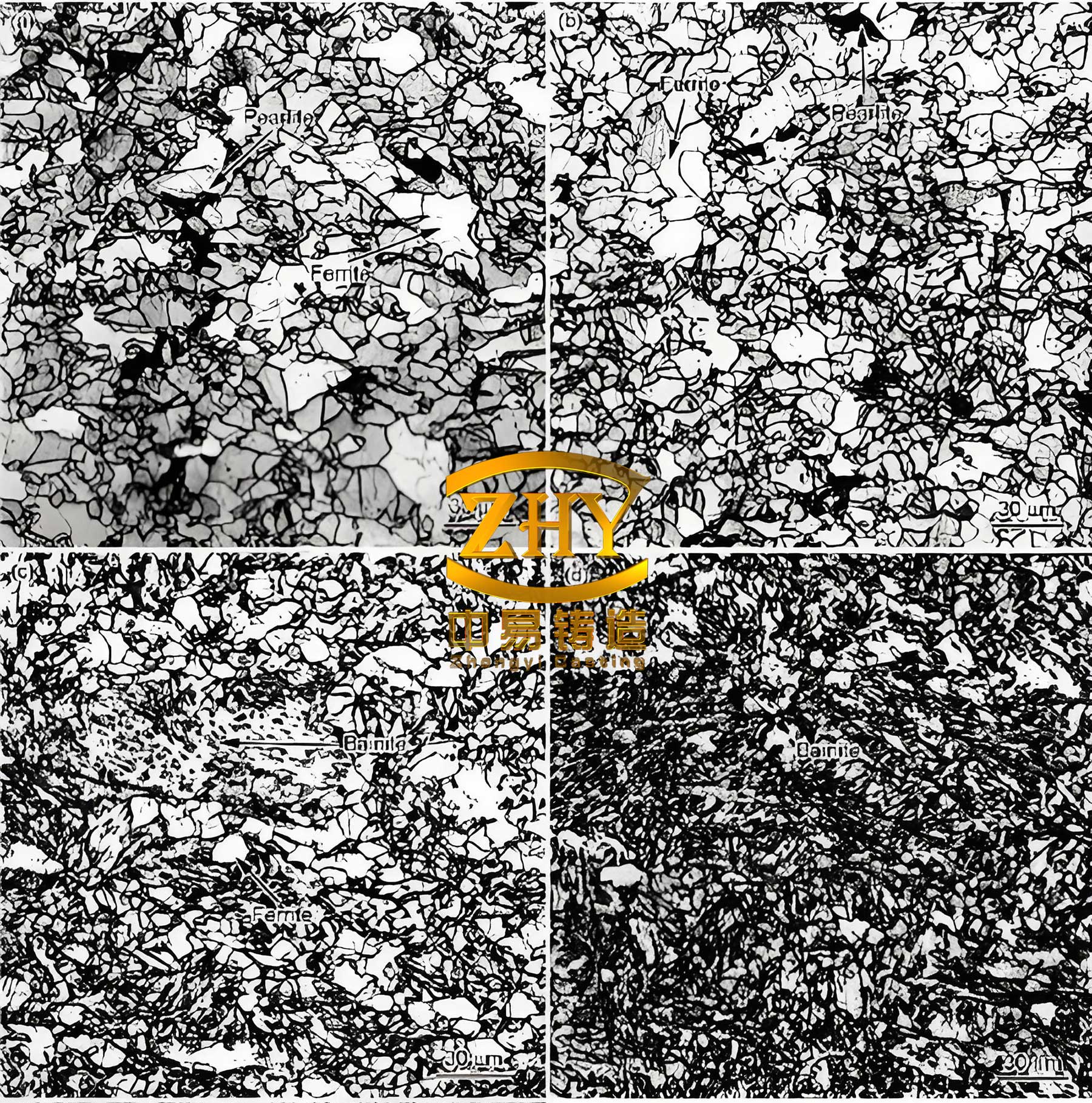
The microstructure of ferrite spheroidal graphite cast iron is a composite of the metallic matrix and the embedded graphite spheres. Both features profoundly influence low-temperature impact properties. Firstly, the ferrite grain size plays a pivotal role. Coarse ferrite grains lead to a larger critical crack size for cleavage fracture, effectively lowering the energy absorbed during impact. In practice, spheroidal graphite cast iron with a finer, more uniform ferrite grain structure consistently demonstrates superior low-temperature toughness. This refinement can be promoted through controlled solidification and heat treatment. Secondly, the morphology, size, distribution, and number of graphite nodules are equally critical. Round, well-formed graphite spheres act as benign stress concentrators compared to irregular graphite forms. A higher nodule count and a smaller average nodule diameter are generally beneficial. They not only lower the DBT temperature but also help suppress the formation of carbides during solidification, which are detrimental to toughness. The relationship between nodule characteristics and impact energy can be conceptually summarized by a parameter like the nodularity index, but the underlying mechanism involves how graphite affects stress distribution and crack initiation. One can consider a simplified model where the upper-shelf impact energy (the ductile regime) is inversely related to the mean graphite nodule diameter, while the DBT temperature is influenced by the nodule count and matrix strength.
$$ E_{upper} \propto \frac{1}{\bar{d}_{graphite}} $$
$$ T_{DBT} = f(N_{nodule}, \sigma_{yield}, I_{purity}) $$
Where \(E_{upper}\) is the upper-shelf impact energy, \(\bar{d}_{graphite}\) is the average graphite nodule diameter, \(T_{DBT}\) is the ductile-to-brittle transition temperature, \(N_{nodule}\) is the nodule count per unit area, \(\sigma_{yield}\) is the yield strength of the ferrite matrix, and \(I_{purity}\) is an index representing the purity from intergranular inclusions.
Perhaps the most insidious threat to the low-temperature toughness of spheroidal graphite cast iron is the presence of intergranular inclusions or micro-slag. Elements such as sulfur, phosphorus, manganese, and residuals from inoculating and nodularizing agents (magnesium, rare earths, calcium, barium) can form various compounds—sulfides, oxides, phosphides—that precipitate at the ferrite grain boundaries. These particles act as potent sites for stress concentration, pinning dislocations and facilitating void formation and coalescence under impact loading. Even in a predominantly dimpled fracture surface, these inclusions are often found at the bottom of the micro-voids. Their presence drastically reduces the cohesive strength between grains, making the material far more susceptible to brittle cleavage at low temperatures. Therefore, the philosophy for producing high-integrity low-temperature spheroidal graphite cast iron must be centered on achieving extreme chemical cleanliness and minimizing elemental segregation.
| Element | Primary Role/Effect | Influence on Low-Temperature Toughness | Recommended Control Range for -40°C Grades | Remarks |
|---|---|---|---|---|
| Carbon (C) | Graphite formation, fluidity | High content increases nodule count/size, can reduce upper-shelf energy. Low content shifts DBT upward. | 3.65 – 3.80 wt% | Balanced for graphitization potential without excessive graphite degeneration. |
| Silicon (Si) | Ferrite strengthener, graphitizer | Strongly elevates DBT temperature. Major “double-edged sword” element. | 1.95 – 2.20 wt% (final) | Must be minimized; often counteracted with Nickel. |
| Phosphorus (P) | Forms brittle phosphides | Severely raises DBT and lowers upper-shelf energy. Extremely detrimental. | < 0.03 wt% (as low as possible) | Control via raw material selection (low P pig iron, steel scrap). |
| Manganese (Mn) | Strengthener, promotes pearlite/carbides | Increases segregation, harms toughness significantly. | < 0.15 wt% | Keep minimal; adds to heat treatment difficulty. |
| Copper (Cu) | Pearlite promoter, strengthener | Elevates DBT temperature (~45°C per 1% Cu). | Avoid or keep trace (<0.05 wt%) | Not recommended for ferrite strengthening in low-Si grades. |
| Magnesium (Mg)res | Nodularizing element | Excess leads to slag inclusions and shrinkage tendency. Essential for nodularity. | 0.035 – 0.050 wt% | Use low-RE nodularizers; optimize for minimal effective residual. |
| Rare Earths (RE)res | Nodularizing aid, controls trace elements | Excess forms oxides/sulfides at boundaries. | As low as possible, typically <0.02 wt% | Employ tailored low-RE alloys. |
| Nickel (Ni) | Austenite stabilizer, ferrite strengthener | Mild effect on DBT (~+10°C per 1% Ni). Can offset Si’s negative impact. | 0 – 1.0 wt% (as needed) | Used judiciously to meet strength if Si is very low; not a primary toughener. |
| Trace Elements (Ti, Sb, Sn, As, etc.) | Various (deoxidizers, contaminants) | Promote boundary segregation, carbides, and intermetallics. Very harmful. | Keep at minimal levels; monitor K1 factor | Control via charge makeup and purity. |
The table above synthesizes the intricate chemical ballet required. Silicon’s role is particularly delicate. While it solid-solution strengthens the ferrite matrix, raising yield and tensile strength, its potency in elevating the DBT temperature is so pronounced that for applications at -40°C and below, its content must be aggressively managed. This often creates a conflict: achieving the minimum tensile strength (e.g., 400 MPa for EN-GJS-400-18LT) with a very low silicon content can be challenging. This is where a balanced addition of nickel may be introduced. Nickel provides solid-solution strengthening with a much milder effect on the DBT (approximately a 10°C increase per 1% Ni addition). Thus, the combined system can be modeled to meet both strength and toughness targets. The反球化指数 (anti-nodularization factor) K1 and the珠光体指数 (pearlite factor) Px are useful empirical tools to predict microstructure stability. For robust low-temperature spheroidal graphite cast iron production, maintaining K1 < 0.6 and Px < 1.0 is advisable to prevent degenerate graphite and pearlite formation, respectively.
$$ K_1 = 4.4 \cdot w(Ti) + 2.0 \cdot w(As) + 2.4 \cdot w(Sn) + 5.0 \cdot w(Sb) + 290 \cdot w(Pb) + 370 \cdot w(Bi) + 1.6 \cdot w(Al) $$
$$ P_x = 3.0 \cdot w(Mn) – 2.65 \cdot (w(Si) – 2.0) + 7.75 \cdot w(Cu) + 90 \cdot w(Sn) + 357 \cdot w(Pb) + 20 \cdot w(Sb) + 9.6 \cdot w(Ni) + 71 \cdot w(Cr) $$
Heat treatment is a powerful lever for optimizing the microstructure of spheroidal graphite cast iron. For ferritic grades, a high-temperature graphitizing anneal is standard. This process, typically involving heating above the eutectoid temperature (e.g., 900-950°C), holding to dissolve any pearlite or carbides, and then slowly cooling or holding in the ferrite region, serves multiple purposes. It ensures a fully ferritic matrix, even in thin sections prone to carbides. It also promotes some spheroidization of any eutectic carbides and can lead to a slight coarsening but also homogenization of the graphite nodules. Crucially, it can refine the ferrite grain structure if the cooling cycle is controlled properly. The impact of this annealing on mechanical properties is quantifiable: elongation and impact values often see an improvement of 10-12% compared to the as-cast state. This enhancement is attributed to the relief of internal stresses, the elimination of brittle phases, and a more uniform distribution of graphite. The kinetics of carbide dissolution during annealing can be approximated by an Arrhenius-type equation, where time and temperature are critical.
$$ t = A \cdot \exp\left(\frac{Q}{RT}\right) $$
Where \(t\) is the time required for complete graphitization, \(A\) is a pre-exponential factor, \(Q\) is the activation energy for carbon diffusion, \(R\) is the gas constant, and \(T\) is the absolute annealing temperature.
Moving from metallurgy to practical foundry operations, production control for low-temperature spheroidal graphite cast iron demands a holistic “clean melting” approach. It starts with raw material selection: high-purity pig iron, selected steel scrap with low residual elements, and specifically formulated ferroalloys. Pre-treatment of the base iron, such as desulfurization to achieve w(S) below 0.010%, is often a prerequisite for efficient and clean nodularization. The melting process itself, whether in coreless induction or channel furnaces, must be managed to prevent excessive oxidation and slag formation. The nodularization and inoculation steps are where precision is paramount. I advocate for the use of specialized low-rare-earth magnesium ferrosilicon alloys for nodularization, with a granularity suited to the treatment ladle size (e.g., 3-25 mm for general use). The treatment process—whether sandwich, tundish cover, or flow-through—must ensure high and reproducible magnesium recovery while minimizing slag generation. Post-inoculation, either in-mould or late stream, is essential to counteract fading, increase nodule count, and refine graphite. The pouring temperature and time must be controlled to prevent dross entrapment and temperature-related fading. Every step is interlinked; a lapse in one can compromise the delicate chemical and microstructural balance required for low-temperature toughness in spheroidal graphite cast iron.
| Process Stage | Key Control Parameter | Target/Standard | Monitoring Method |
|---|---|---|---|
| Raw Material Charging | P, S, Mn, Trace element content | P < 0.03%, S < 0.02%, Mn < 0.15%, Low Ti, Sn, Sb, etc. | Supplier certs, OES analysis of charge batches |
| Melting | Superheat temperature, Atmosphere | 1500 – 1550°C, Slight positive pressure (if induction) | Pyrometer, furnace log |
| Pre-treatment | Desulfurization (if needed) | Final S ≤ 0.010% | Thermal analysis or quick OES |
| Nodularization | Alloy type, weight, treatment method, reaction time | Low-RE MgFeSi (e.g., Mg5-7, RE0.5-1.5), 1.2-1.6% addition, Sandwich method, 60-90 sec reaction | Weighing scales, timer, slag cover observation |
| Inoculation | Alloy type (e.g., FeSi75), addition point & weight | 0.2-0.4% late stream or in-mould inoculation | Calibrated feeders, automatic dispensing systems |
| Pouring | Temperature, time from treatment to end of pour | 1350-1400°C, total time < 10 minutes | Pyrometer, ladle tracking log |
| Moulding | Sand type, binder, permeability | Silica sand, phenolic urethane or alkaline phenolic, high permeability to minimize gas defects | Sand testing (AFS GFN, tensile strength, permeability) |
Quality inspection for these critical castings extends far beyond standard tensile testing on separately cast coupons. It is a multi-layered verification system. Firstly, visual inspection is foundational and irreplaceable. Every casting must be examined for surface defects like cold shuts, sand inclusions, or mistruns that could act as stress raisers. The use of visual comparison standards for surface quality is distinct from checking surface roughness with comparator plates; the former deals with discontinuities, the latter with texture. Secondly, dimensional checks ensure the casting conforms to the machining envelope. The core of quality assurance, however, lies in NDT and destructive testing on samples from the casting itself.
Ultrasonic Testing (UT) is employed to assess internal soundness, detecting shrinkage, slag inclusions, or porosity. It works by sending high-frequency sound waves into the casting and analyzing the reflected echoes. For spheroidal graphite cast iron, the relatively high damping characteristic requires careful calibration and interpretation. Magnetic Particle Testing (MT) is excellent for revealing surface and near-surface discontinuities like cracks or cold shuts. The casting is magnetized, and iron particles applied to the surface cluster at flux leakage points. Liquid Penetrant Testing (PT) is used for non-ferromagnetic areas or as an alternative to MT for surface-breaking defects. It relies on a penetrant liquid being drawn into surface flaws by capillary action. Crucially, these NDT methods are complementary. UT cannot reliably find fine surface cracks, and MT/PT cannot probe the internal volume. Furthermore, none of them can replace a trained eye for certain surface quality assessments. Radiographic Testing (RT), while highly informative, is less common for high-volume production due to cost and safety but may be specified for prototype or sampling inspection.
The ultimate validation of low-temperature performance comes from destructive testing of samples extracted from designated locations on the casting (本体取样) or from attached test blocks (附铸试块). These samples undergo tensile testing and, most importantly, Charpy V-notch impact testing at the specified low temperature (e.g., -20°C, -40°C). The test rig must maintain the temperature within a tight tolerance, often using a liquid bath. Multiple samples are tested to ensure statistical reliability. Microstructural evaluation is mandatory, typically requiring examination at 100x and 400x magnification to report graphite nodule count, nodularity (percentage of nodules with shape factor I > 0.6), ferrite grain size, and the presence of any pearlite, carbides, or inclusions. A typical acceptance criterion for high-grade low-temperature spheroidal graphite cast iron might be >90% nodularity, >150 nodules/mm², and a fully ferritic matrix with no continuous grain boundary networks of inclusions.
$$ Nodularity (\%) = \frac{\text{Number of nodules with } I > 0.6}{\text{Total number of graphite particles}} \times 100 $$
$$ \text{Shape Factor } I = \frac{4\pi \cdot Area}{Perimeter^2} $$
In conclusion, the successful production of low-temperature ferrite spheroidal graphite cast iron is an exercise in extreme process discipline and metallurgical understanding. From my vantage point, it requires a synergistic focus on three pillars: chemical purity, meticulous process control at every stage from melting to heat treatment, and a comprehensive, multi-method quality inspection regime. The goal is to engineer a microstructure characterized by a fine, uniform ferrite matrix populated by a high count of small, round graphite nodules, and crucially, free from deleterious intergranular inclusions. This structure is the key to unlocking good tensile properties combined with reliable impact toughness at sub-zero temperatures. While standards provide the framework, it is the relentless attention to detail—the choice of raw materials, the precision of alloy additions, the control of pouring parameters, and the rigor of inspection—that transforms the theoretical potential of spheroidal graphite cast iron into a reliably performing safety-critical component. The journey to master low-temperature spheroidal graphite cast iron is continuous, driven by evolving standards and ever-more demanding applications, but the foundational principles of cleanliness, control, and verification remain constant.