
The manufacturing of critical, heavy-section casting parts for the hydropower industry presents a unique set of challenges, particularly when the component’s size exceeds the nominal capacity of single-ladle foundry operations. This account details the comprehensive technical strategy developed and executed to successfully produce a runner hub for the Gezhouba Hydroelectric Power Station, a casting part with a finished net weight of 122 metric tons. The entire process was predicated on overcoming the limitations of our smelting infrastructure and crane lifting capacity, leading to the adoption of an innovative quintuple-ladle synchronized pouring and subsequent riser feeding technique.
The core technical specifications for this massive casting part were stringent. The material was specified as ZG20MnSi low-alloy cast steel, requiring precise control over its chemical composition to achieve the necessary mechanical properties. The target composition ranges and the required mechanical performance are summarized in the tables below, which formed the baseline for all metallurgical operations.
| Element | wB Requirement (%) |
|---|---|
| C | 0.16 – 0.22 |
| Mn | 1.00 – 1.30 |
| Si | 0.60 – 0.80 |
| P | ≤ 0.030 |
| S | ≤ 0.030 |
| Cr | ≤ 0.35 |
| Ni | ≤ 0.40 |
| Mo | ≤ 0.20 |
| Cu | ≤ 0.40 |
| V | ≤ 0.05 |
| Property | Symbol | Requirement |
|---|---|---|
| Yield Strength | ReL | ≥ 295 MPa |
| Tensile Strength | Rm | ≥ 510 MPa |
| Elongation | A | ≥ 14 % |
| Reduction of Area | Z | ≥ 30 % |
| Impact Toughness | AKU | ≥ 39 J |
| Hardness | HB | ≥ 156 |
The primary obstacles were multifaceted. First, the sheer mass of the casting part (a total poured weight of 270 tons) necessitated a five-ladle pour. However, with only one 30-ton electric arc furnace (EAF) and one 45-ton ladle furnace (LF) station, meticulous scheduling was paramount to ensure each ladle of steel was refined to specification and arrived at the molding pit at the correct temperature and time. Second, crane availability dictated that two of the five ladles had to be stationary (“seat ladles”) on the mold cope, making their temperature control absolutely critical to prevent premature solidification in the nozzle or excessive segregation in the final casting part. Third, the combined weight of the mold and solidified metal far exceeded the 205-ton maximum crane capacity, rendering conventional knockout impossible. A strategy for cutting the risers in-pit was essential. Finally, traditional slow-cooling protocols to below 200°C would have required an untenable cooling period of nearly two months, jeopardizing delivery schedules.
The浇注工艺 was designed around a bottom-gating system to ensure a tranquil fill and minimize turbulence. To achieve the required metal rise velocity in the mold cavity (≥10 mm/s), ten downsprue channels (ø100 mm) were employed, fed by five ladles each equipped with dual nozzles (ø90 mm + ø80 mm). The system was designed with the following area ratios for optimal flow:
$$ \sum A_{\text{ladle}} : \sum A_{\text{downsprue}} : \sum A_{\text{runner}} : \sum A_{\text{ingate}} = 1 : 1.38 : 2.76 : 2.12 $$
The quintuple-pour sequence was the logistical cornerstone. A rigorous rehearsal using empty ladles was conducted to choreograph movements and timing. The detailed schedule for each ladle, including tapping from EAF, LF refining duration, transfer temperature, and target pouring temperature, was established as follows. Note the staggered temperatures for the seat ladles (#2 and #4) to account for their longer waiting time.
| Ladle No. | Tap Weight (t) | EAF Schedule | LF Refining Schedule | Transfer Temp. (°C) | Target Pour Temp. (°C) |
|---|---|---|---|---|---|
| 1 | 42 | 17:00 – 19:30 | 19:40 – 22:30 | 1,585 | 1,560 ± 10 |
| 2 (Seat) | 42 | 19:50 – 22:20 | 22:35 – 23:45 | 1,615 | |
| 3 | 42 | 22:30 – 01:00 | 01:10 – 02:30 | 1,585 | |
| 4 (Seat) | 40 | 02:30 – 04:50 | 05:00 – 06:20 | 1,615 | |
| 5 | 40 | 05:30 – 09:00 | 09:10 – 10:40 | 1,605-1,615 |
The melting practice for each heat emphasized quality. An oxidizing process in the EAF was used with a melt-down carbon above 0.50% to ensure effective phosphorus removal. In the LF, a basic white slag (basicity 3-4) was maintained for over 25 minutes, with FeO content rigorously controlled below 0.50%. Final chemistry adjustments, calcium wire treatment (3 m/ton), and precise temperature homogenization were performed before tapping each ladle at its specified temperature.
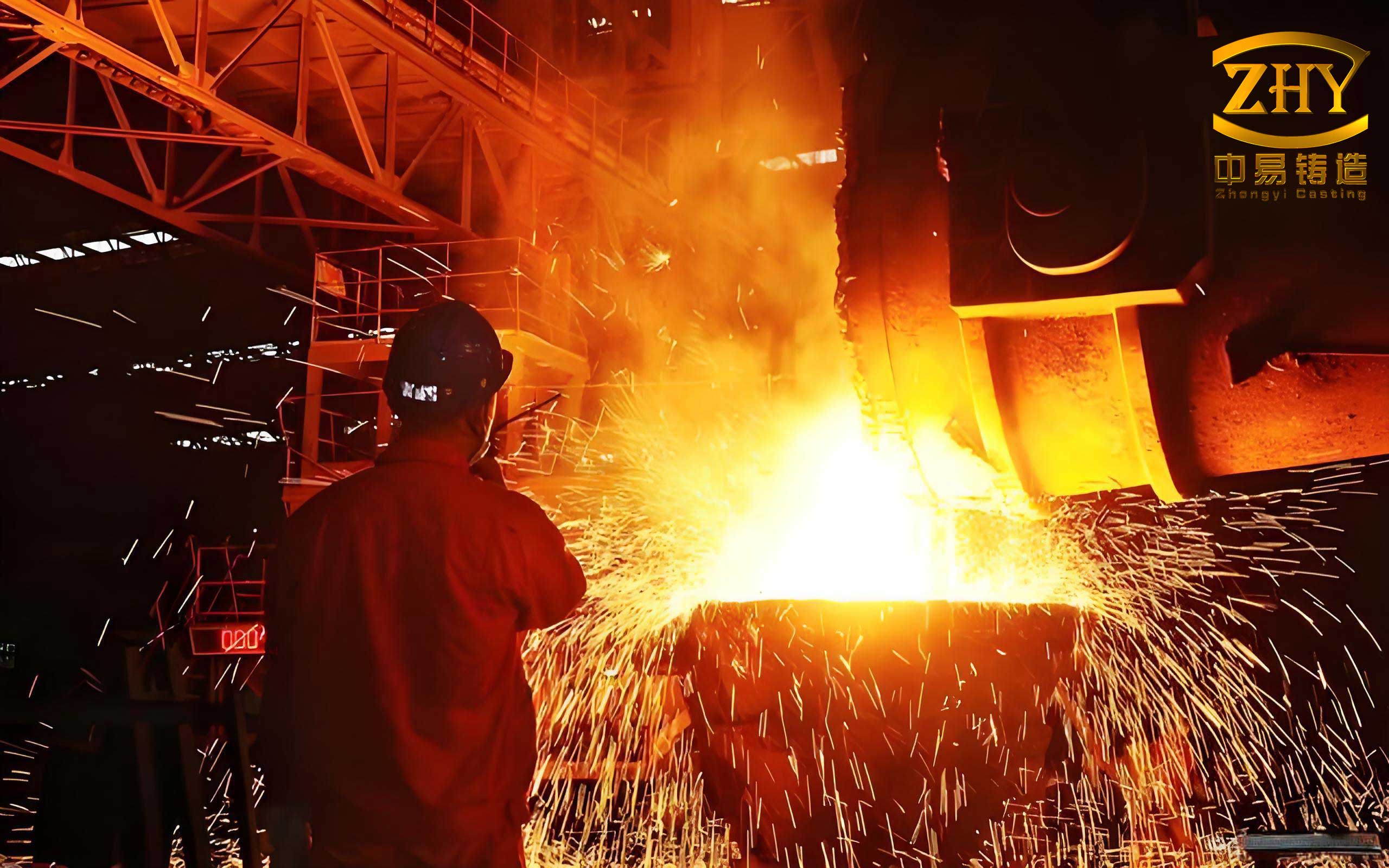
During the pour itself, the two seat ladles (#2 and #4) were positioned first. Then, the three crane-suspended ladles (#1, #3, #5) were moved into place. Pouring commenced simultaneously from ladles #1, #2, and #3 at a half-flow rate until the mold base was filled, then switched to full flow. When the metal level reached the shaft bore, ladles #4 and #5 were opened. Pouring stopped when the risers were filled to a height of 600 mm, immediately covered with exothermic material. To ensure soundness in the heavy sections of this massive casting part, a two-stage riser feeding was executed: first with 32 tons of metal at 45-60 minutes post-pour, and a second feed of 25 tons at 2 hours, both at 1,590-1,600°C.
The knockout phase required innovative thermal management. To solve the crane capacity issue, a “hot cut” procedure was devised. The AC3 transformation temperature for ZG20MnSi is approximately 850°C. Cutting the risers in this fully austenitic state (at 880-900°C) eliminated the risk of cold cracking. After approximately two weeks of cooling in the mold, temperature monitoring at the riser necks confirmed this range. The risers were severed using oxygen lances about 300 mm above the casting part, lifted clear, and then placed back onto the hot casting part to allow the residual heat to anneal the cut surface.
Further cycle time reduction was achieved by determining a safe, elevated knockout temperature. Testing of the as-cast material’s high-temperature strength provided the critical data:
| Temperature (°C) | As-Cast Tensile Strength (MPa) |
|---|---|
| 200 | > 300 |
| 400 | > 200 |
| 600 | > 100 |
Given that the tensile strength at 600°C remained above 100 MPa and this temperature exceeds the standard tempering temperature (580°C), knockout was safely performed at 600°C. This reduced the in-mold cooling time by approximately 30 days compared to cooling to under 200°C. After knockout, the casting part was transferred to the furnace for heat treatment. To refine the coarse as-cast microstructure, particularly in sections over 800 mm thick, a double-normalize-and-temper cycle was employed. The second normalizing was conducted within the intercritical temperature range to effectively refine the austenite grain size, which is crucial for achieving the required ultrasonic testing quality level.
The successful implementation of this integrated工艺技术 resulted in the flawless production of the 122-ton runner hub. The internal quality of the casting part met the stringent Class 3 requirements of the CCH70-3 ultrasonic inspection standard. The demonstrated capability and reliability of this process, especially the mastery of multi-ladle coordination and controlled thermal processes for heavy casting parts, proved highly effective. The initial order was part of a larger project, and the consistent quality and timely delivery achieved through this method led to the award of subsequent contracts for multiple additional units of this critical hydropower component.
In summary, the production of this ultra-large runner hub was a triumph of coordinated process engineering. The quintuple-ladle synchronized pouring scheme, backed by meticulous scheduling and temperature control, enabled the filling of a mold for a casting part of extraordinary size. The subsequent in-pit hot riser removal and optimized high-temperature knockout strategy creatively overcame crane capacity limitations and dramatically shortened the production cycle without compromising the integrity of the casting part. This case underscores that for extreme-scale castings, success depends not only on individual process steps but on a holistic, thermally intelligent strategy that views the entire journey from molten metal to finished casting part as an integrated system.