
In the field of industrial manufacturing, the production of high manganese steel castings has long been a focus due to their exceptional wear resistance and toughness under impact conditions. However, achieving consistent quality in large-scale applications, such as liners for grinding mills, presents significant challenges. Through extensive research and practical experimentation, we have developed an optimized approach for enhancing the performance and longevity of these castings by incorporating rare earth (RE) elements. This article details our methodology, emphasizing the control of chemical composition, metallurgical quality, and process parameters to produce superior high manganese steel castings.
The foundation of producing high-quality high manganese steel castings lies in precise chemical composition control. The primary elements in ZGMn13-grade steel are carbon (C), manganese (Mn), and silicon (Si), with sulfur (S) and phosphorus (P) considered detrimental impurities. Carbon content is typically maintained between 1.0% and 1.2%, while manganese ranges from 11% to 14%. Chromium (Cr) is added to improve corrosion resistance, especially in wet, alkaline environments like ore slurry processing, and is controlled at 2.5% to 3.5%. A critical aspect is the manganese-to-carbon ratio (Mn/C), which we optimize to approximately 11 to ensure balanced mechanical properties. Additionally, trace amounts of rare earth elements, vanadium (V), and titanium (Ti) are incorporated to refine the microstructure and enhance performance. The optimized chemical composition for high manganese steel castings used in large mills is summarized in Table 1.
| Element | Content Range |
|---|---|
| C | 1.0–1.2 |
| Si | 0.3–0.6 |
| Mn | 11–14 |
| Cr | 2.6–3.2 |
| S | ≤0.04 |
| P | ≤0.07 |
| RE (residual) | Trace |
| V, Ti | Trace |
To achieve the desired properties in high manganese steel castings, the Mn/C ratio plays a pivotal role in governing the austenite stability and carbide precipitation. The relationship can be expressed using the following empirical formula, which highlights the interdependence of these elements:
$$ \text{Mn/C Ratio} = \frac{[\text{Mn}]}{[\text{C}]} \approx 11 $$
where [Mn] and [C] represent the weight percentages of manganese and carbon, respectively. This ratio ensures that the austenitic matrix remains stable under working conditions, facilitating strain-induced hardening without excessive deformation.
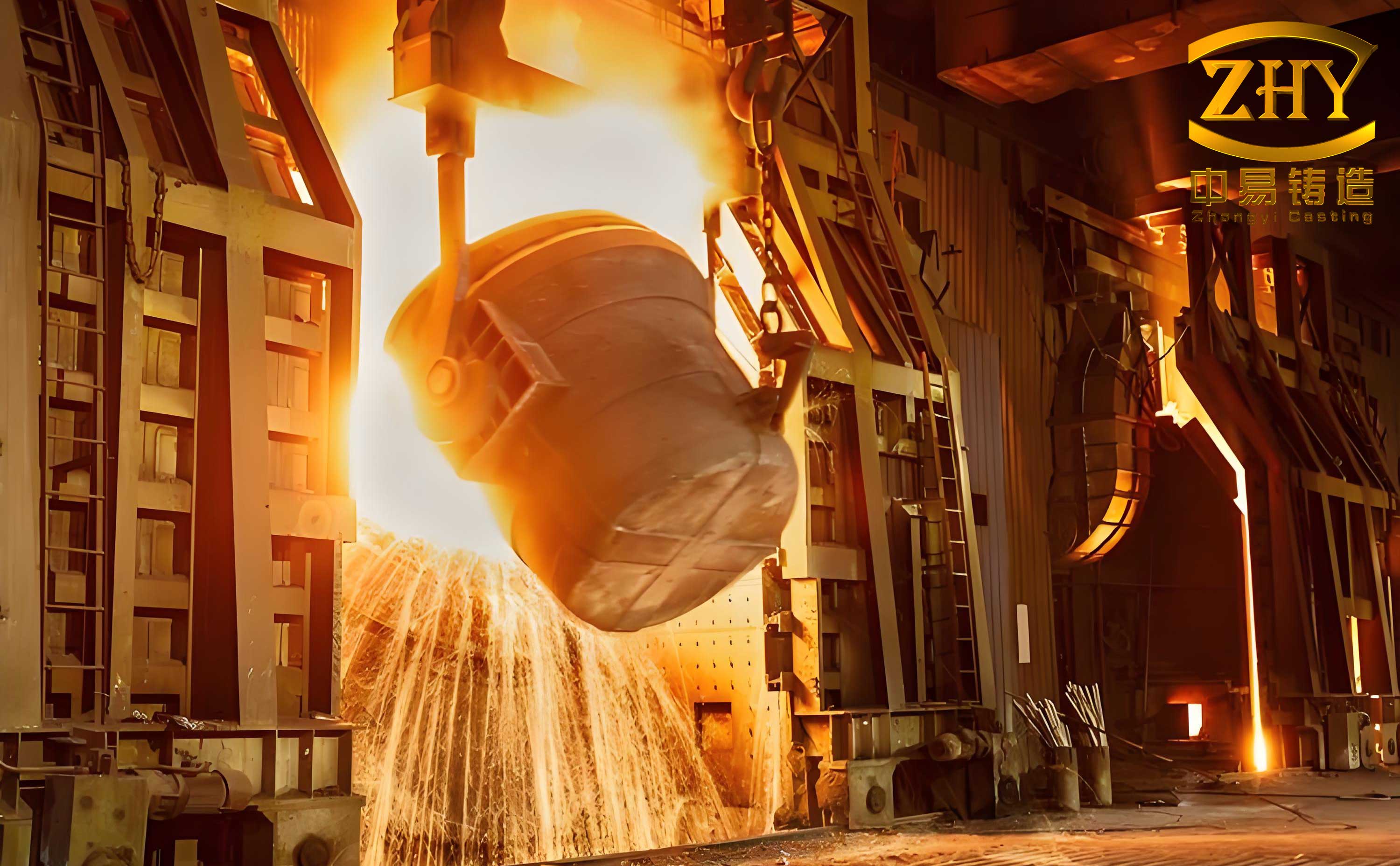
Metallurgical quality control is another critical factor in producing high-performance high manganese steel castings. We employ rare earth modification to address common issues such as carbide precipitation, inclusion content, and grain coarseness. Rare earth elements, primarily cerium and lanthanum, act as potent modifiers by adsorbing onto nascent carbide surfaces, altering their morphology from sharp, angular forms to more rounded and dispersed configurations. This transformation reduces stress concentration points and enhances the overall toughness of the casting. Moreover, RE treatment purifies the molten steel by forming low-density oxides and sulfides that float to the slag, thereby minimizing non-metallic inclusions like Al₂O₃, FeO, MnO, FeS, and MnS. These inclusions, if uncontrolled, tend to accumulate at grain boundaries, weakening the structure and promoting crack initiation.
The refinement of grain structure through RE addition is quantified by the increase in undercooling, which promotes finer austenite grains. The grain size reduction can be modeled using the Hall-Petch relationship, where the yield strength (σ_y) is inversely proportional to the square root of the grain diameter (d):
$$ \sigma_y = \sigma_0 + \frac{k_y}{\sqrt{d}} $$
Here, σ₀ is the friction stress, and k_y is the strengthening coefficient. For high manganese steel castings, RE modification typically results in a grain size reduction from approximately 100–150 μm to 50–80 μm, significantly improving mechanical properties. We add 0.1% RE to the molten steel during furnace operations, and the comparative microstructures and properties are detailed in Table 2. The enhanced performance includes higher tensile strength, elongation, impact toughness, and hardness, demonstrating the efficacy of RE treatment in high manganese steel castings.
| Property | Conventional ZGMn13 | RE-Modified High Manganese Steel |
|---|---|---|
| Tensile Strength (MPa) | 608 | 916 |
| Elongation (%) | 13 | 34 |
| Impact Toughness (J/cm²) | 112 | 187 |
| Hardness (HBS) | 210 | 224 |
In addition to RE modification, we implement rigorous furnace-front testing to assess metallurgical quality. A bend test specimen, with dimensions as illustrated in the following schematic, is utilized to evaluate the steel’s ductility and homogeneity. The specimen is heated to approximately 800°C (appearing yellow-red) and then quenched in water. The absence of cracks or deformations indicates satisfactory quality, allowing for real-time adjustments in composition or treatment parameters. This practice ensures that each batch of high manganese steel castings meets the required standards before proceeding to casting.
The casting process itself demands careful attention to mold design, pouring parameters, and heat treatment to avoid defects such as hot tearing, shrinkage, and inadequate hardening. For molding, we use CO₂-hardened sodium silicate sand due to its good rigidity and dimensional stability. However, to prevent chemical bonding and sticking caused by manganese oxide (MnO) reactions with silica (SiO₂), we apply a magnesia-based alcohol coating to the mold surfaces. Critical areas, such as holes and complex geometries, are cored with furan resin sand to improve collapsibility and reduce thermal stress. The design incorporates large radii and smooth transitions to minimize stress concentrations, which is essential for maintaining the integrity of high manganese steel castings under operational loads.
Pouring temperature and speed are optimized to ensure complete mold filling and effective feeding. The tapping temperature from the furnace is controlled between 1480°C and 1520°C, followed by a brief holding period to allow for inclusion flotation. The pouring temperature is maintained at 1400–1450°C, and the pouring sequence follows a slow-fast-slow pattern to facilitate directional solidification and minimize turbulence. The total pouring time is kept under 10 seconds to prevent premature cooling and ensure a sound casting structure. This controlled approach is vital for achieving uniform properties in high manganese steel castings, particularly for large components like mill liners.
Heat treatment is the final and most crucial step in stabilizing the austenitic matrix and maximizing the work-hardening capability of high manganese steel castings. The solution treatment involves heating the castings to 1050 ± 10°C to dissolve carbides fully into the austenite. The heating rate is carefully regulated to avoid thermal shocks and distortion, with intermediate holding stages to ensure temperature uniformity. Quenching is performed in circulating water to maintain a temperature below 50°C, and the time from furnace exit to water immersion is critical—it must not exceed 10 seconds to achieve rapid cooling and prevent carbide reprecipitation. The effectiveness of this process can be described by the Arrhenius-type equation for diffusion-controlled transformations:
$$ t = A \cdot \exp\left(\frac{Q}{RT}\right) $$
where t is the time for complete dissolution, A is a pre-exponential factor, Q is the activation energy for diffusion, R is the gas constant, and T is the absolute temperature. By adhering to these parameters, we ensure that the high manganese steel castings develop a homogeneous austenitic structure with minimal residual stresses, ready for demanding service conditions.
In summary, the production of high-performance high manganese steel castings relies on an integrated approach that combines precise chemical control, advanced metallurgical treatments, and meticulous process optimization. The use of rare earth modification significantly enhances grain refinement and inclusion removal, leading to superior mechanical properties. Furnace-front testing and controlled heat treatment further ensure consistency and reliability. Through these methods, we have successfully extended the service life of high manganese steel castings in abrasive environments, demonstrating the importance of holistic quality management in industrial applications.
Future developments in high manganese steel castings may explore additional alloying elements or alternative heat treatment cycles to push the boundaries of performance. However, the principles outlined here—focusing on composition ratios, RE modification, and process discipline—form a robust foundation for manufacturing durable and efficient castings. As industries continue to demand higher efficiency and longer component life, the role of optimized high manganese steel castings will remain pivotal in achieving these goals.