
In the realm of advanced engineering materials, ductile cast iron stands out for its unique combination of strength, ductility, and toughness, particularly under low-temperature conditions. The QT350-22AL grade, specified for applications such as wind turbine components, demands exceptional performance at temperatures as low as -40°C, with stringent requirements for tensile strength, yield strength, elongation, and impact energy. Producing heavy-section ductile cast iron castings, like conical supports with wall thicknesses up to 300 mm, presents significant challenges, including graphite flotation, degeneration, shrinkage porosity, and the formation of abnormal graphite structures. This article delves into the optimized melting and production processes developed to consistently manufacture QT350-22AL heavy-section low-temperature ductile cast iron components. Through meticulous control of chemical composition, strategic use of rare-earth spheroidizers, and innovative inoculation techniques, we have achieved stable production of high-quality ductile cast iron castings that meet and exceed international standards.
The fundamental properties of ductile cast iron are governed by its microstructure, which consists of spheroidal graphite embedded in a metallic matrix. For low-temperature applications, a ferritic matrix is preferred due to its superior toughness and impact resistance. However, in heavy sections, the slow cooling rate can lead to graphite degeneration, such as chunk graphite or exploded graphite, which severely compromises mechanical properties. Therefore, the production process must address both compositional and processing factors to ensure a fine, uniform distribution of spherical graphite and a high-purity ferritic matrix. The following sections detail the key aspects of our approach, supported by tables and mathematical models to elucidate the underlying principles.
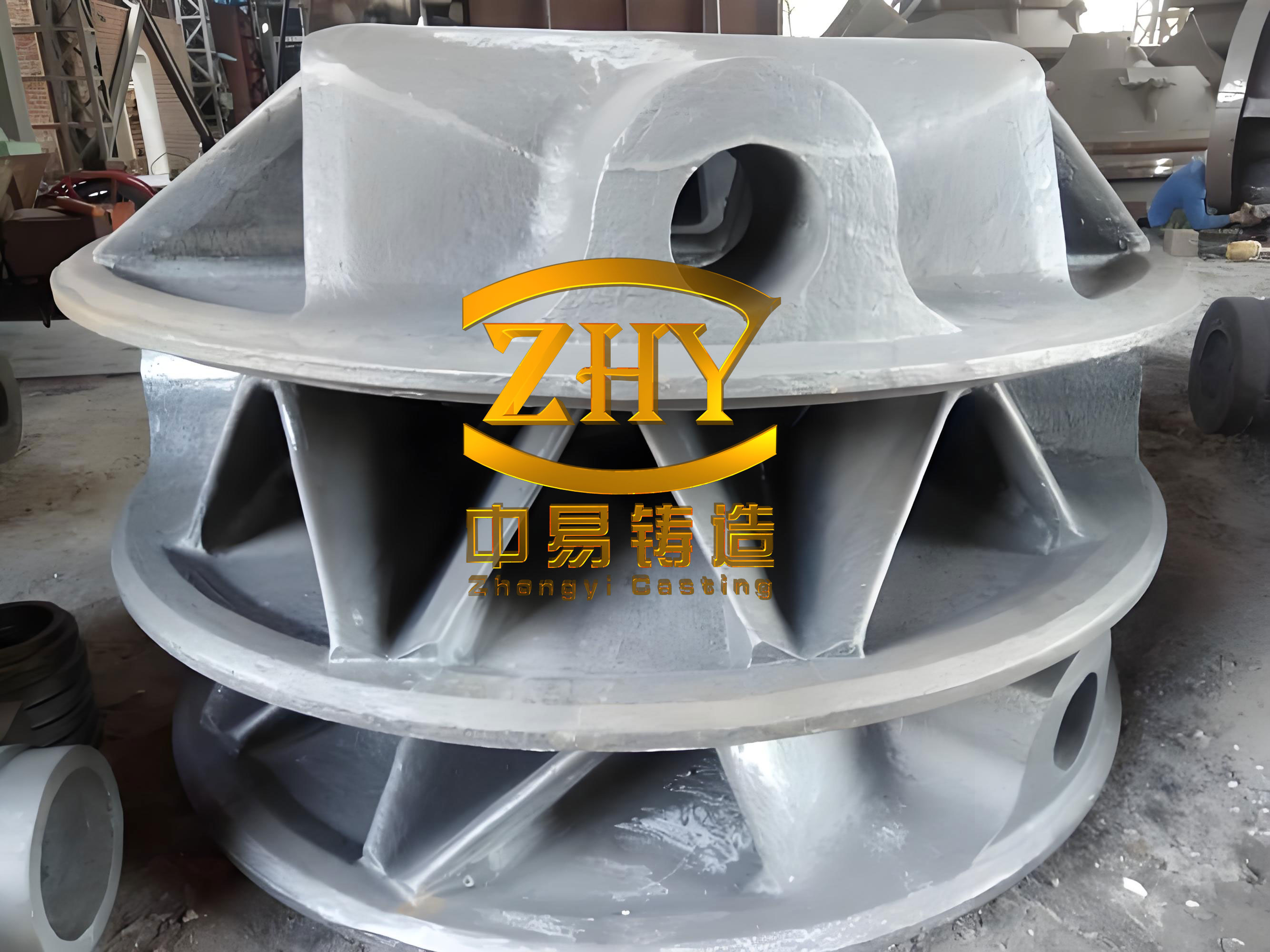
The selection and control of chemical composition are paramount in achieving the desired properties of ductile cast iron. Each element plays a specific role in influencing graphitization, matrix formation, and impurity levels. For QT350-22AL heavy-section castings, we have established precise ranges based on both theoretical considerations and practical experience.
Carbon (C): Carbon is the primary graphitizing element in ductile cast iron. A higher carbon content promotes graphite nucleation, increases graphite nodule count, and reduces the tendency for chilling and carbides. It also enhances fluidity and feeding characteristics, minimizing shrinkage defects. However, excessive carbon can lead to graphite flotation in heavy sections. The optimal final carbon content for low-temperature ductile cast iron is between 3.5% and 4.0%. The relationship between carbon equivalent (CE) and graphite nucleation can be expressed as:
$$ \text{CE} = \text{C} + \frac{1}{3}(\text{Si} + \text{P}) $$
where CE influences the undercooling tendency and graphite morphology. For our ductile cast iron, we aim for a CE of approximately 4.3–4.6 to balance graphitization and structural soundness.
Silicon (Si): Silicon is a strong graphitizer and ferrite promoter. It solid-solution strengthens the ferritic matrix but can embrittle the material if too high. To achieve elongations above 15%, silicon must be carefully controlled. In heavy-section ductile cast iron, high silicon levels (>2.0%) can exacerbate the formation of degenerate graphite. Therefore, the base iron silicon is maintained at 0.6–1.0%, and after inoculation, the final silicon is restricted to 1.7–2.0%. The effect of silicon on tensile strength can be modeled as:
$$ \sigma_b = \sigma_0 – k_{\text{Si}} \cdot \text{Si} $$
where $\sigma_b$ is the tensile strength, $\sigma_0$ is the base strength, and $k_{\text{Si}}$ is a constant. For our ductile cast iron, lower silicon within the specified range favors higher ductility and impact toughness.
Manganese (Mn): Manganese tends to segregate at grain boundaries, promoting pearlite and carbide formation, which degrades toughness. Hence, we use high-purity pig iron with low manganese content, keeping it below 0.2% in the base iron. The detrimental effect of manganese on impact energy at low temperatures is significant, as described by:
$$ \text{Impact Energy} \propto \frac{1}{[\text{Mn}]} $$
where [Mn] is the manganese concentration.
Phosphorus (P) and Sulfur (S): Phosphorus is a harmful element that forms brittle phosphides at grain boundaries, severely reducing ductility and impact resistance. We aim for phosphorus levels below 0.04%. Sulfur, while also detrimental, is necessary in small amounts for effective spheroidization; however, excessive sulfur consumes magnesium and rare-earth elements. The base iron sulfur is controlled to ≤0.02%. The desulfurization reaction during treatment can be represented as:
$$ \text{Mg} + \text{S} \rightarrow \text{MgS} $$
This reaction is crucial for achieving a low residual sulfur content in the final ductile cast iron.
Residual Magnesium (Mg) and Rare Earths (RE): Residual magnesium and rare earths are essential for maintaining spheroidal graphite morphology. However, excess residuals increase chilling tendency and shrinkage. We target residual magnesium at 0.03–0.05% and residual rare earths at 0.01–0.03%. The combined effect on graphite nodule count (N) can be approximated by:
$$ N = A \cdot [\text{Mg}_{\text{res}}]^{m} \cdot [\text{RE}_{\text{res}}]^{n} $$
where A, m, and n are constants dependent on processing conditions.
Antimony (Sb): Antimony is added in trace amounts (≤0.008%) to refine graphite nodules and suppress degenerate graphite in heavy sections, but it must be strictly controlled to avoid pearlite stabilization.
Table 1 summarizes the target chemical composition ranges for the base iron and the final ductile cast iron.
| Element | Base Iron | Final Iron (After Treatment) |
|---|---|---|
| C | 3.8–4.1 | 3.5–4.0 |
| Si | 0.7–1.2 | 1.7–2.0 |
| Mn | ≤0.2 | ≤0.2 |
| P | ≤0.04 | ≤0.04 |
| S | ≤0.02 | ≤0.02 |
| Mgres | – | 0.03–0.05 |
| REres | 0.01–0.03 | 0.01–0.03 |
| Sb | ≤0.008 | ≤0.008 |
Temperature control during melting and pouring is critical for the quality of ductile cast iron. The process involves superheating, holding, spheroidizing, and pouring stages, each with specific temperature targets.
Superheating Temperature: Superheating the iron above 1500°C helps dissolve primary graphite and oxides, reducing genetic inheritance from pig iron and enhancing nucleation potential. We superheat the base iron to 1500–1540°C. The dissolution kinetics of graphite can be described by the Arrhenius equation:
$$ r = r_0 \cdot \exp\left(-\frac{E_a}{RT}\right) $$
where r is the dissolution rate, r0 is a pre-exponential factor, Ea is the activation energy, R is the universal gas constant, and T is the absolute temperature. Superheating promotes a more homogeneous melt, vital for consistent ductile cast iron properties.
Spheroidizing Temperature: Spheroidization is performed via a ladle-to-ladle transfer process. The base iron is allowed to cool to 1400–1450°C in a transfer ladle before being poured into a spheroidizing ladle. This “inverted ladle” method ensures precise temperature control and rapid cooling, preserving innate nucleation sites. The spheroidizing reaction efficiency depends on temperature, as per:
$$ \eta_{\text{sph}} = \eta_0 \cdot \left(1 – \exp\left(-k_{\text{sph}} \cdot t\right)\right) $$
where $\eta_{\text{sph}}$ is the spheroidization efficiency, $\eta_0$ is the maximum efficiency, ksph is a rate constant, and t is time. Optimal temperature minimizes magnesium fade and ensures complete reaction.
Pouring Temperature: Pouring temperature affects fluidity, shrinkage, and slag formation. For heavy-section ductile cast iron castings, we maintain a pouring temperature of 1330–1370°C. Too high a temperature increases liquid contraction and porosity risk, while too low a temperature may cause cold shuts and slag inclusions. The fluidity length (L) can be correlated with temperature by:
$$ L = L_0 + \alpha (T – T_{\text{liquidus}}) $$
where L0 is a base length, α is a coefficient, and Tliquidus is the liquidus temperature of the ductile cast iron.
Raw materials selection and charging sequence are carefully designed to minimize impurities and maximize graphite nucleation. We use low-impurity Q10 pig iron, low-manganese steel scrap, recycled returns from certified ductile cast iron castings (shot-blasted to remove oxides), and graphite-based carburizers. The charging sequence is as follows: steel scrap and carburizer are charged initially to allow for carbon absorption; pig iron is added mid-cycle to reduce nucleation loss; and returns are added later to prevent oxidation. The carburizer acts as a potent inoculant, providing nucleation sites for graphite. The overall carbon recovery (RC) can be estimated as:
$$ R_C = \frac{C_{\text{final}} – C_{\text{initial}}}{C_{\text{added}}} \times 100\% $$
where typical recovery rates exceed 85% with graphite carburizers. This approach ensures a clean, nucleation-rich base iron for producing high-quality ductile cast iron.
The spheroidization and inoculation treatments are the heart of ductile cast iron production. We employ a combination of light and heavy rare-earth spheroidizers along with multiple inoculation steps to achieve fine, round graphite nodules and a ferritic matrix.
Spheroidizer Selection and Addition: Light rare-earth spheroidizers (e.g., based on cerium) offer good spheroidizing power, while heavy rare-earth spheroidizers (e.g., based on yttrium) provide better fade resistance and control over graphite degeneration in heavy sections. We use a 50:50 blend, with a total addition of 0.9–1.3%. The spheroidizing reaction involves magnesium and rare earths reacting with sulfur and oxygen:
$$ \text{Mg} + \text{S} \rightarrow \text{MgS}, \quad \text{RE} + \text{O} \rightarrow \text{RE}_2\text{O}_3 $$
These reactions purify the melt and create favorable conditions for graphite spheroidization. The ladle-to-ladle process allows for accurate temperature management and reduces turbulence, improving spheroidizing efficiency.
Inoculation Strategy: Inoculation is performed in multiple stages to enhance nucleation and combat fading. We use a barium-containing inoculant (2–4% Ba, 5–15 mm size) for primary and secondary inoculation, and a cerium-based inoculant (0.5–1.5 mm) for instantaneous inoculation. The stages are:
- Transfer Ladle Inoculation: Addition of 0.2–0.4% inoculant to the base iron during transfer. This pre-inoculation boosts nucleation sites before spheroidization.
- Spheroidizing Ladle Inoculation: Addition of 0.3–0.6% inoculant during or after spheroidization. This counters magnesium-induced chilling.
- Pouring Ladle Inoculation: Addition of 0.05–0.15% inoculant in the pouring ladle for further refinement.
- Stream Inoculation: Addition of 0.05–0.2% cerium-based inoculant during pouring via a feeder. This last-minute treatment maximizes active nuclei.
The total inoculation amount is 0.6–1.4%, tailored to section size and cooling rate. The nucleation rate (I) due to inoculation can be modeled as:
$$ I = I_0 \cdot \exp\left(-\frac{\Delta G^*}{kT}\right) $$
where I0 is a constant, ΔG* is the activation energy for nucleation, k is Boltzmann’s constant, and T is temperature. Multiple inoculations sustain a high nucleation rate throughout solidification, crucial for heavy-section ductile cast iron.
Table 2 outlines the inoculation schedule and typical addition ranges.
| Stage | Location | Inoculant Type | Addition Range (wt.%) | Particle Size (mm) |
|---|---|---|---|---|
| Primary | Transfer Ladle | Ba-bearing | 0.2–0.4 | 5–15 |
| Secondary | Spheroidizing Ladle | Ba-bearing | 0.3–0.6 | 5–15 |
| Tertiary | Pouring Ladle | Ba-bearing | 0.05–0.15 | 5–15 |
| Instantaneous | Pouring Stream | Ce-bearing | 0.05–0.2 | 0.5–1.5 |
The effectiveness of our process is validated by the mechanical properties and microstructures of castings and attached test blocks (70 mm thickness). The test blocks are machined into specimens for tensile, impact, and metallographic testing. Results consistently meet the requirements of GB/T 1348-2009 for QT350-22AL, with typical values as follows:
- Tensile Strength (Rm): 370–430 MPa
- Yield Strength (Rp0.2): 250–320 MPa
- Elongation (A): 15–18.5%
- Impact Energy at -40°C: 12–14 J (average)
- Hardness: 123–143 HBW
Microstructural analysis reveals fine, well-formed spheroidal graphite (grade 2-3 according to ISO 945) with a nodule count exceeding 100 nodules/mm², embedded in a ferritic matrix (≥95% ferrite). The graphite nodule diameter (d) distribution follows a log-normal function:
$$ f(d) = \frac{1}{d \sigma \sqrt{2\pi}} \exp\left(-\frac{(\ln d – \mu)^2}{2\sigma^2}\right) $$
where μ and σ are the mean and standard deviation of ln(d). Our process yields a narrow distribution with a mean diameter around 20–30 μm, indicative of excellent nucleation and growth control.
Table 3 presents a statistical summary of properties from production batches of conical support castings made from ductile cast iron.
| Sample No. | Tensile Strength (MPa) | Yield Strength (MPa) | Elongation (%) | Impact Energy (-40°C, J) | Hardness (HBW) | Graphite Grade | Ferrite Content (%) |
|---|---|---|---|---|---|---|---|
| 1 | 425 | 275 | 16.5 | 13.8 | 129 | 2 | 95 |
| 2 | 415 | 270 | 16.0 | 13.2 | 129 | 2 | 95 |
| 3 | 435 | 285 | 15.0 | 12.1 | 143 | 2 | 95 |
| 4 | 425 | 275 | 16.5 | 12.5 | 143 | 2 | 95 |
| 5 | 430 | 280 | 16.0 | 13.1 | 143 | 2 | 95 |
| 6 | 405 | 265 | 16.5 | 13.7 | 143 | 2 | 95 |
| 7 | 415 | 270 | 17.5 | 12.8 | 143 | 2 | 95 |
| 8 | 410 | 265 | 16.0 | 14.1 | 143 | 2 | 95 |
| 9 | 410 | 265 | 15.5 | 13.6 | 129 | 2 | 95 |
| 10 | 410 | 265 | 16.0 | 13.5 | 129 | 2 | 95 |
The success of our process hinges on several key factors. First, the ladle-to-ladle spheroidization with precise temperature control minimizes fading and preserves nucleation sites. Second, the multiple inoculation strategy, combining barium and cerium inoculants, ensures a high and sustained nucleation rate throughout solidification. Third, the careful balance of light and heavy rare-earth spheroidizers prevents graphite degeneration in heavy sections. Finally, the stringent control of impurities (Mn, P, S) and trace elements (Sb) guarantees a ferritic matrix with high toughness.
From a theoretical perspective, the process optimizes the parameters that influence graphite nodule count and matrix structure. The nodule count (Nv) in ductile cast iron can be related to processing variables by an equation of the form:
$$ N_v = C \cdot [\text{Inoculant}]^p \cdot \exp\left(-\frac{Q}{RT}\right) \cdot t^q $$
where C is a constant, [Inoculant] is the effective inoculant concentration, p and q are exponents, Q is an activation energy, R is the gas constant, T is the absolute temperature, and t is the holding time. Our process maximizes Nv through high inoculation efficiency and optimal thermal conditions.
In conclusion, the production of QT350-22AL heavy-section low-temperature ductile cast iron castings requires an integrated approach encompassing composition design, temperature management, raw material purity, and advanced treatment techniques. By implementing the ladle-to-ladle spheroidization with combined rare-earth spheroidizers and multiple-stage inoculation, we consistently achieve ductile cast iron with excellent mechanical properties and microstructural integrity, even in sections up to 300 mm thick. This methodology not only meets the demands of critical applications like wind energy but also provides a robust framework for manufacturing high-performance ductile cast iron components across various industries. Future work may focus on further refining the inoculation mechanisms and exploring digital process control to enhance reproducibility and efficiency in ductile cast iron production.