
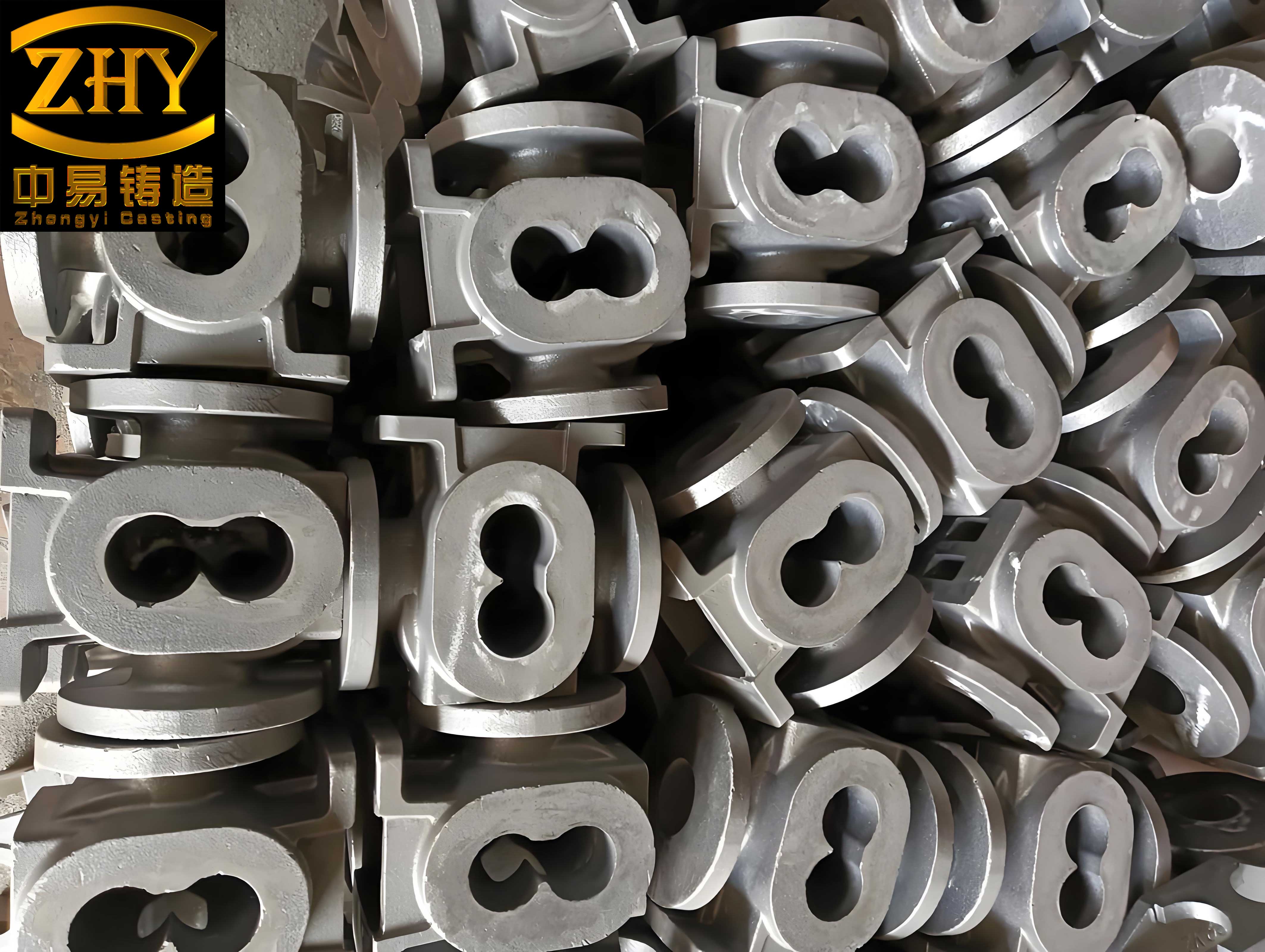
In my research and practical experience, I have focused on the smelting and production of QT350-22AL conical support castings, which are thick-section low-temperature nodular cast iron components. These castings are critical for applications in wind power equipment, requiring stable low-impact properties at ultra-low temperatures, such as -40°C. The challenges in producing such nodular cast iron include controlling graphite flotation, graphite degeneration, slag inclusion, and graphite distortion in thick sections exceeding 60 mm, with some areas up to 300 mm. Through systematic optimization of chemical composition, use of light and heavy rare earth spheroidizing agents, on-site ladle spheroidizing, and multiple inoculation treatments, I have successfully stabilized the production process. This article details my approach, incorporating tables and formulas to summarize key aspects, aiming to provide technical insights for heavy-section low-temperature nodular cast iron manufacturing.
The importance of nodular cast iron in industrial applications cannot be overstated, especially for components operating in harsh environments. For QT350-22AL, according to GB/T 1348-2009 standards, the attached test blocks for wall thicknesses between 60 mm and 200 mm must meet tensile strength ≥320 MPa, yield strength ≥220 MPa, elongation ≥15%, and an average impact energy ≥10 J at -40°C. My work addresses these requirements by refining the melting process. I emphasize the term “nodular cast iron” throughout this discussion, as it underscores the material’s unique graphite spheroidization that grants it superior ductility and toughness compared to other cast irons.
In my production of nodular cast iron, the selection and control of chemical composition are paramount. Each element plays a specific role in achieving the desired microstructure and mechanical properties. For carbon, I maintain a final content between 3.5% and 4.0% to promote graphitization, enhance fluidity, and reduce shrinkage porosity. The relationship can be expressed as the graphitization potential, where higher carbon equivalent (CE) values favor graphite formation: $$CE = C + \frac{1}{3}(Si + P)$$. For QT350-22AL, I aim for a CE that minimizes carbides while ensuring adequate graphite nodule count. Silicon is controlled rigorously; as a strong graphitizer, it fosters ferrite formation but can embrittle the matrix if excessive. I keep the raw iron silicon at 0.6%-1.0% and the final silicon after inoculation at 1.7%-2.0% to balance ductility and strength. This is crucial for nodular cast iron to achieve high elongation.
Manganese, phosphorus, and sulfur are harmful elements that I minimize. Manganese content is kept below 0.2% to avoid pearlite promotion and boundary carbides, which degrade toughness. Phosphorus is restricted to ≤0.04% to prevent phosphide eutectic formation, as it can severely impair mechanical properties. Sulfur, while detrimental, is controlled to ≤0.02% in the raw iron to facilitate effective spheroidization. Antimony is added in trace amounts (≤0.008%) to refine graphite nodules and prevent degeneration in thick sections, but excess can promote pearlite. The residual rare earth and magnesium are vital for spheroidization; I maintain residual rare earth at 0.01%-0.03% and residual magnesium at 0.03%-0.05% to ensure spherical graphite growth without excessive white iron tendency. The following table summarizes my target composition ranges for the raw and spheroidized iron in producing this nodular cast iron:
| Iron Type | C (%) | Si (%) | Mn (%) | P (%) | S (%) | Residual RE (%) | Residual Mg (%) |
|---|---|---|---|---|---|---|---|
| Raw Iron | 3.8-4.1 | 0.7-1.2 | ≤0.2 | ≤0.04 | ≤0.02 | 0.01-0.03 | 0.03-0.05 |
| Spheroidized Iron | 3.5-4.0 | 1.7-2.0 | ≤0.2 | ≤0.04 | ≤0.02 | 0.01-0.03 | 0.03-0.05 |
Temperature control is another critical aspect I manage carefully. For the raw iron, I superheat to 1500-1540°C to dissolve coarse graphite and reduce oxide inclusions, which improves the genetic quality of the melt. The spheroidization temperature is set at 1400-1450°C using an on-site ladle transfer method; this cools the iron rapidly and preserves innate nucleation sites. The pouring temperature is maintained at 1330-1370°C to balance fluidity and minimize shrinkage defects. The cooling rate influences graphite nodule count, which can be approximated by the equation for nucleation rate in nodular cast iron: $$N = N_0 \exp\left(-\frac{Q}{RT}\right)$$, where \(N\) is the nodule count, \(N_0\) is a pre-exponential factor, \(Q\) is the activation energy, \(R\) is the gas constant, and \(T\) is the temperature. By optimizing temperatures, I enhance the graphite morphology in the final nodular cast iron.
Raw materials and their addition timing are selected to ensure purity and consistency. I use low-impurity Q10 pig iron with total trace elements below 0.1%, added late in the melting process to reduce nucleation loss. Low-manganese steel scrap is introduced early, while recycled returns from previous nodular cast iron castings, after shot blasting, are added mid-to-late. Graphitizing carburizers are included initially with the scrap, reserving 0.1% for pretreatment. Ferrosilicon (75% Si) is used for final silicon adjustment. This strategy minimizes harmful elements and promotes a clean melt, essential for high-quality nodular cast iron.
The spheroidization and inoculation processes are where I achieve precise control over graphite formation. I employ a combination of light and heavy rare earth spheroidizing agents, with a total addition of 0.9%-1.3%, to leverage their synergistic effects: light rare earths enhance nodularity, while heavy rare earths improve resistance to fading. The on-site ladle spheroidizing involves transferring iron to a treatment ladle, where I perform multiple inoculations. Inoculation is done in stages: first in the transfer ladle with 0.2%-0.4% Ba-containing inoculant (5-15 mm grain size), second in the spheroidizing ladle with 0.3%-0.6%, third in the pouring ladle with 0.05%-0.15%, and instantaneous inoculation during pouring with 0.05%-0.2% Ce-bearing inoculant (0.5-1.5 mm). This multi-stage approach increases effective nucleation sites, refining graphite nodules. The reaction during spheroidization can be represented as: $$Mg + S \rightarrow MgS$$ and $$2Mg + O_2 \rightarrow 2MgO$$, forming substrates for graphite growth. The inoculation effect on nodule count can be modeled as: $$N_i = N_b + k \cdot I$$, where \(N_i\) is the final nodule count, \(N_b\) is the base count, \(k\) is a constant, and \(I\) is the inoculation amount. Through this, I ensure the nodular cast iron has fine, round graphite balls.
To validate my process, I conducted production trials with attached test blocks of 70 mm thickness. The results demonstrated consistent performance. The microstructure showed small, round graphite nodules with a high count and fine ferrite matrix, indicating effective control. The mechanical properties met and exceeded standards, as summarized in the table below. This table compiles data from multiple castings, highlighting the stability achieved in producing this nodular cast iron.
| Test ID | Tensile Strength (MPa) | Yield Strength (MPa) | Elongation (%) | Hardness (HBW) | Graphite Grade | Pearlite (%) | Avg. Impact Energy at -40°C (J) |
|---|---|---|---|---|---|---|---|
| 7 | 425 | 275 | 16.5 | 129 | 7 | 5 | 13.8 |
| 9 | 415 | 270 | 16.0 | 129 | 7 | 5 | 13.2 |
| 230 | 435 | 285 | 15.0 | 143 | 7 | 5 | 12.1 |
| 213 | 425 | 275 | 16.5 | 143 | 7 | 5 | 12.5 |
| 231 | 430 | 280 | 16.0 | 143 | 7 | 5 | 13.1 |
| 214 | 405 | 265 | 16.5 | 143 | 7 | 5 | 13.7 |
| 232 | 415 | 270 | 17.5 | 143 | 7 | 5 | 12.8 |
| 215 | 410 | 265 | 16.0 | 143 | 7 | 5 | 14.1 |
| 295 | 410 | 265 | 15.5 | 129 | 7 | 5 | 13.6 |
| 344 | 410 | 265 | 16.0 | 129 | 7 | 5 | 13.5 |
| 345 | 400 | 260 | 16.5 | 129 | 7 | 5 | 12.7 |
| 347 | 420 | 275 | 15.0 | 131 | 7 | 5 | 13.2 |
| 346 | 425 | 280 | 15.0 | 131 | 7 | 5 | 13.8 |
| 343 | 420 | 275 | 15.0 | 131 | 7 | 5 | 12.7 |
| 513 | 390 | 255 | 18.0 | 129 | 7 | 5 | 13.2 |
| 514 | 425 | 275 | 16.0 | 130 | 7 | 5 | 12.2 |
| 3554 | 376 | 320 | 18.5 | 123 | 7 | 5 | 15.9 |
The data shows that tensile strength ranges from 376 to 435 MPa, yield strength from 255 to 320 MPa, elongation from 15% to 18.5%, and impact energy at -40°C from 12.1 to 15.9 J, all conforming to specifications. The graphite morphology is consistently rated grade 7, indicating small, evenly distributed nodules. This success underscores the effectiveness of my approach for heavy-section nodular cast iron. To further analyze, I use the formula for ductility in nodular cast iron: $$\delta = A – B \cdot (\%Si) + C \cdot (N^{1/2})$$, where \(\delta\) is elongation, \(A\), \(B\), and \(C\) are constants, and \(N\) is the graphite nodule count. My process optimizes silicon and nucleation to maximize elongation.
In conclusion, my production process for QT350-22AL heavy-section low-temperature nodular cast iron relies on meticulous chemical control, strategic use of rare earth agents, and innovative melting techniques. The on-site ladle spheroidizing and multiple inoculations preserve nucleation sites and refine graphite, while temperature management prevents defects. The results demonstrate that stable production is achievable, with properties exceeding standards. This methodology not only ensures quality for conical support castings but also offers a framework for other thick-section nodular cast iron applications. Future work could explore dynamic solidification models to further optimize cooling rates and inoculation timing for even better performance in nodular cast iron.
Throughout this article, I have emphasized the term “nodular cast iron” to highlight its significance. The integration of tables and formulas provides a comprehensive summary, aiding in the understanding and replication of this process. By sharing these insights, I aim to contribute to the advancement of nodular cast iron technology, particularly for demanding low-temperature environments. The continuous refinement of such processes will enhance the reliability and efficiency of industrial components made from nodular cast iron.