
In the production of heavy-section ductile iron castings, achieving a consistent combination of high ductility and structural integrity presents significant metallurgical and foundry challenges. One of the most persistent and detrimental defects encountered is the formation of slag inclusions. These non-metallic inclusions, often appearing as dark, irregular discontinuities on machined surfaces or in radiographic inspections, severely compromise the mechanical properties, particularly fatigue strength and impact resistance. This article details a comprehensive approach undertaken to produce a critical gear housing component in grade QT400-18RT, focusing on the systematic analysis and elimination of slag inclusions to ensure stable, high-quality production.
The gear housing, a substantial component weighing approximately 2055 kg with primary wall thicknesses ranging from 100 to 108 mm, demanded stringent technical specifications. The material specification was EN-GJS-400-18U-LT (QT400-18RT), requiring exceptional low-temperature toughness. Key requirements included:
- Chemical Composition: Silicon content limited to < 2.0% to prevent embrittlement.
- Mechanical Properties (via attached test blocks): Tensile Strength (Rm) ≥ 370 MPa, Yield Strength (Rp0.2) ≥ 240 MPa, Elongation (A) ≥ 12%.
- Metallurgical Quality: Nodularity ≥ 90% according to ISO 945 (GB/T9441), with a predominantly ferritic matrix.
- Integrity Testing: Full ultrasonic inspection with zero tolerance for defects like cold shuts, sand inclusions, porosity, and notably, slag inclusions.
Foundry Process Design and Rationale
The casting process was designed to ensure dimensional stability, sound feeding, and minimal turbulence. A furan resin sand system was selected for its excellent dimensional accuracy and good collapsibility. Mold and core strength was maintained above 0.98 MPa to withstand metallostatic pressure and minimize mold wall movement. Robust, rigid flasks with sufficient sand backing were employed to maintain overall mold rigidity, thereby reducing risks of shrinkage defects and veining.
A key strategy involved the extensive use of chills to control solidification in the thick sections and promote directional solidification towards the risers. Various cylindrical and contoured chills were strategically placed with specific spacing to create a favorable thermal gradient.
The gating system was designed as an open, pressurized system to ensure a calm and controlled fill. A ceramic sprue well was used to minimize erosion. The system featured a large cross-sectional area runner bar to reduce flow velocity and allow for slag buoyancy, with multiple ingates to distribute metal flow evenly. The final process layout is summarized below.
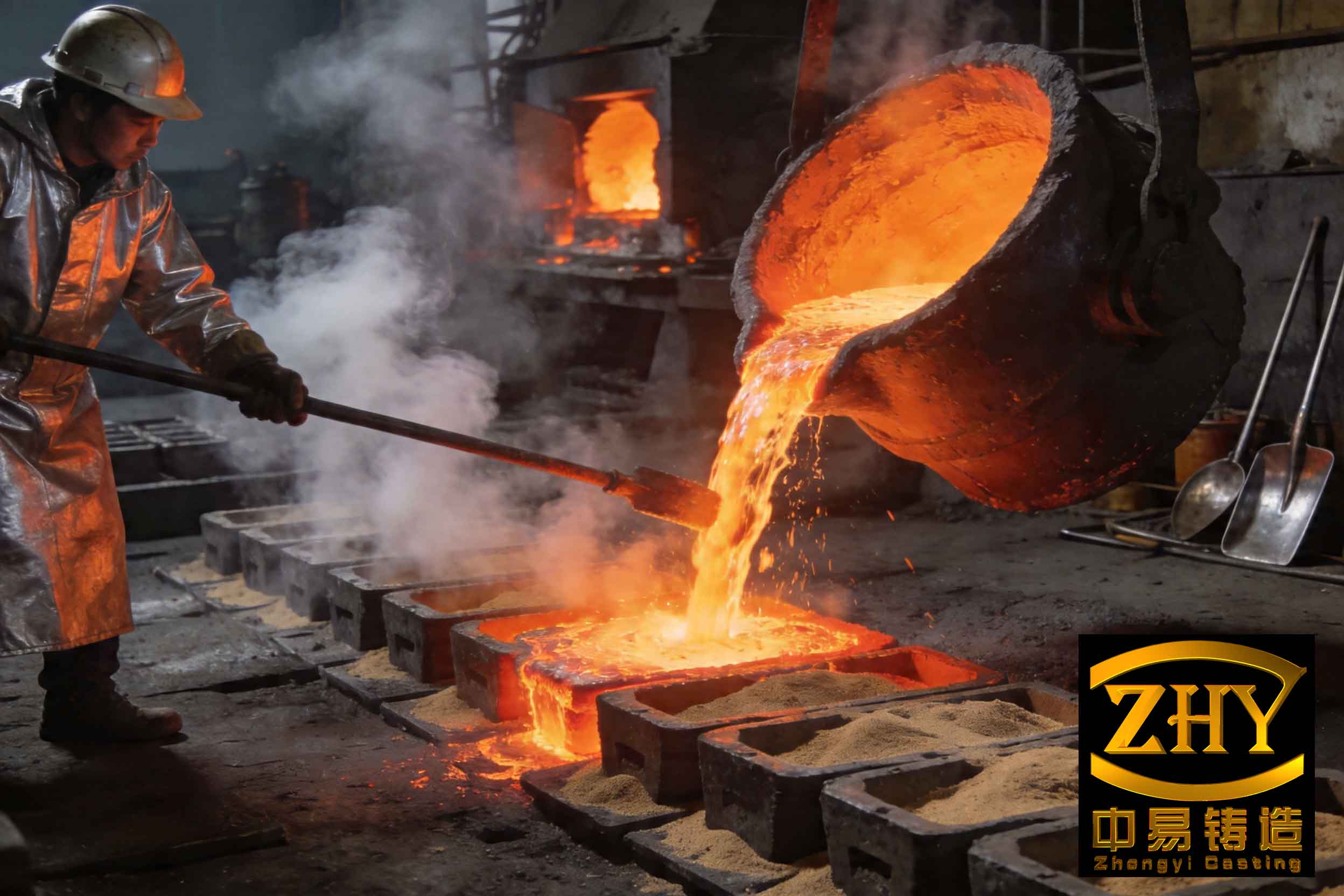
Melting, Chemistry Control, and Treatment
A strict raw material and chemistry control protocol is fundamental to producing high-ductility iron with low defect propensity. To minimize the introduction of carbide-stabilizing and trace elements that could impair nodularity and promote defect formation, the charge consisted of 20-30% high-purity pig iron balanced with 70-80% selected steel scrap. No returns were used to avoid the accumulation of trace elements from previous treatments.
The target base iron chemistry was carefully chosen to serve as an optimal platform for subsequent treatment:
| Element | Target Range (wt.%) | Purpose & Rationale |
|---|---|---|
| Carbon (C) | 3.8 – 3.9 | Promotes graphitization, improves fluidity, reduces shrinkage tendency. Taken at high end for this grade. |
| Silicon (Si) | 0.9 – 1.0 | Base level; strong graphitizer but controlled pre-inoculation to allow for effective late inoculation. |
| Manganese (Mn) | 0.2 – 0.3 | Kept as low as possible to avoid pearlite stabilization and segregation. |
| Phosphorus (P) | ≤ 0.05 | Minimized to prevent the formation of brittle phosphide eutectics. |
| Sulfur (S) | ≤ 0.02 | Low base sulfur is critical for efficient magnesium treatment and clean metal. |
Melting was conducted in a medium-frequency induction furnace. The treatment process is the heart of ductile iron production. A sandwich method in a pre-heated, well-designed treatment ladle was used.
- Nodularization: A Mg-FeSi-Ce alloy (nodularizer) was placed in the well of the ladle, covered by a layer of primary inoculant, and then topped with a light steel scrap cover to delay reaction.
- Inoculation: A multi-stage inoculation strategy was critical for achieving high nodule count and roundness, which directly influences mechanical properties and defect formation. The total inoculation addition can be represented as a summation of stages:
$$ I_{total} = I_{primary} + I_{stream} + I_{late} $$
Where typically:
$$ I_{primary} \approx 0.4\% ,\quad I_{stream} \approx 0.5\% ,\quad I_{late} \approx 0.1\% $$
The late inoculation, using a fine-grained (0.2-0.7 mm) FeSi alloy, was added directly into the pouring stream to maximize nucleation potency.
Quality Verification: Attached Test Block Analysis
Quality was rigorously monitored via attached test blocks (Y-blocks). Two randomly selected castings (A1, A2) were subjected to full characterization.
| Sample | C (%) | Si (%) | Mn (%) | P (%) | S (%) | RE (%) | Mg (%) |
|---|---|---|---|---|---|---|---|
| A1 | 3.57 | 1.98 | 0.22 | 0.022 | 0.010 | 0.0059 | 0.045 |
| A2 | 3.58 | 2.00 | 0.23 | 0.023 | 0.009 | 0.0055 | 0.047 |
The chemistry confirmed successful treatment with low residual magnesium and rare earths, vital for minimizing oxidation tendency.
| Sample | Rm (MPa) | Rp0.2 (MPa) | Elongation, A (%) | Hardness (HBW) |
|---|---|---|---|---|
| A1 | 383 | 246 | 25.5 | 126 |
| A2 | 379 | 241 | 26.0 | 130 |
Metallographic examination revealed excellent microstructures: nodularity >95%, graphite size of 6 (ASTM), nodule count >200 nodules/mm², and a ferrite content exceeding 98%. All specified mechanical and metallographic targets were met.
Slag Inclusions: Root Cause Analysis and Mechanism
Despite meeting test block specifications, ultrasonic testing identified indications in casting A1 suggestive of subsurface discontinuities. Subsequent sectioning and microscopic analysis confirmed the presence of slag inclusions in the upper sections of the casting cavity. Slag inclusions in ductile iron are primarily complex oxides and sulfides (e.g., MgO, SiO₂, MgS, Ce₂O₃) formed during treatment and pouring. Their formation is governed by thermodynamic and kinetic factors.
The primary sources analyzed were:
- Pouring Temperature: This is a critical parameter with a non-linear relationship to defect formation. At low temperatures (~1300°C and below), metal viscosity is high, severely hindering the buoyant separation of oxide/sulfide particles. The particles remain entrained and are trapped by the advancing solidification front. As temperature increases, viscosity decreases according to an Arrhenius-type relationship, and Stokes’ law buoyancy velocity increases, favoring slag removal:
$$ v_b = \frac{2 g r^2 ( \rho_m – \rho_s )}{9 \eta} $$
where \( v_b \) is the buoyancy velocity, \( g \) is gravity, \( r \) is the particle radius, \( \rho_m \) and \( \rho_s \) are the density of metal and slag, and \( \eta \) is the metal viscosity. However, at excessively high temperatures, the slag layer becomes more fluid and less stable, making it easier to be entrained during turbulent pouring. Furthermore, high temperature accelerates the reaction: \( [Mg] + [S] \rightarrow MgS_{(s)} \), increasing the volume of sulfide slag. The initial process was operating at the lower end of the range (1300-1340°C), and the last casting from a ladle often fell below 1300°C, creating a high risk for slag inclusions. - Gating System Efficiency: While the open system was designed for slag trapping, its effectiveness was compromised by operational factors. An unfilled pouring basin and inconsistent slag skimming practice allowed oxide films (dross) to enter the runner. Once inside, fragmented dross particles could bypass the system and be carried into the mold cavity, resulting in dross-related slag inclusions.
- Chill Quality and Management: The extensive use of chills introduced another variable. Chills with rust, sand adhesion, or surface micro-porosity can generate gas and oxides upon contact with molten iron. Furthermore, chills degrade with repeated use; their cooling efficiency drops, and the degraded surface more readily promotes localized gas/slag reactions, leading to pinholes and associated slag defects near the chill-casting interface.
Implemented Countermeasures and Solutions
Based on the root cause analysis, a multi-pronged corrective action plan was implemented targeting the key variables influencing slag inclusions.
| Factor | Initial Condition / Problem | Corrective Action | Mechanism of Improvement |
|---|---|---|---|
| Pouring Temperature | Low (1300-1340°C), last cast often <1300°C. | Increased to 1360-1380°C. Strictly enforced for all casts from a ladle. | Reduces metal viscosity (\( \eta \)), increases slag-buoyancy velocity (\( v_b \)), extends slag-floatation time before solidification. |
| Gating System | Open system, reliant on skimming, prone to dross entry. | Integrated ceramic foam filters (150x150x32 mm) at the junction of runners and ingates. | Filters physically intercept macroscopic and microscopic non-metallic inclusions (slag inclusions) before metal enters the cavity. |
| Chill Management | Uncontrolled quality, surface condition, and reuse count. | Implemented strict protocol: Machined contact surfaces, pre-heating to 150°C, maximum 5 uses, inspection for rust/defects before each use. | Eliminates moisture/gas sources, ensures consistent chilling power, prevents gas-slag reactions at the interface. |
| Operation | Inconsistent basin filling and slag skimming. | Standardized pouring procedure: mandatory full basin, trained “basin-keeper” role for continuous slag removal. | Prevents primary oxide film (dross) from entering the gating system. |
Results and Validation
The combined countermeasures were applied to a subsequent production batch of 18 gear housing castings. The results were unequivocal:
- Defect Elimination: No slag inclusions were detected in the previously problematic upper sections of the castings upon visual and non-destructive testing (NDT) inspection.
- Ultrasonic Testing: All 18 castings passed ultrasonic inspection with no indications of slag-related or other shrinkage discontinuities.
- Consistent Quality: The mechanical properties and microstructure from the attached test blocks remained consistently within the stringent specification limits, confirming that the process changes did not adversely affect the metallurgy.
The relationship between pouring temperature and defect incidence was empirically validated, aligning with the theoretical model where an optimal window exists. The introduction of filters provided a critical failsafe against turbulent entrainment, and chill management removed a significant variable from the process.
Conclusion
The stable production of high-integrity, heavy-section ductile iron castings like the QT400-18RT gear housing requires a holistic approach that integrates robust process design, precise metallurgical control, and vigilant analysis of defect mechanisms. Slag inclusions represent a major quality threat stemming from interrelated factors in treatment, handling, and solidification.
This case study demonstrates that a systematic investigation into the causes of slag inclusions—focusing on pouring temperature dynamics, gating system effectiveness, and auxiliary tooling quality—can lead to effective, targeted solutions. Raising the pouring temperature to an optimal range (1360-1380°C) enhanced slag separation kinetics. The incorporation of ceramic foam filters provided a positive mechanical barrier against slag inclusions. Implementing a disciplined chill management program eliminated a key source of sub-surface defects.
The successful resolution, verified through extensive NDT and mechanical testing, underscores that preventing slag inclusions is not merely about one correction but about optimizing the entire chain from molten metal treatment to solidified casting. This integrated methodology ensures reliable production of ductile iron components that meet the most demanding performance criteria.