
In my decades of hands-on experience in the manganese steel casting foundry industry, I have witnessed the transformative impact of proper techniques on the quality and performance of high manganese steel and super high manganese steel castings. These materials are indispensable under high-impact conditions, yet many foundries struggle with fundamental aspects of their production. To bridge this gap, I will share practical insights, emphasizing critical steps from composition control to final inspection, all aimed at achieving superior castings. This guide is tailored for practitioners in manganese steel casting foundry operations, blending empirical knowledge with technical rigor to ensure repeatable success.
The essence of producing durable manganese steel castings lies in a holistic approach—every stage, from raw materials to post-processing, must be meticulously managed. I have visited numerous facilities where shortcuts led to failures, such as cracking, poor wear resistance, or inadequate toughness. By adhering to the principles outlined here, a manganese steel casting foundry can minimize defects and maximize output of premium castings. Let’s delve into the core components, starting with chemistry, which forms the foundation of material properties.
Chemical Composition: The Blueprint for Performance
Controlling chemical composition is paramount in a manganese steel casting foundry, as it directly influences hardness, toughness, and work-hardening ability. High manganese steel typically contains 11–14% manganese and 0.75–1.45% carbon, with lower carbon for higher impact applications. Super high manganese steel exceeds 18% manganese. Silicon should be kept low (≤0.5%) to preserve impact toughness, while phosphorus and sulfur must be minimized—phosphorus below 0.07% is critical to prevent embrittlement. Chromium around 2.0% enhances wear resistance. Here’s a summary based on standards and practical adjustments:
| Element | High Manganese Steel Range | Super High Manganese Steel Range | Key Influence |
|---|---|---|---|
| Carbon (C) | 0.75–1.45% | 0.7–1.2% | Hardness vs. toughness; lower for high impact |
| Manganese (Mn) | 11.0–14.0% (≥13% ideal) | >18% | Austenite stability, work-hardening |
| Silicon (Si) | ≤0.5% | ≤0.4% | Reduces impact toughness if high |
| Phosphorus (P) | <0.07% | <0.05% | Causes brittleness; must be minimized |
| Sulfur (S) | <0.03% | <0.02% | Detrimental inclusions; Mn naturally desulfurizes |
| Chromium (Cr) | 1.5–2.5% | 2.0–3.0% | Improves abrasion resistance |
The carbon-to-manganese ratio is crucial for austenitic structure. A simplified relationship for desired austenite retention can be expressed as: $$A_{stable} = \frac{Mn}{C} \geq 10$$ where higher ratios enhance toughness. For a manganese steel casting foundry, maintaining this balance ensures castings withstand repetitive impacts without fracturing.
Charge Materials: Selecting the Right Feedstock
In a manganese steel casting foundry, charge materials dictate final chemistry and purity. The primary charge should be high-quality carbon steel or steel ingots, supplemented by high-carbon ferromanganese, medium-carbon ferromanganese, high-carbon ferrochromium, and limited returns (used castings). A common pitfall is overusing returns—this introduces oxides and inconsistencies, degrading quality. I recommend keeping returns below 25% of total charge weight. Excessive returns often stem from high scrap rates; by improving processes, returns can be controlled. Below is a typical charge makeup for a 1000 kg heat:
| Material | Percentage (%) | Mass (kg) | Purpose |
|---|---|---|---|
| Carbon Steel | 60–70 | 600–700 | Base iron, low residuals |
| High-Carbon FeMn | 15–20 | 150–200 | Mn and C addition |
| Medium-Carbon FeMn | 5–10 | 50–100 | Fine-tuning Mn without excess C |
| High-Carbon FeCr | 2–4 | 20–40 | Cr for wear resistance |
| Returns (Clean) | ≤25 | ≤250 | Economy, but limit impurities |
Charge materials should be sized 50–80 mm to promote rapid melting and reduce segregation. Large chunks (e.g., 200–300 mm) hinder heat transfer and cause compositional gradients—a mistake I’ve seen lead to uneven properties in manganese steel casting foundry outputs.
Melting Practices: Precision in the Furnace
Melting is where chemistry comes to life; careless practices here ruin even the best charges. In a manganese steel casting foundry, whether using induction or arc furnaces, sequence matters. Start by melting carbon steel, then add ferromanganese in small, multiple batches to minimize oxidation. Expensive alloys like ferrochromium go last. Aim for a final temperature of 1580–1600°C to ensure fluidity and gas removal. Deoxidation and degassing are critical: use aluminum wire or Si-Ca alloy, plunged deep into the melt, followed by a cover flux to shield from air. A calming period allows inclusions to float—skimping on this causes defects.
Adjust manganese and carbon with medium-carbon ferromanganese during the calm phase. Before tapping, inoculate with V-Fe, Ti-Fe, or rare-earth microalloys for grain refinement, which boosts toughness. The inoculation effect on grain size can be approximated by: $$d = k \cdot (CET)^{-n}$$ where d is grain diameter, CET is cooling rate, and k, n are constants dependent on inoculant type. Preheat ladles to >400°C to prevent thermal shock and reoxidation. In a manganese steel casting foundry, these steps transform molten metal into a homogeneous, clean alloy ready for casting.
Refractories and Molding Materials: Ensuring Compatibility
Manganese steel’s basic nature demands alkaline refractories. Magnesia-based linings are ideal for furnaces; they resist slag attack and extend campaign life. For ramming linings, apply layers ≤80 mm, compact thoroughly, and bake slowly. Preformed crucibles are a boon for efficiency—they install quickly and reduce breakout risks. I’ve observed operators throwing charge from afar, damaging linings and safety; instead, preheat materials near the furnace and place them gently along the walls.
Molding sands and coatings must match metal chemistry. Neutral materials like chromite sand or alumina are preferred; their high heat capacity accelerates solidification, refining as-cast structure. For lost-foam casting, chromite sand counters slow cooling. A well-designed manganese steel casting foundry uses these materials to achieve consistent surface finish and dimensional accuracy. Consider this comparison:
| Material | pH Nature | Heat Capacity (J/g·°C) | Suitability for Mn Steel |
|---|---|---|---|
| Chromite Sand | Neutral | 0.8–1.0 | Excellent, promotes chilling |
| Silica Sand | Acidic | 0.7–0.8 | Poor, reacts with basic slag |
| Magnesia | Basic | 1.0–1.2 | Good for linings, not molds |
| Zircon Sand | Neutral | 0.5–0.6 | Moderate, expensive |
Casting Process Design: Engineering Solidification
Manganese steel has high solidification shrinkage (~25–27%) and poor thermal conductivity, demanding thoughtful design. In a manganese steel casting foundry, pattern allowances should account for this: for large castings, use upper shrinkage limits (e.g., 27%). Gating systems must be open and multiple ingates placed at thin sections, shaped as flat, wide trumpets to ensure rapid, tranquil filling. Risers must be larger than hot spots, adjacent to them, and hot-topped—even gating-riser combinations—to feed shrinkage. Position sprue and risers higher with a 5–8° mold tilt for better feeding.
Chills, both internal and external, are invaluable: they refine grains and eliminate shrinkage. Internal chills should be small, clean, and fusible; external chill dimensions relate to casting dimensions by a factor of 0.6–0.7. For a casting thickness T, chill width W can be: $$W = 0.65 \times T$$ Oversized chills cause cracks. Pour at low temperatures but fast rates to minimize thermal gradients. After pouring, allow prolonged in-mold cooling below 200°C before shakeout to reduce stresses. Here’s a design checklist for a manganese steel casting foundry:
| Parameter | Recommendation | Rationale |
|---|---|---|
| Shrinkage Allowance | 25–27% | High contraction of Mn steel |
| Gating Ratio | Open (e.g., 1:2:3) | Minimize turbulence |
| Ingate Shape | Flat, trumpet-like | Distribute flow evenly |
| Riser Size | >1.5× hot spot diameter | Adequate feeding reserve |
| Chill Factor | 0.6–0.7 of casting dimension | Control cooling without cracking |
| Pouring Temperature | 1480–1520°C | Balance fluidity and grain size |
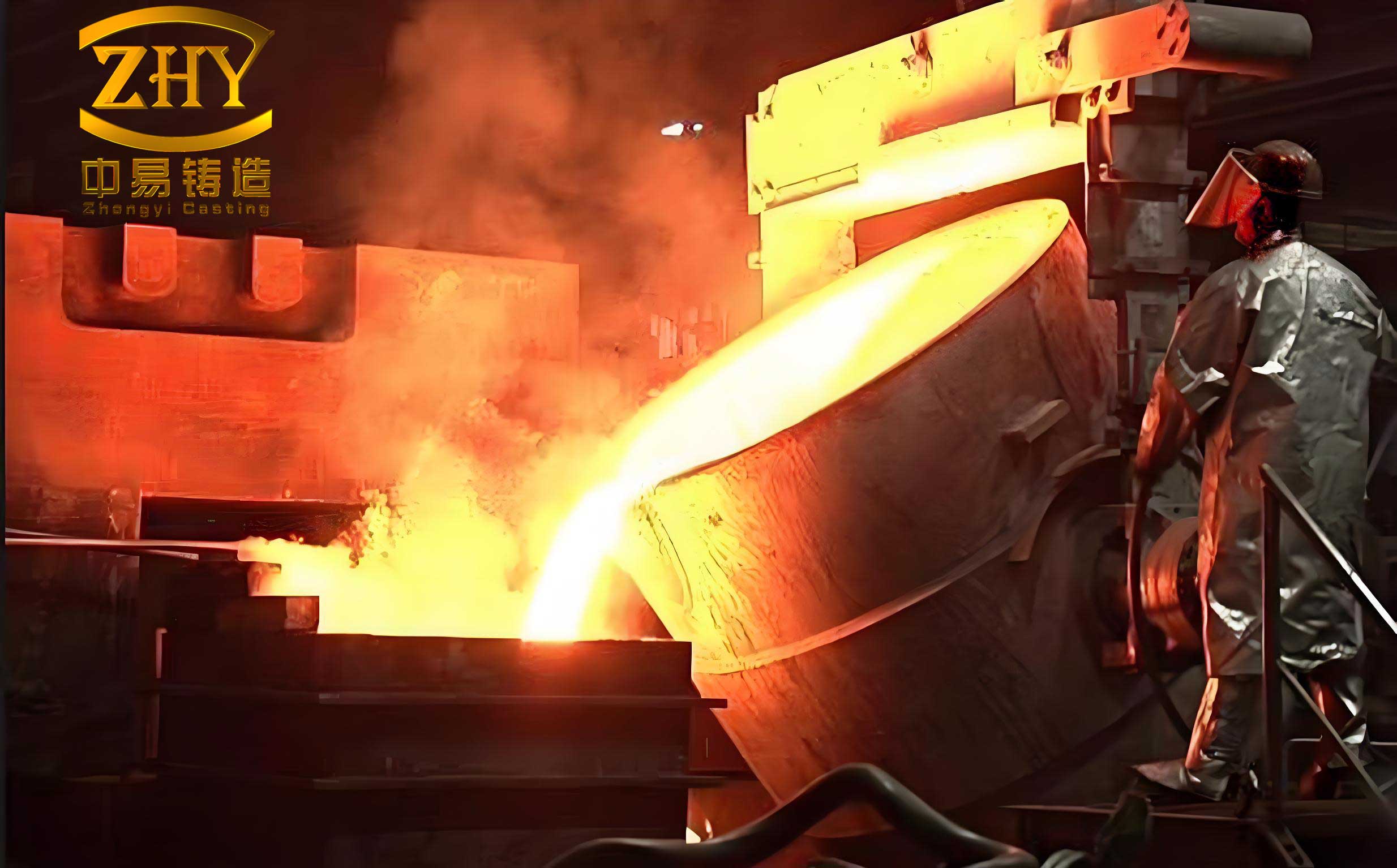
The image above illustrates a typical high manganese steel casting, showcasing the complex geometries achievable with proper design in a manganese steel casting foundry. Note the robust risering and gating, essential for soundness.
Heat Treatment: Unlocking Austenitic Toughness
Heat treatment is make-or-break; I’ve seen sound castings crack due to improper heating. The goal is to dissolve carbides and obtain a homogeneous austenitic matrix. For high manganese steel, heat to 1050–1100°C, hold for sufficient time, then water quench. The challenge is low thermal conductivity—heating too fast below 750°C induces thermal stresses. Use slow ramp rates: <80°C/h below 350°C, <100°C/h below 750°C, with intermediate soaks. Above 750°C, rapid heating is safe due to increased plasticity.
For super high manganese steel, a double austenitizing cycle helps: heat to 1050°C, cool in furnace to 850°C, then reheat to 1100°C before quenching. This enhances carbide dissolution. Quenching must be swift: transfer time <30 seconds into water <30°C, with water volume ≥8 times casting weight. Circulate water from bottom to top, and agitate castings in three dimensions. The quenching rate affects hardness; a simplified model for cooling rate Q is: $$Q = \frac{k \cdot (T_m – T_w)}{V^{1/3}}$$ where k is a constant, Tm is metal temperature, Tw is water temperature, and V is casting volume. Below are typical heat treatment parameters for a manganese steel casting foundry:
| Stage | Temperature Range (°C) | Heating Rate (°C/h) | Hold Time (min/cm thickness) |
|---|---|---|---|
| Low-Temperature Heat | 20–350 | <80 | 10–15 |
| Intermediate Heat | 350–750 | <100 | 15–20 |
| High-Temperature Heat | 750–1100 | 150–200 | 20–30 |
| Quench | 1100 to water | Immediate | N/A |
Post-quench, castings should be tempered if needed, but often the as-quenched state suffices. Monitoring these steps ensures every piece from a manganese steel casting foundry meets impact standards.
Cutting and Welding: Finishing with Care
Poor thermal conductivity makes manganese steel prone to heat-affected zone cracks during cutting and welding. For riser removal, submerge the casting in water, exposing only the cut area, and leave a stub for post-heat-treatment grinding. Welding requires austenitic manganese-nickel electrodes (e.g., ENiCrMo-type), diameter 3.2 mm, with basic coating. Use low current, short arc, small beads, and multiple layers to limit heat input. Peen each pass to relieve stress. Critical castings must be non-destructively tested (e.g., dye penetrant or ultrasonic). In a manganese steel casting foundry, these practices salvage value and extend service life.
A common error is using mild steel electrodes (like E7018) with high current—this invites brittle zones. The heat input HI should be controlled: $$HI = \frac{60 \cdot V \cdot I}{S}$$ where V is voltage, I is current, and S is travel speed (mm/min). Keep HI below 1.5 kJ/mm for manganese steel. Here’s a welding parameter guide:
| Parameter | Value | Reason |
|---|---|---|
| Electrode Type | Austenitic (D256/D266) | Matches base metal microstructure |
| Current (A) | 90–120 for 3.2 mm | Minimizes dilution and heat |
| Voltage (V) | 20–25 | Stable short arc |
| Travel Speed (mm/min) | 50–100 | Prevents overheating |
| Interpass Temperature | <100°C | Avoids cumulative stress |
Quality Assurance and Economic Considerations
In a competitive manganese steel casting foundry, quality isn’t just technical—it’s economic. Reducing scrap lowers costs more than cheapening inputs. Every defective casting represents wasted energy, materials, and time. Implement statistical process control (SPC) for key variables like chemistry and temperature. Use spectrometers for rapid analysis and thermocouples for real-time monitoring. The total cost TC of production can be modeled as: $$TC = C_m + C_l + C_e + C_s$$ where Cm is material cost, Cl is labor, Ce is energy, and Cs is scrap cost. Minimizing Cs through robust practices boosts profitability.
Moreover, a manganese steel casting foundry should invest in training. Operators must understand why steps matter, not just follow routines. For instance, knowing that slow heating prevents cracks fosters diligence. Regular audits of furnace practices, mold preparation, and heat treatment logs ensure consistency. I recall a facility that cut corners on deoxidation, leading to porous castings; after retraining, their yield improved by 15%.
Conclusion: A Mnemonic for Excellence
To encapsulate these principles, I’ve distilled them into a verse—a handy reminder for any manganese steel casting foundry team:
- Low phosphorus, low sulfur, control silicon and carbon; keep manganese high, this is the first bargain.
- Carbon steel leads the charge, add manganese iron in batches not large.
- Treasure costly elements, add late to avoid resentment.
- Deoxidize, degas, and calm the brew, adjust manganese and carbon anew.
- Refine grains with micro-additions, this wards off brittle limitations.
- Design with care, chill and feed everywhere; use cold iron wise, specify shape and size.
- Gates thin and wide, trumpet-shaped to guide; risers big and nigh, toward hot spots they lie.
- Pour cool and fast, solidify at last; feed risers pronto, then let molds relax slow.
- Basic linings for the furnace, including sands that enhance sternness.
- Shrinkage brings cracking risk, so cores and molds should be brisk.
- Cut in water with a stub, grind later with a rub.
- Heat treat with patience, slow rise wins the races; reach high heat, then quench complete.
- Water volume eightfold, keep it fresh and cold; agitate in 3D, for toughness to be.
- Weld with tiny arcs, nickel rods leave their marks; layers small and neat, peening beats the heat.
- Inspect critical parts, with probes and arts; ensure quality prime, for success every time.
- This steel sums in a line: shrinks a lot, heat moves slow as a clot. Follow this rhyme, achieve sublime.
Embracing these practices transforms a manganese steel casting foundry into a center of excellence. It’s not about quick fixes but disciplined execution—where each casting emerges as a testament to metallurgical art. As the industry evolves, continuous improvement in these areas will keep manganese steel castings at the forefront of demanding applications, from mining to construction. Remember, in a manganese steel casting foundry, precision begets performance, and diligence drives durability.