
In the field of diesel engine manufacturing, the cylinder block stands as a critical component whose casting quality directly influences engine performance. Traditionally, high-grade gray cast iron or alloy cast iron has been widely used for diesel engine cylinder blocks. However, these materials often suffer from thermal fatigue cracks due to their nearly zero elongation characteristics. Additionally, high-grade gray cast iron has a composition far from the eutectic point, resulting in a wider cooling crystallization range and poorer casting properties, leading to shrinkage porosity and leakage failures. In contrast, nodular cast iron offers superior strength and higher elongation under harsh conditions such as high temperature, high pressure, and poor lubrication. Ferritic nodular cast iron exhibits better fatigue resistance compared to gray cast iron and alloy cast iron, making it an ideal material for cylinder blocks that require complex stress handling, high loads, and a balance of strength and toughness. Moreover, its production cost is lower than that of alloy cast iron. Thus, nodular cast iron has become a preferred choice for diesel engine cylinder blocks. In this article, I will detail the trial production process of an as-cast ferritic nodular cast iron cylinder block, focusing on structural design, technical requirements, melting and casting工艺, and experimental results.
The cylinder block in question is designed for a C500 diesel engine, intended for military applications. The material specification is QT400-18A nodular cast iron, with overall dimensions of 2,650 mm × 1,160 mm × 870 mm and a rough casting weight of 3.2 tons. It features 20 cylinder holes arranged in a V-type configuration, with wall thicknesses ranging from a minimum of 8 mm to a maximum of 62 mm. The structural complexity includes thin-walled ribs and thick-walled regions such as cylinder holes and bearing seats, creating significant thermal gradients during solidification. To ensure quality, stringent technical requirements were established, as summarized in Table 1.
| Parameter | Requirement |
|---|---|
| Chemical Composition | w(S) ≤ 0.02%, w(P) ≤ 0.05% |
| Impact Toughness | Average of three samples: 14 J/cm², individual not below 11 J/cm² |
| Metallurgical Structure | Nodularity grade 1-2, graphite size 5-6, ferrite volume fraction ≥ 90% |
| Pressure Testing | Water pressure: 0.5 MPa for 10 min; Oil pressure: 1.2 MPa for 15 min; no leakage |
| Internal Defect Control | No shrinkage defects in cylinder holes, bolt holes, etc., verified by dissection and ultrasonic testing |
The melting process employed a duplex method involving a cupola furnace and a holding furnace. The charge composition consisted of 78% Q10 pig iron and 22% steel scrap. The target chemical composition for the nodular cast iron was carefully controlled, as shown in Table 2. The nodularizing treatment used a conventional冲入法 in a堤坝式处理包, with nodularizing agent added at approximately 1.7% of the total iron weight of 4.3 tons. Inoculation was enhanced through multiple stages to refine graphite, increase graphite nodule count, and improve nodularity. The process involved covering the nodularizing agent with 0.1% silicon-barium inoculant (5-15 mm grain size), adding 0.4% inoculant during tapping, and another 0.4% after slag removal, followed by 0.1%随流孕育剂 during pouring. The tapping temperature from the holding furnace was maintained at 1,480–1,490°C, with a pouring temperature range of 1,360–1,380°C. The effectiveness of inoculation can be related to the cooling rate and undercooling, often expressed by equations such as the nucleation rate formula: $$ N = N_0 \exp\left(-\frac{\Delta G^*}{kT}\right) $$ where \( N \) is the nucleation rate, \( N_0 \) is a pre-exponential factor, \( \Delta G^* \) is the activation energy for nucleation, \( k \) is Boltzmann’s constant, and \( T \) is temperature. For nodular cast iron, enhanced inoculation promotes graphite nodule formation, critical for achieving the desired microstructure.
| Element | Content (wt%) |
|---|---|
| C | 3.51 |
| Si | 2.7 |
| Mn | 0.2 |
| P | 0.03 |
| S | 0.009 |
| Mg | 0.052 |
| RE | 0.041 |
The casting工艺 was designed to address challenges such as shrinkage defects, cold shuts, and dimensional deviations due to uneven wall thickness. A three-part molding system (upper, middle, and lower boxes) was adopted for ease of gating system placement, core assembly, and debris removal. The gating system was closed-type, with a gating ratio of \( \Sigma F_{\text{直}} : \Sigma F_{\text{横}} : \Sigma F_{\text{内}} = 1.18 : 1.04 : 1 \). A stopper-controlled pouring cup was used to initiate bottom pouring through the lower gating system first, followed by simultaneous pouring from the upper gating system when 3/4 of the mold was filled. The sprue introduced iron into the cavity from the center of the flywheel end. The runners were distributed in two layers: the lower runner had a cross-section of 80/70 mm × 75 mm, and the upper runner measured 65/55 mm × 65 mm. The ingates comprised 22 ceramic tubes of φ25 mm for bottom pouring and 16 flat gates of 55/50 mm × 9 mm on the upper parting surface to maintain temperature in the upper regions. This design ensured smooth filling and minimized turbulence, crucial for resin sand molds that require fast and stable pouring.
To manage solidification shrinkage in nodular cast iron, which cannot rely solely on graphitization expansion, a combination of risers and chills was implemented. Eight φ180 mm top-mounted exothermic insulating risers were evenly placed on the upper box. These risers utilize exothermic materials to sustain high temperatures in the riser iron, creating a favorable temperature gradient from top to bottom. The补缩效率 of risers can be quantified by the feeding efficiency formula: $$ \eta = \frac{V_{\text{feeding}}}{V_{\text{riser}}} \times 100\% $$ where \( \eta \) is the feeding efficiency, \( V_{\text{feeding}} \) is the volume of iron used to feed the casting, and \( V_{\text{riser}} \) is the total riser volume. Ordinary risers typically have an efficiency of 6–10%, insulating risers 20–25%, and exothermic insulating risers up to 45%. By maintaining a steep temperature gradient, these risers enhanced液态补缩, preventing shrinkage defects in thick sections. Additionally,随形冷铁 were applied to critical thick-walled areas like cylinder holes and bolt holes to accelerate cooling and improve densification, reducing the risk of internal shrinkage. The solidification process can be modeled using the Chvorinov’s rule: $$ t_s = B \left( \frac{V}{A} \right)^n $$ where \( t_s \) is solidification time, \( B \) is a mold constant, \( V \) is volume, \( A \) is surface area, and \( n \) is an exponent. For nodular cast iron, controlling cooling rates through chills helps achieve uniform solidification.
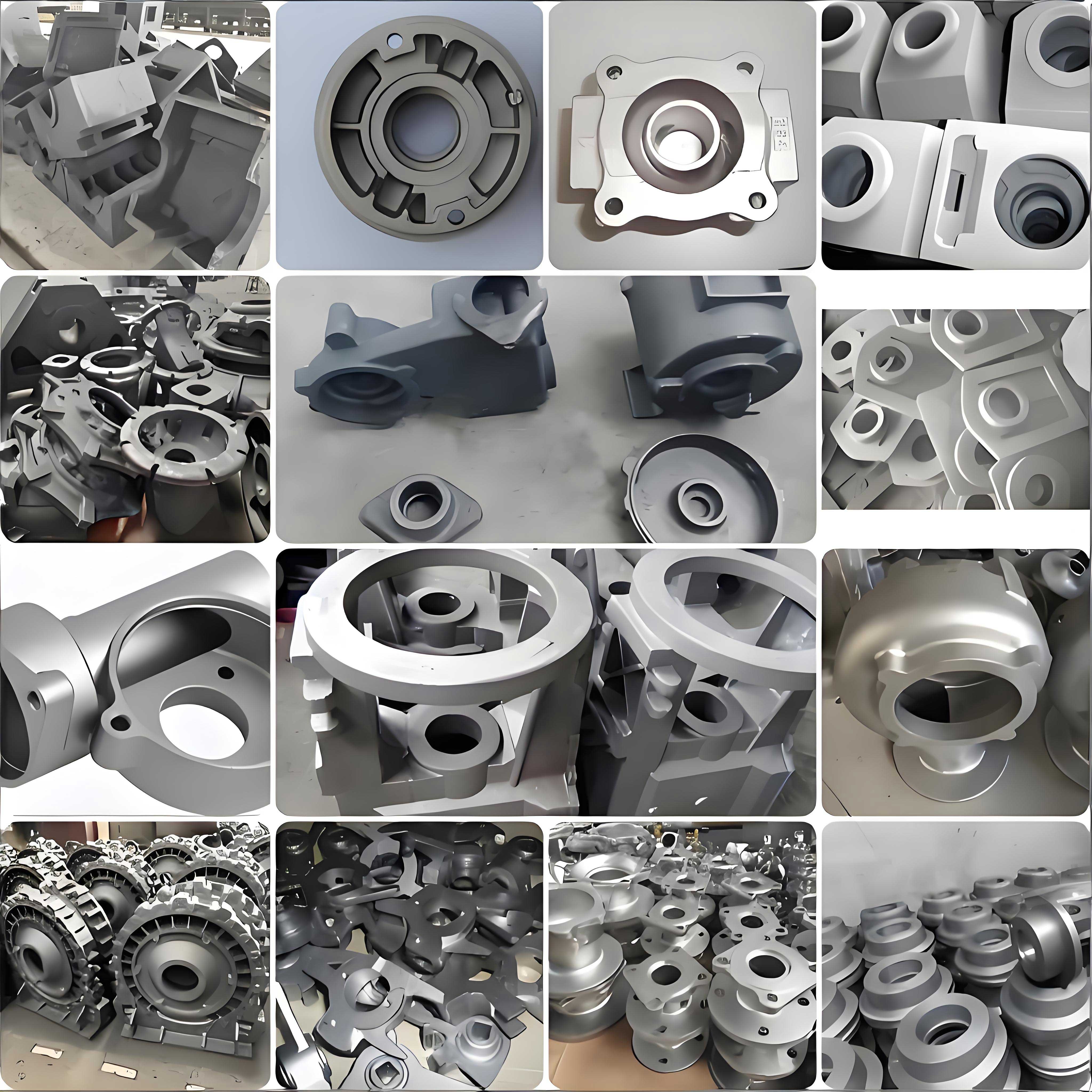
After trial production, the nodular cast iron cylinder block underwent comprehensive testing. Specimens were taken from the casting本体 for metallurgical and mechanical analysis. The metallurgical structure, as observed under显微镜, showed a nodularity of 90%, graphite size of grade 6, and a ferritic matrix volume fraction exceeding 90%, meeting the technical requirements. The mechanical properties are summarized in Table 3. These results demonstrate that the nodular cast iron achieved the desired balance of strength and ductility, essential for cylinder block applications. The impact toughness values, in particular, highlight the material’s resilience under dynamic loads.
| Property | Value |
|---|---|
| Tensile Strength | 442 MPa |
| Yield Strength | 305 MPa |
| Elongation | 22% |
| Impact Absorbed Energy (3 samples) | 15 J, 15 J, 16 J |
| Hardness | 160 HBW |
Defect inspection included ultrasonic testing according to JB/T 5439—1991 standards, where all critical areas met grade 2 requirements. Pressure tests involved water pressure at 0.5 MPa for 10 minutes and oil pressure at 1.2 MPa for 15 minutes, with no leakage observed. Additionally, dissection of the first article confirmed the absence of shrinkage defects in cylinder holes, bolt holes, and other thick sections. These outcomes validate the effectiveness of the casting工艺 in producing sound nodular cast iron components. The success can be attributed to the optimized gating system, which minimized turbulence, and the use of exothermic insulating risers, which maximized feeding efficiency. The temperature gradient control during solidification played a key role in preventing defects, as described by the heat transfer equation: $$ \frac{\partial T}{\partial t} = \alpha \nabla^2 T $$ where \( T \) is temperature, \( t \) is time, and \( \alpha \) is thermal diffusivity. By managing this gradient, the工艺 ensured directional solidification towards the risers.
In summary, the trial production of this ferritic nodular cast iron cylinder block highlights the advantages of nodular cast iron over traditional materials. Through intensified inoculation measures, such as multiple-stage silicon-barium additions, the graphite nodules were refined, and nodularity was enhanced, leading to superior metallurgical structures and mechanical properties. The casting工艺, featuring a well-designed gating system, exothermic insulating risers, and strategic use of chills, effectively addressed shrinkage and leakage issues. This approach demonstrates the feasibility of using nodular cast iron for complex, high-performance components like diesel engine cylinder blocks. Future work could focus on进一步 optimizing the inoculation process to reduce costs or exploring digital模拟 techniques for工艺 design. Nonetheless, this trial underscores the potential of nodular cast iron in advancing casting technology for demanding applications.
The properties of nodular cast iron, such as its high elongation and fatigue resistance, make it suitable for various industrial uses beyond cylinder blocks. For instance, in automotive and machinery sectors, nodular cast iron components can withstand cyclic loads and高温 environments. The graphitization process in nodular cast iron contributes to its ductility, which can be expressed by the relationship between graphite nodule count and mechanical properties: $$ \sigma_y = \sigma_0 + k_y d^{-1/2} $$ where \( \sigma_y \) is yield strength, \( \sigma_0 \) is a material constant, \( k_y \) is a strengthening coefficient, and \( d \) is graphite nodule diameter. By controlling inoculation and cooling rates, the microstructure of nodular cast iron can be tailored to meet specific requirements. This versatility reinforces the importance of nodular cast iron in modern manufacturing.
In conclusion, the production trial of this nodular cast iron cylinder block achieved all technical specifications through careful control of melting, casting, and solidification processes. The use of优质 raw materials, precise chemical composition management, and innovative工艺 design resulted in a high-quality casting with excellent mechanical and metallurgical properties. This success paves the way for broader adoption of nodular cast iron in critical applications, leveraging its unique combination of strength, ductility, and cost-effectiveness. As casting technology evolves, nodular cast iron will continue to play a vital role in meeting the demands of advanced engineering systems.