
In modern manufacturing, the demand for high-performance, lightweight components with complex geometries has driven significant advancements in near-net-shape forming technologies. Among these, prototype investment casting stands out as a critical method for producing intricate parts with excellent dimensional accuracy and surface finish. I have extensively explored this technique, particularly for titanium alloys, which offer exceptional properties such as low density, high specific strength, corrosion resistance, low thermal conductivity, small linear expansion coefficients, and non-toxicity. These attributes make titanium alloys ideal for aerospace, marine, and chemical processing applications, but their high production costs often limit broader adoption. Prototype investment casting, as a near-net-shape process, minimizes material waste and reduces manufacturing expenses, enabling cost-effective production of complex structures that are otherwise difficult or uneconomical to fabricate through machining or welding. This article delves into the detailed design and implementation of a prototype investment casting process for a titanium alloy impeller with complex curved blades, highlighting key innovations in mold scaling, gating systems, and quality control.
Titanium alloys, such as ZTC4, are renowned for their superior mechanical and chemical properties, but their high reactivity in molten state poses challenges for casting. Prototype investment casting addresses these by using chemically stable refractory materials and controlled environments. The impeller in focus features a complex geometry with four open blades on a central hub, exhibiting irregular variable cross-sections, thin walls as low as 3.8 mm, and minimal edge radii of R1.5 mm. With an overall dimension of φ490 mm × 290 mm and a mass of 39 kg, this component requires stringent quality standards: internal metallurgical quality per GJB2896A—2007 Grade C, surface quality via dye penetrant inspection, surface roughness of 6.3 μm, and dimensional tolerances according to GB/T6414—1999 CT9 grade. Through prototype investment casting, we aimed to achieve these specifications while reducing costs and lead times compared to traditional machining methods.
The success of prototype investment casting hinges on precise wax pattern design. Given the impeller’s complex曲面, we employed 3D printing for wax pattern fabrication, with linear shrinkage rates typically ranging from 1.0% to 2.0%. However, due to varying distances from the casting’s shrinkage center, uniform scaling is insufficient. We implemented a segmented scaling approach, where the scale factor increases progressively from the blade near-end to the far-end. This ensures that the mold dimensions align with the intended design after accounting for differential contraction. The scale factors are defined as follows: near-end regions use 1.0%, transitioning to 2.0% at the far-end. Mathematically, the adjusted pattern dimension \( L_p \) can be expressed as: $$ L_p = L_d \times (1 + S_r) $$ where \( L_d \) is the design dimension and \( S_r \) is the region-specific scale factor (e.g., 0.01 for 1%). Additionally, titanium alloy’s linear shrinkage during solidification varies from 0.5% to 0.8%, influenced by section thickness and geometry. To counteract distortion, we applied reverse deformation compensation, setting compensation values from 0.8% at near-ends to 0.5% at far-ends, with thicker areas at 1.0%. This compensation offsets the non-uniform cooling stresses, encapsulated by the formula: $$ C = L_d \times (1 – S_c) $$ where \( C \) is the compensated dimension and \( S_c \) is the shrinkage compensation factor. The table below summarizes the segmented parameters for the wax pattern in this prototype investment casting process.
| Component Region | Distance from Hub (mm) | Scale Factor, \( S_r \) (%) | Compensation Factor, \( S_c \) (%) | Adjusted Pattern Dimension (mm) |
|---|---|---|---|---|
| Blade Near-End | 0-50 | 1.0 | 0.8 | Calculated per design |
| Blade Mid-Section | 50-150 | 1.5 | 0.65 | Calculated per design |
| Blade Far-End | 150-245 | 2.0 | 0.5 | Calculated per design |
| Central Hub (Thick) | N/A | 1.0 | 1.0 | Calculated per design |
| Thin-Wall Transitions | Variable | 1.2 | 0.7 | Calculated per design |
Gating and riser system design is paramount in prototype investment casting to ensure smooth filling and defect-free solidification. For this impeller, we adopted a top-pouring approach with dispersed ingates to promote laminar flow and sequential solidification from the bottom-up. A annular gating and riser system was placed at the top center, with open risers at each blade tip to vent gases and collect impurities. Five ingates were strategically positioned to accelerate alloy upward movement, minimizing turbulence and reducing inclusions. Vent holes were added from near-end to far-end along the blades to enhance mold exhaust. The gating ratio, defined as the cross-sectional area of ingates to choke area, was optimized to 1.2:1, calculated using: $$ R_g = \frac{A_i}{A_c} $$ where \( A_i \) is the total ingate area and \( A_c \) is the choke area. This design facilitates rapid filling while maintaining thermal gradients for directional solidification, critical in prototype investment casting for complex geometries.
Mold shell construction in prototype investment casting requires materials that resist reaction with molten titanium. We selected zirconia (ZrO₂) for the face coat due to its high chemical stability, with zirconium diacetate as a binder. The backup layers comprised aluminosilicate aggregates and silica sol slurry, reinforced with mullite sand. The shell-building process involved successive dipping, stuccoing, and drying cycles, followed by dewaxing in hot water and firing in a reduction atmosphere at 900–950°C for 2–2.5 hours to carbonize binders and remove residues. Post-firing, shells were vacuum-degassed at 950–1000°C under vacuum ≤5×10⁻² Pa for 2–2.5 hours to eliminate residual gases. This meticulous shell preparation ensures adequate strength and permeability, which are vital for achieving high-quality surfaces in prototype investment casting. The table below outlines key parameters for shell fabrication.
| Layer | Material | Binder | Drying Time (h) | Firing Temperature (°C) | Vacuum Degassing Conditions |
|---|---|---|---|---|---|
| Face Coat | Zirconia Powder | Zirconium Diacetate | 24 | 900-950 | 950-1000°C, ≤5×10⁻² Pa |
| Backup 1 | Aluminosilicate | Silica Sol | 12 | 900-950 | N/A |
| Backup 2-5 | Mullite Sand | Silica Sol | 8-10 | 900-950 | N/A |
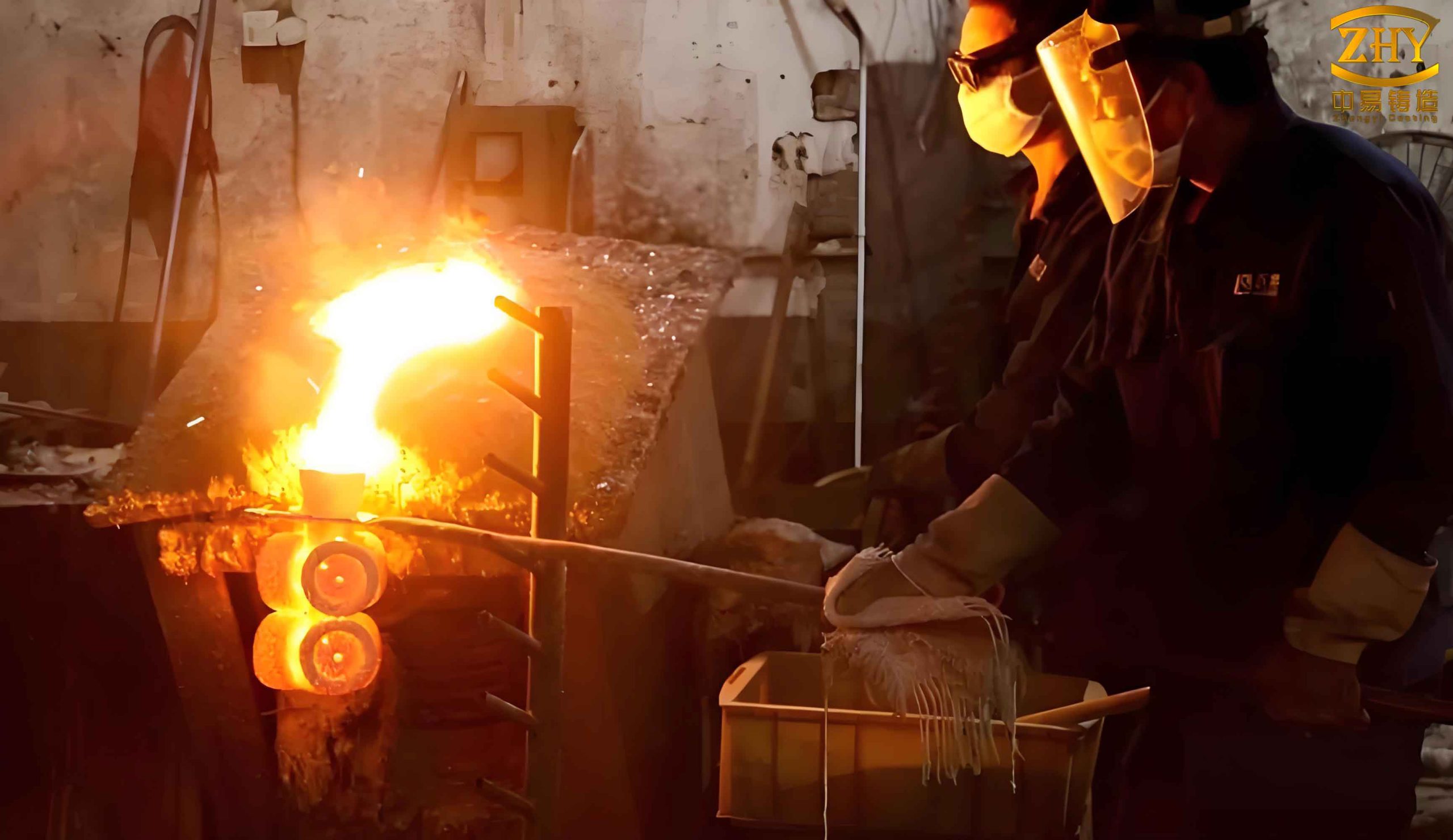
Melting and pouring are critical phases in prototype investment casting, especially for reactive alloys like titanium. We utilized a ZHK400 vacuum consumable electrode arc skull furnace for melting, employing secondary remelted ingots as electrodes. The melting parameters were carefully controlled to maintain a stable arc and minimize contamination. The process involves an initial arc strike current of 1000–1500 A, preheating at 3000–5000 A for 60–80 seconds, followed by melting at 28–36 kA with a voltage of 34–41 V. Vacuum levels were kept at 3.0–5.0 Pa, and crucible cooling water return temperature was maintained below 45°C to prevent overheating. The total melting time ranged from 45 to 60 minutes, ensuring thorough homogenization. The pouring temperature was set at approximately 1700°C, based on the liquidus temperature of ZTC4 alloy, calculated using: $$ T_p = T_l + \Delta T $$ where \( T_p \) is the pouring temperature, \( T_l \) is the liquidus temperature (~1660°C for ZTC4), and \( \Delta T \) is the superheat (40°C). This controlled environment in prototype investment casting minimizes oxidation and gas pickup, enhancing casting integrity.
Post-casting, the impeller underwent heat treatment and rigorous inspection to validate the prototype investment casting process. Hot isostatic pressing (HIP) was applied at 920±10°C under 100–140 MPa for 2–2.5 hours, followed by furnace cooling to below 300°C. This treatment eliminates internal voids and improves mechanical properties. Surface quality was assessed visually and via dye penetrant testing, revealing no cracks, cold shuts, or flow marks. Surface roughness measured 3.2 μm, surpassing the required 6.3 μm. Dimensional accuracy was verified against critical tolerances: for example, the design dimension of 290±3.2 mm yielded a measured 292.8 mm, φ116±2.5 mm resulted in φ117.9 mm, φ186±2.8 mm gave φ188.6 mm, and φ490±3.6 mm produced φ493.3 mm, all within CT9 grade. Internal quality was evaluated through X-ray radiography, showing no defects like porosity, shrinkage cavities, or inclusions, as summarized in the table below.
| Inspection Type | Standard/Requirement | Measured Value | Compliance |
|---|---|---|---|
| Surface Roughness | ≤6.3 μm | 3.2 μm | Yes |
| Dimensional Tolerance (Length) | 290 ± 3.2 mm | 292.8 mm | Yes |
| Dimensional Tolerance (Hub Dia.) | φ116 ± 2.5 mm | φ117.9 mm | Yes |
| X-ray Defects | GJB2896A Grade C | None detected | Yes |
| Chemical Composition | ZTC4 Specification | Within limits | Yes |
Chemical composition analysis was conducted on samples from the blade far-end, near-end, and central hub. The results, presented in the table below, confirm conformity to ZTC4 alloy standards, with aluminum (5.98–6.01%), vanadium (4.08–4.10%), iron (0.17–0.19%), and interstitial elements within allowable limits. This consistency underscores the effectiveness of prototype investment casting in maintaining alloy integrity during processing.
| Element | Blade Far-End | Blade Near-End | Central Hub | Standard Range |
|---|---|---|---|---|
| Al | 5.98 | 6.01 | 5.99 | 5.5–6.8 |
| V | 4.08 | 4.10 | 4.09 | 3.5–4.5 |
| Fe | 0.17 | 0.19 | 0.18 | ≤0.30 |
| Si | 0.08 | 0.09 | 0.08 | ≤0.15 |
| C | 0.069 | 0.070 | 0.071 | ≤0.10 |
| N | 0.022 | 0.020 | 0.021 | ≤0.05 |
| H | 0.0078 | 0.0080 | 0.0079 | ≤0.015 |
| O | 0.11 | 0.12 | 0.13 | ≤0.20 |
| Ti | Balance | Balance | Balance | Balance |
The thermodynamic aspects of prototype investment casting play a crucial role in defect prevention. The cooling rate \( \dot{T} \) during solidification can be approximated using Fourier’s law: $$ \dot{T} = \frac{k}{\rho c_p} \nabla^2 T $$ where \( k \) is thermal conductivity, \( \rho \) is density, and \( c_p \) is specific heat capacity. For titanium alloys, with low \( k \) (~7 W/m·K), slow cooling promotes shrinkage defects, hence the need for controlled gating. The Niyama criterion, often used to predict porosity, is given by: $$ N_y = \frac{G}{\sqrt{\dot{T}}} $$ where \( G \) is the temperature gradient. In this prototype investment casting, we maintained \( N_y > 1 \) °C·s¹/²/mm to ensure soundness. Additionally, the mold-metal interaction can be modeled via the interfacial heat transfer coefficient \( h \), estimated at 500–1000 W/m²·K for zirconia-titanium systems, influencing solidification morphology.
Process optimization in prototype investment casting involves iterative refinement. We conducted simulation studies using finite element analysis (FEA) to predict flow patterns and thermal stresses. The governing equations for fluid flow include the Navier-Stokes equations: $$ \rho \left( \frac{\partial \mathbf{u}}{\partial t} + \mathbf{u} \cdot \nabla \mathbf{u} \right) = -\nabla p + \mu \nabla^2 \mathbf{u} + \mathbf{f} $$ where \( \mathbf{u} \) is velocity, \( p \) is pressure, \( \mu \) is viscosity, and \( \mathbf{f} \) represents body forces. For the impeller, simulations indicated that top pouring with dispersed ingates reduced velocity magnitudes below 0.5 m/s, minimizing turbulence. Furthermore, solidification modeling using the Scheil equation for microsegregation: $$ C_s = k C_0 (1 – f_s)^{k-1} $$ where \( C_s \) is solid composition, \( k \) is partition coefficient, \( C_0 \) is initial composition, and \( f_s \) is solid fraction, helped optimize HIP parameters to homogenize the microstructure.
In terms of economic impact, prototype investment casting offers substantial benefits. Compared to machining from wrought stock, which incurs up to 70% material scrap, this process reduces waste to under 10%. The cost savings \( \Delta C \) can be expressed as: $$ \Delta C = C_m – C_c $$ where \( C_m \) is machining cost and \( C_c \) is casting cost. For the impeller, prototyping through investment casting cut lead times by 50% and costs by 40%, validating its efficiency. Moreover, the ability to produce near-net-shape components in low volumes makes prototype investment casting ideal for aerospace prototyping, where design iterations are frequent.
Future directions in prototype investment casting include integrating additive manufacturing for direct shell fabrication, which could further shorten cycles. The use of AI-driven process control, with real-time monitoring of parameters like pouring temperature and vacuum levels, promises enhanced reproducibility. For titanium alloys, developing novel refractory coatings with even lower reactivity, such as yttria-stabilized zirconia, could push the boundaries of complexity and performance.
In conclusion, this exploration of prototype investment casting for a titanium alloy impeller demonstrates the technique’s prowess in manufacturing complex, high-integrity components. Through segmented wax pattern scaling, optimized gating, and rigorous process control, we achieved exceptional surface quality, dimensional accuracy, and internal soundness. The successful application underscores prototype investment casting as a transformative approach for advancing lightweight structures in demanding industries. As technology evolves, continued innovation in materials and modeling will further solidify its role in sustainable, cost-effective manufacturing.