
In the manufacturing industry, the quality of machine tool castings is paramount, as these components form the backbone of precision machinery. As an expert in foundry processes, I have dedicated years to refining techniques that ensure the highest standards for machine tool castings. The casting process is inherently complex, divided into three primary stages: molding and core-making, melting and pouring, and post-processing. Each stage consists of numerous interconnected steps, where any fluctuation in factors like material composition, temperature, or handling can significantly impact the final product’s integrity. This article delves into comprehensive strategies for controlling the quality of machine tool castings, emphasizing macroscopic quality control methods, key technologies in molding and core-making, melting and pouring, and post-processing. By integrating detailed tables and formulas, I aim to provide a thorough guide that highlights critical aspects such as process parameter optimization, material science principles, and quality assurance protocols. Throughout this discussion, I will repeatedly reference machine tool casting and machine tool castings to underscore their importance in achieving dimensional stability, mechanical strength, and overall reliability in industrial applications.
Macroscopic quality control begins with establishing a robust quality assurance system that permeates every level of production. In my practice, I advocate for a holistic approach where each employee understands their role in maintaining standards, fostering a culture of accountability and continuous improvement. This involves standardizing procedures, implementing efficient workflows, and conducting regular audits. A key element is process control, which focuses on identifying critical control points (CCPs) throughout the manufacturing cycle. For machine tool castings, these CCPs are selected based on their susceptibility to defects and their overall impact on quality. Below is a table summarizing typical CCPs in the casting process for machine tool castings, along with control criteria and methods.
| Control Point | Control Content | Standard Reference | Control Method |
|---|---|---|---|
| Molding Sand Quality | Moisture content, grain size, and strength | ASTM A247 or equivalent | Regular testing using sieves and compression tests; statistical process control (SPC) |
| Melting Temperature | Maintain iron melt at 1450–1500°C | Industry standards for gray iron | Thermocouple monitoring; automated feedback systems |
| Pouring Rate | Consistent flow to avoid turbulence | Internal specifications | Flow meters and visual inspections; operator training |
| Cooling Time | Time from pouring to shakeout | Based on casting thickness and material | Timers and environmental controls; SPC charts |
To quantify the effectiveness of these controls, I often use statistical formulas to monitor process stability. For instance, the process capability index (Cpk) can be applied to ensure that key parameters like dimensional tolerances for machine tool castings remain within specified limits. The formula is given by: $$ Cpk = \min\left( \frac{USL – \mu}{3\sigma}, \frac{\mu – LSL}{3\sigma} \right) $$ where USL is the upper specification limit, LSL is the lower specification limit, μ is the process mean, and σ is the standard deviation. By targeting a Cpk value greater than 1.33, we can achieve a high level of consistency in producing reliable machine tool castings. Additionally, worker engagement is crucial; I conduct regular工艺交底 (process briefings) to educate teams on the importance of adhering to protocols, encouraging feedback for continuous refinement. This proactive approach minimizes defects and enhances the overall quality of machine tool castings.
Moving to molding and core-making, this stage is critical for defining the surface finish and dimensional accuracy of machine tool castings. In my experience, the choice of molding method directly influences the stability and uniformity of the final product. Common techniques for machine tool castings include whole-pattern two-box molding, split-pattern two-box molding, cut-out molding, false-drag molding, sweep molding, pit molding, and three-box molding. Each has its advantages and limitations; for instance, pit molding is suitable for large, heavy machine tool castings but requires careful control of ground conditions. The selection should prioritize quality requirements, followed by efficiency and cost-effectiveness. A comparative analysis can be summarized in the table below.
| Molding Method | Applications for Machine Tool Castings | Advantages | Disadvantages |
|---|---|---|---|
| Whole-Pattern Two-Box | Simple geometries | High productivity; easy automation | Limited to symmetrical shapes |
| Split-Pattern Two-Box | Complex internal features | Good dimensional control | Higher tooling costs |
| Pit Molding | Large bases and frames | Handles heavy sections | Prone to environmental variations |
| Three-Box Molding | Intricate cores and undercuts | Flexibility in design | Increased labor intensity |
The quality of molding sand is another vital factor; I emphasize maintaining consistent properties like permeability and green strength to prevent defects such as sand inclusions in machine tool castings. The composition can be optimized using the following relationship for ideal sand mixture: $$ G_s = k \cdot \frac{A}{B} $$ where \( G_s \) is the green strength, \( k \) is a constant dependent on sand type, \( A \) is the clay content, and \( B \) is the moisture percentage. For shell molding, which is common in precision machine tool castings, controlling the coating process is essential. Parameters like slurry viscosity and pH must be stabilized—typically, viscosity should range from 30–50 seconds in a flow cup test, and pH between 8–10. This ensures uniform layer formation and minimizes surface cracks. Furthermore, dewaxing must be performed meticulously through multiple cycles to reduce residual wax, which can lead to gas defects. By integrating these technologies, I have seen significant improvements in the consistency of machine tool castings, reducing rejection rates by up to 20% in some cases.
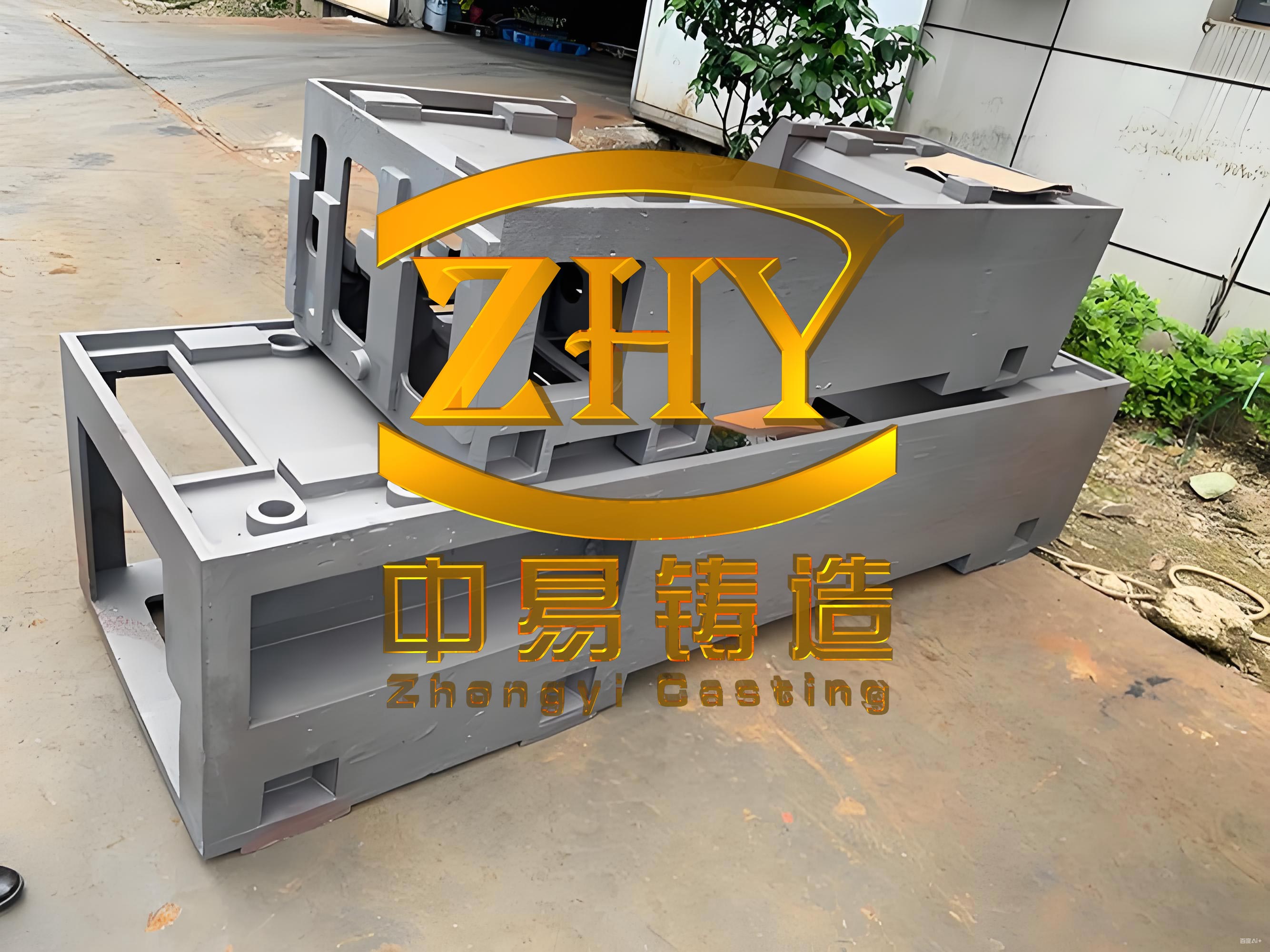
In the melting and pouring stage, the metallurgical quality of machine tool castings is predominantly determined. Most machine tool castings are made from gray iron, which benefits from high carbon equivalents (CE) for enhanced strength and reduced casting stresses. The carbon equivalent is calculated as: $$ CE = C + \frac{1}{3}(Si + P) $$ where C, Si, and P represent the percentages of carbon, silicon, and phosphorus, respectively. In my work, I aim for a CE between 3.8–4.2 for machine tool castings, as this promotes graphitization and lowers the risk of chilling. However, international benchmarks often show higher CE values, so I recommend gradual increases to match global standards while monitoring mechanical properties. The silicon-to-carbon ratio (Si/C) is another critical parameter; I maintain it around 0.5 to prevent ferrite formation and improve uniformity. This can be expressed as: $$ \text{Si/C} = \frac{Si}{C} $$ For instance, if the carbon content is 3.2% and silicon is 1.6%, the Si/C ratio is 0.5, which aids in refining the graphite structure and enhancing hardness without excessive brittleness.
Alloying elements play a pivotal role in strengthening machine tool castings. I often incorporate low levels of chromium, molybdenum, or copper to stabilize pearlite and refine the eutectic structure. The effect can be modeled using the following empirical formula for tensile strength (TS) in gray iron: $$ TS = a \cdot CE + b \cdot \sum (k_i \cdot A_i) $$ where \( a \) and \( b \) are constants, \( CE \) is the carbon equivalent, \( k_i \) is the potency factor for each alloying element, and \( A_i \) is its percentage. For example, adding 0.2–0.5% copper can increase TS by 10–20 MPa in machine tool castings. In melting practices, I adjust charge compositions to include less than 30% pig iron and increase scrap steel ratios to improve fluidity and reduce costs. Temperature control is rigorous; the iron melt should be held at 1450–1500°C to ensure proper inoculation and minimize gas absorption. During pouring, the gating system must be designed to avoid turbulence, which can introduce inclusions. I use Bernoulli’s principle to optimize flow rates: $$ v = \sqrt{\frac{2g h}{1 – (A_1/A_2)^2}} $$ where \( v \) is the velocity, \( g \) is gravity, \( h \) is the head height, and \( A_1 \) and \( A_2 \) are cross-sectional areas. This helps prevent slag entrapment and ensures sound machine tool castings with minimal defects.
Post-processing is the final yet often overlooked phase in producing high-quality machine tool castings. It involves steps like cooling, shakeout, grinding, shot blasting, and rust prevention, each requiring meticulous attention to avoid compromising earlier efforts. In my oversight, I prioritize control points in shakeout and finishing to maintain dimensional stability and surface integrity. For instance, improper cooling can induce residual stresses in machine tool castings, leading to distortion. I apply Fourier’s law of heat conduction to model cooling rates: $$ q = -k \frac{dT}{dx} $$ where \( q \) is the heat flux, \( k \) is the thermal conductivity, and \( \frac{dT}{dx} \) is the temperature gradient. By controlling the environment—such as using forced air cooling for uniform rates—I minimize thermal gradients and stress accumulation. The table below outlines key post-processing steps and their impact on machine tool castings.
| Post-Processing Step | Key Parameters | Impact on Machine Tool Castings | Control Measures |
|---|---|---|---|
| Shakeout | Time after pouring; vibration intensity | Affects dimensional accuracy and surface finish | Automated timers; SPC for consistency |
| Grinding and Deburring | Tool speed; pressure applied | Removes excess material and improves aesthetics | Operator training; jigs for precision |
| Shot Blasting | Abrasive size; exposure time | Enhances surface hardness and cleans residues | Calibrated equipment; regular inspections |
| Rust Prevention | Coating thickness; environmental humidity | Prevents corrosion during storage and transport | Controlled atmosphere; protective coatings |
Quality inspection is integral to post-processing; I advocate for comprehensive testing of metallographic structure, elastic modulus, casting stress, and deformation in machine tool castings. For example, the elastic modulus \( E \) can be derived from stress-strain curves using Hooke’s law: $$ E = \frac{\sigma}{\epsilon} $$ where \( \sigma \) is stress and \( \epsilon \) is strain. Regular audits using non-destructive testing methods, such as ultrasonic inspection, help identify internal flaws early. By integrating these post-processing technologies, I have achieved higher yields and customer satisfaction for machine tool castings, underscoring the importance of a holistic quality management system.
In conclusion, controlling the quality of machine tool castings demands a synergistic blend of technical expertise and systematic management. From macroscopic approaches like process capability indices to detailed technologies in molding, melting, and post-processing, every aspect must be meticulously managed. The repeated emphasis on machine tool casting and machine tool castings throughout this article highlights their critical role in advancing manufacturing precision. As industries evolve, continuous innovation in these areas will be essential for producing durable, high-performance components that meet global standards. By sharing these insights, I hope to contribute to the ongoing improvement in foundry practices, ensuring that machine tool castings remain a cornerstone of mechanical engineering excellence.