
As a researcher focused on advanced manufacturing technology, I have dedicated significant effort to studying the quality control of wear-resistant manganese steel castings. These castings are pivotal in industries such as mining, metallurgy, construction, railways, military, and agricultural machinery due to their unique work-hardening characteristics. Under high-impact loads, the surface layer of manganese steel casting foundry components forms a hard martensitic structure, while the core retains a tough austenitic matrix, providing an ideal combination of durability and resilience. However, achieving consistent quality in manganese steel casting foundry production requires meticulous attention to alloy composition, casting processes, and heat treatment. In this comprehensive article, I will delve into the mechanisms influencing quality, present optimized parameters using tables and formulas, and share insights from my investigations to enhance the reliability of these critical components. The goal is to provide a detailed guide that underscores the importance of integrated quality management in manganese steel casting foundry operations.
The foundation of quality in manganese steel casting foundry products lies in their chemical composition. Alloy elements play a crucial role in determining mechanical properties, microstructure, and performance under service conditions. Based on my research, I have analyzed how various elements affect the quality of wear-resistant manganese steel, and I will summarize these effects with supporting data. First, let’s consider the basic elements: manganese (Mn) and carbon (C). Manganese is essential for stabilizing austenite, improving hardenability, and enhancing strength through solid solution strengthening. The relationship between manganese content and austenite stability can be expressed using thermodynamic models. For instance, the effect of manganese on the Gibbs free energy of austenite formation can be approximated by:
$$\Delta G_{\gamma} = \Delta G_{\text{Fe}} + x_{\text{Mn}} \cdot \Delta G_{\text{Mn}} – T \Delta S_{\text{mix}}$$
where $\Delta G_{\gamma}$ is the free energy change, $x_{\text{Mn}}$ is the mole fraction of manganese, $\Delta G_{\text{Fe}}$ and $\Delta G_{\text{Mn}}$ are contributions from iron and manganese, $T$ is temperature, and $\Delta S_{\text{mix}}$ is the entropy of mixing. Typically, manganese content in wear-resistant grades ranges from 11% to 14%, but excessive amounts can lead to coarse grains and reduced toughness. Carbon, on the other hand, contributes to hardness and wear resistance through interstitial solid solution and carbide formation. The hardness $H$ of manganese steel can be correlated with carbon content $C$ via empirical equations like:
$$H = H_0 + k \cdot C^{n}$$
where $H_0$ is base hardness, and $k$ and $n$ are constants derived from experimental data. In practice, carbon levels between 0.9% and 1.3% are optimal for balancing wear resistance and ductility. To provide a clear overview, I have compiled the effects of key elements in Table 1, which highlights their roles and recommended ranges based on my findings in manganese steel casting foundry studies.
| Element | Primary Functions | Recommended Range | Impact on Quality |
|---|---|---|---|
| Manganese (Mn) | Stabilizes austenite, improves hardenability, solid solution strengthening | 11–14% | Enhances toughness and work-hardening; excess causes grain coarseness |
| Carbon (C) | Increases hardness and wear resistance via carbides | 0.9–1.3% | Boosts abrasion resistance; high levels may reduce ductility |
| Silicon (Si) | Acts as deoxidizer, affects carbide precipitation | < 0.6% | Reduces oxygen content; excessive Si promotes brittle carbides |
| Phosphorus (P) | Harmful impurity | < 0.07% | Forms brittle phosphides, lowering mechanical properties |
| Sulfur (S) | Harmful impurity | < 0.05% | Leads to hot tearing and reduced toughness |
| Aluminum (Al) | Deoxidizer, controls oxide inclusions | < 0.2% | Improves cleanliness; too much Al decreases plasticity |
Beyond basic elements, alloy additions like molybdenum (Mo), chromium (Cr), tungsten (W), and rare earth (RE) elements significantly refine the properties of manganese steel casting foundry outputs. In my work, I have explored how these elements modify microstructure and performance. Molybdenum, for example, enhances solid solution strengthening and suppresses carbide precipitation along grain boundaries, which is critical for minimizing brittleness in as-cast structures. The effect of molybdenum on yield strength $\sigma_y$ can be modeled using:
$$\sigma_y = \sigma_0 + \alpha \cdot \sqrt{[Mo]} + \beta \cdot d^{-1/2}$$
where $\sigma_0$ is the lattice friction stress, $\alpha$ and $\beta$ are material constants, $[Mo]$ is molybdenum concentration, and $d$ is grain size. Chromium increases strength but reduces toughness by accelerating carbide formation; it is often paired with molybdenum to balance these effects. Tungsten contributes to hardness through fine carbide dispersions and atomic bonding effects, with tungsten carbides like WC and W2C enhancing wear resistance. Rare earth elements are particularly valuable in manganese steel casting foundry practices for grain refinement and inclusion modification. They increase the solubility of carbon and manganese in austenite, reduce grain boundary carbides, and promote spherical inclusion morphology, leading to cleaner steel and improved ductility. The grain size reduction due to rare earth additions can be quantified by the Hall-Petch equation:
$$\sigma_y = \sigma_i + k_y \cdot d^{-1/2}$$
where $\sigma_i$ is the intrinsic strength, and $k_y$ is the strengthening coefficient. Through systematic trials, I have determined optimal combinations, such as adding 0.3–0.5% Mo with 1–2% Cr for heavy-duty applications, ensuring that manganese steel casting foundry components achieve superior performance without cracking risks.
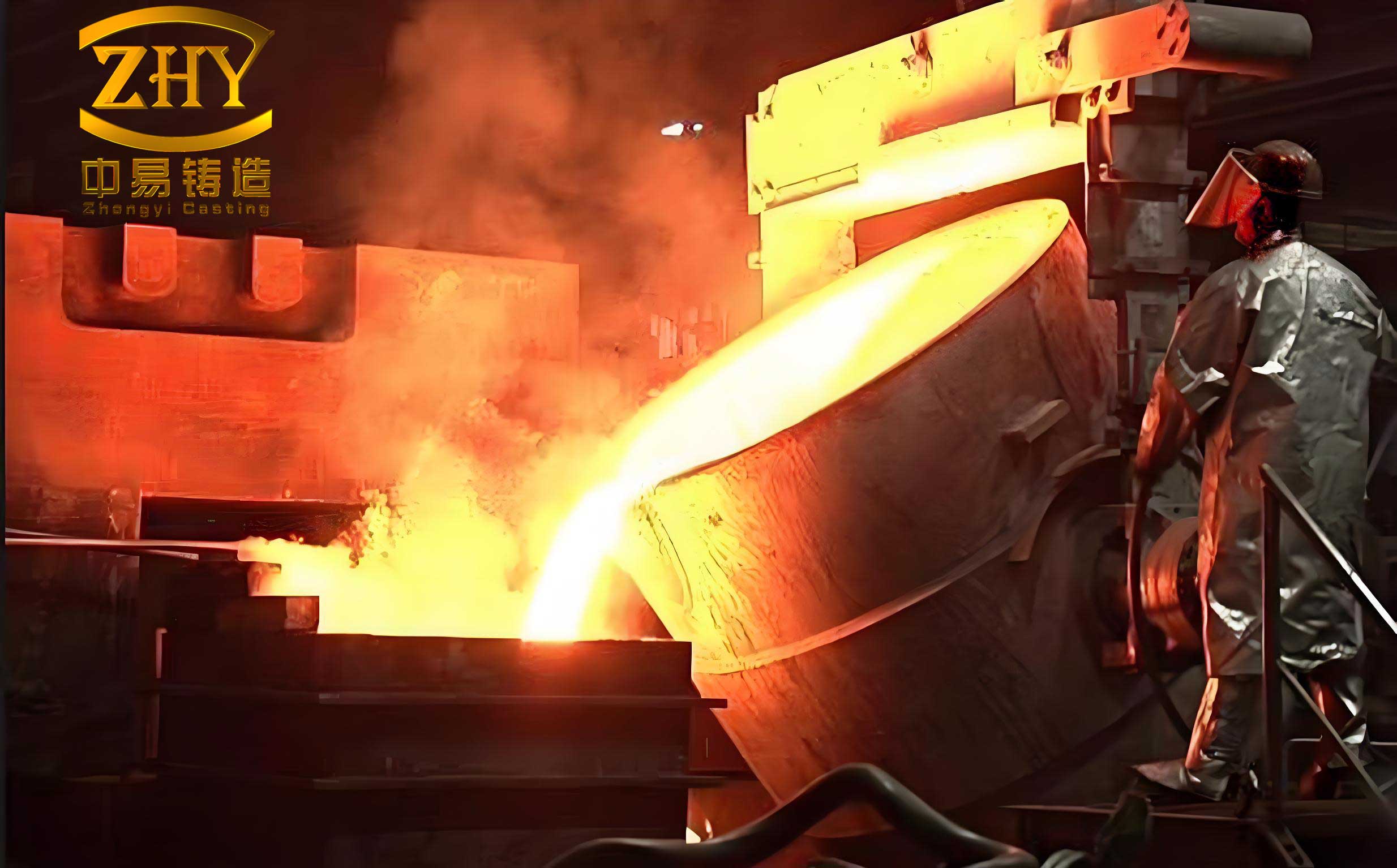
Casting process design is another critical area where quality control must be rigorous to prevent defects, especially cracks, in manganese steel casting foundry products. From my experience, cracks often originate from thermal stresses, shrinkage constraints, and improper gating and risering. Manganese steel has a narrow solidification range, with liquidus around 1,390°C and solidus near 1,340°C, making it prone to thermal cracking if cooling is uneven. To mitigate this, I emphasize designing castings with uniform wall thickness, generous fillet radii, and transitional sections to reduce stress concentration. The thermal stress $\sigma_{\text{thermal}}$ during cooling can be estimated using:
$$\sigma_{\text{thermal}} = E \cdot \alpha \cdot \Delta T / (1 – \nu)$$
where $E$ is Young’s modulus, $\alpha$ is the coefficient of thermal expansion, $\Delta T$ is the temperature gradient, and $\nu$ is Poisson’s ratio. For manganese steel, which has relatively low thermal conductivity, controlling $\Delta T$ is essential. Gating and riser systems should be arranged to ensure smooth filling and minimal obstruction to contraction. I recommend using multiple gates distributed evenly and avoiding oversized risers that can create hot spots and stress raisers. Additionally, mold and core materials must exhibit good collapsibility to allow free shrinkage; adding organic materials like wood flour to sand mixes enhances yield. Pouring temperature is a key parameter: too high (above 1,480°C) increases stress, while too low (below 1,440°C) risks cold shuts. Based on my experiments, the optimal pouring range is 1,440–1,480°C with fast pouring rates to minimize temperature differentials. Table 2 summarizes the key casting process parameters and their effects on crack prevention in manganese steel casting foundry operations, derived from my practical assessments.
| Parameter | Recommended Value/Range | Rationale | Impact on Quality |
|---|---|---|---|
| Pouring Temperature | 1,440–1,480°C | Balances fluidity and thermal stress | Reduces hot tearing and cold shut defects |
| Pouring Speed | High (consistent flow) | Minimizes temperature gradients | Enhances uniformity and decreases stress |
| Wall Thickness Design | Uniform, with transitions | Avoids stress concentration | Prevents shrinkage and thermal cracks |
| Gating System | Multiple, evenly distributed | Ensures smooth filling and feeding | Reduces turbulence and segregation |
| Riser Size | Moderate, not oversized | Prevents local overheating | Lowers risk of cracking at junctions |
| Mold/Core Collapsibility | High (with additives) | Allows free contraction | Minimizes mechanical restraint cracks |
| Slag Control (MnO+FeO) | < 1.2% in slag | Reduces oxide inclusions | Improves cleanliness and toughness |
Heat treatment is the final yet pivotal step in achieving the desired microstructure and properties in manganese steel casting foundry components. The standard practice involves solution treatment followed by water quenching, known as water toughening, to obtain a single-phase austenitic structure. My research has focused on optimizing the thermal parameters to avoid issues like grain growth, residual stresses, and insufficient carbide dissolution. The solution temperature is critical: too low, and carbides remain undissolved; too high, and grains coarsen, reducing fatigue strength. I have found that holding at 1,050–1,090°C for 2–3 hours effectively dissolves carbides into austenite. The kinetics of carbide dissolution can be described by the Avrami equation:
$$f = 1 – \exp(-k t^n)$$
where $f$ is the fraction dissolved, $k$ is a rate constant dependent on temperature, $t$ is time, and $n$ is an exponent. For manganese steel, $k$ increases with temperature, but excessive temperatures lead to rapid grain growth described by:
$$d = d_0 + A \cdot \exp(-Q / RT) \cdot t^m$$
where $d$ is grain size, $d_0$ is initial size, $A$ is a constant, $Q$ is activation energy, $R$ is gas constant, $T$ is temperature, and $m$ is a time exponent. To prevent cracking during heating, I recommend a slow heating rate below 650°C, around 50–80°C/h, with a holding period at 700–750°C to relieve casting stresses. After solution treatment, rapid water quenching fixes the austenitic structure, and the cooling rate must be sufficient to suppress carbide reprecipitation. The quench severity can be evaluated using heat transfer coefficients, but in practice, agitated water at ambient temperature works well. Furthermore, I have studied the effect of prior processing steps, such as mold removal and riser cutting. Early shakeout and riser removal after solidification reduce constraints, and reheating for heat treatment should include a homogenization soak of 1–2 hours to equalize temperatures. These measures ensure that manganese steel casting foundry products exhibit optimal toughness and work-hardening capability. Table 3 outlines the recommended heat treatment parameters based on my experimental data, providing a guideline for consistent quality.
| Stage | Temperature Range | Time | Purpose | Key Considerations |
|---|---|---|---|---|
| Preheating/Homogenization | 700–750°C | 1–2 hours | Relieve casting stresses, equalize temperature | Slow heating below 650°C to avoid thermal shock |
| Solution Treatment | 1,050–1,090°C | 2–3 hours | Dissolve carbides into austenite | Avoid exceeding 1,100°C to prevent grain growth |
| Quenching | Water at 20–30°C | Immediate immersion | Retain austenitic structure | Agitate water to ensure uniform cooling |
| Post-Quench Handling | Ambient temperature | – | Prevent contamination or stress | Dry and inspect for defects |
In conclusion, quality control in wear-resistant manganese steel casting foundry production is a multifaceted endeavor that demands integration of metallurgical knowledge, process engineering, and thermal management. Through my research, I have established that optimizing alloy composition—with careful balance of manganese, carbon, and microalloying elements—lays the groundwork for superior properties. The casting process must be designed to mitigate cracks by controlling thermal gradients and stresses, while heat treatment parameters must be precisely calibrated to achieve a homogeneous austenitic matrix. The formulas and tables presented here encapsulate key relationships and guidelines derived from systematic study. As the manganese steel casting foundry industry evolves, continuous refinement of these practices will enhance component reliability and lifespan. I encourage foundries to adopt data-driven approaches, leveraging such models to tailor processes for specific applications, ensuring that manganese steel castings meet the rigorous demands of modern engineering environments. Ultimately, the synergy between composition, casting, and heat treatment is the cornerstone of quality, driving innovation and excellence in manganese steel casting foundry operations worldwide.