
In the field of manufacturing for water supply systems, the application of nodular cast iron in valve components has become increasingly prevalent due to its superior mechanical properties and durability. As an engineer involved in quality assurance, I have extensively studied and implemented various control techniques to ensure the reliability and performance of these critical parts. This article delves into the methodologies applied in quality control for nodular cast iron castings used in water supply valves, drawing from practical project experiences and accumulated test data. The focus is on mechanical performance, metallographic examination, hardness testing, chemical composition analysis, and other ancillary methods, all aimed at optimizing the material’s properties such as corrosion resistance, impact resistance, and wear resistance.
Nodular cast iron, also known as ductile iron, is characterized by its spherical graphite microstructure, which imparts enhanced strength and ductility compared to traditional gray cast iron. In water supply valves, these components often operate under low-pressure conditions, typically with nominal pressures not exceeding 4.0 MPa, and medium temperatures ranging from -30°C to 350°C, primarily handling water. The service life of such valves can extend up to 60–80 years, making quality control paramount. However, the casting process of nodular cast iron presents technical challenges, including potential defects in microstructure and mechanical properties if not properly managed. Thus, implementing rigorous quality control techniques is essential to mitigate these issues and ensure the longevity and safety of the valves.
The advantages of nodular cast iron stem from its unique microstructure. The spherical graphite nodules, embedded in a metallic matrix of ferrite or pearlite, reduce stress concentrations and improve toughness. Key benefits include high tensile strength, good yield strength, excellent corrosion and oxidation resistance, enhanced ductility, wear resistance, and impact resistance. Moreover, the cost-effectiveness of casting nodular cast iron makes it a preferred material in valve production. To quantify these properties, consider the following relationship for the tensile strength of nodular cast iron, which can be expressed as a function of its microstructure parameters:
$$ \sigma_t = f(G_s, M_b) $$
where $\sigma_t$ is the tensile strength, $G_s$ represents the graphite sphericity (a measure of nodule shape), and $M_b$ denotes the matrix composition (e.g., ferrite or pearlite content). This formula highlights how controlling the graphite morphology and matrix directly influences mechanical performance.
In practical applications, the technical difficulties revolve around ensuring consistent quality under specific operational conditions. For low-pressure water supply valves, the primary challenges include maintaining mechanical integrity at pressures below 4.0 MPa, withstanding temperature fluctuations, and preventing premature failure due to casting defects. Without proper control, nodular cast iron components may exhibit reduced mechanical properties, structural instability, or diminished impact resistance. Therefore, a comprehensive quality control framework is necessary, encompassing multiple testing and inspection phases.
One of the core aspects of quality control for nodular cast iron components is mechanical performance testing. This involves evaluating tensile strength, yield strength, and elongation to verify that the material meets specified standards. Based on my experience, the testing process follows a structured approach. First, samples are extracted from the castings as per standard guidelines, ensuring they represent the component’s characteristics in terms of weight, wall thickness, and geometry. These samples are then machined into standard test bars according to GB/T 228.1-2010 (equivalent to ISO 6892-1 for room temperature tensile testing). The bars are marked with gauge lengths, and tensile tests are conducted using a hydraulic universal testing machine. After fracture, the final gauge length is measured to calculate elongation. The results are compared against standards such as GB/T 1348-2019 for nodular cast iron castings. To summarize typical mechanical properties, the following table provides an overview based on common grades:
| Grade (Standard) | Tensile Strength (MPa) | Yield Strength (MPa) | Elongation (%) | Hardness (HBW) |
|---|---|---|---|---|
| QT400-15 (EN) | ≥ 415 | ≥ 275 | ≥ 18 | 143–187 |
| QT450-10 (GB) | ≥ 450 | ≥ 310 | ≥ 10 | 160–210 |
| QT500-7 (GB) | ≥ 500 | ≥ 320 | ≥ 7 | 170–230 |
These values underscore the importance of mechanical testing in validating nodular cast iron quality. Additionally, the relationship between tensile strength and hardness can be approximated using empirical formulas, such as:
$$ \sigma_t \approx k \times \text{HBW} $$
where $k$ is a material-specific constant, typically around 3.5 for nodular cast iron. This allows for cross-verification of test results.
Metallographic examination is another critical technique for assessing the quality of nodular cast iron. This process involves analyzing the microstructure to evaluate graphite sphericity, nodule count, matrix composition, and potential defects. In my work, I follow a meticulous procedure: samples are cut from the castings, mounted, ground, polished, and etched with a 2–5% nitric alcohol solution. The prepared specimens are then observed under an optical microscope at 100x magnification. Key parameters include the nodularity grade, which indicates the percentage of spherical graphite, and the matrix structure (ferrite or pearlite). Using image analysis software, such as JX-2000, quantitative assessments are made. Based on extensive data, I have found that nodularity levels significantly impact mechanical properties. For instance, a nodularity grade of 2 (90% spherical graphite) or above generally ensures good performance, while lower grades lead to reduced strength due to irregular graphite shapes causing stress concentrations. The effect can be modeled as:
$$ \Delta \sigma \propto \frac{1}{1 – N} $$
where $\Delta \sigma$ is the reduction in strength and $N$ is the nodularity percentage. This emphasizes the need for high nodularity in quality control. Common microstructure classifications are summarized below:
| Nodularity Grade | Graphite Morphology | Typical Nodularity (%) | Mechanical Performance |
|---|---|---|---|
| 1–2 | Spherical, uniform | ≥ 90 | Excellent |
| 3–4 | Mostly spherical, some irregular | 75–90 | Good |
| 5–6 | Vermicular or flake graphite | < 75 | Poor |
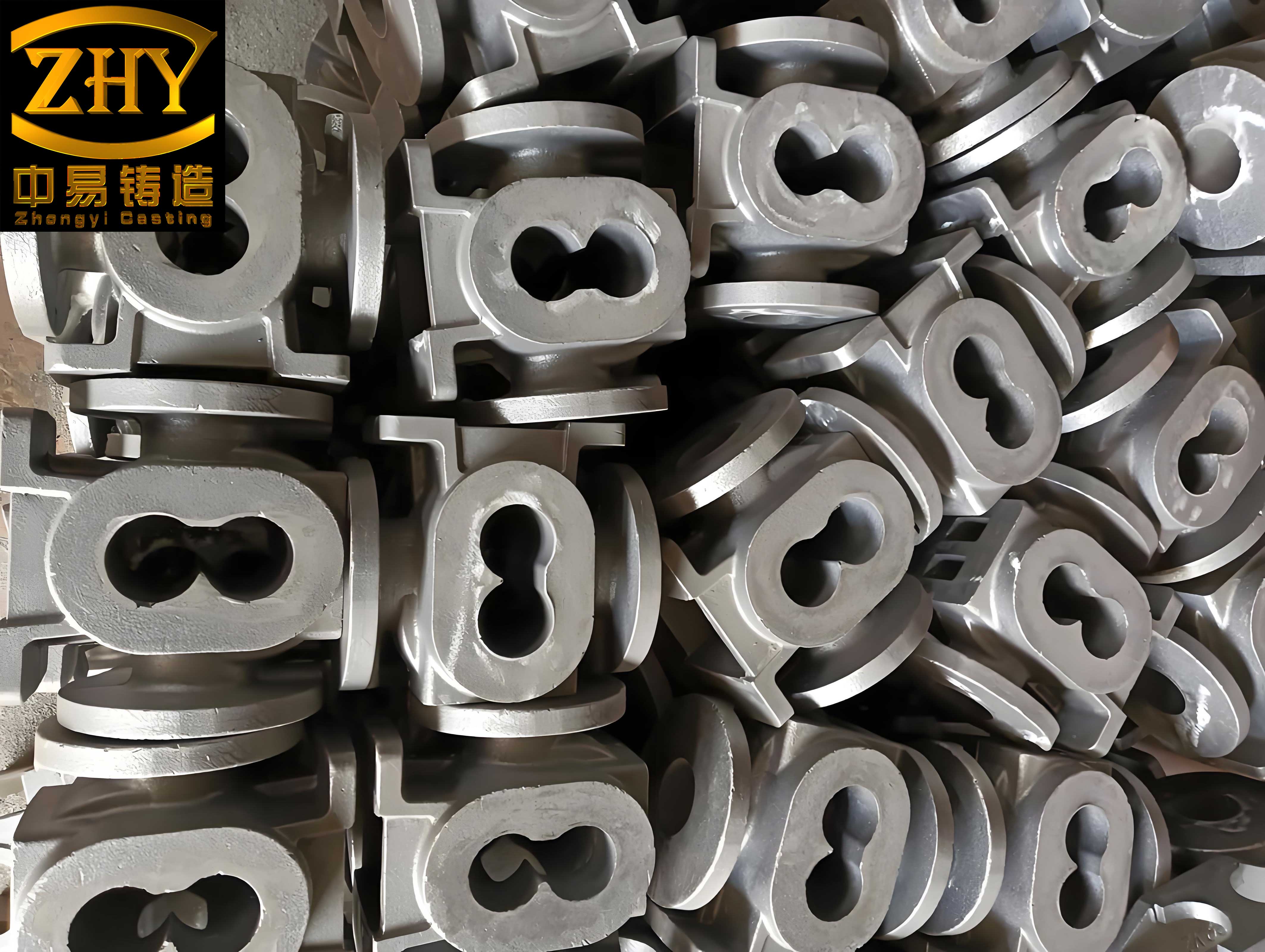
To visualize the microstructure of high-quality nodular cast iron, the following image provides an example of spherical graphite in a ferritic matrix, which is essential for achieving optimal properties in valve components.
Hardness testing complements mechanical and metallographic analyses by providing a quick indicator of material strength and wear resistance. For nodular cast iron components, I typically use the Brinell hardness test, as per GB/T 231.1-2018 (equivalent to ISO 6506-1). Samples are prepared with a surface roughness ≤ 1.6 µm and a thickness at least 8 times the indentation depth. The test involves applying a load to create an indentation, and the diameter is measured using a reading microscope. The Brinell hardness number (HBW) is then derived from reference tables. Hardness values correlate with tensile strength, as mentioned earlier, and help in quality assurance. For instance, for grade QT450-10, the hardness range of 160–210 HBW corresponds to a tensile strength of approximately 450 MPa. The relationship can be expressed as:
$$ \text{HBW} = \frac{2P}{\pi D (D – \sqrt{D^2 – d^2})} $$
where $P$ is the applied load, $D$ is the ball diameter, and $d$ is the indentation diameter. This formula ensures accurate hardness calculations during testing.
Chemical composition analysis is fundamental to controlling the properties of nodular cast iron. The key elements—carbon (C), silicon (Si), sulfur (S), phosphorus (P), and manganese (Mn)—must be within specified ranges to achieve desired microstructure and performance. In my practice, samples are taken from the castings, processed into fine particles, and analyzed using spectroscopic instruments. The results are compared against standard limits to ensure compliance. For example, excessive sulfur can lead to graphite degeneration, while optimal silicon content promotes ferrite formation. The following table outlines typical chemical requirements for common nodular cast iron grades used in valves:
| Element | QT400-15 (EN) | QT450-10 (GB) | QT500-7 (GB) |
|---|---|---|---|
| C | ≥ 3.0% | 3.4–3.9% | 3.6–3.8% |
| Si | ≤ 2.5% | 2.3–2.7% | 2.5–2.9% |
| S | < 0.025% | < 0.025% | < 0.025% |
| P | < 0.08% | < 0.08% | < 0.08% |
| Mn | < 0.5% | < 0.5% | < 0.6% |
The impact of composition on nodular cast iron properties can be modeled using regression equations. For instance, the combined carbon equivalent (CE) is often calculated as:
$$ \text{CE} = \text{C} + \frac{\text{Si} + \text{P}}{3} $$
where a higher CE generally improves castability but may affect strength. Maintaining precise chemical control is thus vital for consistent quality in nodular cast iron production.
Beyond these core techniques, additional control methods are employed to ensure comprehensive quality assurance for nodular cast iron components. Surface quality inspection involves visual and non-destructive testing to detect cracks, porosity, or inclusions. Geometric dimension measurement verifies that castings conform to design specifications, using tools like coordinate measuring machines (CMMs). Dimensional tolerance checks ensure fit and function in valve assemblies. Defect detection methods, such as ultrasonic or radiographic testing, identify internal flaws that could compromise performance. These supplementary approaches, combined with the primary tests, form a holistic quality control system. For example, statistical process control (SPC) can be applied to monitor variations in nodular cast iron properties over time, using control charts for parameters like hardness or chemical composition. The overall quality index $Q$ for a nodular cast iron component can be conceptualized as:
$$ Q = \alpha \cdot \sigma_t + \beta \cdot N + \gamma \cdot \text{HBW} + \delta \cdot C_{\text{comp}} $$
where $\alpha, \beta, \gamma, \delta$ are weighting factors, and $C_{\text{comp}}$ represents chemical composition compliance. This multi-faceted evaluation underscores the importance of integrated quality management.
In conclusion, the quality control of nodular cast iron components for water supply valves is a multifaceted process that requires meticulous attention to mechanical, metallographic, hardness, and chemical properties. Through my experience, I have demonstrated how techniques such as tensile testing, metallographic examination, Brinell hardness measurement, and compositional analysis are applied to ensure that nodular cast iron meets stringent standards. The use of tables and formulas, as shown throughout this article, aids in summarizing data and establishing correlations between different quality parameters. By implementing these methods, manufacturers can enhance the reliability, durability, and performance of nodular cast iron valves, ultimately contributing to safer and more efficient water supply systems. The continuous advancement in nodular cast iron technology, coupled with robust quality control practices, promises further improvements in material performance and application scope.