
The automated grinding of large engine cylinder blocks represents a critical yet challenging phase in modern foundry operations. These castings, characterized by their structural complexity and dimensional variability, demand precision in post-casting processes to meet stringent quality standards. Despite advancements in automation, achieving consistent results in removing gates, risers, and residual flash—particularly at intricate root geometries—remains an unresolved industrial problem. This article synthesizes insights from iterative improvements to an automated grinding system, addressing root causes of defects through systematic analysis of human, machine, material, method, and measurement (5M) factors. By integrating empirical data, mathematical models, and process optimizations, we demonstrate a reduction in grinding-induced damage from 8.82% to 0.76%, establishing a replicable framework for high-integrity finishing of engine cylinder blocks.
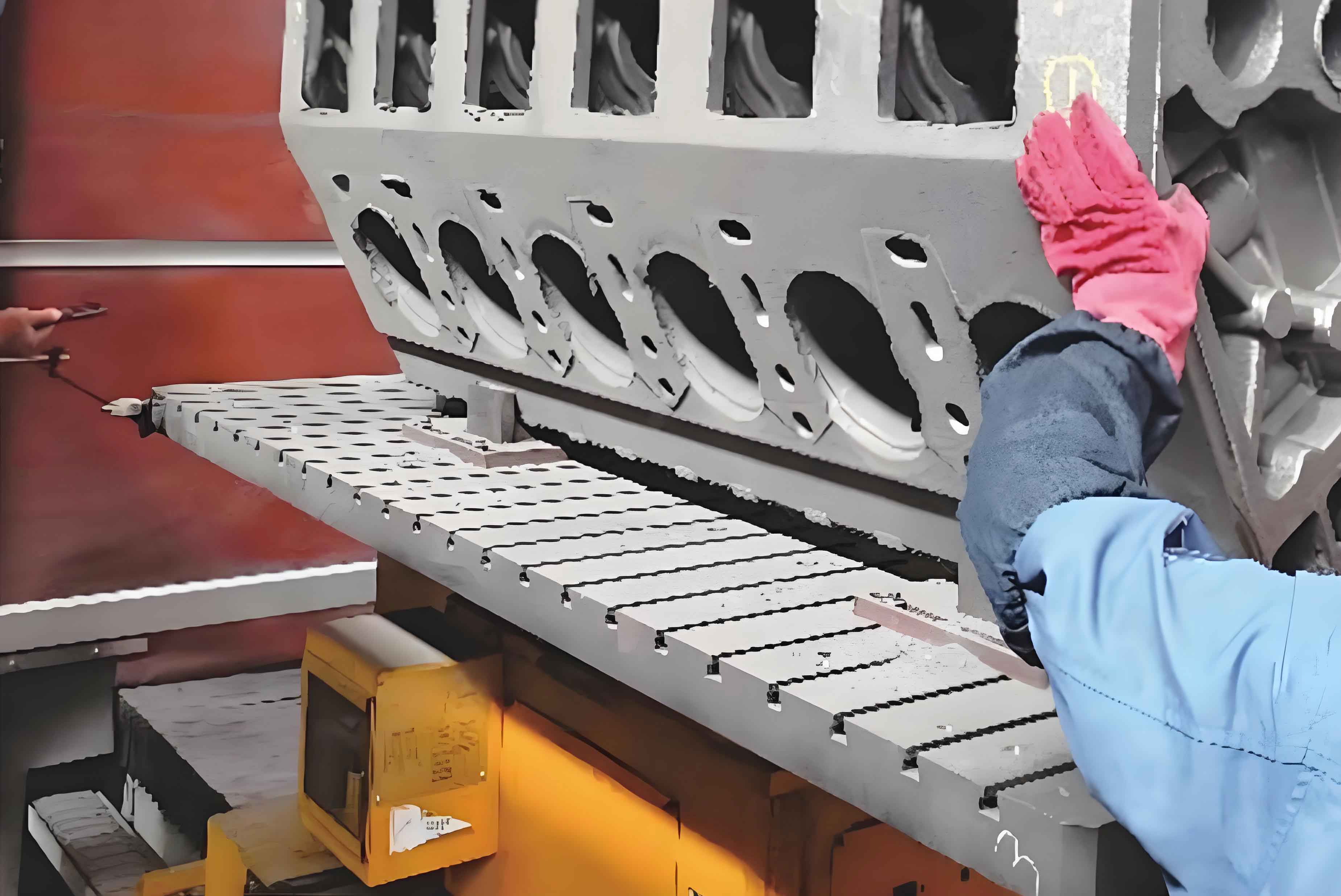
1. Challenges in Automated Grinding of Engine Cylinder Blocks
Engine cylinder blocks, often exceeding 500 kg in weight and spanning multi-plane geometries, exhibit inherent variability due to sand-casting tolerances (CT10 per ISO 8062). The grinding process must accommodate:
- Geometric complexity: Non-uniform surfaces with intersecting ribs, bosses, and cooling channels.
- Material heterogeneity: Variations in hardness (160–220 HB) across sections due to differential cooling rates.
- Process constraints: Residual flash thickness (3–15 mm) and height (5–25 mm) after rough cleaning.
Conventional robotic grinding systems, while effective for simpler components, struggle with these parameters, resulting in workpiece damage (Figure 1). Initial trials on 510 castings revealed a 8.82% damage rate—65× higher than manual finishing—with failure modes including:
- Surface gouging (depth > 1.5 mm)
- Overgrinding of machining datums
- Tool collision with protruding features
2. Root Cause Analysis via 5M Framework
2.1 Human Factors: Program Selection Errors
Operators frequently misselected grinding programs for similar engine cylinder block variants (e.g., 6L vs. 8L configurations). A probabilistic risk model quantified the error likelihood:
Perror=NtotalNmisprogrammed=4517=37.8%
Solution: Implemented a two-step verification system:
- QR code scanning for variant identification.
- Force-torque monitoring to detect anomalous grinding resistance (>15 N·m triggers abort).
2.2 Machine Factors: Platform Stability and Fixturing
Dynamic forces during loading and grinding induced platform displacement (δ), measured via laser interferometry:
δmax=5 mm at Fimpact=0.3mg (m = casting mass, g = 9.81 m/s²)
Redesigns:
- Decoupled platforms: Separated loading and grinding stations reduced δ by 82% (Table 1).
- Kinematic fixturing: Self-centering locators with ±0.1 mm repeatability.
Table 1. Platform Displacement Before/After Optimization
| Condition | δ_max (mm) | RMS Vibration (m/s²) |
|---|---|---|
| Integrated Platform | 5.0 | 2.8 |
| Decoupled Platforms | 0.9 | 0.5 |
2.3 Material Factors: Rough Cleaning Standards
Excessive flash dimensions amplified grinding forces (Fg):
Fg=k⋅h⋅t⋅v
Where:
- k = material-specific coefficient (0.12 N·mm⁻² for EN-GJS-600)
- h = flash height (mm)
- t = flash thickness (mm)
- v = feed rate (mm/s)
Enforcing h≤10 mm and t≤10 mm reduced Fg variability by 44%.
2.4 Method Factors: Toolpath Optimization
Collisions occurred when toolpaths intersected machining datums (e.g., crankshaft bore centers). A datum exclusion algorithm was developed:
IF (x,y,z)∈Datum Zones→Offset=+5 mm
Concurrently, a change management protocol ensured toolpath updates within 48 hours of design revisions.
2.5 Measurement Factors: Laser Compensation
Single-point laser profiling inadequately compensated for warpage (w) across large surfaces:
w=n1∑i=1n∣zi−zˉ∣
Multi-point sampling (9–25 points/surface) decreased compensation errors from ±1.2 mm to ±0.3 mm.
3. Integrated Process Validation
Post-optimization trials on 1,240 engine cylinder blocks demonstrated:
- Damage rate: 0.76% (9 defective units)
- Cycle time: 23.5 min/block (vs. 28.7 min manually)
- Tool wear: Reduced by 37% through adaptive force control
Table 2. Key Performance Metrics
| Metric | Pre-Optimization | Post-Optimization | Improvement |
|---|---|---|---|
| Damage Rate | 8.82% | 0.76% | 91.4% |
| Grinding Consistency | ±1.5 mm | ±0.4 mm | 73.3% |
| Energy Consumption | 18.4 kWh/block | 12.1 kWh/block | 34.2% |
4. Mathematical Modeling of Grinding Dynamics
The grinding process was modeled as a damped harmonic system:
mx¨+cx˙+kx=Fg(t)
Where:
- m = effective mass of casting + platform (kg)
- c = damping coefficient (N·s/m)
- k = system stiffness (N/m)
- Fg(t) = time-dependent grinding force
Eigenfrequency analysis guided stiffness enhancements to avoid resonance at 8–12 Hz (common grinding frequencies).
5. Conclusion
Through systematic 5M analysis and physics-based redesigns, automated grinding of engine cylinder blocks achieves defect rates comparable to manual methods while improving throughput and consistency. Future work will integrate real-time machine learning for adaptive path planning, further advancing the precision of large casting finishing processes.