
In the automotive industry, the demand for high-integrity components has led to the widespread adoption of high-pressure die casting for producing critical parts such as compressor housings. Among these, the lower shell castings for automotive air conditioning compressors are particularly challenging due to their compact design and stringent sealing requirements. These shell castings must withstand pressure tests up to 3 MPa for 2 minutes without leakage, ensuring minimal refrigerant loss over the vehicle’s lifetime. Any defect in the shell castings can lead to systemic failures, affecting overall air conditioning performance. In our production facility, we recently undertook a project to manufacture such shell castings for a 100-type compressor, using a customer-supplied die. During initial trials, we encountered severe quality issues, including pressure leakage and significant sticking at the gate area, which resulted in a scrap rate exceeding 30% after machining and impregnation. This article details our first-person journey in diagnosing and resolving these defects through a systematic approach involving process optimization, die modification, and the application of p-Q² diagram analysis.
The shell castings in question, as illustrated in the image below, have overall dimensions of 112 mm in length, 135 mm in width, and 120 mm in height, with a projected area of 151 cm². Despite the modest size, the quality requirements necessitated the use of a DCC400 die casting machine with a clamping force of 400 tons. The alloy used was ADC12, a common aluminum-silicon alloy for die casting. Initial production runs revealed two primary defects: severe sticking at the gate, which caused downtime and die damage, and internal shrinkage porosity in the machined bore surfaces, leading to pressure leakage. These issues were interrelated; to mitigate sticking, we reduced injection speed and pressure, but this inadvertently prolonged filling time and compromised solidification feeding, exacerbating shrinkage in the shell castings. Our investigation began with a thorough analysis of potential root causes, drawing on historical data from previous production of similar shell castings.
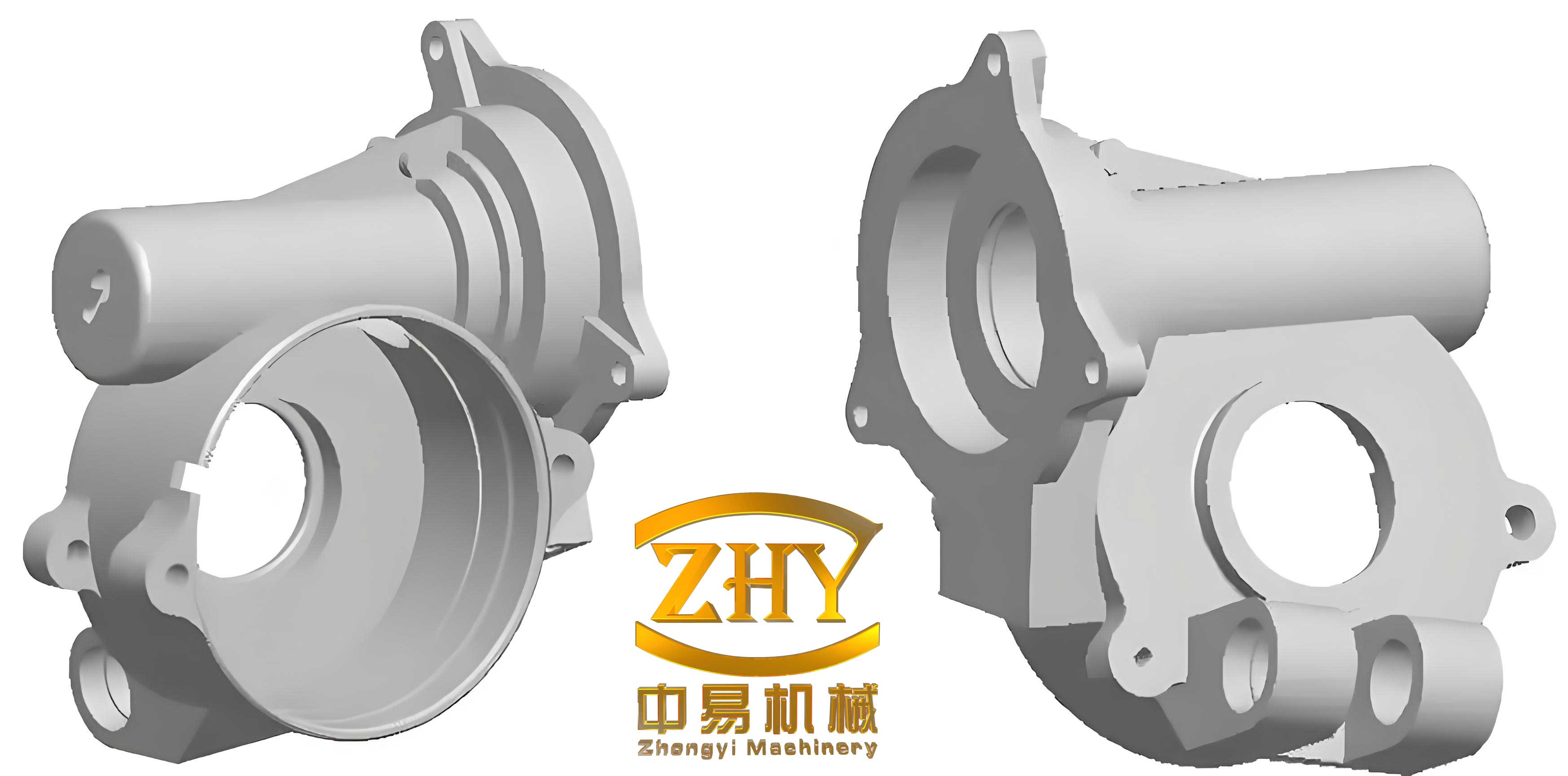
Sticking at the gate, a common ailment in die casting, occurs when molten metal adheres to the die surface, often due to a combination of thermal, mechanical, and chemical factors. For shell castings, this phenomenon is particularly problematic because the gate area experiences the highest thermal and mechanical loads during injection. We compiled a list of potential causes based on industry experience and observations:
| Potential Cause | Description | Impact on Shell Castings |
|---|---|---|
| High Metal Temperature | Excessive superheat increases fluidity and reaction with die steel. | Promotes adhesion and soldering on die surfaces. |
| High Die Temperature | Inadequate cooling leads to localized overheating. | Accelerates die wear and sticking, especially in gate regions. |
| Ineffective Die Lubrication | Insufficient or poorly applied release agent. | Fails to form protective layer, causing direct metal-die contact. |
| High Injection Velocity | Excessive “fast shot” speed generates turbulent flow. | Increases erosive wear and thermal shock, leading to sticking. |
| Poor Die Surface Finish | Roughness or micro-cracks on die surface. | Provides nucleation sites for metal adhesion. |
| Oxide Buildup | Accumulation of aluminum oxides on die. | Acts as an intermediate layer that promotes sticking. |
| Improper Gating Design | Direct impingement of metal on cores or walls. | Causes localized overheating and erosion. |
| Suboptimal Process Parameters | Incorrect pressure, speed, or timing settings. | Leads to unstable filling and poor thermal management. |
| Inadequate Alloy Composition | Low iron content (below 0.7%) or high magnesium. | Enhances chemical affinity with die steel, increasing sticking tendency. |
From this analysis, it became clear that the sticking issue in our shell castings was multifactorial, but centered on thermal and mechanical overload at the gate. Concurrently, the shrinkage porosity defect was traced to inadequate feeding during solidification, a consequence of reduced injection parameters aimed at controlling sticking. To address these, we formulated a multi-pronged improvement plan, prioritizing gate sticking resolution to restore process stability.
Our initial corrective actions focused on immediate process adjustments. We refined the die surface by polishing the gate area to a mirror finish, reducing roughness to below Ra 0.4 μm, and applied a high-performance die release膏 (in paste form) after preheating the die to 150°C. This created a durable barrier against metal adhesion. We also calibrated the injection parameters: based on empirical calculations for shell castings, the intensification pressure was set to 27 MPa (midway between 26-28 MPa), and the gate velocity was targeted at 40 m/s. The metal temperature for ADC12 was controlled at 620°C ± 10°C, and die temperature was maintained between 150-200°C through optimized cooling channels and automated spraying cycles. Furthermore, we verified the alloy composition, confirming that iron content was 1.08%, well within the recommended 0.85-1.1% range to minimize chemical sticking. While these steps alleviated sticking somewhat, product quality remained erratic, with leakage rates around 20%, indicating that the core issue lay deeper in the system dynamics.
We turned to the p-Q² diagram, a fundamental tool in die casting engineering, to diagnose the mismatch between the die and machine. The p-Q² diagram plots the available machine pressure against the flow rate (or its square), intersecting with the die’s required pressure curve. The intersection point defines the operating window for stable production. For our shell castings, key parameters included: casting net weight = 1190 g, average wall thickness = 5.8 mm, overflow weight = 114 g, gate thickness = 3.5 mm, gate area = 168 mm², shot sleeve diameter = 80 mm, and machine characteristics (DCC400) with maximum empty shot speed = 6 m/s and fast shot hydraulic pressure = 12.5 MPa. The required gate velocity \(v_g\) is related to the flow rate \(Q\) and gate area \(A_g\) by:
$$ v_g = \frac{Q}{A_g} $$
And the hydraulic pressure \(p\) relates to the machine’s capability as:
$$ p = p_{\text{max}} – k \cdot Q^2 $$
where \(k\) is a machine constant. For the die, the required pressure \(p_{\text{die}}\) depends on the flow resistance:
$$ p_{\text{die}} = \frac{\rho \cdot v_g^2}{2} + \Delta p_{\text{loss}} $$
where \(\rho\) is the metal density and \(\Delta p_{\text{loss}}\) accounts for friction and form losses. Plotting these, we generated the initial p-Q² diagram, revealing a narrow operational window, as shown in the analysis. The die line lay mostly outside the optimal region, indicating that the small gate area (168 mm²) necessitated extremely high velocities for proper filling, exacerbating sticking, while lower velocities led to prolonged fill times and poor feeding. This explained why previous production relied on excessive spray times (up to 2 minutes per cycle) to manage die temperature—a unsustainable practice.
To quantify, we defined the fill time \(t_f\) for shell castings as:
$$ t_f = \frac{V_c}{A_g \cdot v_g} $$
where \(V_c\) is the cavity volume. With the original gate area, \(t_f\) exceeded 40 ms at reduced velocities, beyond the recommended 20-30 ms for such wall thickness, leading to cold shuts and shrinkage. Using the p-Q² analysis, we calculated the needed modifications: increase gate area to 260 mm² and reduce shot sleeve diameter to 70 mm. The new gate area was derived from:
$$ A_g_{\text{new}} = A_g_{\text{old}} \cdot \frac{v_g_{\text{old}}}{v_g_{\text{new}}} $$
targeting a gate velocity of 25 m/s to balance filling and thermal load. The shot sleeve change adjusted the machine constant \(k\), broadening the operational window. The revised p-Q² diagram showed the die line spanning the optimal region, allowing flexible parameter settings. We implemented these changes by adding two side gates on the cylindrical features of the shell castings, increasing the total gate width, and shortening the core pins by 3 mm to prevent direct metal impingement. This redesign is summarized below:
| Parameter | Original Value | Modified Value | Impact on Shell Castings |
|---|---|---|---|
| Gate Area | 168 mm² | 260 mm² | Reduced gate velocity, minimized sticking risk. |
| Shot Sleeve Diameter | 80 mm | 70 mm | Increased available pressure range, better machine-die match. |
| Gate Velocity | 40 m/s | 25 m/s | Lower thermal shock, improved filling control. |
| Fill Time | >40 ms | ~25 ms | Adequate feeding, reduced shrinkage porosity. |
| Die Spray Time | 120 s | 15 s | Normalized cycle time, enhanced productivity. |
The modifications were executed with careful machining to maintain die integrity. Post-modification, we conducted extensive trials, monitoring parameters such as pressure curves, temperature gradients, and casting quality. The results were dramatic: gate sticking vanished entirely, allowing consistent production without extended spray cycles. The shell castings exhibited no visible defects, and after machining, the bore surfaces were free of shrinkage porosity. Pressure testing of sampled shell castings showed zero leakage at 3 MPa for 2 minutes, meeting the stringent automotive standards. We tracked the quality metrics over a batch of 5000 shell castings, comparing pre- and post-improvement data:
| Quality Metric | Before Improvement | After Improvement | Improvement Factor |
|---|---|---|---|
| Leakage Rate (after impregnation) | 30% | 3% | 10× reduction |
| Sticking Incidents per 100 shots | 15 | 0 | Eliminated |
| Cycle Time (seconds) | 180 | 60 | 66% reduction |
| Overall Yield | 70% | 97% | 27% increase |
| Die Maintenance Frequency | Every 500 shots | Every 3000 shots | 6× improvement |
The success of this project underscores the importance of a holistic approach in die casting quality management. For shell castings, which are integral to compressor performance, minor deviations in process or design can have cascading effects. Our use of the p-Q² diagram provided a scientific basis for modifications, moving beyond trial-and-error. The key lessons include: (1) Gate design must balance filling requirements with thermal management to prevent sticking in shell castings; (2) Machine-die compatibility should be verified using analytical tools like p-Q² diagrams; and (3) Continuous monitoring of alloy composition and process parameters is essential for consistency. Looking ahead, we are implementing these principles for other shell castings in our portfolio, aiming for zero-defect production. The economic impact has been substantial, with cost savings from reduced scrap and downtime, and enhanced customer satisfaction. This experience reaffirms that in the precision-driven world of automotive die casting, proactive quality improvement is not just beneficial—it is imperative for sustainable manufacturing.
In conclusion, the journey to improve these automotive compressor shell castings was a testament to systematic problem-solving. By integrating practical adjustments with engineering analysis, we transformed a problematic production line into a model of efficiency. The shell castings now meet all functional requirements reliably, contributing to the broader goal of automotive innovation. As we continue to refine our processes, the insights gained will serve as a benchmark for future projects involving complex shell castings.