
The design of effective feeding systems, particularly risers, remains a cornerstone in the production of sound, high-integrity steel castings. Traditional methodologies for riser design in steel castings, including modulus extension, feeding capacity, and proportional methods, rely heavily on empirical rules and designer experience. While often successful, this experiential dependency can lead to inconsistencies, defects such as shrinkage cavities, and prolonged development cycles, especially when coupled with iterative simulation software validation. This article, from the perspective of a foundry engineer, details the adoption and application of a more deterministic approach: the Quantitative Riser Modulus Calculation Method. This method provides a mathematical framework for designing risers for steel castings, reducing reliance on pure empiricism and simulation trial-and-error, thereby enhancing the quality, reliability, and efficiency of the process development phase.
The core principle of this method is establishing a quantitative relationship between the geometry of the steel casting and its riser through their moduli. The modulus (M), defined as the volume (V) to cooling surface area (S) ratio (M = V / S), is a fundamental concept representing the solidification time of a section. For a riser to effectively feed a steel casting, its solidification must be prolonged relative to the section it feeds, traditionally ensured by having a larger modulus. The quantitative method extends this by deriving specific formulas to calculate critical, safety-related parameters.
The derivation starts with the fundamental condition for soundness: the riser must contain sufficient liquid metal to feed the solidification shrinkage of the steel casting it serves until the casting is completely solid. By applying Chvorinov’s rule and considering the solidification sequence, the following four key formulas are established for a cylindrical riser:
- Minimum Safe Height of the Riser (Ymin): This is the distance from the top of the casting-riser contact plane to the lowest point of the shrinkage pipe in the riser. Ensuring this height is positive and sufficient guarantees the shrinkage cavity does not penetrate into the steel casting.
$$Y_{min} = R \left( k\alpha – \frac{1}{k\alpha} \right) – \frac{T}{2}$$ - Relative Radius of Surplus Liquid Steel (e): The ratio of the radius of the remaining liquid metal pool in the riser (r) at the end of casting solidification to the riser’s initial radius (R).
$$e = \frac{r}{R} = 1 – \frac{1}{(k\alpha)^2}$$ - Relative Height of Surplus Liquid Steel (n): The ratio of the height of the remaining liquid metal pool (h) to the total riser height (H).
$$n = \frac{h}{H} = 1 – \frac{3\varepsilon}{e^2 + e + 1} \cdot \frac{V_{casting} \times 1.06 + V_{padding} + V_{gating}}{V_{riser}} + 0.5$$ - Surplus Liquid Steel Volume Ratio (θ): The percentage of the riser’s initial volume that remains liquid after the connected steel casting has solidified. This liquid serves as a reservoir for feeding shrinkage, slag trapping, and gas collection.
For a cylindrical open riser:
$$\theta = \frac{V_{surplus}}{V_{riser}} \times 100\% = e^2 n \times 100\%$$
For a slab (or “waist”) cylindrical open riser:
$$\theta = 1.18 \times \frac{V_{surplus}}{V_{riser}} \times 100\% = 1.18 e^2 n \times 100\%$$
Where the critical parameters are defined in the following table:
| Symbol | Description | Typical Value/Range |
|---|---|---|
| Mriser, Mcasting | Geometric modulus of riser and casting section | Calculated (cm) |
| α | Modulus ratio (Mriser / Mcasting) | >1 (Design variable) |
| R, H | Initial radius and height of the cylindrical riser | Designed (cm) |
| k | Relative solidification coefficient of the riser | 1.0 (sand) / 1.1-1.3 (insulating/exothermic) |
| T | Thickness or hot spot diameter of the casting section under the riser | Measured (cm) |
| ε | Volumetric solidification shrinkage of steel | 0.04 – 0.05 (4-5%) |
| Vcasting | Volume of the casting region fed by the riser | Calculated (dm³) |
| Vriser | Volume of the riser | Calculated (dm³) |
| Vpadding, Vgating | Volume of feeding pads and gating system | Calculated (dm³) |
The design and validation criteria derived from extensive application on steel castings are twofold:
- The calculated Ymin must be greater than 30-50% of the casting section thickness (T).
- The calculated surplus liquid steel volume ratio θ must be greater than 20%.
Meeting both conditions empirically ensures no shrinkage defects in the steel casting and leaves adequate liquid in the riser for its secondary functions. This method clarifies that riser efficiency is not strictly limited to 12-15% but should be optimized to achieve this safe θ value.
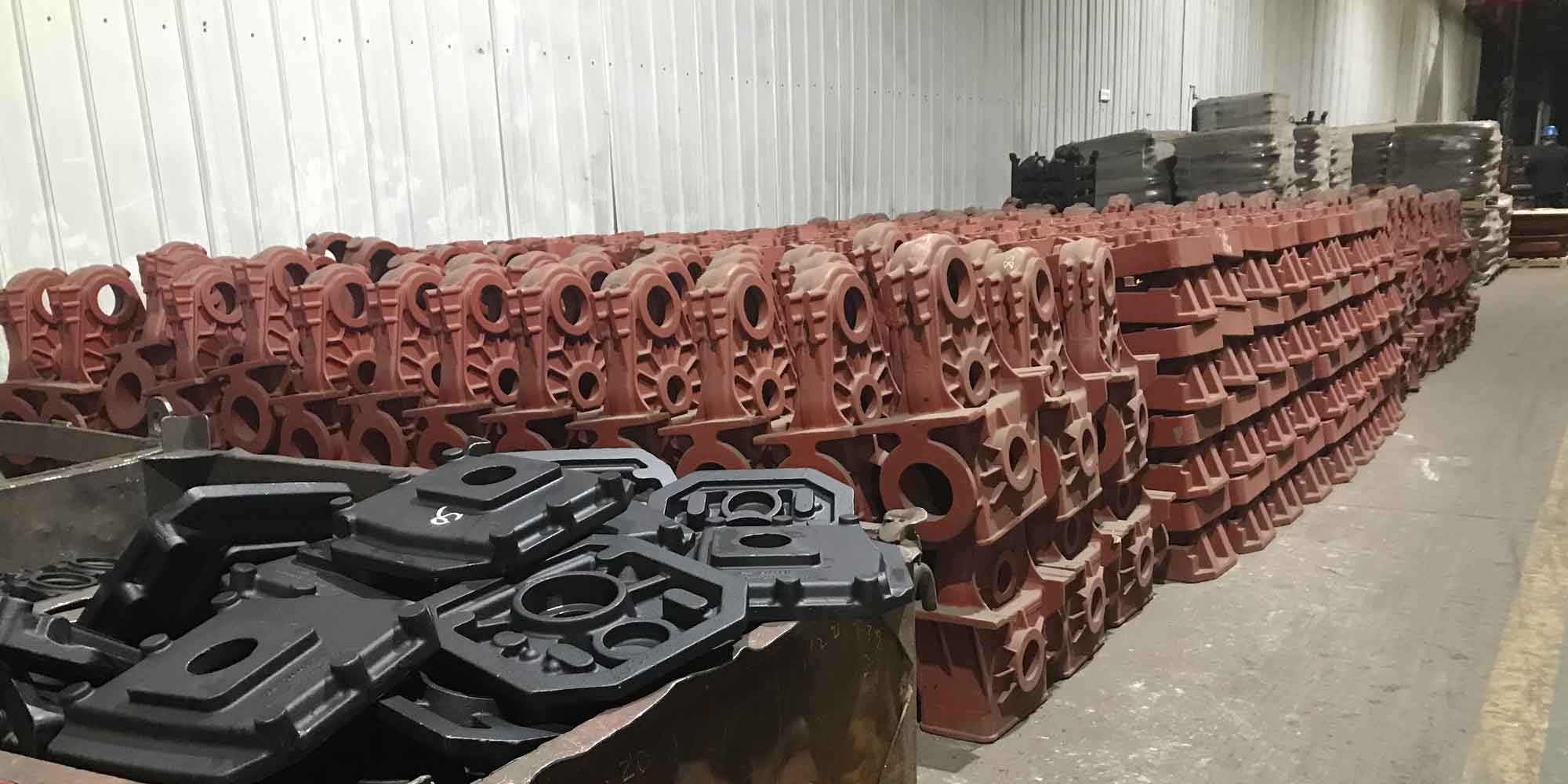
Case Study Analysis: Diagnosis of a Shrinkage Defect
A practical example involves the production of heavy-duty mining vehicle flanges (left and right hand parts) made from low/medium-carbon alloy quenched and tempered steel. The steel castings required high integrity with NDT (RT, MT, PT). The initial process, designed using traditional experience and validated by simulation software, resulted in severe shrinkage cavities beneath all nine exothermic risers, leading to scrap.
Original Design & Outcome: The steel casting had a net weight of 2,453.6 kg. Nine exothermic slab risers of size 140mm x 300mm x 250mm were used. Simulation did not predict defects. However, upon shakeout and riser removal, deep shrinkage was found in the casting body underneath each riser.
Quantitative Analysis using the New Method: The original design was audited using the quantitative formulas.
- Modulus Calculation:
$$M_{riser} = \frac{V_{riser}}{S_{riser}} = \frac{9.45 dm^3}{20.88 dm^2} \approx 4.5 cm$$
$$M_{casting} \approx 4.5 cm \quad \text{(for the hot spot)}$$
$$\alpha = \frac{M_{riser}}{M_{casting}} = \frac{4.5}{4.5} = 1.0$$ - Minimum Safe Height (Ymin): Taking k=1.2 for exothermic risers and T=176mm.
$$Y_{min} = 70 \times \left( 1.2 \times 1.0 – \frac{1}{1.2 \times 1.0} \right) – \frac{176}{2} = 70 \times (1.2 – 0.833) – 88 \approx -62 mm$$
The negative value indicates the theoretical shrinkage pipe extends 62 mm into the steel casting, guaranteeing a defect. - Surplus Liquid Volume Ratio (θ):
$$e = 1 – \frac{1}{(1.2 \times 1.0)^2} = 0.31$$
$$n = 1 – \frac{3 \times 0.045}{0.31^2 + 0.31 + 1} \cdot \frac{353 \times 1.06 + 21 + 20}{9 \times 9.45} + 0.5 \approx 0.48$$
For slab risers: $$\theta = 1.18 \times e^2 \times n \times 100\% = 1.18 \times 0.31^2 \times 0.48 \times 100\% \approx 5.45\%$$
This is far below the 20% safety threshold. The quantitative audit clearly identified the root cause: an insufficient modulus ratio (α=1.0) leading to a negative safety height and a critically low surplus liquid volume.
Case Study Analysis: Successful Re-Design and Validation
The same steel castings were successfully re-designed using the quantitative method.
Re-Design Calculations: Nine cylindrical exothermic risers of Ø300mm x 300mm were selected.
- Modulus & Safety Height:
$$M_{riser} = \frac{\frac{\pi}{4} \times 3.0^2 \times 3.0}{\pi \times 3.0 \times 3.0 + \frac{\pi}{4} \times 3.0^2 \times \frac{1}{2}} = \frac{21.2}{31.8} \approx 6.7 cm$$
$$\alpha = \frac{6.7}{4.5} \approx 1.49$$
$$Y_{min} = 150 \times \left( 1.2 \times 1.49 – \frac{1}{1.2 \times 1.49} \right) – \frac{176}{2} \approx 96 mm$$
This positive Ymin (96mm > 30% of T) meets the first safety criterion. Simulation software predicted a safe height of ~110mm, showing excellent correlation. - Surplus Liquid Volume Ratio (θ):
$$e = 1 – \frac{1}{(1.2 \times 1.49)^2} \approx 0.69$$
$$n = 1 – \frac{3 \times 0.045}{0.69^2 + 0.69 + 1} \cdot \frac{353 \times 1.06 + 21 + 20}{9 \times 21.2} + 0.5 \approx 0.83$$
$$\theta = e^2 \times n \times 100\% = 0.69^2 \times 0.83 \times 100\% \approx 39.5\%$$
This comfortably exceeds the 20% safety margin, meeting the second criterion.
Results: The steel castings produced with this re-designed process were sound, with no shrinkage defects upon riser removal. Sectioning of the risers confirmed a measured safe height of approximately 120mm, aligning well with both the calculated (96mm) and simulated (110mm) values. The process yield was 64.9%, with a calculated riser efficiency of 14.3%.
Comparative Advantages and Implementation
The quantitative method offers distinct advantages over traditional approaches for steel castings:
| Aspect | Traditional Empirical/Simulation-Iterative Method | Quantitative Riser Modulus Calculation |
|---|---|---|
| Basis | Rules of thumb, experience, iterative simulation. | Mathematical derivation based on solidification principles. |
| Design Output | Primarily riser dimensions (D, H). | Dimensions plus quantified safety metrics (Ymin, θ). |
| Defect Prediction | Reliant on simulation or post-casting discovery. | Proactively calculated via Ymin and θ; negative Ymin or low θ predicts defects. |
| Role of Simulation | Primary design validation tool, leading to multiple cycles. | Final verification tool; calculation provides close initial design. |
| Dependency | High on individual designer experience and software. | Reduced; codifies expertise into calculable criteria. |
| Development Speed | Can be slow due to iterative simulation loops. | Accelerated by providing a sound first-pass design. |
The implementation workflow for designing risers for steel castings using this method is systematic:
- Calculate the geometric modulus (Mcasting) of the section to be fed.
- Select a target modulus ratio (α). For steel castings with exothermic risers, α typically ranges from 1.3 to 1.6.
- Calculate the required riser modulus: Mriser = α × Mcasting.
- Determine initial riser dimensions (Diameter D, Height H) that satisfy Mriser and practical aspect ratios (H/D often 1-1.5). Calculate Vriser.
- Calculate the Minimum Safe Height (Ymin) using formula (1). Verify Ymin > (0.3 to 0.5)T.
- Calculate the Surplus Liquid Steel Volume Ratio (θ) using formulas (2), (3), and (4). Verify θ > 20%.
- If either criterion fails, adjust riser dimensions (increase D or H) or consider a more efficient riser type (higher k value) and recalculate from step 3 or 4.
- Use solidification simulation for final visual confirmation and to analyze fill and thermal gradients.
Conclusion
The Quantitative Riser Modulus Calculation Method provides a powerful, physics-based framework for the design of feeding systems for steel castings. By deriving and utilizing the formulas for minimum safe riser height and surplus liquid steel volume ratio, this method moves riser design from a predominantly empirical art towards a more deterministic engineering discipline. It enables the proactive prevention of shrinkage defects in steel castings by providing clear, calculable safety criteria. The close agreement between its calculations and simulation software results validates its accuracy, while its ability to diagnose faulty designs post-mortem highlights its diagnostic power. By reducing over-reliance on individual experience and minimizing iterative simulation loops, this method significantly improves the consistency, quality, and efficiency of the process development phase for steel castings, making it an invaluable tool in modern foundry engineering.