
In the realm of modern manufacturing, particularly for aerospace and high-performance industrial components, the demand for complex, high-integrity metal parts has escalated dramatically. Traditional manufacturing routes often struggle with the geometric intricacies, lead times, and costs associated with such components. As a researcher deeply involved in additive manufacturing and foundry processes, I have explored the synergistic integration of stereolithography (SLA) from the 3D printing domain with the venerable art of lost wax investment casting. This hybrid approach, which I term SLA-based rapid lost wax investment casting, fundamentally redefines the prototyping and production pathway for parts like impellers, turbine blades, and other complex enclosures. The core premise is to use an SLA-printed, high-resolution resin pattern directly as the sacrificial model in the investment casting process, bypassing the need for traditional wax pattern tooling. This methodology not only slashes lead times and costs but also unlocks geometric freedom. The lost wax investment casting process, known for its superb surface finish and dimensional accuracy for complex shapes, is thus supercharged by the agility of additive manufacturing.
The specific component that served as the test case for this investigation was a ventilator impeller. This part exemplifies the challenges posed by modern designs: it features a central hub with eight upper blades and sixteen radially distributed lower blades, creating a thin-walled, intricate geometry with an overall diameter exceeding 435 mm and a height of nearly 250 mm. The average blade wall thickness is a mere 3 mm. Producing such a component through conventional sand or permanent mold casting is fraught with difficulty due to core-making and parting line complexities. Therefore, lost wax investment casting presents itself as the ideal candidate for achieving the required precision. However, the conventional route to create the wax pattern for such a part would involve designing and machining a complex metal die, a process that is prohibitively time-consuming and expensive for low-volume or prototype production. This is where the SLA-based rapid approach creates a paradigm shift.
The initial and critical phase of any successful lost wax investment casting process is robust process design. For the impeller, a low-pressure casting scheme was selected to ensure smooth, controlled filling of the thin sections and to improve metallurgical quality through applied pressure during solidification. The gating and feeding system was designed using CAD software, with the primary goal of achieving sequential, tranquil filling and providing adequate feed metal to compensate for solidification shrinkage. The system comprised a central downsprue branching into eight ingates to distribute metal evenly into the impeller’s lower section. Recognizing the thermal hotspots created by the blade roots and hub, a total of forty-eight supplementary risers were strategically placed at the tips of all twenty-four blades. This extensive feeding scheme was crucial for the lost wax investment casting process to yield a sound casting. The three-dimensional model of this assembly was then used for computational validation.
Numerical simulation is an indispensable tool for de-risking the lost wax investment casting process. I employed ProCAST software to simulate the low-pressure filling and solidification of the impeller. The material was defined as ZL101 aluminum alloy, with key process parameters set as follows:
| Process Parameter | Value | Unit |
|---|---|---|
| Pouring Temperature | 720 | °C |
| Mold Preheating Temperature | 350 | °C |
| Alloy Liquidus Temperature | 616 | °C |
| Pressure Ramp Rate | 0.0015 | MPa/s |
| Interfacial Heat Transfer Coefficient | 500 | W/(m²·K) |
The pressure-time sequence for the low-pressure cycle was defined programmatically:
| Stage | Pressure (MPa) | Time (s) |
|---|---|---|
| Lift | 0 → 0.012 | 10 |
| Filling | 0.012 | 10 |
| Intensification | 0.012 → 0.05 | 1 |
| Pressure Hold | 0.05 | 1010 |
| Pressure Release | 0.05 → 0 | 970 |
The filling simulation revealed an orderly progression of the melt front. The metal ascended the sprue and filled the lower cavity first before progressively moving upwards, culminating in the filling of the risers. No turbulent splashing or premature freezing was predicted. The solidification simulation was even more instructive. It showed that the thin blades solidified rapidly, while thermal centering occurred at the heavier sections like the hub and the junctions of the ingates. The directional solidification pattern, aided by the risers and the applied pressure, was largely favorable. The predicted shrinkage porosity was primarily isolated to the central sprue and ingate masses, areas that are subsequently removed by machining and thus do not compromise the final part’s integrity. This virtual validation gave high confidence that the designed lost wax investment casting process was viable.
The physical realization of this rapid lost wax investment casting process begins with pattern fabrication. Here, the SLA process shines. A high-resolution SLA machine was used to fabricate the impeller pattern directly from a UV-curable photopolymer resin (LP R300-1). The accuracy and surface finish achievable with SLA are exceptional, making it an ideal direct replacement for a molded wax pattern. Concurrently, the complex gating system with its numerous risers was produced using conventional injection molding with a 162-grade medium-temperature wax (melting point 87.7-93.3°C). The SLA pattern and the wax gating system were then meticulously assembled into a complete cluster using sticky wax. This hybrid pattern assembly is the cornerstone of this accelerated lost wax investment casting methodology.
The subsequent steps adhere to the classic lost wax investment casting sequence but are applied to the 3D-printed resin pattern. The cluster underwent repeated dipping in ceramic slurry and stuccoing with refractory sand to build a robust shell. The binder used was a GRJ-30 silica sol, whose properties are summarized below:
| Property | Specification |
|---|---|
| Color | Milky White |
| SiO₂ Content | 29-31% |
| Na₂O Content | ≤0.5% |
| pH | 9-10 |
| Density | 1.20-1.22 g/cm³ |
| Kinematic Viscosity | 6 mm²/s |
| Average SiO₂ Particle Size | 9-20 nm |
Approximately five and a half layers were applied to achieve a shell thickness of about 8 mm. Each layer was thoroughly dried. The critical dewaxing step was performed using an autoclave, where steam heat rapidly melts and removes the wax gates and the SLA resin pattern. The resin, upon heating, decomposes and is removed, leaving a precise negative cavity in the ceramic shell. The shell was then fired at a high temperature (around 1000°C) to burn out any residual pattern material, sinter the ceramic for strength, and prepare it for receiving molten metal. This creates the essential mold for the lost wax investment casting process.
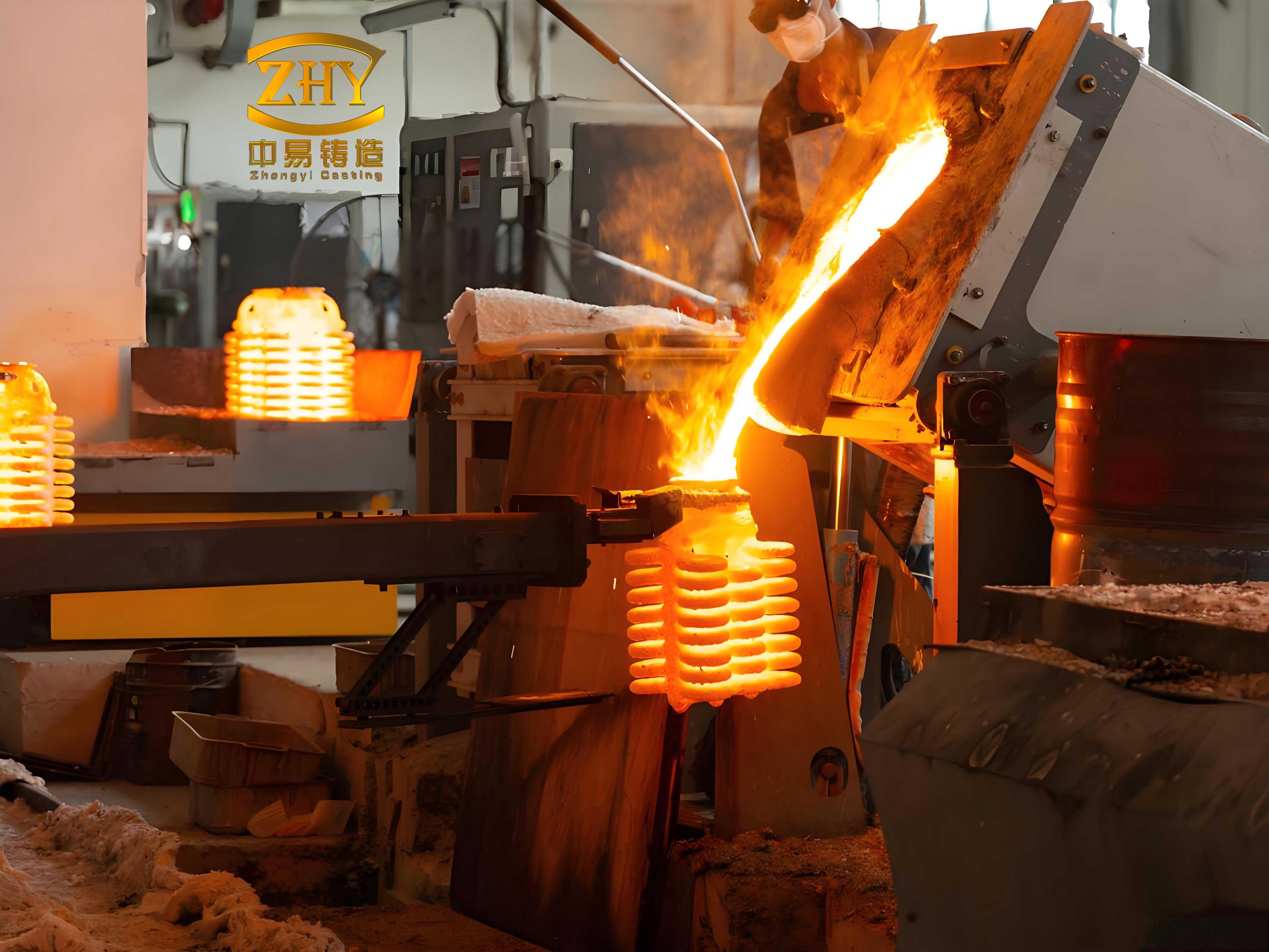
The final act was the low-pressure casting itself. The preheated ceramic shell was placed in the casting machine. ZL101 aluminum was melted, degassed, and poured into the machine’s holding furnace. The programmed low-pressure cycle was executed, forcing the metal upwards into the mold cavity. The physics of low-pressure filling can be conceptually described by a modified Bernoulli’s equation with a pressure term:
$$ P_{applied} + \rho g h_1 + \frac{1}{2} \rho v_1^2 = \rho g h_2 + \frac{1}{2} \rho v_2^2 + P_{loss} $$
where \( P_{applied} \) is the controlled furnace pressure, \( \rho \) is the metal density, \( g \) is gravity, \( h \) and \( v \) are height and velocity at different points, and \( P_{loss} \) accounts for viscous losses in the gating system. This controlled pressure ensures a non-turbulent, laminar fill critical for thin-walled lost wax investment castings. After solidification under pressure, the shell was knocked off, and the casting was cleaned. Non-destructive testing via X-ray radiography confirmed the absence of major shrinkage or gas porosity defects in the casting body, with any predicted defects being confined to the sacrificial gating system.
The quantitative benefits of this SLA-facilitated rapid lost wax investment casting process are staggering. A comparative analysis against traditional methods for producing such a complex impeller reveals orders-of-magnitude improvement. The table below summarizes a holistic comparison:
| Metric | Traditional Lost Wax Investment Casting (with machined metal die) | SLA-Based Rapid Lost Wax Investment Casting | Improvement Factor |
|---|---|---|---|
| Tooling Lead Time | 8-12 weeks | 24-48 hours (SLA print time) | ~15x faster |
| Tooling Cost | High (CNC machining of complex die) | Very Low (CAD data to printer) | Approx. 1/10th |
| Total Project Lead Time | 10-14 weeks | 2-3 weeks | ~5x faster |
| Total Prototype Cost | Base Cost = X | Approximately X/3 | 66% reduction |
| Design Change Flexibility | Very Low/Costly (new die needed) | Very High (modify CAD, re-print) | Revolutionary |
The underlying principles that make this integration so powerful can be further elucidated through thermal analysis models central to lost wax investment casting. The solidification time for a section in a ceramic shell mold can be approximated by Chvorinov’s rule:
$$ t_s = B \left( \frac{V}{A} \right)^n $$
where \( t_s \) is solidification time, \( V \) is volume, \( A \) is surface area, \( B \) is a mold constant dependent on material properties and mold temperature, and \( n \) is an exponent (typically ~2). For the thin blades (\( V/A \) is small), \( t_s \) is very short, promoting rapid solidification. The role of the applied pressure \( P \) during solidification in reducing shrinkage porosity is qualitatively described by Darcy’s law, governing interdendritic feeding:
$$ v = -\frac{K}{\mu} \nabla P $$
where \( v \) is the feeding velocity of liquid metal through the mushy zone, \( K \) is permeability, and \( \mu \) is viscosity. The applied \( P \) from the low-pressure system increases \( \nabla P \), enhancing feeding and suppressing pore formation. This is a key advantage of combining low-pressure casting with the precision of the lost wax investment casting process.
The success of this rapid lost wax investment casting approach is not without its considerations and optimizations. The choice of SLA resin is critical; it must burn out cleanly without ash residue that could cause surface defects. The thermal expansion mismatch between the resin pattern and the ceramic shell during dewaxing must be managed to prevent shell cracking. Furthermore, the gating system design, while validated by simulation, requires empirical refinement for different geometries. For instance, the pressure parameters \( P(t) \) are a function of part geometry and alloy characteristics. An optimized profile can be derived from minimizing the velocity at the ingate to prevent turbulence, which can be expressed as an optimization problem:
$$ \min_{P(t)} \left( v_{ingate}(t) – v_{critical} \right)^2 $$
subject to constraints of complete filling before premature freezing. This level of process control is what elevates the lost wax investment casting process from an art to a predictable engineering discipline.
Looking beyond a single component, the implications of this methodology are vast. The rapid lost wax investment casting pipeline enables functional metal prototypes in days, facilitates bridge production, and makes small-batch manufacturing of complex parts economically viable. It democratizes access to high-quality metal components for research, aerospace, automotive, and medical industries. The integration of SLA for pattern making is particularly effective for parts with internal channels, undercuts, and organic shapes that are impossible to mold with traditional wax tooling. Every iteration of the lost wax investment casting process becomes faster and cheaper, accelerating innovation cycles.
In conclusion, the fusion of stereolithography-based pattern fabrication with low-pressure lost wax investment casting establishes a formidable rapid manufacturing platform for complex, high-performance metal parts. The case study of the ventilator impeller demonstrates that this hybrid approach can achieve castings with excellent dimensional accuracy, surface finish, and metallurgical integrity. The dramatic reductions in lead time and cost—empirically observed to be up to 80% and 66% respectively compared to conventional pathways—are its most compelling advantages. This SLA-based rapid lost wax investment casting process effectively decouples the cost and time of production from the geometric complexity of the part. It represents a significant leap forward, transforming the lost wax investment casting process from a tooling-intensive, slow method into an agile, digital, and responsive manufacturing solution perfectly suited for the demands of modern industry. The future lies in further automating this chain, integrating in-situ process monitoring, and expanding the material palette to include superalloys and titanium, all within the versatile framework of lost wax investment casting supercharged by additive manufacturing.