
In the field of metallurgy, enhancing the nitrogen content in high manganese steel casting is critical for improving mechanical properties such as wear resistance, grain refinement, and corrosion resistance. However, conventional production methods often face limitations in nitrogen solubility due to nitrogen escape during solidification. To address this, we explore rapid solidification techniques that shorten the solidification time, thereby minimizing nitrogen loss. This study focuses on two primary aspects: reducing the superheat of molten steel and enhancing cooling efficiency through various methods. By analyzing heat release during solidification and implementing accelerated cooling strategies, we demonstrate significant improvements in nitrogen retention in high manganese steel casting.
The solidification process of high manganese steel casting involves complex heat transfer phenomena. We begin by calculating the heat released during cooling and solidification. The total heat released, \( W_{\text{total}} \), consists of the sensible heat due to temperature drop and the latent heat of solidification. For a typical high manganese steel composition with 0.7% C, 18.0% Mn, 6.0% Cr, 0.2% Al, 0.3% Si, and 0.18% N, the liquidus and solidus temperatures are approximately 1410°C and 1290°C, respectively, as determined via phase diagram calculations. The sensible heat, \( W_1 \), is given by:
$$W_1 = C_{\text{steel}} m_{\text{steel}} (T_1 – T_2)$$
where \( C_{\text{steel}} \) is the specific heat capacity of steel (460 J/(kg·°C)), \( m_{\text{steel}} \) is the mass of the casting (e.g., 1200 kg), \( T_1 \) is the pouring temperature, and \( T_2 \) is the solidus temperature. The latent heat, \( W_2 \), is expressed as:
$$W_2 = m_{\text{steel}} \Delta H_{\text{tr}}$$
with \( \Delta H_{\text{tr}} \) being the phase transformation enthalpy (260 kJ/kg). Thus, the total heat released from pouring to complete solidification is:
$$W_{\text{total1}} = W_1 + W_2 = C_{\text{steel}} m_{\text{steel}} (T_1 – T_2) + m_{\text{steel}} \Delta H_{\text{tr}}$$
To accelerate solidification in high manganese steel casting, we propose three methods: using molding sand with higher thermal conductivity, incorporating cooling devices in sand molds, and adding cold steel during pouring. Each method aims to increase the heat transfer rate, thereby reducing solidification time and suppressing nitrogen escape.
First, replacing conventional silica sand (\(\lambda = 1.38-1.40 \, \text{W/(m·K)}\)) with high-thermal-conductivity sands like zircon sand or magnesite sand (\(\lambda = 1.8-2.5 \, \text{W/(m·K)}\)) enhances heat dissipation. Second, installing cooling systems, such as copper pipes carrying compressed air or water, in the sand mold improves the effective thermal conductivity. The equivalent thermal conductivity, \( \lambda_{\text{eff}} \), is modified by a correction factor \( \xi \):
$$\lambda_{\text{eff}} = \xi \lambda$$
where \( \lambda \) is the actual thermal conductivity of the sand. Third, introducing cold steel—preferably with a composition similar to the melt—during pouring absorbs heat and promotes nucleation. The maximum cold steel mass, \( m_{\text{cold}} \), can be derived from heat balance:
$$C_{\text{steel}} m_{\text{cold}} \Delta T_{\text{cold}} = C_{\text{steel}} m_{\text{liquid}} \Delta T_{\text{liquid}}$$
where \( \Delta T_{\text{cold}} \) is the temperature rise of cold steel from ambient to solidus, and \( \Delta T_{\text{liquid}} \) is the temperature drop of molten steel from pouring to solidus. Typically, cold steel addition should not exceed 10% of the total melt mass to avoid casting defects.
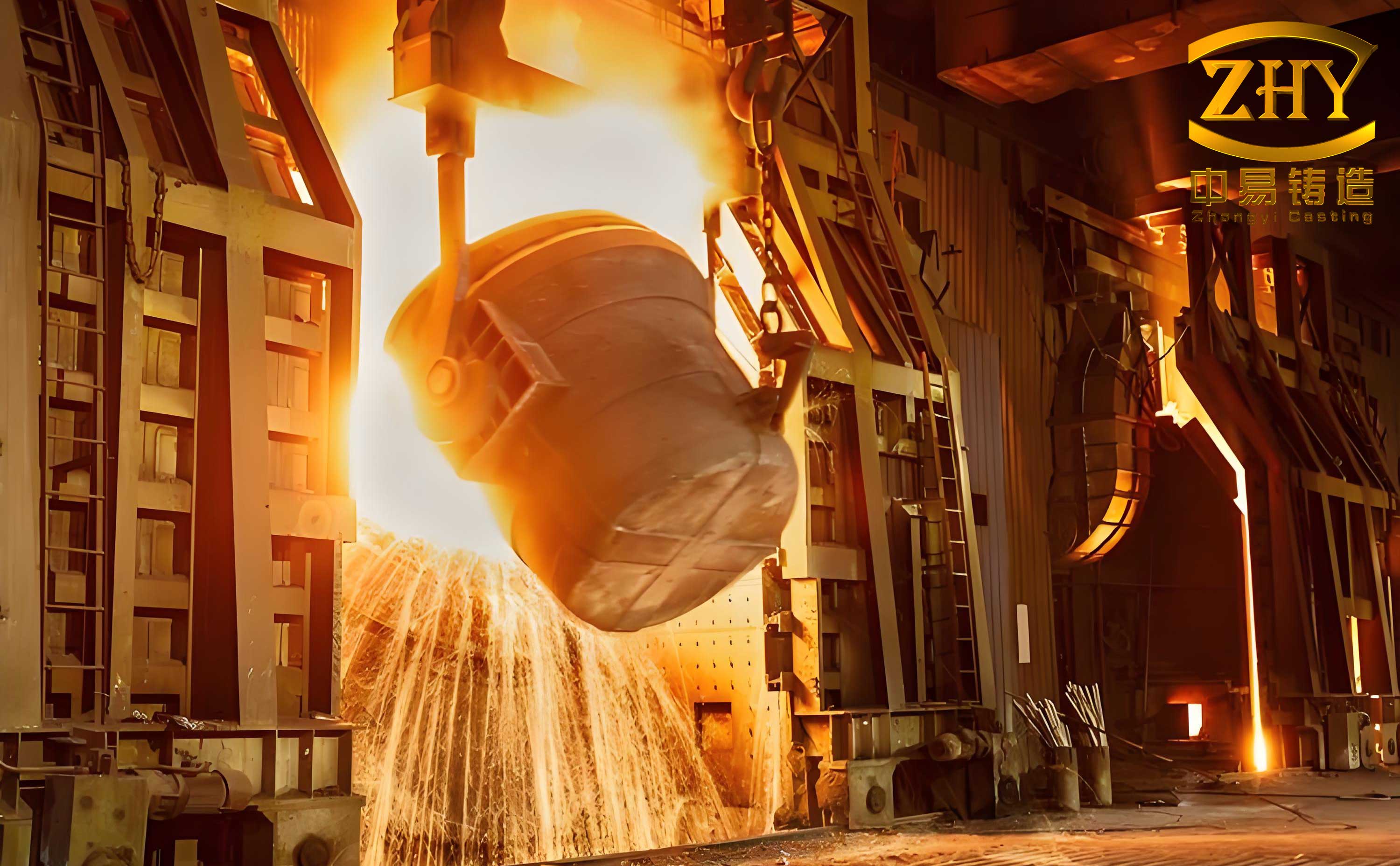
The solidification time of high manganese steel casting is influenced by several factors, including superheat, sand thermal conductivity, cooling intensity, and cold steel addition. We model the solidification time, \( \tau \), using the Fourier differential equation for unsteady heat conduction. For a cylindrical casting with radius 0.07 m and length 10 m, the equation is:
$$\frac{W_{\text{total}}}{F} = 2 \lambda_{\text{eff}} (t_1 – t_4) \sqrt{\frac{\tau \rho C}{\pi \lambda_{\text{eff}}}}$$
where \( F \) is the surface area of the casting, \( t_1 \) is the pouring temperature, \( t_4 \) is ambient temperature (25°C), \( \rho \) is sand density (2400 kg/m³), and \( C \) is sand specific heat capacity (0.29 × 10³ J/(kg·°C)). Rearranging gives:
$$\tau = \frac{\pi W_{\text{total}}^2}{4 \lambda_{\text{eff}} \rho C F^2 (t_1 – t_4)^2}$$
We analyze the impact of each factor on solidification time. For instance, reducing superheat from 60°C to 30°C decreases solidification time linearly, but the effect is modest. In contrast, increasing sand thermal conductivity significantly shortens solidification time, as shown in Table 1. Cooling devices (e.g., with \( \xi = 1.2 \) to 1.8) further reduce time, while cold steel addition (1–9% of melt mass) leads to substantial reductions.
| Thermal Conductivity, \(\lambda\) (W/(m·K)) | Solidification Time, \(\tau\) (s) |
|---|---|
| 1.0 | 4500 |
| 1.5 | 3000 |
| 2.0 | 2250 |
| 2.5 | 1800 |
| 3.0 | 1500 |
Similarly, the influence of cooling intensity and cold steel addition is quantified in Tables 2 and 3. For example, with a superheat of 40°C and no cold steel, increasing \( \xi \) from 1.0 to 1.8 reduces solidification time by over 50%. Adding 5% cold steel cuts time by approximately 170 s per 1% increase, highlighting its effectiveness.
| Correction Factor, \(\xi\) | Solidification Time, \(\tau\) (s) |
|---|---|
| 1.0 | 3510 |
| 1.2 | 2925 |
| 1.4 | 2507 |
| 1.6 | 2194 |
| 1.8 | 1950 |
| Cold Steel Addition (% of Melt Mass) | Solidification Time, \(\tau\) (s) |
|---|---|
| 1 | 3340 |
| 3 | 3000 |
| 5 | 2660 |
| 7 | 2320 |
| 9 | 1980 |
In practical applications, we compare conventional and improved high manganese steel casting processes. For a 1.2 t casting, conventional methods with a pouring temperature of 1500°C and silica sand (\(\lambda = 1.4 \, \text{W/(m·K)}\)) yield a solidification time of 3510 s. By optimizing parameters—reducing superheat to 40°C (pouring at 1450°C), using zircon sand (\(\lambda = 2.1 \, \text{W/(m·K)}\)), applying air cooling (\(\xi = 1.2\)), and adding 5% cold steel—the solidification time drops to 1523 s. This represents a 56.61% reduction, which significantly curbs nitrogen escape and boosts nitrogen content in high manganese steel casting.
However, increased nitrogen content may lead to shrinkage defects, necessitating extended risers and post-casting treatments like heat treatment and forging. Overall, the rapid solidification methods presented here offer a viable alternative to high-pressure equipment, making high nitrogen high manganese steel casting more accessible and efficient. Future work could focus on optimizing these parameters for industrial-scale production and exploring additional cooling techniques.
In conclusion, through detailed heat analysis and implementation of accelerated cooling strategies, we have demonstrated that rapid solidification in high manganese steel casting can effectively enhance nitrogen retention. The integration of high-thermal-conductivity sands, cooling devices, and cold steel addition not only shortens solidification time but also improves the quality and performance of high manganese steel casting, paving the way for broader applications in demanding environments.