
In the production of ductile iron, the presence of slag inclusions has long been a persistent and troublesome defect, often leading to compromised mechanical properties, surface imperfections, and reduced casting integrity. Our extensive experience at the foundry has consistently shown that slag inclusions, along with subsurface blowholes, shrinkage porosity, and shrinkage cavities, are intimately linked to the residual magnesium content in the molten iron. Specifically, excessive residual magnesium, while ensuring complete graphite spheroidization, tends to exacerbate the formation of these defects. This realization prompted our focused investigation into minimizing magnesium addition and controlling residual magnesium levels as a primary strategy to mitigate slag inclusions. The adoption of pressure magnesium addition for spheroidization treatment, while significantly improving magnesium utilization efficiency, inadvertently led to higher residual magnesium, making the defect issue more pronounced. Therefore, we embarked on a systematic study under normal production conditions to reduce magnesium addition, precisely control residual magnesium, and develop effective methods to diminish slag inclusions. This article details our first-person perspective on the principles, practices, and results of these efforts, emphasizing the critical role of process control in enhancing ductile iron quality.
The foundational principle for determining magnesium addition in ductile iron hinges on several key factors: the original sulfur content of the base iron, the minimum residual magnesium required to ensure complete graphite spheroidization, and the magnesium losses during processing and pouring. Mathematically, the required magnesium addition (Mgadded) can be approximated by considering the sulfur removal consumption and the target residual magnesium (Mgresidual). The relationship is often expressed as:
$$ Mg_{added} = \frac{Mg_{residual} + Mg_{desulfurization}}{\eta} $$
where Mgdesulfurization represents the magnesium consumed for desulfurization, and η is the overall magnesium utilization efficiency. The desulfurization consumption is directly proportional to the sulfur removal; for instance, removing 0.01% sulfur typically consumes approximately 0.0075% magnesium. Thus, if the base iron sulfur content is Sinitial and the target sulfur after treatment is Sfinal, the magnesium consumed for desulfurization can be estimated as:
$$ Mg_{desulfurization} = k \times (S_{initial} – S_{final}) $$
with k being a constant around 0.75 (for 0.01% S removal requiring 0.0075% Mg). Historically, to avoid the risk of imperfect spheroidization, foundries often over-added magnesium, neglecting the consequent increase in defects like slag inclusions. Our approach reversed this: we aimed to reduce magnesium addition to the bare minimum necessary for spheroidization, targeting a residual magnesium level just above the critical threshold of 0.03-0.04%. This required meticulous control over all process variables.
Our production setup utilized an acid-lined cupola for melting, with charge materials including pig iron, returned ductile iron scrap, ferromanganese (containing 70-80% Mn), ferrosilicon, magnesium alloy (containing 8-10% Mg), and silicon-calcium alloy (containing 55-60% Si, 25-30% Ca). The spheroidization equipment was a bottle-type pressure magnesium addition ladle, with capacities of 500 kg and 1000 kg, as illustrated in the following schematic description: the ladle features a sealed design with a bell-shaped cover, a plunger mechanism for immersing magnesium, and insulation layers to minimize heat loss. This design is crucial for enhancing magnesium utilization by reducing oxidation losses and ensuring prolonged contact between magnesium and molten iron.
The melting and treatment conditions were standardized to minimize variability. The charge composition was adjusted to achieve a hypereutectic composition with high carbon and low silicon to improve magnesium absorption and graphite nucleation. A typical charge ratio is summarized in Table 1.
| Material | Proportion (%) | Approximate Composition (%) |
|---|---|---|
| Pig Iron | 60-70 | C: 4.0-4.3, Si: 1.2-1.5, S: 0.02-0.04, P: 0.05-0.07 |
| Return Ductile Iron | 20-30 | C: 3.6-3.9, Si: 2.0-2.5, S: 0.01-0.02, Mg: 0.03-0.05 |
| Ferromanganese | 0.5-1.0 | Mn: 70-80 |
| Ferrosilicon | 1.0-1.5 | Si: 75 |
| Others (alloys) | As needed | Varies |
The spheroidization treatment involved precise control of the pressure ladle operations. Key parameters included the free space above the molten iron in the ladle, the immersion depth of the magnesium bell, and the treatment time. We found that minimizing the headspace volume and ensuring deep immersion significantly reduced magnesium oxidation losses and extended the reaction time, thereby improving utilization. The magnesium utilization efficiency (η) is defined as:
$$ \eta = \frac{Mg_{residual} + Mg_{desulfurization}}{Mg_{added}} \times 100\% $$
However, in practice, Mgdesulfurization is often estimated from sulfur reduction. A more operational formula we used for quick estimation is:
$$ \eta \approx \frac{Mg_{residual}}{Mg_{added}} \times 100\% + \text{correction factor} $$
but for accuracy, we relied on direct measurements. By systematically varying magnesium addition from 0.20% down to 0.15%, we monitored residual magnesium and defect occurrence. The results, as shown in Table 2, demonstrate a clear correlation.
| Heat Number | Mg Addition (%) | Base Iron S (%) | Residual Mg (%) | Mg Utilization η (%) | Slag Inclusion Rating* |
|---|---|---|---|---|---|
| 1 | 0.20 | 0.035 | 0.065 | ~65 | High |
| 2 | 0.18 | 0.032 | 0.052 | ~68 | Moderate |
| 3 | 0.16 | 0.030 | 0.041 | ~70 | Low |
| 4 | 0.15 | 0.028 | 0.036 | ~72 | Very Low |
*Slag inclusion rating based on visual inspection of test castings: High = severe slag bands, Low = minimal or no visible slag.
To further understand the dynamics, we developed an empirical model for residual magnesium as a function of addition and base sulfur:
$$ Mg_{residual} = \alpha \cdot Mg_{added} – \beta \cdot S_{initial} + \gamma $$
where α, β, and γ are constants derived from regression of our production data, approximately α = 0.85, β = 0.6, and γ = 0.01 for our specific conditions. This model helped in pre-calculating the required addition to achieve a target residual of 0.04-0.05%, which proved effective in reducing slag inclusions.
The reduction of slag inclusions was not solely dependent on magnesium control; we also investigated the role of post-inoculation and ladle treatments. Inoculation with ferrosilicon or silicon-calcium alloy was performed after spheroidization, but we optimized the method to ensure high and consistent silicon recovery. Adding inoculant in the ladle after slag removal and with thorough stirring improved silicon recovery to about 90%, compared to 70-80% when added in the stream. This enhanced inoculation promoted finer graphite and reduced oxide formation, thereby mitigating slag inclusions. The mechanism is believed to be related to improved fluidity and reduced surface oxidation of the molten iron.
We conducted dedicated trials to quantify the effect of reduced magnesium and added silicon-calcium on slag inclusions. Test castings in the form of stepped blocks were produced under controlled conditions, with varying magnesium addition and inoculation practices. Each block was examined macroscopically and microscopically for slag inclusions, and mechanical properties were tested. The chemical composition and mechanical properties of representative samples are given in Table 3.
| Sample ID | C (%) | Mn (%) | Si (%) | S (%) | P (%) | Mg (%) | Tensile Strength (MPa) | Elongation (%) | Hardness (HB) |
|---|---|---|---|---|---|---|---|---|---|
| A (0.20% Mg) | 3.75 | 0.45 | 2.60 | 0.012 | 0.035 | 0.065 | 480 | 12 | 200 |
| B (0.16% Mg) | 3.80 | 0.42 | 2.65 | 0.010 | 0.033 | 0.041 | 520 | 16 | 190 |
| C (0.15% Mg + SiCa) | 3.78 | 0.43 | 2.70 | 0.009 | 0.034 | 0.036 | 540 | 18 | 185 |
The microstructure analysis revealed that samples with lower residual magnesium (0.04% range) exhibited well-formed spheroidal graphite with minimal oxide inclusions, whereas higher residual magnesium led to increased interdendritic oxides and slag particles. The graphite spheroidization rate remained above 90% even at 0.15% Mg addition, provided the base sulfur was below 0.03%. This confirms that reducing magnesium addition is feasible without compromising graphite morphology.
To visually appreciate the severity of slag inclusions, consider the following image which illustrates typical slag defects in ductile iron castings. These inclusions often appear as dark, discontinuous lines or patches near the casting surface or along thermal gradients, and they are primarily composed of magnesium silicates, oxides, and other reaction products. Their presence is a direct consequence of excessive residual magnesium and inadequate process control.
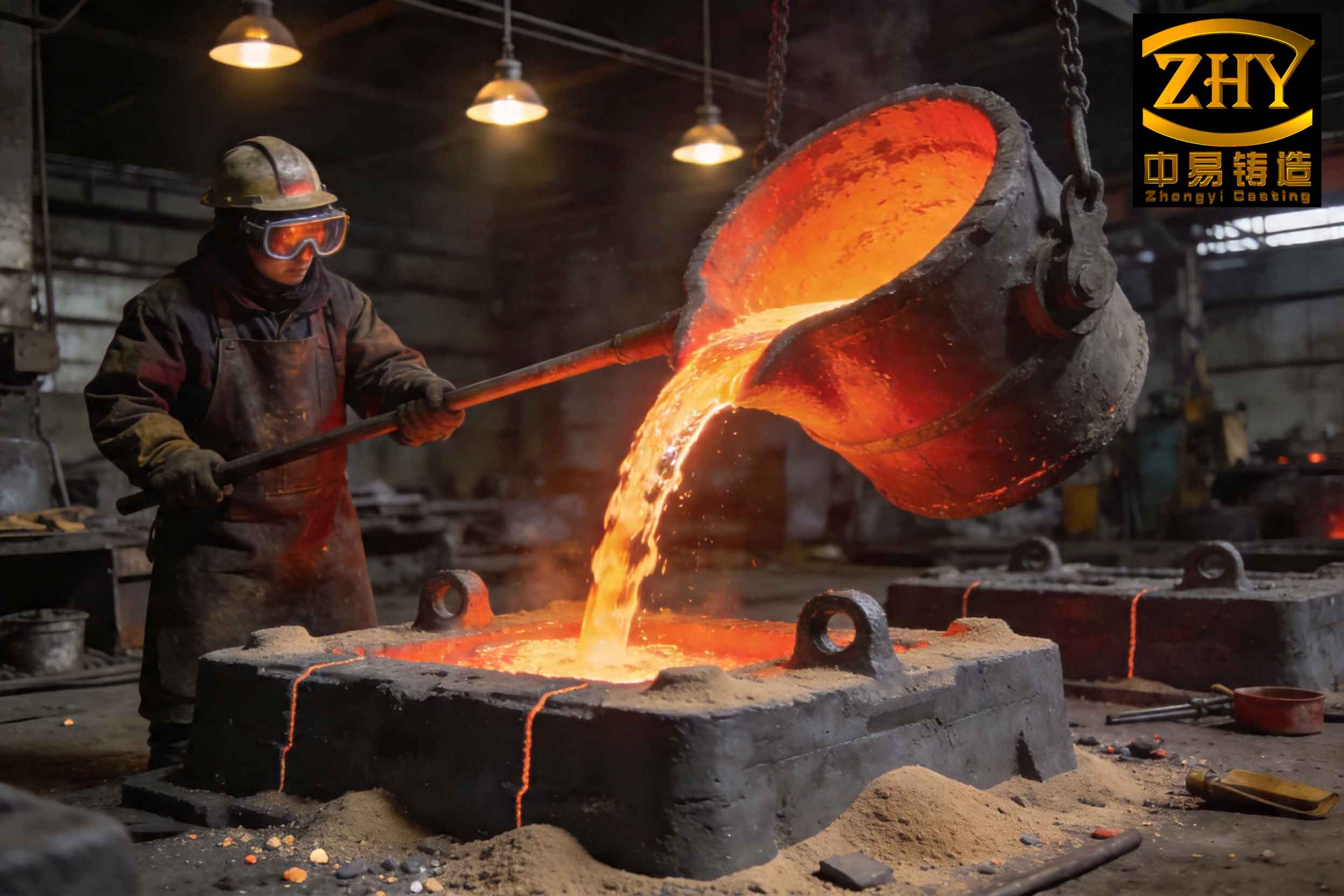
The image underscores the importance of our efforts: by controlling magnesium, we can significantly reduce such defects. Our trials involved producing over several hundred tons of ductile iron castings, including complex parts like gearboxes and hydraulic components. The consistent outcome was a dramatic reduction in slag-related scrap rates, from about 5-7% down to less than 1%, when magnesium addition was maintained at 0.15-0.16% and residual magnesium at 0.035-0.045%.
Another critical aspect was the control of base iron sulfur. Since magnesium consumption for desulfurization is a major factor, lowering initial sulfur directly reduces the required magnesium addition. In our acid cupola, achieving sulfur levels below 0.02% was challenging, but we implemented measures such as using low-sulfur coke and pig iron, and optimizing blast parameters to enhance desulfurization in the cupola. The installation of a hot blast system improved iron temperature and reduced coke consumption, which indirectly lowered sulfur pickup. Data from before and after hot blast installation is shown in Table 4.
| Condition | Blast Temperature (°C) | Coke Ratio (%) | Average Base Iron S (%) | Remarks |
|---|---|---|---|---|
| Before Hot Blast | Ambient | 12-14 | 0.035-0.045 | Higher sulfur pickup |
| After Hot Blast | 250-300 | 10-12 | 0.025-0.035 | Improved melting efficiency |
With lower base sulfur, the magnesium required for desulfurization drops, allowing for lower addition to achieve the same residual. For example, if base sulfur is reduced from 0.04% to 0.02%, the desulfurization consumption decreases by approximately 0.015% Mg, enabling a proportional reduction in addition. This synergy between sulfur control and magnesium management is vital for minimizing slag inclusions.
We also studied the kinetics of magnesium loss during holding and pouring. Residual magnesium tends to decrease over time due to oxidation and evaporation, but our measurements showed that the decay is relatively slow, with a loss rate of about 0.001-0.002% per minute under covered ladle conditions. Therefore, as long as pouring is completed within 10-15 minutes after treatment, the residual magnesium remains within the target range. This allowed us to schedule casting operations without significant concern for magnesium fade affecting spheroidization.
The role of inoculation cannot be overstated in the context of slag inclusions. Silicon-calcium alloy, added in small amounts (0.1-0.2%), not only improves graphite nucleation but also acts as a deoxidizer, reducing the formation of primary oxides that contribute to slag. The calcium in the alloy forms stable oxides that coalesce and float out more easily, while silicon enhances fluidity. We quantified the effect by comparing test blocks with and without silicon-calcium addition at reduced magnesium levels. The results, summarized in Table 5, show a clear benefit in terms of slag reduction and mechanical properties.
| Inoculation Type | Addition Amount (%) | Slag Inclusion Index* | Tensile Strength (MPa) | Elongation (%) | Graphite Nodule Count (per mm²) |
|---|---|---|---|---|---|
| None | 0 | 0.6 | 510 | 14 | 120 |
| Ferrosilicon only | 0.8 | 0.4 | 525 | 16 | 150 |
| Ferrosilicon + SiCa | 0.7 + 0.15 | 0.2 | 540 | 18 | 180 |
*Slag Inclusion Index: 0 = no slag, 1 = severe slag; based on standardized visual assessment.
The improvement is attributed to the combined effects of better graphite morphology and reduced oxide content. The silicon-calcium inoculation promotes the formation of more uniform, smaller spheroidal graphite, which enhances ductility and strength, while simultaneously reducing the oxygen potential in the melt, thereby minimizing the sources of slag inclusions.
In terms of process optimization, we established a comprehensive control protocol. First, the cupola melting is stabilized to produce base iron with consistent temperature (1480-1520°C) and sulfur content (≤0.03%). Second, the pressure ladle is prepared with precise freeboard control, ensuring the bell immersion depth is at least 300 mm for a 500 kg ladle. Third, magnesium addition is calculated based on real-time sulfur analysis, targeting a residual of 0.04-0.05%. Fourth, inoculation is performed immediately after slag removal, using preheated ferrosilicon and silicon-calcium, with vigorous stirring. Fifth, pouring is completed within 10 minutes to minimize magnesium loss. This protocol, when adhered to, resulted in reproducible high-quality castings with negligible slag inclusions.
To further validate our findings, we performed statistical analysis on production data from multiple heats. The correlation between residual magnesium and slag inclusion occurrence was modeled using a logistic regression, yielding the following probability function for slag defect occurrence (Pslag):
$$ P_{slag} = \frac{1}{1 + e^{-(a \cdot Mg_{residual} + b)}} $$
where a and b are coefficients determined from our data, approximately a = 120 and b = -5. This function indicates that as residual magnesium increases beyond 0.05%, the probability of slag inclusions rises sharply. Conversely, below 0.04%, the probability is very low. This mathematical model helps in setting tight control limits for residual magnesium.
Moreover, we explored the effect of pouring temperature on slag inclusions. Higher pouring temperatures (above 1350°C) improve fluidity and allow slag particles to float out more easily, but they also increase oxidation. We found an optimal range of 1320-1360°C, where the iron is fluid enough for slag separation but not excessively oxidized. This was particularly important for thin-section castings, where slag inclusions are more detrimental.
The economic impact of reducing magnesium addition is significant. Magnesium is a costly alloying element, and reducing addition from 0.20% to 0.15% represents a 25% saving in magnesium consumption. For a foundry producing 10,000 tons of ductile iron annually, this translates to savings of several tons of magnesium, reducing material costs substantially. Additionally, the reduction in slag inclusions lowers scrap rates, rework, and inspection costs, further enhancing profitability.
In conclusion, our extensive trials and production experience demonstrate that reducing magnesium addition to 0.15-0.16% and controlling residual magnesium to 0.035-0.045% is entirely feasible and highly beneficial in minimizing slag inclusions in ductile iron castings. Key to this achievement is the precise control of melting and treatment conditions, including the use of an optimized pressure ladle, management of base iron sulfur, and effective inoculation with silicon-calcium alloys. The result is improved casting quality, enhanced mechanical properties, and significant cost savings. The fight against slag inclusions is multifaceted, but through diligent process engineering and a deep understanding of magnesium metallurgy, we have developed a robust methodology that ensures high-integrity ductile iron components for demanding applications. Future work may focus on further lowering sulfur through advanced melting techniques and exploring alternative inoculants to push the boundaries of defect-free casting.
Throughout this journey, we have learned that every parameter—from the cupola blast temperature to the ladle geometry—plays a role in determining the final casting quality. By embracing a data-driven approach and continuously refining our practices, we have turned the challenge of slag inclusions into an opportunity for process excellence. The insights shared here, rooted in first-hand experimentation and production validation, offer a practical roadmap for foundries worldwide seeking to enhance their ductile iron operations and eliminate the persistent problem of slag inclusions.