
In my extensive experience within the foundry industry, the pervasive issue of slag inclusions in ductile iron castings has consistently posed significant challenges to product quality and cost-efficiency. Slag inclusions, which are non-metallic oxide compounds entrapped within or on the surface of a casting, severely degrade mechanical properties, particularly toughness and yield strength, and can lead to leakage in pressure-bearing sections. This article details a comprehensive analysis and successful engineering approach to mitigate these defects, focusing on the critical redesign of the gating system based on hydrodynamic principles. The core of the solution lay in transitioning from a choked, turbulent flow regime to a calm, open system, dramatically reducing the formation and entrapment of slag inclusions.
The problematic casting in this case was a large gas turbine component made from QT400-18 ductile iron. Its complex geometry, with varying wall thicknesses and large upper surfaces, made it particularly susceptible to slag defects. The initial production process utilized a common semi-pressurized gating system with a single sprue, a horizontal runner, and four bottom-gated ingates. The flow was characterized by high velocity and severe turbulence within the mold cavity, promoting re-oxidation of the molten iron and the vigorous formation of secondary slag inclusions.
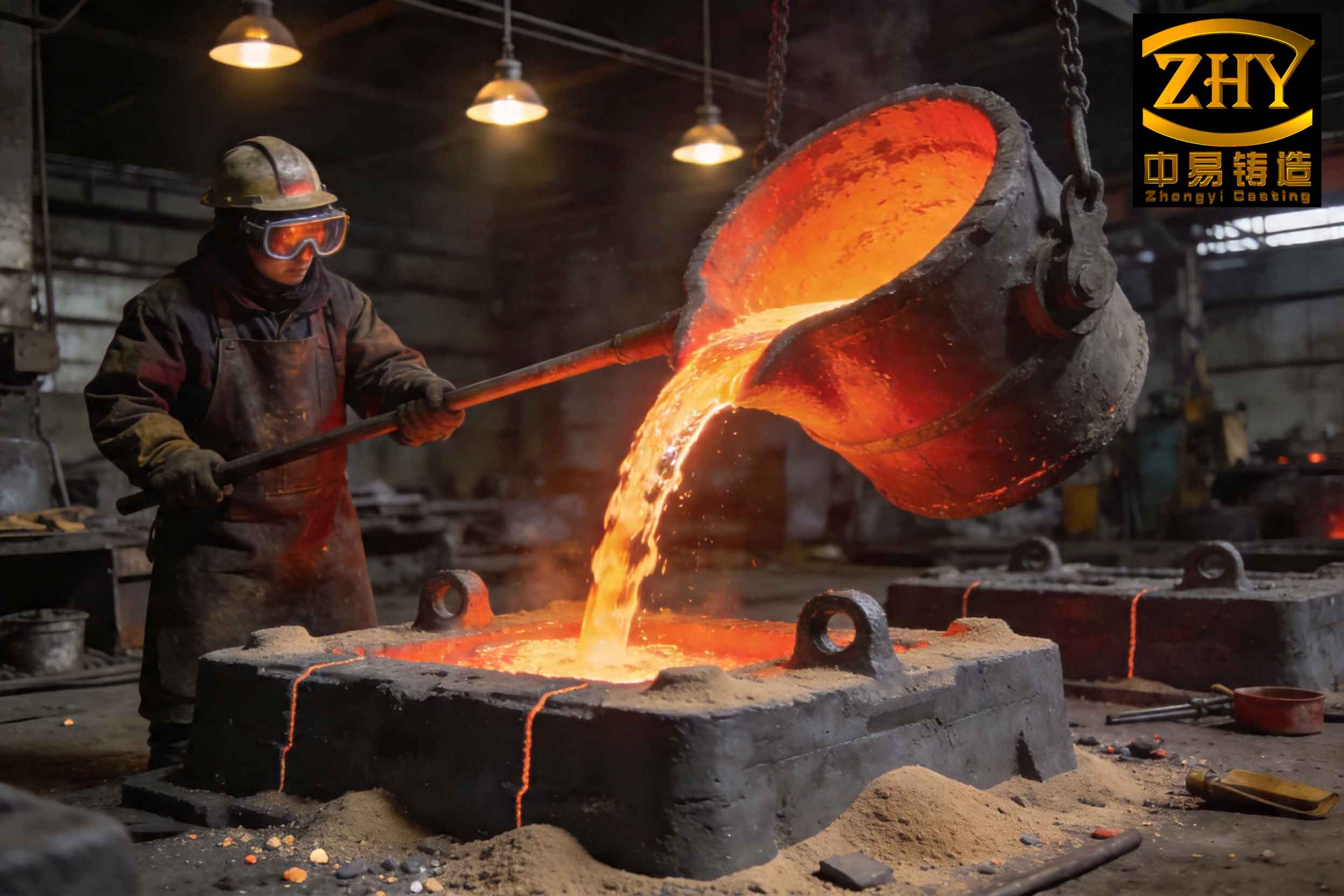
The visual inspection of the initial castings revealed extensive, irregular slag inclusions concentrated on the upper surfaces of the flanges and bearing seats—areas directly in the path of rising, agitated metal. These slag inclusions were not superficial but penetrated 3 to 15 mm into the casting wall, constituting a critical failure. The scrap rate for the first batch of production using the old method was an unacceptable 26.7%. The primary culprit was identified as the gating design, which forced metal into the mold at excessively high speed, causing splashing and entrainment of air and existing slag. The high velocity increased the kinetic energy of the flow, preventing effective slag separation in the runner system and leading to direct incorporation of oxides into the casting. The mechanism for the formation of these troublesome slag inclusions involves the reaction of residual magnesium in the ductile iron with oxygen from entrained air, forming magnesium silicate and other complex oxides that agglomerate into dross.
The fundamental redesign was guided by the “Large Orifice Discharge” theory, which advocates for an open gating system. The principle is to sequentially increase the cross-sectional area from the sprue to the ingates, thereby progressively reducing the flow velocity and ensuring laminar, non-turbulent filling of the mold cavity. This calm filling minimizes agitation, prevents re-oxidation, and allows slag particles to float out in the pouring basin or runner rather than being carried into the casting. The key calculations for the new system are detailed below.
First, the total pouring time must be determined. For a bottom-gated heavy casting, the empirical formula is:
$$ t_{\text{pour}} = f \left( \sqrt{G_{\text{casting}}} + \frac{1}{5} \delta \sqrt[3]{G_{\text{casting}}} \right) \times \frac{2}{3} $$
Where:
$t_{\text{pour}}$ = Pouring time (s),
$f$ = Resistance coefficient (0.6-0.8, higher for bottom-gating),
$G_{\text{casting}}$ = Casting weight (kg),
$\delta$ = Predominant wall thickness (mm).
For a 4,500 kg casting with a 41 mm wall, using $f=0.75$, the calculated pouring time was approximately 66 seconds.
The next step is to size the choke, which in an open system is the sprue’s bottom area. The formula for the choke area $S_{\text{choke}}$ is:
$$ S_{\text{choke}} = \frac{22.6 \times W}{\rho \times t_{\text{pour}} \times f_v \sqrt{H_p}} $$
Where:
$W$ = Total metal poured (kg),
$\rho$ = Density of molten ductile iron (≈6.9 kg/dm³),
$f_v$ = Velocity coefficient (0.4 for bottom-gating),
$H_p$ = Average effective metal head height (cm).
With $W=6000$ kg, $t_{\text{pour}}=66$ s, $f_v=0.4$, and $H_p=250$ cm, the required choke area $S_{\text{choke}}$ was calculated to be 52 cm². This corresponds to a sprue ceramic tube with an inner diameter of 80 mm.
An open system requires the runner and ingate total areas to be larger than the sprue area. The recommended gating ratio is $\Sigma F_{\text{sprue}} : \Sigma F_{\text{runner}} : \Sigma F_{\text{ingate}} = 1 : 1.5-2 : 2$. To ensure exceptionally calm filling for this large, slag-prone casting, we adopted a ratio of 1 : 2.15 : 2.49. The runner was designed as a rectangular channel, and multiple ceramic tubes were used for ingates to distribute flow evenly. The final design parameters are summarized in the table below, contrasting sharply with the old system.
| Parameter | Original (Semi-pressurized) System | Improved (Open) System |
|---|---|---|
| Sprue (Choke) Area | 50.2 cm² (φ80 mm tube) | 50.2 cm² (φ80 mm tube) |
| Total Runner Area | 150 cm² (Trapezoidal 70/80×100 mm) | 108 cm² (Rectangular 90×60 mm) |
| Total Ingate Area | 38.5 cm² (4 x φ35 mm tubes) | 125 cm² (13 x φ35 mm tubes) |
| Gating Ratio (ΣFsprue : ΣFrunner : ΣFingate) | 1 : 2.99 : 0.77 | 1 : 2.15 : 2.49 |
| Calculated Ingate Velocity | ~0.91 m/s | 0.28 m/s |
| Flow Characteristic | High-speed, turbulent, prone to splashing | Low-speed, laminar, calm filling |
The ingate entry velocity $V_I$ is a critical indicator of flow tranquility and its role in generating slag inclusions. It can be derived and approximated as:
$$ V_I = \frac{Q}{A_I} = \frac{W / (\rho \cdot t_{\text{pour}})}{n \cdot A_{\text{sprue}}} \approx \frac{10 \sqrt{H_p}}{n \cdot 22.6} $$
Where $n$ is the ratio of total ingate area to sprue area ($A_I / A_{\text{sprue}}$). For the new system, with $n=2.49$ and $H_p=2.5$ m, $V_I$ computes to 0.28 m/s, a reduction of over 60% from the original 0.91 m/s. This low velocity is well below the threshold that causes serious surface turbulence and vortex formation, which are direct precursors to slag inclusions. The relationship between velocity and slag formation can be further explored through the Reynolds number $Re$, which predicts the transition from laminar to turbulent flow:
$$ Re = \frac{\rho V D_h}{\mu} $$
Where $D_h$ is the hydraulic diameter of the ingate and $\mu$ is the dynamic viscosity of molten iron. The drastic reduction in $V$ directly lowers $Re$, favoring laminar flow and reducing the shear forces that can rip the oxide skin and create dispersed slag inclusions.
The success of this gating system overhaul was immediately apparent. The first trial casting produced using the open system was completely free from the gross slag inclusions that had plagued previous parts. A subsequent production run of 34 castings yielded only one scrapped piece due to minor slag, reducing the chronic scrap rate from 26.7% to an impressive 3%. While the new system required approximately 150 kg more metal for feeders and the larger gating system, the dramatic reduction in scrap generated a net saving of 500 USD per casting. The prevention of slag inclusions translated directly into superior casting integrity, reliable mechanical properties, and significant economic gain.
The chemical composition of the iron also plays a supporting role in the tendency to form slag inclusions. While the gating system is the primary control, optimal melt chemistry minimizes the source material for oxides. The target ranges used are shown below.
| Element | Target Weight % | Influence on Slag Inclusions |
|---|---|---|
| Carbon (C) | 3.5 – 3.7 | Higher carbon equivalent improves fluidity but must be balanced against graphite floating. |
| Silicon (Si) | 2.2 – 2.7 | Promotes graphitization; high Si can increase slag volume if oxidized. |
| Manganese (Mn) | 0.3 – 0.47 | Low level is maintained to minimize formation of MnS and complex manganese silicates which contribute to slag inclusions. |
| Phosphorus (P) | ≤ 0.06 | Kept very low as P increases fluidity but also promotes hard phosphide eutectic and can exacerbate micro-slag inclusions. |
| Sulfur (S) | ≤ 0.05 | Low sulfur is crucial post-inoculation to reduce the amount of MgS slag, a primary component of slag inclusions in ductile iron. |
| Magnesium (Mg) | 0.03 – 0.05 (Residual) | Precise control is vital; excess residual Mg significantly increases the propensity for forming magnesium silicate slag inclusions. |
The interplay between kinetics and thermodynamics in slag formation is crucial. The rate of oxide formation, which feeds the population of slag inclusions, is governed by factors like temperature and concentration. The activity of oxygen in the melt in contact with air can be considered. While a full kinetic model is complex, the reduction in velocity directly decreases the mass transfer coefficient for oxygen at the metal-air interface, effectively slowing the reaction:
$$ [\text{Mg}]_{\text{Fe}} + \frac{1}{2} \text{O}_2 \rightarrow (\text{MgO})_{\text{slag}} $$
This reaction is a major contributor to the secondary slag that forms during pouring. By designing a system that minimizes interfacial area renewal and exposure time through calm filling, we directly suppress the driving force for creating new slag inclusions.
Beyond the gating system, other process factors were standardized to support the reduction of slag inclusions. The pouring temperature was strictly maintained between 1350°C and 1380°C. Too low a temperature increases viscosity, impeding slag floatation; too high a temperature accelerates oxidation. Mold coatings with enhanced refractory properties were used to prevent sand reaction, another potential source of non-metallic inclusions. Furthermore, the use of ceramic filter blocks in the runner system was evaluated. While not implemented in this specific case due to the success of the open gating, the pressure drop across a filter $\Delta P$ can be estimated using the Darcy-Forchheimer equation, and its inclusion can be a powerful additional tool for trapping slag inclusions:
$$ \Delta P = \frac{\mu L}{K} V + \beta \rho L V^2 $$
Where $L$ is filter thickness, $K$ is permeability, $\beta$ is the inertial coefficient, and $V$ is approach velocity. The successful application of the large orifice discharge theory has since been replicated on numerous other casting geometries prone to slag inclusions, such as valve bodies, pump casings, and large gear blanks. The universal approach involves calculating the necessary slow filling time, sizing the sprue as the choke, and then systematically designing runner and ingate networks with progressively larger total cross-sections to ensure metal expansion and velocity reduction.
In conclusion, the battle against slag inclusions in ductile iron castings is won through a fundamental understanding and control of fluid flow during mold filling. The shift from a traditional, velocity-driven gating philosophy to one prioritizing volumetric flow and tranquility is transformative. The mathematical framework provided by the large orifice discharge theory offers a rational design methodology. By meticulously calculating pouring time, choke area, and gating ratios to achieve ingate velocities below 0.3 m/s, foundries can effectively eliminate the turbulent conditions that birth slag inclusions. This engineering solution, coupled with consistent melt quality control, provides a robust and reliable path to producing high-integrity ductile iron castings free from the costly and damaging effects of slag inclusions. The economic and quality benefits are substantial, turning a chronic quality problem into a controlled process variable.