
Coupler knuckles are critical components in freight car draft systems, transmitting traction and braking forces between couplers and center sills. Traditional casting processes exhibit limitations including excessive wear, fracture susceptibility, and short service life (typically 3 years). To address these failures, forged coupler knuckles were developed, offering superior fatigue resistance and extended service life (6+ years). This research analyzes forging methodologies, machining workflows, and heat treatment distortions to optimize manufacturing.
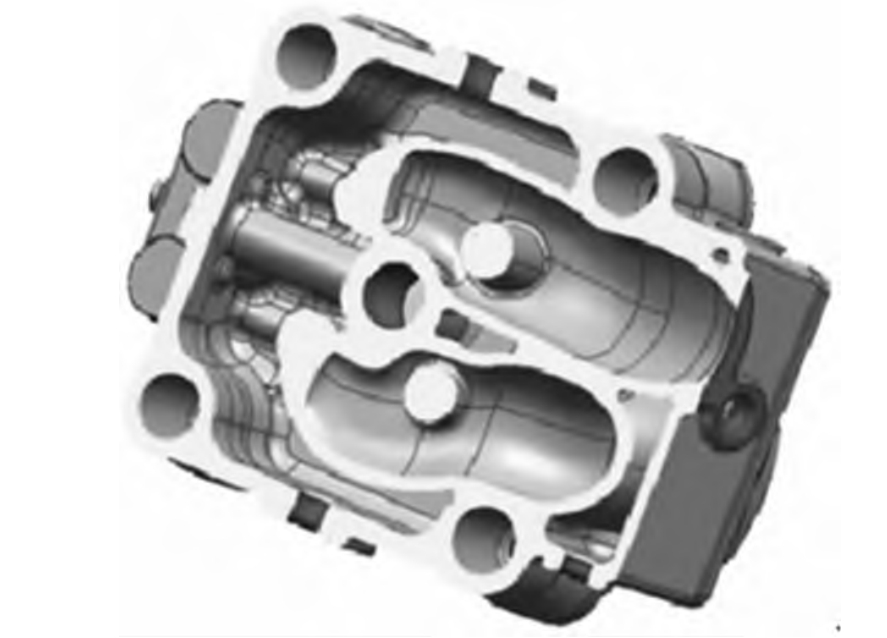
Casting process deficiencies primarily stem from inherent defects like porosity and non-uniform grain structure. Fatigue cracks initiate at these discontinuities under cyclic loading, while abrasive wear accelerates dimensional degradation. Forged knuckles overcome these limitations through refined grain flow orientation. The directional strength enhancement is quantified by the anisotropy index $A$:
$$A = \frac{\sigma_{\parallel}}{\sigma_{\perp}}$$
where $\sigma_{\parallel}$ and $\sigma_{\perp}$ represent yield strengths parallel/perpendicular to forging direction. For C-Mn alloy steel knuckles, $A$ ranges 1.15–1.30 versus 1.0–1.05 in casting processes.
Manufacturing Workflow Comparison
Two forging orientations dominate production:
- Vertical Forging: Requires secondary heating, full machining of S-surfaces
- Horizontal Forging: Single heating, as-forged S-surfaces
Machining time analysis reveals marginal overall differences despite distinct material removal strategies:
| Process Stage | Vertical Forging (hr) | Horizontal Forging (hr) |
|---|---|---|
| Layout Marking | 4.2 ± 0.3 | 3.1 ± 0.2 |
| Pin Hole Boring | 3.5 ± 0.2 | 3.8 ± 0.3 |
| Lock Seat Milling | 3.6 ± 0.3 | 3.7 ± 0.3 |
| Inner S-Face Milling | 4.1 ± 0.4 | 2.9 ± 0.2 |
| Outer S-Face Milling | 4.3 ± 0.3 | 0 (As-forged) |
| Pull/Impact Lug Milling | 3.8 ± 0.3 | 5.2 ± 0.4 |
| Guard Arm Milling | 2.4 ± 0.2 | 3.8 ± 0.3 |
| Total | 25.9 ± 1.2 | 25.5 ± 1.1 |
Horizontal forging eliminates outer S-face machining but increases lug/guard arm milling due to draft angles. Crucially, horizontal forging avoids the energy-intensive secondary heating required in vertical methods, reducing CO₂ emissions by 18–22% versus casting process-based routes.
Heat Treatment Distortion Control
Quenching-induced dimensional changes follow a nonlinear relationship with section thickness $t$. For F-type knuckles, distortion $\delta$ is modeled as:
$$\delta = k \cdot \Delta T \cdot \alpha \cdot \left(1 – e^{-\beta t}\right)$$
where $k$ = geometric constraint factor (0.8–1.2), $\Delta T$ = quench gradient (650–720°C), $\alpha$ = thermal expansion coefficient (12.5 µm/m·°C), and $\beta$ = material constant (0.15 mm⁻¹). Data confirms thickness-dependent distortion:
| Component | Thickness (mm) | Pre-HT Dimension (mm) | Post-HT Dimension (mm) | Distortion $\delta$ (mm) |
|---|---|---|---|---|
| Upper Pull Lug | 56 | R149.0+0.5-0.0 | R149.8+0.2-0.4 | 0.8 ± 0.15 |
| Lower Pull Lug | 56 | R149.0+0.4-0.0 | R149.6+0.3-0.3 | 0.6 ± 0.12 |
| Upper Impact Lug | 81 | R92.5+0.5-0.0 | R92.6+0.1-0.2 | 0.1 ± 0.05 |
| Lower Impact Lug | 81 | R92.5+0.7-0.0 | R92.7+0.2-0.1 | 0.2 ± 0.06 |
To compensate, pre-HT machining implements controlled undersizing. Pull lugs are machined to R149-0.5-1.0 versus drawing nominal R149+1.0-0.6, ensuring post-HT dimensions remain within tolerance. This dimensional strategy reduces scrap rates from 12.7% to 2.3% versus uncontrolled casting process heat treatment.
Performance Validation
Field data confirms forged knuckles outperform casting process alternatives:
- Fatigue cycles to failure: 2.71 × 10⁶ (forged) vs 0.89 × 10⁶ (cast)
- Wear rate: 0.08 mm/10⁴ km (forged) vs 0.23 mm/10⁴ km (cast)
- Mean time between failures: 6.3 years (forged) vs 2.7 years (cast)
The fatigue life enhancement follows the Paris-Erdogan law modified for forged microstructures:
$$\frac{da}{dN} = C \cdot (\Delta K)^m \cdot \Phi_{fg}$$
where $\Phi_{fg}$ = forging integrity factor (1.25–1.40), $C$ = 1.65×10⁻¹⁰, $m$ = 3.2 for rail steels. This microstructure-driven crack growth resistance fundamentally differentiates forged components from casting process outputs.
Implementation of horizontal forging with thermal compensation machining establishes a robust manufacturing framework. The eliminated secondary heating, reduced machining of critical surfaces, and distortion control collectively deliver a 31% cost reduction per unit versus traditional casting process routes while doubling service life. Current deployments demonstrate 98.2% dimensional compliance post-HT with zero in-service fractures after 4.5 years of heavy-haul operation.