
As a researcher in the field of wear-resistant materials, I have extensively studied the development and application of high manganese steel casting, particularly for lining plates in mining and industrial machinery. High manganese steel casting, often referred to as Hadfield steel, has been a cornerstone material due to its unique combination of high toughness and significant work-hardening capability under impact. This article delves into the comprehensive research on high manganese steel casting, covering traditional compositions, alloying modifications, heat treatment processes, surface pre-hardening techniques, and current applications. The focus is on optimizing high manganese steel casting for enhanced durability and cost-effectiveness in demanding environments like ball mills and crushers.
The importance of lining plates in equipment such as ball mills and crushers cannot be overstated. They are critical components subjected to severe abrasive wear, impact, and fatigue. Historically, high manganese steel casting has been the material of choice for these applications, thanks to its ability to harden superficially while retaining a ductile austenitic core. However, traditional high manganese steel casting, like ZGMn13, has limitations, including low yield strength and inadequate wear resistance under low-impact conditions. This has spurred extensive research into improving high manganese steel casting through various metallurgical approaches. In this review, I will explore the advancements in high manganese steel casting, emphasizing alloy design, processing techniques, and future directions to meet industrial needs for longer service life and reduced operational costs.
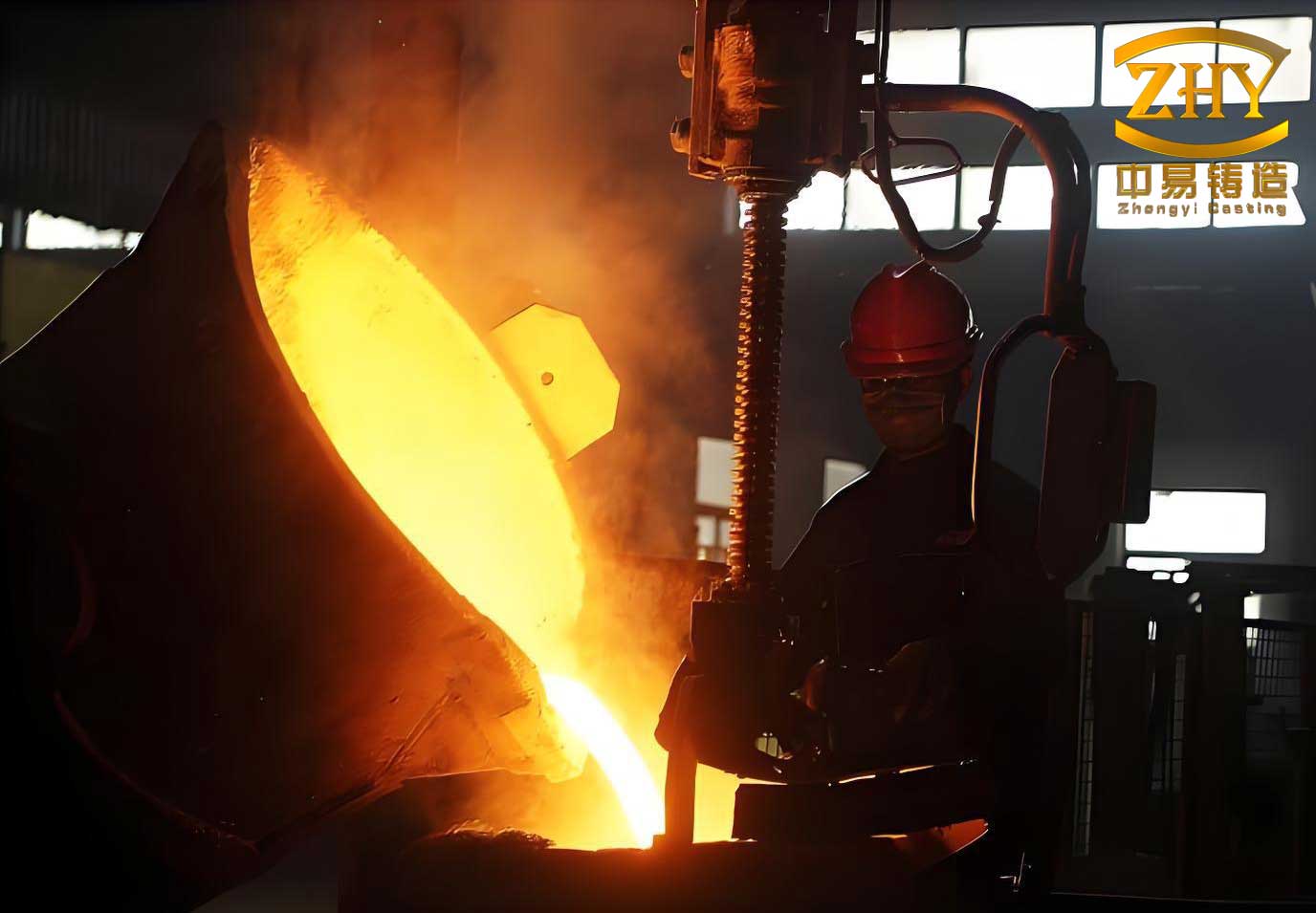
Traditional high manganese steel casting, exemplified by ZGMn13, typically contains 0.9-1.5% carbon and 10-15% manganese, as shown in Table 1. This composition results in a fully austenitic structure after water toughening, providing excellent impact toughness. However, its initial hardness is relatively low (around 200 HB), which can lead to excessive deformation and wear in service if not sufficiently work-hardened. The work-hardening mechanism in high manganese steel casting involves the formation of deformation twins and dislocation networks under stress, which can be described by the following relationship for strain hardening: $$ \sigma = \sigma_0 + K \epsilon^n $$ where $\sigma$ is the flow stress, $\sigma_0$ is the yield strength, $K$ is the strength coefficient, $\epsilon$ is the strain, and $n$ is the work-hardening exponent. For high manganese steel casting, $n$ is typically high due to the low stacking fault energy of austenite, promoting twin formation. Despite its advantages, the performance of traditional high manganese steel casting depends heavily on service conditions; it excels under high-stress impact but may underperform in low-stress abrasion. This has led to the development of modified high manganese steel casting variants.
| Element | C | Si | Mn | S | P |
|---|---|---|---|---|---|
| Content | 0.9-1.5 | 0.3-1.0 | 10-15 | ≤0.05 | ≤0.10 |
To enhance the properties of high manganese steel casting, alloying has been a primary strategy. By adding elements such as chromium, molybdenum, vanadium, titanium, and rare earths, researchers have developed modified high manganese steel casting with improved hardness, strength, and wear resistance. These alloying elements influence the microstructure by forming hard carbide precipitates (e.g., (Fe,Cr)₃C, VC) that strengthen the austenitic matrix and refine grain size. The Hall-Petch relationship explains the grain refinement effect: $$ \sigma_y = \sigma_0 + k_y d^{-1/2} $$ where $\sigma_y$ is the yield strength, $\sigma_0$ is the friction stress, $k_y$ is the strengthening coefficient, and $d$ is the grain diameter. In high manganese steel casting, alloying reduces $d$, thereby increasing $\sigma_y$. For instance, adding 1.5-2.5% chromium can enhance carbide formation, while molybdenum improves hardenability and high-temperature stability. Table 2 summarizes the compositions and properties of some modified high manganese steel casting grades used for lining plates. The incorporation of these elements not only boosts the initial hardness but also accelerates work-hardening kinetics, making high manganese steel casting more versatile for various wear conditions.
| Grade | C (%) | Mn (%) | Cr (%) | Other Elements | Hardness (HB) | Typical Application |
|---|---|---|---|---|---|---|
| ZGMn13Cr2RE | 1.1-1.3 | 11-14 | 1.5-2.5 | RE 0.1-0.2 | 200-360 | Crusher liners, enhanced life |
| ZGMn13CrMo | 1.2-1.3 | 11-13 | 1.5-1.8 | Mo 0.4-0.5 | 207-213 | Mining equipment liners |
| ZGMn13CrTi | 1.4-1.7 | 11-13 | 2.0 | Ti 1.0-1.5 | N/A | High-impact liners |
| Super-high Mn Steel | 0.9-1.3 | 16-18 | 1.8-2.2 | Mo, V additions | 200-260 | Large mill liners |
Heat treatment plays a crucial role in optimizing the microstructure of high manganese steel casting. The standard water toughening process involves solution treatment at 1050-1100°C followed by rapid water quenching to obtain a single-phase austenitic structure. This eliminates brittle carbides that form during casting, as described by the solubility product of carbides in austenite: $$ [C][Mn] = K e^{-Q/RT} $$ where $K$ is a constant, $Q$ is the activation energy, $R$ is the gas constant, and $T$ is temperature. By holding at high temperature, carbides dissolve, and quenching suppresses their reprecipitation. However, improper heat treatment can lead to residual carbides or pearlite, degrading toughness. An alternative approach is residual heat water toughening, where castings are quenched directly after solidification at temperatures above 950°C. This reduces energy consumption and minimizes surface decarburization, but it requires precise control to avoid thermal stresses. For high manganese steel casting, the kinetics of carbide dissolution can be modeled using the Avrami equation: $$ f = 1 – \exp(-kt^n) $$ where $f$ is the fraction dissolved, $k$ is a rate constant, and $n$ is a time exponent. Optimizing these parameters ensures a fully austenitic matrix with enhanced work-hardening potential.
Precipitation strengthening is another heat treatment method for high manganese steel casting. After solution treatment, aging at temperatures around 250-400°C promotes the dispersion of fine carbides like M₂₃C₆ within the austenite. These precipitates impede dislocation motion, increasing strength and hardness without significant loss of ductility. The Orowan mechanism explains this strengthening: $$ \Delta \tau = \frac{Gb}{\lambda} $$ where $\Delta \tau$ is the increase in shear stress, $G$ is the shear modulus, $b$ is the Burgers vector, and $\lambda$ is the inter-precipitate spacing. In high manganese steel casting, such treatments can raise yield strength by 10-20% and hardness by 10-15%, as evidenced in studies on ultra-high manganese steel casting variants. Additionally, the effect of heat treatment on wear resistance can be quantified using the Archard wear equation: $$ V = K \frac{W}{H} $$ where $V$ is wear volume, $K$ is a wear coefficient, $W$ is load, and $H$ is hardness. By increasing $H$ through precipitation, high manganese steel casting exhibits lower wear rates in abrasive environments.
Surface pre-hardening treatments, such as shot peening and explosion hardening, are employed to enhance the initial hardness of high manganese steel casting liners before service. Shot peening involves bombarding the surface with small media, inducing compressive residual stresses and microstructural changes like twin formation and increased dislocation density. The residual stress profile $\sigma(x)$ can be approximated by: $$ \sigma(x) = \sigma_{max} \left(1 – \frac{x}{d}\right)^2 $$ where $\sigma_{max}$ is the surface stress and $d$ is the affected depth. For high manganese steel casting, shot peening can raise surface hardness from 190 HB to over 300 HB, improving resistance to fatigue and wear. Explosion hardening uses controlled detonations to impart shock waves, generating similar effects but with greater depth. The hardening mechanism involves rapid plastic deformation, leading to strain-induced martensite and twin networks. The relationship between explosive pressure $P$ and hardened depth $h$ can be expressed as: $$ h = C \sqrt{\frac{P}{\rho E}} $$ where $C$ is a constant, $\rho$ is density, and $E$ is Young’s modulus. Field trials on high manganese steel casting liners have shown that explosion hardening can increase service life by 15-30% in mining applications. These treatments are particularly beneficial for high manganese steel casting used in low-impact conditions, where natural work-hardening is insufficient.
The application of high manganese steel casting in lining plates spans various modified grades. Modified high manganese steel casting, such as ZGMn13Cr2RE, incorporates chromium and rare earths to form hard carbides and refine grains, resulting in liners that last 50-100% longer than traditional ones in crushers. Ultra-high manganese steel casting, with manganese content up to 18% and additions like chromium and molybdenum, offers superior work-hardening capacity for large-diameter mill liners. For example, ZGMn17Cr2 exhibits enhanced toughness and wear resistance in ball mills processing hard ores. The performance of these materials can be evaluated using wear testing models, such as the specific wear rate $w_s$: $$ w_s = \frac{\Delta m}{\rho A d} $$ where $\Delta m$ is mass loss, $\rho$ is density, $A$ is contact area, and $d$ is sliding distance. High manganese steel casting variants show lower $w_s$ values due to their adaptive hardening behavior. Moreover, explosion-hardened high manganese steel casting has been successfully used in cone crusher mantles and concaves, where pre-hardening reduces initial wear and extends lifespan. Table 3 compares the wear rates of different high manganese steel casting types under standardized abrasion tests, highlighting the benefits of alloying and processing.
| Material Type | Initial Hardness (HB) | Work-Hardened Hardness (HB) | Relative Wear Rate | Typical Service Life Increase |
|---|---|---|---|---|
| Traditional ZGMn13 | 190-210 | 450-500 | 1.0 (baseline) | N/A |
| Modified ZGMn13Cr2 | 200-250 | 500-550 | 0.6-0.8 | 50-70% |
| Ultra-high Mn Steel | 200-260 | 550-600 | 0.5-0.7 | 70-100% |
| Explosion-Hardened | 300-350 | 500-550 | 0.4-0.6 | 20-30% |
Looking ahead, the future of high manganese steel casting for lining plates lies in cost reduction and lightweight design. Current trends focus on minimizing the use of expensive alloying elements like molybdenum, chromium, and nickel without compromising performance. For instance, microalloying with vanadium, titanium, or boron can provide similar strengthening effects at lower cost. Additionally, the addition of aluminum to high manganese steel casting has emerged as a promising approach. Aluminum reduces density, with formulas like $\rho = \rho_0 – k_{Al} \cdot [Al]$ where $\rho_0$ is the base density and $k_{Al}$ is a coefficient. Lightweight high manganese steel casting with 6.6-7.1 g/cm³ density (9-15% lower than conventional) has been developed, offering lower energy consumption in mill operation due to reduced mass. The hardening mechanism involves aluminum stabilizing austenite and enhancing work-hardening, as described by the stacking fault energy $\gamma$: $$ \gamma = \gamma_0 + \sum_i k_i X_i $$ where $\gamma_0$ is the base value and $X_i$ are alloying concentrations. Aluminum lowers $\gamma$, promoting twin formation and increasing hardness under strain. This aligns with sustainability goals, as lighter liners reduce torque and power requirements in rotating equipment.
Further research directions for high manganese steel casting include optimizing heat treatment cycles using computational models. For example, finite element analysis can simulate temperature profiles during water toughening to minimize distortion and residual stresses. The heat transfer equation during quenching is: $$ \frac{\partial T}{\partial t} = \alpha \nabla^2 T $$ where $\alpha$ is thermal diffusivity. By controlling cooling rates, tailored microstructures can be achieved. Moreover, additive manufacturing of high manganese steel casting components is gaining interest, allowing for complex geometries and graded properties. The wear performance can be predicted using machine learning algorithms trained on service data, incorporating factors like ore hardness and impact energy. In summary, high manganese steel casting remains a vital material for lining plates, and ongoing innovations in alloy design, processing, and surface engineering will continue to enhance its economic and technical viability.
In conclusion, high manganese steel casting has evolved significantly from its traditional formulations to meet the demands of modern mining and milling operations. Through alloying, heat treatment, and surface hardening, the material’s wear resistance and toughness have been substantially improved. The application of modified and ultra-high manganese steel casting in liners demonstrates tangible benefits in service life extension. Future developments will likely focus on cost-effective compositions, such as aluminum-alloyed lightweight high manganese steel casting, and advanced processing techniques. As a researcher, I believe that continued exploration of high manganese steel casting will yield even more durable and efficient solutions for industrial wear applications, contributing to reduced downtime and operational costs. The integration of theoretical models and practical testing will further optimize high manganese steel casting for diverse environments, ensuring its relevance in the years to come.