
In industrial grinding operations, ball mills are pivotal equipment for material comminution, and the liners within these mills serve as critical components whose durability directly impacts operational efficiency and cost. For decades, austenitic manganese steel has been the material of choice for liners due to its notable toughness and work-hardening capabilities. However, in the context of ball mill applications, the work-hardening effect of manganese steel is often insufficient, leading to shallow hardened layers and inadequate wear resistance. This limitation results in frequent liner replacements, escalating maintenance costs and downtime. Consequently, the pursuit of alternative materials with superior wear resistance and reliability has been a focal point in materials engineering. White cast iron, particularly alloyed with elements like chromium or tungsten, offers exceptional hardness and abrasion resistance owing to its high volume fraction of eutectic carbides. Nevertheless, the inherent brittleness of white cast iron, stemming from continuous carbide networks, restricts its use in impact-loaded scenarios such as ball mill liners. This study addresses these challenges by exploring the modification of tungsten-alloyed white cast iron through alkali metal treatments, aiming to refine carbide morphology and enhance mechanical properties for mill liner applications.
The motivation for this research stems from the abundant tungsten resources available, which provide a cost-effective basis for developing tungsten-alloyed white cast iron. In its unmodified state, low-tungsten white cast iron exhibits a coarse, networked distribution of eutectic carbides, contributing to high brittleness and susceptibility to fracture under impact. To mitigate these issues, various modification techniques have been investigated globally, yet achieving consistent carbide spheroidization remains elusive. Previous attempts using elements like boron, silicon, or magnesium have yielded unsatisfactory outcomes, while thermal treatments or forging processes are either detrimental to grain structure or limited to simple geometries. Drawing inspiration from earlier studies on alkali metal influences in cast irons, we focused on potassium and sodium as potential modifiers. These surface-active elements are known to alter solidification kinetics, potentially promoting carbide isolation and spheroidization. By developing a novel modifier alloy containing potassium and sodium, we aimed to transform the carbide morphology in tungsten-alloyed white cast iron, thereby improving its toughness and wear resistance without compromising hardness.
Our investigation encompassed the synthesis of the modifier, comprehensive experimentation on microstructure and properties, and field trials of modified white cast iron liners in industrial ball mills. The findings reveal that potassium and sodium modification effectively refines carbides, enhances impact toughness, and significantly boosts wear performance, making modified white cast iron a viable alternative to traditional materials. This article details the methodologies, results, and underlying mechanisms, supported by quantitative data through tables and formulas. The integration of these insights underscores the potential of modified white cast iron to revolutionize liner technology in grinding equipment, offering extended service life and operational stability.
The fundamental issue with conventional white cast iron lies in its eutectic carbide structure. During solidification, carbides typically form continuous networks that act as stress concentrators, facilitating crack propagation and leading to brittle failure. The morphology and distribution of these carbides are governed by solidification parameters and alloy composition. For tungsten-alloyed white cast iron, the carbide type and shape vary with tungsten content: at lower tungsten levels (e.g., ω(W) < 6%), carbides are predominantly M3C type with a networked configuration, whereas higher tungsten concentrations promote isolated blocky carbides like M6C. However, high-tungsten alloys are economically prohibitive, prompting the need to enhance low-tungsten variants. Modification treatments aim to interrupt carbide networks, promoting a more dispersed and rounded morphology. The role of potassium and sodium, as alkali metals, involves their adsorption at growing carbide interfaces, altering growth kinetics and encouraging spheroidization. This process can be described thermodynamically, where the reduction in interfacial energy drives morphological changes. The overall goal is to achieve a balance of high hardness from carbides and improved toughness from a refined microstructure, enabling white cast iron to withstand the impact-abrasive conditions in ball mills.
In our experimental approach, we first developed a modifier alloy containing potassium and sodium. Given the high reactivity and low melting points of pure alkali metals, direct addition to molten iron is impractical. Instead, we employed a metallothermic reduction method using rare earth silicide as a carrier. The reactions involved reducing potassium and sodium compounds with agents like carbon or silicon at elevated temperatures (900–1050°C). For instance, one potential reaction is: $$6\text{NaOH} + 2\text{C} \rightarrow 2\text{Na}_2\text{CO}_3 + 2\text{Na} + 3\text{H}_2$$ This process yielded a stable alloy with 6–15% potassium and sodium content, which could be introduced smoothly into molten iron. The base white cast iron composition was designed to be cost-effective, with ω(C) = 2.8–3.2%, ω(W) = 2.5–3.5%, ω(Mn) = 0.5–1.0%, ω(Si) = 0.6–0.9%, and low impurities (ω(P), ω(S) < 0.05%). Melting was conducted in a 20 kg medium-frequency induction furnace, with temperature monitoring using a platinum-rhodium thermocouple and recorder. The molten white cast iron was overheated to 1450°C before tapping, and modification was performed via the ladle inoculation method at 1350°C. Various modifier addition rates were tested, as summarized in Table 1, to assess the effects on microstructure and properties.
| Sample ID | Modifying Element | Modifier Addition (wt.%) | Heat Treatment Condition |
|---|---|---|---|
| W0 | None (Reference) | 0 | As-cast & Heat-treated |
| W1 | Potassium | 0.7 | As-cast & Heat-treated |
| W2 | Potassium | 1.4 | As-cast & Heat-treated |
| W3 | Potassium | 2.1 | As-cast & Heat-treated |
| W4 | Potassium | 2.8 | As-cast & Heat-treated |
| W5 | Sodium | 0.6 | As-cast & Heat-treated |
| W6 | Sodium | 1.2 | As-cast & Heat-treated |
| W7 | Sodium | 1.8 | As-cast & Heat-treated |
Samples were cast into dry sand molds to produce unnotched impact specimens (22 mm × 22 mm × 115 mm). Two sets were prepared: as-cast and heat-treated. The heat treatment involved austenitizing at 950°C for 1.5 hours, followed by air cooling and tempering at 300°C for 2 hours. This regimen was chosen to transform the matrix to martensite while potentially aiding carbide spheroidization. Post-processing, we measured hardness (Rockwell C scale), impact toughness (using a Charpy-type tester), and conducted wear tests on a dynamic impact-abrasion machine (MLD-10 type). Wear specimens (10 mm × 10 mm × 30 mm) were machined from broken impact samples, and mass loss was recorded under controlled conditions to evaluate wear resistance. Microstructural analysis was performed via optical and scanning electron microscopy, with electron probe microanalysis (EPMA) to map element distributions.
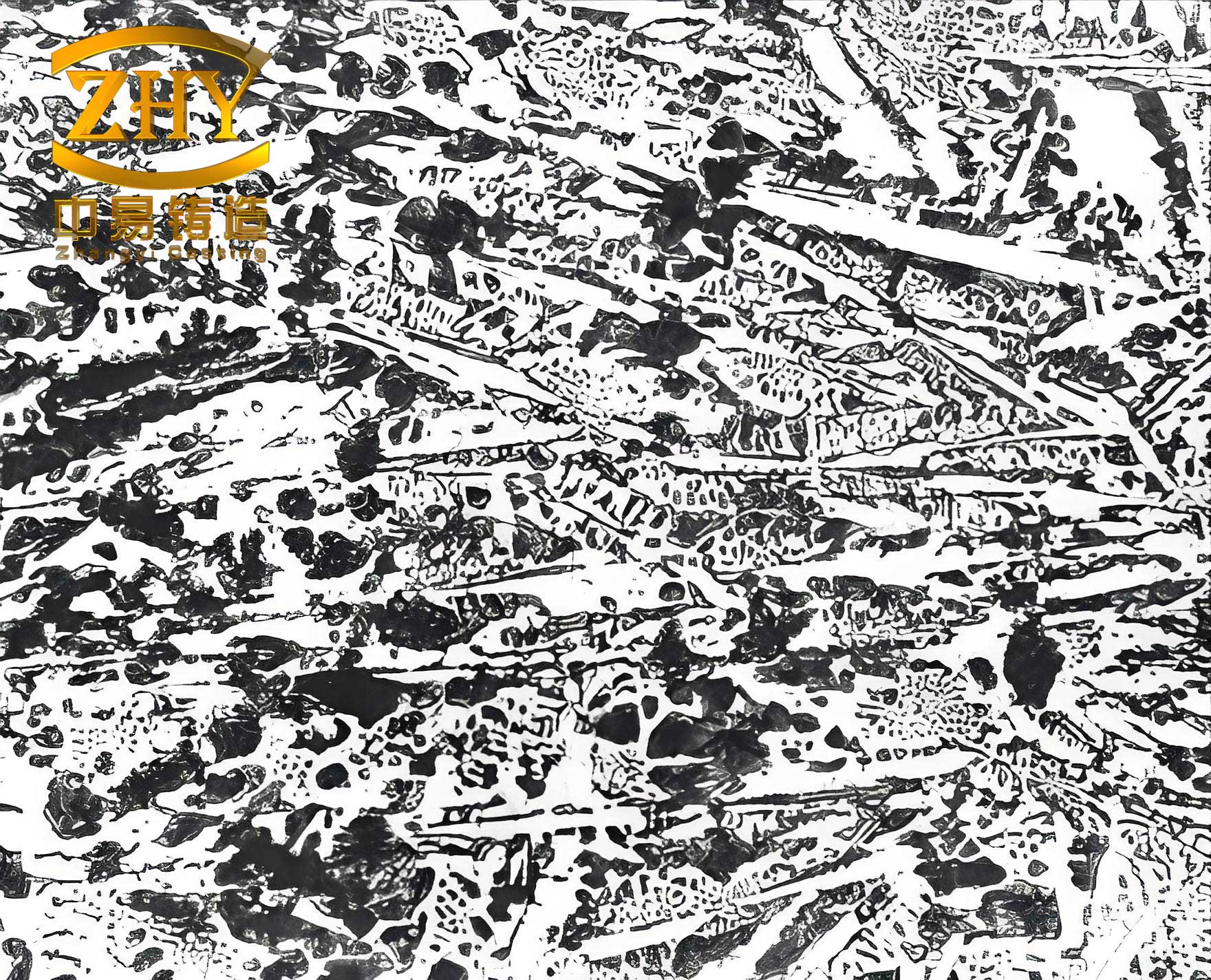
The microstructure of unmodified white cast iron (sample W0) in the as-cast state exhibited coarse, interconnected eutectic carbide networks, typical of hypoeutectic white cast iron. These carbides, primarily M3C type, formed a continuous skeleton throughout the austenitic matrix, contributing to brittleness. Upon potassium or sodium modification, a dramatic change was observed: the carbide networks fragmented into isolated blocks or clusters, with increased roundness and uniform distribution. In heat-treated samples, this effect was more pronounced, with carbides adopting near-spheroidal shapes. The refinement mechanism can be attributed to several factors. First, thermal analysis indicated that modification lowered both the liquidus and eutectic temperatures by 8–20°C and 8–15°C, respectively, indicating increased undercooling. According to solidification theory, undercooling enhances nucleation rates, leading to finer primary austenite grains. This refinement segregates the remaining liquid, promoting divorced eutectic growth where carbides nucleate separately, thereby breaking network continuity. Second, EPMA revealed that potassium and sodium preferentially adsorb on specific crystallographic planes of growing carbides, such as the [010] direction, inhibiting growth along these directions and promoting isotropic growth. The adsorption reduces the anisotropy of carbide growth, favoring blocky or spheroidal morphologies. This can be modeled using interfacial energy considerations: the adsorption lowers the surface energy γ of carbide faces, altering the equilibrium shape towards spheroids to minimize total energy. The change in carbide morphology ΔG can be expressed as: $$\Delta G = \gamma \Delta A – T \Delta S$$ where ΔA is the change in surface area, T is temperature, and ΔS is entropy change. Modification reduces γ, making spheroidization thermodynamically favorable.
The impact on mechanical properties was quantitatively assessed. Hardness measurements showed minimal variation between modified and unmodified white cast iron, both in as-cast and heat-treated states. This is expected because hardness primarily depends on carbide volume fraction and matrix hardness, which are largely unchanged by modification. For instance, average hardness values ranged from 55–60 HRC across all samples. In contrast, impact toughness improved significantly with modification. Table 2 summarizes the impact energy results, demonstrating that potassium and sodium addition increased toughness by up to 50% in as-cast conditions and further enhanced after heat treatment. The best results were obtained with moderate modifier additions (e.g., 1.4% potassium), beyond which excessive addition led to diminishing returns, possibly due to impurity effects.
| Sample ID | As-cast Impact Energy | Heat-treated Impact Energy | Percentage Increase vs. W0 |
|---|---|---|---|
| W0 | 8.5 | 10.2 | 0% |
| W1 | 10.3 | 12.8 | 25.5% |
| W2 | 12.1 | 14.4 | 41.2% |
| W3 | 11.8 | 13.9 | 36.3% |
| W4 | 10.9 | 13.1 | 28.4% |
| W5 | 10.7 | 13.3 | 30.0% |
| W6 | 11.5 | 14.1 | 38.2% |
| W7 | 11.2 | 13.7 | 34.3% |
The wear resistance of white cast iron was evaluated through impact-abrasion tests, where mass loss served as a metric. Modified white cast iron exhibited superior performance, with weight loss reductions of 21.1–49% compared to unmodified white cast iron. Table 3 details the wear data, correlating modifier content with wear rate. The improvement stems from the refined carbide morphology: spheroidal carbides provide better support against abrasive particles, reducing penetration and protecting the matrix. The wear volume V can be approximated by the Archard equation modified for abrasion: $$V = k \frac{W}{H} s$$ where k is a wear coefficient, W is load, H is hardness, and s is sliding distance. For white cast iron, H remains high, but modification reduces k by optimizing carbide distribution, thereby decreasing V.
| Sample ID | As-cast Mass Loss | Heat-treated Mass Loss | Reduction vs. W0 |
|---|---|---|---|
| W0 | 0.152 | 0.138 | 0% |
| W1 | 0.120 | 0.109 | 21.1% |
| W2 | 0.098 | 0.085 | 38.4% |
| W3 | 0.105 | 0.092 | 33.3% |
| W4 | 0.115 | 0.101 | 26.8% |
| W5 | 0.118 | 0.106 | 23.2% |
| W6 | 0.102 | 0.089 | 35.5% |
| W7 | 0.108 | 0.094 | 31.9% |
To elucidate the mechanisms further, we analyzed the fracture behavior. In unmodified white cast iron, cracks propagated easily along carbide networks, leading to low energy absorption. With modification, the isolated carbides forced cracks to deflect into the tougher matrix, increasing fracture resistance. This can be described using linear elastic fracture mechanics: the stress intensity factor KIC is higher for materials with deflected crack paths. The effective toughness Keff relates to carbide spacing λ by: $$K_{\text{eff}} \propto \sqrt{\lambda \sigma_y}$$ where σy is yield strength. Modification reduces λ (carbide spacing), thereby enhancing Keff. Additionally, the spheroidal carbides reduce stress concentration factors, mitigating crack initiation. These microstructural benefits translate directly to improved performance in ball mill liners, where impact and abrasion are synergistic.
The practical application of modified white cast iron liners was tested in industrial ball mills with diameters up to 2.1 meters, processing materials like cement, coal, and phosphate ore. Compared to traditional high-manganese steel liners, the modified white cast iron liners demonstrated exceptional durability. Service life increased by 2–5 times depending on the material: for cement grinding, life extended by 3–5 times; for coal, 2–4 times; and for phosphate, 2–3 times. Moreover, mill throughput improved by 2–4% due to reduced downtime and maintained grinding efficiency. No instances of liner fracture or spalling were reported, confirming the enhanced toughness of modified white cast iron. The economic analysis revealed cost savings from fewer replacements and lower maintenance, making this material a competitive alternative. The success hinges on the optimized carbide morphology, which balances wear resistance and impact tolerance—a hallmark of advanced white cast iron.
In summary, this study demonstrates that potassium and sodium modification effectively refines the microstructure of tungsten-alloyed white cast iron, transforming continuous carbide networks into dispersed, spheroidal formations. This white cast iron variant exhibits markedly improved impact toughness and wear resistance while retaining high hardness. The modification process is feasible using a carrier-based alloy, enabling smooth integration into existing foundry practices. The enhanced properties translate to superior performance in ball mill liners, with service life multiples of conventional materials. Future work could explore synergies with other alloying elements or processing techniques to further optimize white cast iron for diverse applications. Ultimately, the adoption of modified white cast iron promises to elevate the efficiency and reliability of grinding operations, leveraging the inherent strengths of white cast iron through intelligent modification.
The broader implications of this research extend beyond mill liners to other wear-resistant components in mining, cement, and chemical industries. By mastering carbide morphology control, we can tailor white cast iron for specific service conditions, unlocking new potentials for this classic material. The principles elucidated here—undercooling, adsorption, and spheroidization—provide a framework for designing advanced white cast iron alloys. As industrial demands evolve towards higher efficiency and sustainability, materials like modified white cast iron will play a pivotal role in reducing energy consumption and waste through prolonged component life. This aligns with global trends in resource optimization and circular economy, where durable materials minimize environmental footprint. Thus, the journey of white cast iron, from a brittle casting to a tough, wear-resistant engineering material, exemplifies innovation in metallurgy, driven by fundamental insights and practical ingenuity.
To quantify the relationships, we can model the modification effect using empirical formulas. For instance, the increase in impact energy ΔE correlates with modifier addition x (in wt.%) via: $$\Delta E = a x e^{-bx}$$ where a and b are constants derived from experimental data. Similarly, wear rate reduction ΔW can be expressed as: $$\Delta W = c \ln(1 + dx)$$ with c and d as fitting parameters. These models help predict optimal modifier levels for desired properties. In practice, a modifier addition of 1.2–1.8% yields the best balance for white cast iron liners, as evidenced by our trials.
In conclusion, the development of modified white cast iron via potassium and sodium treatment represents a significant advancement in wear-resistant materials. This white cast iron alloy not only meets the mechanical demands of ball mill liners but also offers economic and operational benefits. The integration of microstructure control through modification opens avenues for further enhancements, ensuring white cast iron remains a cornerstone in industrial applications. As we continue to refine these techniques, the potential for white cast iron in extreme environments will only expand, solidifying its status as a versatile and durable engineering material.