
In the demanding field of aero-engine manufacturing, the production of critical hot-section components like turbine guide vanes and structural casings presents significant challenges. These components often feature intricate geometries with thin walls, internal cavities, and complex multi-ring, multi-strut configurations. Achieving the requisite metallurgical quality, dimensional accuracy, and surface finish in such parts is paramount for engine performance and reliability. This study focuses on the application and optimization of precision investment casting for a representative complex thin-walled component made from a nickel-based superalloy. The work encompasses process design, numerical simulation, and practical validation, specifically addressing common defects like shrinkage porosity and incomplete filling of delicate features.
Introduction and Background
Precision investment casting, often referred to as the lost-wax process, is a pivotal manufacturing technique for producing complex, near-net-shape metal components with excellent surface finish and dimensional accuracy. The fundamental process involves creating a wax or polymer pattern of the desired part, assembling it into a cluster with a gating system, repeatedly dipping it in ceramic slurry to build a robust shell, melting out the pattern material, firing the ceramic mold, and finally pouring molten metal into the resulting cavity. This method is particularly suited for alloys that are difficult to machine and for parts with complex internal passages.
The component under investigation in this work is a typical multi-ring, multi-strut structure characterized by extensive thin-walled sections (as low as 1.5 mm), hollow struts, and V-shaped annular grooves on both sides. The alloy chosen is a cast nickel-based superalloy, designated here as Alloy K447A for reference, known for its high temperature strength, corrosion resistance, and reliability. However, its relatively high shrinkage tendency during solidification makes it prone to internal shrinkage porosity, especially in intricate, heavy-sectioned junctions or areas difficult to feed with molten metal. Traditional mold-based pattern production can be time-consuming for such complex geometries, hindering rapid prototyping and development cycles.
The advent of additive manufacturing, specifically Stereolithography (SLA), has revolutionized the pattern-making stage of precision investment casting. SLA utilizes a UV laser to selectively cure layers of photopolymer resin, building a high-resolution, high-strength pattern directly from a CAD model. This approach eliminates the need for expensive and time-consuming hard tooling, drastically shortens lead times for complex parts, and offers unparalleled geometric freedom. This research leverages SLA for pattern fabrication, integrated with advanced simulation and traditional shell-building techniques, to develop a robust casting process.
Materials and Experimental Methodology
The base material for this study is a nickel-based superalloy. Its nominal chemical composition, crucial for determining its casting and solidification behavior, is summarized in Table 1.
| Element | C | Cr | Co | W | Mo | Al | Ti | Ta | Hf | B | Zr | Ni |
|---|---|---|---|---|---|---|---|---|---|---|---|---|
| Wt. % | 0.15 | 8.40 | 11.00 | 10.00 | 0.70 | 5.50 | 1.00 | 3.00 | 1.50 | 0.015 | 0.050 | Bal. |
Table 1: Nominal chemical composition of the nickel-based superalloy (Alloy K447A).
The core of the methodology involved a synergistic approach combining computational modeling and physical experimentation.
1. Gating System Design and Numerical Simulation:
Two distinct gating system designs were conceptualized for the gravity-pour precision investment casting process:
- Scheme 1 (Top Gating): A conventional system where molten metal enters primarily from the top of the mold cavity.
- Scheme 2 (Combined Top, Side, and Bottom Gating): An innovative design incorporating ingates at multiple levels—top, side, and bottom—to promote controlled filling and directional solidification.
The three-dimensional models of both casting clusters (component + gating system) were created. The filling and solidification processes were simulated using a commercial finite element analysis software, ProCAST. The key physics involved solving the equations for fluid flow, heat transfer, and solidification. The governing equations for fluid flow during mold filling include the continuity equation and the Navier-Stokes equations:
$$
\nabla \cdot \vec{v} = 0
$$
$$
\rho \left( \frac{\partial \vec{v}}{\partial t} + (\vec{v} \cdot \nabla) \vec{v} \right) = -\nabla p + \mu \nabla^2 \vec{v} + \rho \vec{g}
$$
where $\vec{v}$ is the velocity vector, $p$ is pressure, $\rho$ is density, $\mu$ is dynamic viscosity, and $\vec{g}$ is gravitational acceleration. For solidification, the energy equation incorporating the latent heat release is solved:
$$
\rho c_p \frac{\partial T}{\partial t} = \nabla \cdot (k \nabla T) – \rho L \frac{\partial f_s}{\partial t}
$$
where $T$ is temperature, $c_p$ is specific heat, $k$ is thermal conductivity, $L$ is latent heat, and $f_s$ is the solid fraction. The simulation accounted for the temperature-dependent interfacial heat transfer coefficient (HTC) between the alloy and the ceramic shell, a critical parameter for accurate thermal history prediction. The mesh was meticulously generated, with finer elements on the thin-walled part and coarser elements in the feeders and pouring cup. Key simulation parameters are listed in Table 2.
| Parameter | Value / Condition |
|---|---|
| Alloy Pouring Temperature | 1550 °C |
| Mold (Shell) Preheating Temperature | 1050 °C |
| Pouring Time | 5 s |
| Interfacial Heat Transfer Coefficient (HTC) | Temperature-dependent curve (see simulation setup) |
| Solidification Porosity Criterion | Niyama criterion and feeding algorithms within the software |
Table 2: Key parameters for the numerical simulation of the precision investment casting process.
2. Pattern Fabrication and Shell Building:
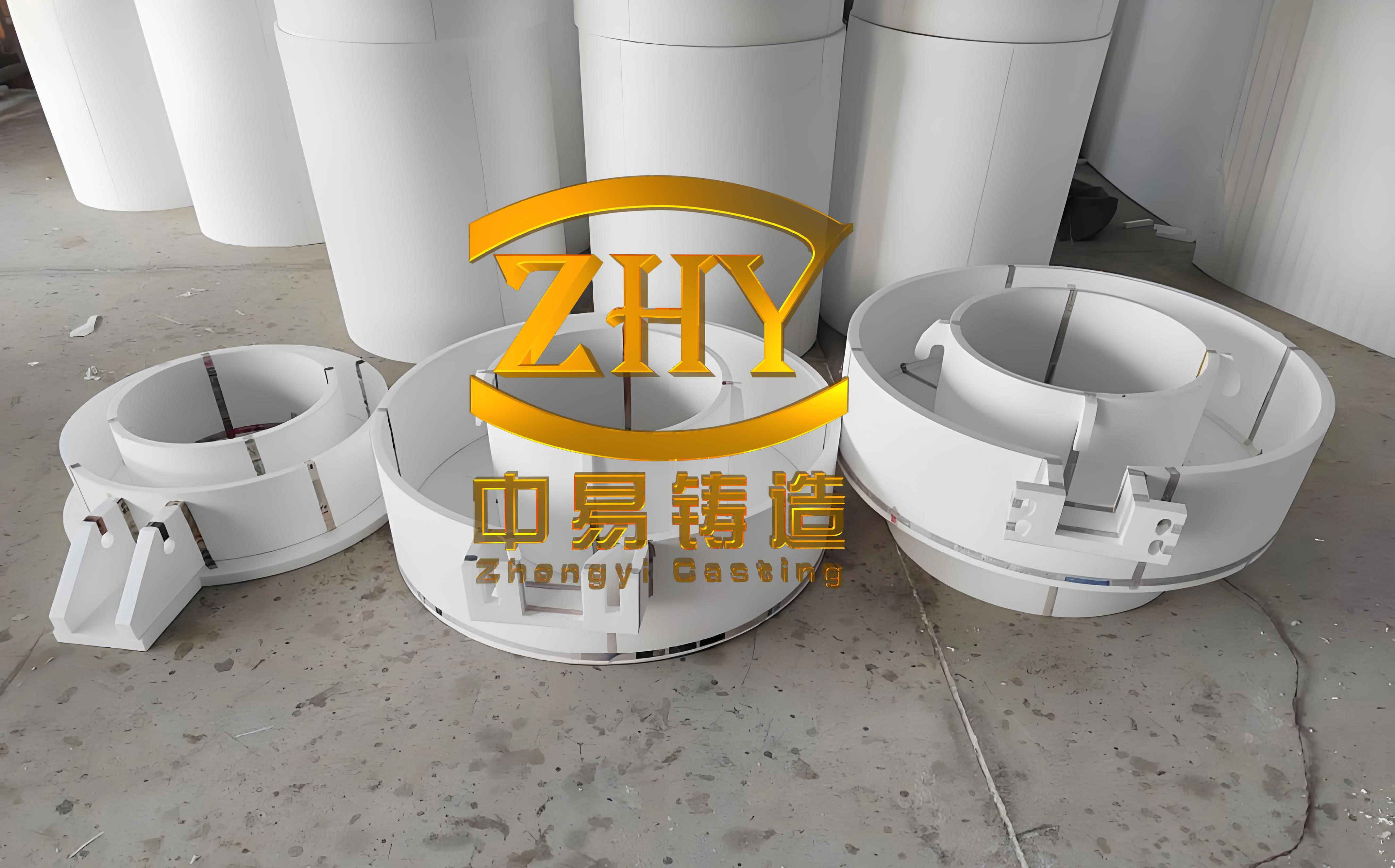
The patterns for the actual casting trials were manufactured using SLA technology. A photopolymer resin was used to create the precise, high-definition patterns of the component and its gating system (Scheme 2). The resulting patterns exhibited a surface roughness (Ra) of approximately 1.2 μm, which is suitable for high-quality precision investment casting. The following figure illustrates the intricate nature of such a mold-ready cluster.
A multi-layer ceramic shell was then built around the assembled pattern cluster. The shell system employed a silica sol binder. The primary (face) coat used zircon flour/sand with a cobalt aluminate grain refiner. The subsequent backup coats utilized fused mullite flour and sand of varying granulometry. The shell build sequence consisted of 1 primary coat, 1 transition coat, 8 backup coats, and 1 seal coat. After thorough drying, the shells were fired in a furnace at 850°C for 2 hours to combust the resin pattern, strengthen the ceramic, and achieve the required preheat temperature for pouring.
3. Melting, Pouring, and Inspection:
The alloy was melted in a vacuum induction furnace under an inert atmosphere to prevent oxidation. The melt was superheated and poured at 1550°C into the preheated ceramic shells (1050°C) using a gravity pour technique. After cooling, the shells were removed via mechanical and chemical means. The castings were then cut from the gating system, ground, and shot-peened. A comprehensive inspection regimen followed, including visual examination, radiographic testing (X-ray) to detect internal defects like shrinkage or inclusions, and metallographic preparation to evaluate microstructure and surface grain characteristics.
Results, Analysis, and Discussion
The findings from the simulation and practical casting trials are analyzed and discussed in detail below, focusing on the critical aspects of mold filling, solidification, defect formation, and final part quality.
Mold Filling Analysis: Simulation Insights
The simulation results for the two gating schemes revealed profoundly different filling patterns, which have direct implications for casting quality.
Scheme 1 (Top Gating): The simulation showed that molten metal entered the sprue, filled a lower splash basin, and then flowed back upward into the horizontal runners. From there, it primarily fed into the feeders attached to the outer ring of the component. This led to a preferential filling of the outer ring before the inner ring. The metal then filled the mold cavity in a generally bottom-up manner, but with turbulent flow and potential for cold shuts in the thin sections. The total simulated fill time was relatively long (over 7 seconds to completely fill the cavity). The temperature distribution at the end of filling showed significant cooling in the early-filled sections, particularly the inner ring feeders.
Scheme 2 (Combined Gating): This design demonstrated a far more controlled and efficient fill. Metal entered through the top, side, and bottom ingates almost simultaneously. The inner ring began filling early (around 0.7s) via dedicated gates, while the side and bottom gates ensured rapid filling of the outer ring and hollow struts. The mold cavity filled in a more uniform, progressive manner from multiple points, minimizing temperature gradients and turbulence. The total fill time was significantly shorter (approximately 4.6 seconds) compared to Scheme 1. A comparative summary is provided in Table 3.
| Filling Characteristic | Scheme 1 (Top Gate) | Scheme 2 (Combined Gate) |
|---|---|---|
| Initial Fill Path | Splash basin -> Horizontal runner -> Outer ring feeders | Concurrent flow through top, side, and bottom ingates |
| Fill Sequence | Outer ring precedes inner ring; general bottom-up | More uniform, multi-directional filling; inner ring fed early |
| Flow Nature | Potentially more turbulent, longer flow paths | More controlled, shorter flow paths to thin sections |
| Simulated Total Fill Time | > 7.0 seconds | ~ 4.6 seconds |
| Thermal Profile at End of Fill | Large gradients; early-filled areas are cooler | More uniform temperature distribution |
Table 3: Comparative analysis of mold filling behavior for the two gating schemes from simulation results.
The shorter, more controlled fill of Scheme 2 is highly advantageous in precision investment casting. It reduces the time the metal is in contact with the mold before complete filling, lowering the risk of surface defects like cold laps. It also helps maintain a higher thermal gradient favorable for directional solidification towards the feeders.
Solidification and Porosity Prediction
The analysis of solidification sequence and defect prediction is where the critical difference between the two schemes becomes starkly apparent. The solid fraction evolution and the predicted shrinkage porosity were extracted from the simulations.
In Scheme 1, the solidification analysis revealed a problematic sequence. The inner ring and the sections connected to the thin feeders began solidifying first, developing a high solid fraction early in the process. Meanwhile, the larger mass of metal in the horizontal runners and main feeders remained liquid for longer but was located “above” the casting in terms of gravity feed. This created an inverse pressure gradient. As the inner ring solidified and shrank, it could not draw feed metal from the runners effectively; instead, the liquid in the runners and feeders tended to create a suction effect, pulling metal away from the already solidifying casting. This classic “reversed feeding” or “fountain effect” is a primary cause of gross shrinkage porosity. The simulation’s porosity prediction module, often based on criteria like the Niyama criterion ($G/\sqrt{\dot{R}}$ where $G$ is thermal gradient and $\dot{R}$ is cooling rate), flagged extensive shrinkage defects throughout the inner ring and the gating system itself. The Niyama criterion can be expressed as:
$$
N_y = \frac{G}{\sqrt{\dot{R}}}
$$
Regions where $N_y$ falls below a critical threshold are predicted to contain shrinkage porosity. In Scheme 1, large areas of the casting fell below this threshold.
In contrast, Scheme 2 promoted excellent directional solidification. The simulation showed that the thin-walled sections of the component (the rings and struts) solidified last, while the extensive, strategically placed top feeders and the central downgate solidified last of all. The solid fraction plots demonstrated a clear progression: liquid metal in the casting was continually fed by liquid metal in the feeders, which in turn was fed by the central sprue. This is the ideal “progressive solidification” or “directional solidification” towards the major thermal mass of the feeder. Consequently, the predicted shrinkage porosity was almost entirely isolated within the voluminous feeders, with the casting body itself showing a very low probability of significant internal defects. This outcome validates the core principle of precision investment casting process design: to orchestrate thermal conditions so that the casting solidifies directionally towards designed feed metal reservoirs.
Practical Casting Validation and Metallurgical Quality
Based on the compelling simulation results, the combined gating system (Scheme 2) was selected for physical trials. The casting process, utilizing the SLA-printed patterns and the developed ceramic shell system, was executed successfully.
The resulting casting was examined thoroughly. Radiographic (X-ray) inspection confirmed the simulation predictions. No major shrinkage porosity was detected in the critical thin-walled rings or hollow struts. Some minor, acceptable levels of micro-porosity were noted at the thermal centers of the thickest junctions, such as the roots of the V-shaped grooves, which is common and often within specification for such alloys. The hollow struts were completely formed without any core breakage or misruns, and the challenging V-grooves were fully replicated with sharp definition.
Metallographic examination of the casting surface and cross-sections revealed a fine, equiaxed grain structure at the surface, transitioning in some thicker sections. The surface finish was excellent, directly attributable to the fine surface of the SLA pattern and the high-quality primary ceramic coat. The grain size was on the order of a few hundred micrometers to millimeters, which is typical for conventional cast superalloys. Importantly, no continuous columnar grains were found growing perpendicular to the thin edges, which is a specification requirement to avoid potential fatigue initiation sites. The key quality metrics of the final casting are summarized in Table 4.
| Quality Attribute | Observation/Result | Assessment |
|---|---|---|
| Dimensional Integrity | All features (struts, rings, V-grooves, bosses) fully formed to drawing dimensions. | Excellent |
| Internal Defects (X-Ray) | No major shrinkage in thin walls/struts. Minor micro-porosity in heaviest junctions. | Within Acceptance Criteria |
| Surface Finish | Smooth, no cold laps or mistruns. Good replication of pattern detail. | Excellent |
| Surface Grain Structure | Fine, equiaxed grains. No offending columnar grains. | Meets Specification |
| Hollow Feature Formation | Strut cavities completely formed, no core-related defects. | Excellent |
Table 4: Summary of metallurgical and quality inspection results for the cast component using the optimized precision investment casting process (Scheme 2).
Conclusion
This integrated study successfully addressed the manufacturing challenges of a complex, thin-walled aero-engine component through the development and optimization of an advanced precision investment casting process. The key conclusions are as follows:
1. Numerical simulation proved to be an indispensable tool for precision investment casting process design. It accurately predicted the shortcomings of a conventional top-gating scheme (Scheme 1), which led to unfavorable filling patterns and severe reversed feeding, resulting in predicted and actual shrinkage porosity in the casting body.
2. An innovative gating system design (Scheme 2), which intelligently combined top, side, and bottom ingates, was developed. Simulation confirmed its superiority, demonstrating rapid, controlled filling and, most critically, a solidification pattern that promoted strong directional solidification towards large, hot feeders. This effectively eliminated the risk of gross shrinkage in the casting itself.
3. The integration of Stereolithography (SLA) for pattern manufacturing enabled the rapid and accurate fabrication of the extremely complex wax pattern cluster, bypassing traditional tooling constraints and proving ideal for prototyping and low-volume production in precision investment casting.
4. Practical casting trials validated the simulation-based design. The component cast using the optimized Scheme 2 process exhibited excellent metallurgical quality: full formation of all geometric features (including delicate thin walls and internal cavities), the absence of major internal defects, a satisfactory surface finish, and a compliant grain structure.
This work underscores the power of a holistic approach combining computational modeling, additive manufacturing for tooling, and fundamental precision investment casting expertise. The methodology and findings are directly applicable to the production of other complex, high-integrity components for the aerospace, power generation, and medical industries, where geometric complexity and material performance are paramount. Future work may focus on further optimizing the feeder sizes using simulation to improve yield, investigating the effect of different shell preheat temperatures on grain structure, and performing mechanical property testing on specimens extracted from the cast component.