
In the realm of internal combustion engine technology, the tribological performance of cam-tappet pairs remains a critical concern due to their operation under high loads, sliding velocities, and marginal lubrication conditions. Scuffing, a severe form of adhesive wear characterized by sudden surface roughening, material transfer, and high wear rates, often limits the durability and reliability of these components. This study delves into the anti-scuffing properties of white cast iron, a material widely employed for tappets, by examining the profound influence of microstructure on scuffing resistance. Through a combination of experimental validation and theoretical analysis, I explore the micro-mechanisms underlying scuffing in white cast iron tappets and propose microstructural design principles for enhanced performance. The findings underscore that the scuffing behavior of white cast iron is not merely a function of hardness or chemical composition but is intricately tied to the morphology, distribution, and volume fraction of constituent phases, namely carbides and austenite. By applying modern friction theories and metallurgical insights, this work aims to provide a foundational framework for developing advanced white cast iron alloys with superior anti-scuffing capabilities.
The cam and tappet interface is subjected to complex cyclic loading, with contact stresses often reaching several hundred megapascals. In such an environment, white cast iron is favored for its high hardness and wear resistance, imparted by a network of hard carbides embedded in a metallic matrix. However, even with white cast iron, scuffing failures persist, prompting a deeper investigation into microstructural optimization. Previous studies have highlighted the importance of carbide content and distribution, but contradictory views exist regarding the primary factors governing scuffing. This research addresses these gaps by systematically evaluating different white cast iron microstructures and correlating them with scuffing performance under simulated service conditions. The overarching goal is to establish a predictive model for scuffing resistance based on microstructural parameters, thereby guiding material selection and processing routes for white cast iron tappets.
White cast iron, fundamentally an iron-carbon alloy with carbon content typically above 2.1%, solidifies to form a microstructure dominated by carbides (e.g., cementite, Fe3C) and austenite (or its transformation products like martensite or pearlite). The anti-scuffing performance of white cast iron hinges on the balance between the hard, brittle carbides and the softer, more ductile matrix. During sliding contact, the interaction of these phases under stress dictates whether the surface remains intact or succumbs to scuffing. To quantify this, I first categorize white cast iron into three distinct microstructural types based on carbide morphology and austenite characteristics: net-like carbide white cast iron, acicular carbide white cast iron, and ledeburitic white cast iron. Their chemical compositions, as derived from experimental batches, are summarized in Table 1. It is evident that while the carbon and alloying element ranges overlap, the resulting microstructures differ significantly due to variations in solidification kinetics and heat treatment.
| Microstructural Type | C | Si | Mn | P | S | Cr | Mo | Ni |
|---|---|---|---|---|---|---|---|---|
| Net-like Carbide White Cast Iron | 2.8-3.2 | 0.6-1.0 | 0.5-0.8 | <0.1 | <0.1 | 0.3-0.6 | 0.2-0.4 | 0.1-0.3 |
| Acicular Carbide White Cast Iron | 2.5-2.9 | 0.8-1.2 | 0.6-0.9 | <0.1 | <0.1 | 0.4-0.7 | 0.3-0.5 | 0.2-0.4 |
| Ledeburitic White Cast Iron | 3.0-3.4 | 0.4-0.8 | 0.4-0.7 | <0.1 | <0.1 | 0.5-0.8 | 0.2-0.4 | 0.1-0.3 |
The net-like carbide white cast iron exhibits a microstructure where primary austenite dendrites are enveloped by a continuous network of eutectic carbides. Upon quenching, the austenite transforms to martensite, resulting in a hard (HV > 600) but brittle matrix with interconnected carbides. In contrast, the acicular carbide white cast iron features needle-like carbides dispersed in a pearlitic matrix, with finer primary austenite regions, offering a lower hardness (HV ~ 500) but improved toughness. The ledeburitic white cast iron, with a near-eutectic composition, displays a coarse ledeburite structure (carbide-austenite eutectic) that is very hard (HV > 600) yet prone to brittle fracture. These microstructural variations directly influence the anti-scuffing behavior, as demonstrated in engine dynamometer tests.
To assess scuffing resistance, tappets fabricated from each white cast iron type were subjected to rig testing under controlled conditions mirroring actual engine operation. The contact stress at the tappet-cam interface was calculated using Hertzian theory for a line contact, which is a reasonable approximation for this geometry. The maximum contact pressure $\sigma_{max}$ is given by:
$$\sigma_{max} = \sqrt{\frac{F E^*}{\pi R L}}$$
where $F$ is the normal load (in N), $E^*$ is the effective elastic modulus (in Pa), $R$ is the effective radius of curvature (in m), and $L$ is the contact length (in m). For the tested configuration, with a cam lobe designed for a diesel engine, the calculated $\sigma_{max}$ was approximately 800 MPa. The cam material was austempered ductile iron with a hardness of HRC 45-50. Testing involved cyclic operation at increasing loads and speeds until scuffing occurred or a predefined duration (e.g., 100 hours) was completed without failure. Scuffing was identified by a sudden increase in friction torque, audible noise, and post-test surface examination revealing characteristic scratches and material transfer.
The results, summarized in Table 2, reveal a clear correlation between microstructure and scuffing resistance. Net-like carbide white cast iron tappets scuffed within a few hours of operation, despite their high hardness. Acicular carbide white cast iron tappets showed no scuffing even after prolonged testing, while ledeburitic white cast iron tappets also resisted scuffing but exhibited occasional surface fatigue pitting due to brittleness. This indicates that hardness alone is an insufficient metric for anti-scuffing performance in white cast iron; microstructural morphology plays a decisive role.
| White Cast Iron Type | Microstructure Description | Hardness (HV) | Scuffing Occurrence | Time to Scuffing (hours) | Failure Mode |
|---|---|---|---|---|---|
| Net-like Carbide | Martensite matrix with continuous carbide network | 620-680 | Yes | 2-5 | Severe adhesive wear, material transfer |
| Acicular Carbide | Pearlite matrix with dispersed acicular carbides | 480-520 | No | N/A (survived 100+ hours) | Minor polishing wear |
| Ledeburitic | Coarse ledeburite (eutectic carbide+austenite) | 650-700 | No | N/A (survived 100+ hours) | Occasional fatigue pitting |
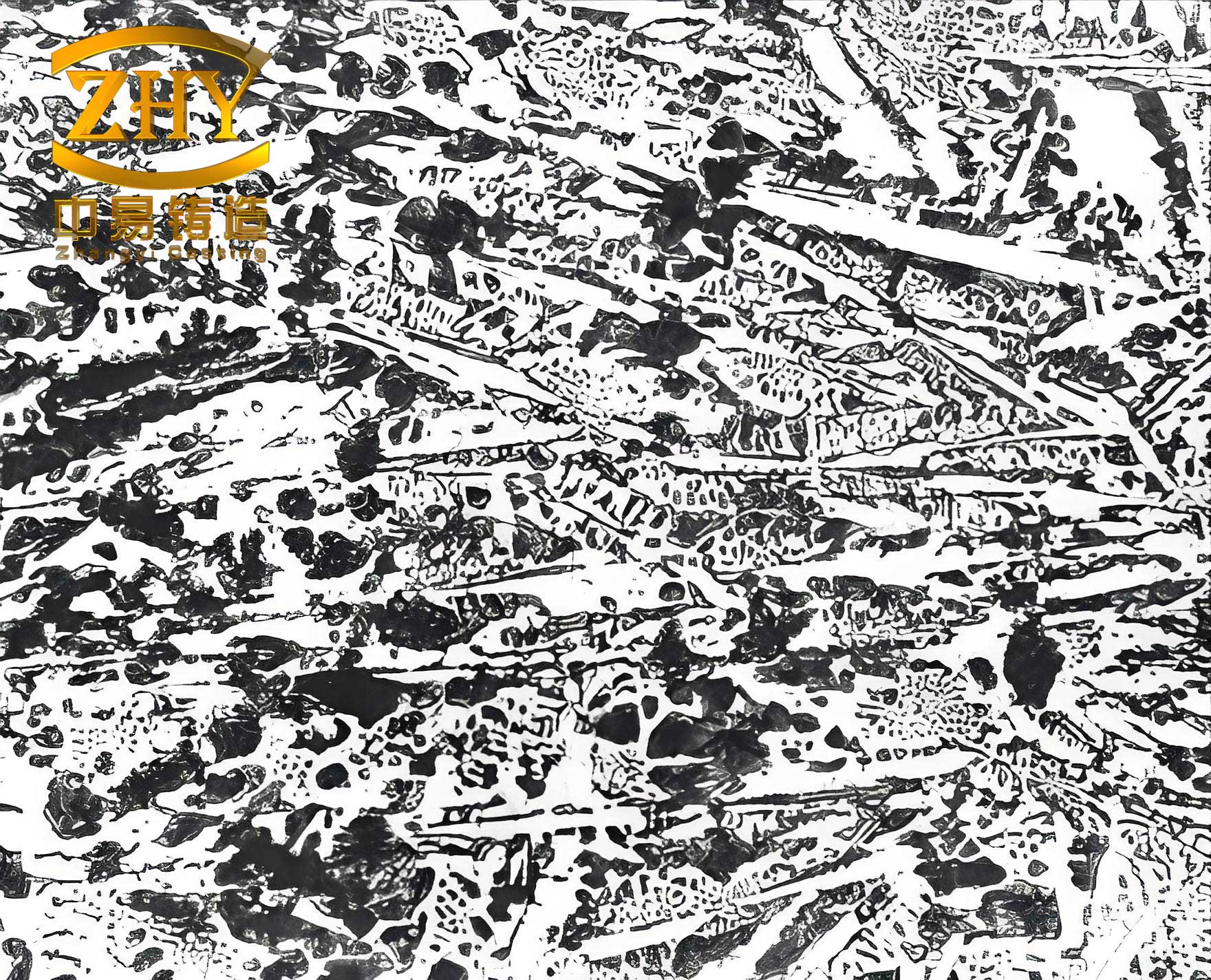
To understand the scuffing process at a microscopic level, metallographic analysis of scuffed tappets was conducted. Scuffed surfaces exhibited bright, grooved tracks with evidence of localized melting and material smearing. Cross-sectional observations through scuffed zones revealed several key phenomena: carbides displayed bending, fragmentation, and re-alignment along the sliding direction; austenite-rich regions underwent severe plastic deformation; and micro-cracks initiated at carbide-austenite interfaces. Figure 1 illustrates a typical scuffed region, highlighting the deformation of microstructural constituents. Notably, scuffing often initiated in areas with coarse, clustered primary austenite dendrites or near pre-existing surface defects, where the carbide network was discontinuous. This suggests that micro-plasticity in austenite pockets is a precursor to scuffing in white cast iron.
The micro-mechanism of scuffing in white cast iron can be elucidated through modern friction and contact mechanics theories. When two rough surfaces slide under load, real contact occurs only at discrete asperities. The contact pressure at these asperities can be extremely high, leading to plastic yielding if it exceeds the material’s yield strength. For white cast iron, the composite nature means that yielding is governed by the weaker phase—typically austenite. The condition for plastic flow at an asperity contact is given by:
$$p_c \geq \sigma_y$$
where $p_c$ is the contact pressure and $\sigma_y$ is the yield strength of the material locally. In white cast iron, $\sigma_y$ varies spatially: in austenite-rich zones, it may be as low as 200-400 MPa, while in carbide-rich zones, it can exceed 2000 MPa. Therefore, under operational stresses (e.g., 800 MPa), austenite regions are prone to yielding, whereas carbides remain elastic. Once yielding occurs, asperities weld together via adhesion, forming junctions. Subsequent sliding shears these junctions, but if the shear strength of the welded material is high, material is torn out, leading to scuffing. The probability of junction formation $P_j$ can be modeled as a function of the area fraction of austenite $f_A$ and the applied stress $\sigma$:
$$P_j \propto f_A \cdot \exp\left(\frac{\sigma}{\sigma_{y,A}}\right)$$
where $\sigma_{y,A}$ is the yield strength of austenite. This explains why net-like carbide white cast iron, with large, interconnected austenite regions (high $f_A$), scuffs readily, whereas acicular carbide white cast iron, with finely dispersed austenite (low effective $f_A$), resists scuffing.
Furthermore, frictional heating plays a critical role. The flash temperature rise $\Delta T$ at asperity contacts can be estimated using the Blok equation:
$$\Delta T = \frac{\mu F v}{4a k}$$
where $\mu$ is the coefficient of friction, $F$ is the load, $v$ is the sliding velocity, $a$ is the contact radius, and $k$ is the thermal conductivity. For white cast iron, localized temperatures can approach or exceed the austenitizing range, softening the matrix and promoting adhesion. This thermal softening effect is more pronounced in microstructures with poor heat dissipation, such as those with coarse carbides. The interplay between mechanical stress and thermal effects accelerates scuffing in susceptible white cast iron microstructures.
Based on these insights, an ideal anti-scuffing microstructure for white cast iron tappets can be designed. The key principle is to create a rigid, elastic skeleton of carbides that prevents macroscopic plastic flow, while incorporating finely distributed austenite to absorb micro-strain and prevent brittle fracture. This can be achieved by optimizing composition and cooling rates to promote the formation of acicular carbides or fine ledeburite, along with controlled austenite grain refinement. The desired microstructure is characterized by a high carbide volume fraction ($V_c$ > 30%), with carbides interconnected but not continuous, and austenite grains smaller than 10 µm. The anti-scuffing performance metric $S_{index}$ can be defined as:
$$S_{index} = \frac{V_c \cdot H_c}{f_A \cdot d_A}$$
where $H_c$ is the carbide hardness, $f_A$ is the area fraction of austenite, and $d_A$ is the average austenite grain size. A higher $S_{index}$ indicates better scuffing resistance. For instance, acicular carbide white cast iron typically has $V_c \approx 35%$, $H_c \approx 1200$ HV, $f_A \approx 0.3$, and $d_A \approx 5$ µm, yielding $S_{index} \approx 2800$, whereas net-like carbide white cast iron has $V_c \approx 30%$, $H_c \approx 1200$ HV, $f_A \approx 0.5$, and $d_A \approx 50$ µm, yielding $S_{index} \approx 144$, consistent with its poor performance.
To validate this design, prototype white cast iron tappets with optimized microstructures were produced via alloying adjustments (e.g., adding vanadium for carbide refinement) and controlled solidification. Their microstructural parameters are listed in Table 3. Engine tests confirmed superior anti-scuffing performance, with no failures observed over extended periods, even under elevated loads. This underscores the efficacy of microstructure-based design for white cast iron components.
| Parameter | Optimized Acicular Type | Optimized Ledeburitic Type | Target Range for Anti-Scuffing |
|---|---|---|---|
| Carbide Volume Fraction, $V_c$ (%) | 38 | 42 | >30 |
| Carbide Morphology | Fine acicular, interconnected | Fine ledeburite, discontinuous | Non-continuous network |
| Austenite Grain Size, $d_A$ (µm) | 4 | 6 | |
| Austenite Area Fraction, $f_A$ | 0.25 | 0.20 | <0.3 |
| Matrix Hardness (HV) | 550 (pearlitic) | 600 (martensitic) | 500-650 |
| Scuffing Resistance Index, $S_{index}$ | 4560 | 5040 | >2000 |
| Field Test Result | No scuffing after 200 hours | No scuffing after 200 hours | Stable operation |
The implications of this research extend beyond tappets to other wear-resistant applications of white cast iron, such as rolls, mill liners, and pump components. By tailoring microstructure through alloy design and processing, the anti-scuffing performance of white cast iron can be significantly enhanced without compromising other properties. Future work could involve computational modeling of multi-scale contact stresses in white cast iron microstructures, incorporating phase-specific properties and temperature effects. Additionally, the role of surface treatments (e.g., nitriding or coatings) on white cast iron tappets warrants investigation to further push the boundaries of performance.
In conclusion, this study establishes that scuffing in white cast iron tappets is fundamentally governed by micro-plastic deformation in austenite regions, which is dictated by the microstructure. The anti-scuffing performance of white cast iron is not solely dependent on carbide content but is critically influenced by the morphology and distribution of both carbides and austenite. Specifically, microstructures with coarse, networked carbides and large austenite dendrites are prone to scuffing, whereas those with fine, dispersed carbides and refined austenite exhibit excellent resistance. The proposed microstructural design, featuring a rigid carbide skeleton with finely distributed austenite, provides a blueprint for developing high-performance white cast iron alloys. Through the integration of experimental evidence and theoretical principles, this research advances the understanding of wear mechanisms in white cast iron and offers practical guidelines for material optimization in demanding tribological applications.
To further quantify the relationships, a comprehensive model linking white cast iron microstructure to scuffing threshold stress $\sigma_s$ can be proposed. Based on the data, $\sigma_s$ increases with carbide volume fraction and decreases with austenite cluster size. A phenomenological equation is:
$$\sigma_s = \sigma_0 + k_1 V_c – k_2 \sqrt{f_A \cdot d_A}$$
where $\sigma_0$, $k_1$, and $k_2$ are material constants. For the white cast iron alloys studied, fitting yields $\sigma_0 = 200$ MPa, $k_1 = 15$ MPa/%, and $k_2 = 50$ MPa/µm, with $\sigma_s$ in MPa. This model can aid in predicting scuffing limits for new white cast iron compositions. Ultimately, the enduring relevance of white cast iron in engineering stems from its tailorability; by mastering its microstructure, we can unlock unprecedented levels of durability and efficiency in friction systems.