
In my extensive research into advanced metallic materials, I have focused on enhancing the mechanical properties of spheroidal graphite iron through heat treatment processes. Spheroidal graphite iron, commonly known as ductile iron, has revolutionized industrial applications due to its unique combination of strength, ductility, and wear resistance. The advent of austempered ductile iron (ADI) has further pushed the boundaries, offering superior performance compared to traditional spheroidal graphite iron. In this study, I embarked on a detailed investigation to optimize the austempering process for a novel composition of spheroidal graphite iron, aiming to achieve an ideal balance of high tensile strength and elongation. The significance of this work lies in its potential to provide reference data for industrial applications and guide production practices, leveraging the inherent benefits of spheroidal graphite iron.
The historical context of spheroidal graphite iron dates back to the mid-20th century, but modern advancements have continuously refined its microstructure and properties. My motivation stems from the growing demand for materials that exceed the limitations of conventional spheroidal graphite iron, particularly in sectors like automotive, rail, and mining. Through systematic experimentation, I explored various heat treatment parameters to unlock the full potential of this material. The core of my approach involved manipulating austenitizing and isothermal quenching conditions to tailor the matrix structure, primarily consisting of bainite and retained austenite. This report documents my methodologies, findings, and insights, emphasizing the critical role of precise thermal processing in elevating the performance of spheroidal graphite iron.
To begin, I characterized the base material used in my experiments. The spheroidal graphite iron was sourced from a standard foundry process, and its chemical composition was meticulously analyzed using inductively coupled plasma (ICP) techniques. The results, summarized in Table 1, reveal a typical composition designed to facilitate graphite nodulization and ensure mechanical integrity. Key elements like carbon and silicon are present in amounts that promote graphitization, while magnesium and rare earth elements aid in nodule formation. This composition serves as the foundation for all subsequent heat treatment trials, highlighting the importance of initial material quality in processing spheroidal graphite iron.
| Element | Content (wt%) |
|---|---|
| C | 3.63 |
| S | 0.012 |
| P | 0.035 |
| Si | 2.6 |
| Mn | 0.45 |
| RE | 0.012 |
| Mg | 0.04 |
| Fe | Balance |
My experimental design centered on a heat treatment流程 that involved austenitizing followed by isothermal quenching, as illustrated in the schematic diagram. The process entails heating the spheroidal graphite iron to an austenitizing temperature, holding for a specified duration, rapidly quenching to an isothermal bath, maintaining that temperature, and finally air-cooling to room temperature. I employed a single-variable method to isolate the effects of each parameter, ensuring clear correlations between processing conditions and material properties. The parameters investigated are detailed in Table 2, covering a range of austenitizing temperatures, times, isothermal quenching temperatures, and times. This structured approach allowed me to methodically determine the optimal combination for enhancing the spheroidal graphite iron.
| Heat Treatment Process | Parameter Selection |
|---|---|
| Austenitizing Temperature | 860°C, 880°C, 900°C |
| Austenitizing Time | 60 min, 90 min, 120 min |
| Isothermal Quenching Temperature | 250°C, 280°C, 310°C, 340°C, 370°C, 400°C |
| Isothermal Quenching Time | 30 min, 60 min, 120 min |
The selection of these parameters was guided by metallurgical principles. For instance, austenitizing temperatures above 900°C can lead to grain coarsening in spheroidal graphite iron, while temperatures below 860°C may result in incomplete austenitization. Similarly, isothermal temperatures were chosen to avoid martensite formation below 230°C and excessive carbide precipitation above 400°C. My goal was to navigate these constraints to achieve a fine, homogeneous microstructure. The transformation kinetics during austempering can be described using equations like the Johnson-Mehl-Avrami-Kolmogorov (JMAK) model, which relates the fraction transformed to time and temperature. For spheroidal graphite iron, the rate constant \( k \) for bainitic transformation often follows an Arrhenius relationship:
$$ k = A \exp\left(-\frac{Q}{RT}\right) $$
where \( A \) is a pre-exponential factor, \( Q \) is the activation energy, \( R \) is the gas constant, and \( T \) is the absolute temperature. This formula underscores the temperature dependence of phase transformations in spheroidal graphite iron during isothermal holding.
Moving to the results, I first examined the influence of austenitizing temperature on the microstructure of spheroidal graphite iron. Samples were austenitized at 860°C, 880°C, and 900°C for 60 minutes, followed by isothermal quenching at 340°C for 60 minutes. Metallographic analysis revealed distinct differences. At 860°C, the matrix comprised acicular bainite with retained austenite uniformly distributed between the bainite plates. This structure is desirable for spheroidal graphite iron as it enhances both strength and toughness. As the temperature increased to 900°C, I observed coarsening of the bainite needles, which could detrimentally affect mechanical properties. The retained austenite content, measured via X-ray diffraction (XRD), showed a gradual increase with rising austenitizing temperature, as plotted in Table 3. This trend aligns with the higher carbon solubility in austenite at elevated temperatures, which stabilizes more austenite upon quenching in spheroidal graphite iron.
| Austenitizing Temperature (°C) | Retained Austenite Content (%) | Hardness (HRC) |
|---|---|---|
| 860 | 18.5 | 31.2 |
| 880 | 20.1 | 30.8 |
| 900 | 22.3 | 31.5 |
The hardness values, presented in Table 3, exhibited a slight decrease at 880°C before rising at 900°C, indicating complex interactions between phase fractions and dislocation densities. For spheroidal graphite iron, hardness can be estimated using a rule-of-mixtures model:
$$ H = f_B H_B + f_A H_A + f_M H_M $$
where \( H \) is the overall hardness, \( f_B \), \( f_A \), and \( f_M \) are the volume fractions of bainite, austenite, and martensite, respectively, and \( H_B \), \( H_A \), \( H_M \) are their intrinsic hardness values. In my samples, the presence of martensite was minimal, so the hardness primarily reflected bainite and austenite contributions. Based on these observations, I concluded that an austenitizing temperature of 860°C is optimal for spheroidal graphite iron, as it yields a fine microstructure without excessive energy consumption.
Next, I varied the austenitizing time while keeping the temperature at 860°C, isothermal quenching at 340°C for 60 minutes. The microstructures after 60, 90, and 120 minutes are depicted in the following analysis. At 60 minutes, the spheroidal graphite iron displayed fine acicular bainite; at 90 minutes, the bainite needles grew slightly; and at 120 minutes, noticeable coarsening occurred, along with uneven distribution of retained austenite. The XRD data for retained austenite content are summarized in Table 4, showing an increase with longer times due to enhanced carbon diffusion. However, prolonged times also risked grain growth, compromising the benefits of spheroidal graphite iron.
| Austenitizing Time (min) | Retained Austenite Content (%) | Hardness (HRC) |
|---|---|---|
| 60 | 18.5 | 31.2 |
| 90 | 19.8 | 31.6 |
| 120 | 21.2 | 31.0 |
Hardness measurements, included in Table 4, peaked at 90 minutes before declining, suggesting that over-austenitizing can soften the spheroidal graphite iron matrix. The relationship between time and phase fraction can be modeled using diffusion-controlled growth equations. For instance, the average bainite plate thickness \( \lambda \) might scale with time \( t \) as:
$$ \lambda = k_D \sqrt{t} $$
where \( k_D \) is a diffusivity constant. This implies that extending austenitizing time broadens the bainite plates, potentially reducing strength in spheroidal graphite iron. Thus, I selected 60 minutes as the optimal austenitizing time, ensuring complete transformation without detrimental coarsening.
The isothermal quenching temperature proved to be a critical factor for spheroidal graphite iron. I austenitized samples at 860°C for 60 minutes and then quenched them to temperatures ranging from 250°C to 400°C for 60 minutes. The microstructural evolution was striking. At 250°C, a mixture of fine bainite and some martensite appeared; at 280°C, martensite diminished, and bainite became coarser; at 340°C, coarse acicular bainite with abundant, well-distributed retained austenite was observed; at 370°C, feathery upper bainite emerged; and at 400°C, pronounced upper bainite dominated.
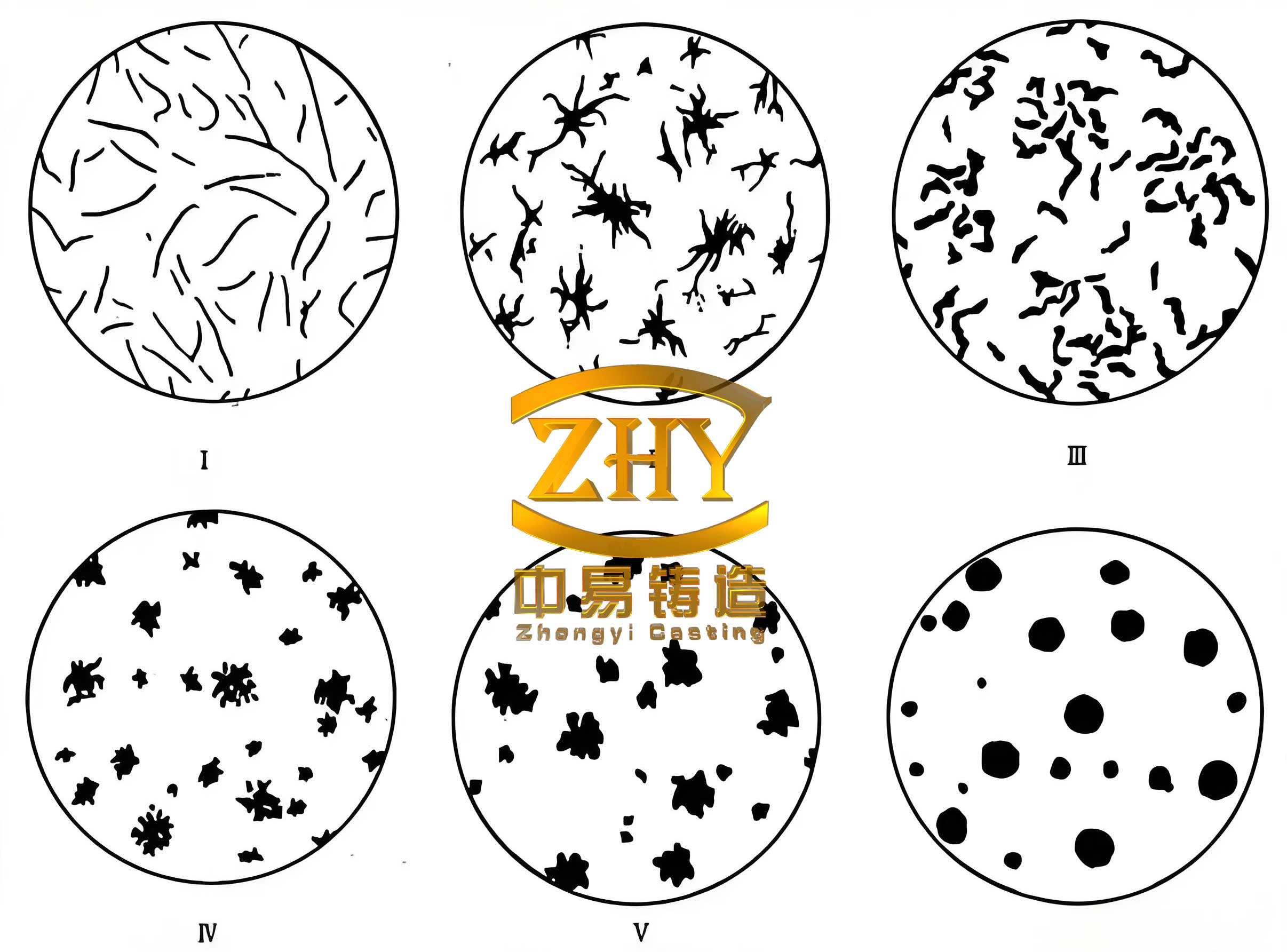
This visual representation underscores the microstructural diversity achievable in spheroidal graphite iron through temperature control. The tensile properties, tested according to standard protocols, are compiled in Table 5, demonstrating how strength and elongation vary with isothermal temperature.
| Isothermal Temperature (°C) | Tensile Strength (MPa) | Elongation (%) |
|---|---|---|
| 250 | 1150 | 4.5 |
| 280 | 1200 | 6.2 |
| 310 | 1235 | 7.3 |
| 340 | 1228 | 8.1 |
| 370 | 1180 | 9.5 |
| 400 | 1100 | 10.8 |
The data reveal a trade-off: as temperature increases, tensile strength of spheroidal graphite iron generally decreases, while elongation improves, due to higher retained austenite content and coarser bainite. The strength-elongation product, often used to gauge material performance, can be expressed as:
$$ P = \sigma \cdot \epsilon $$
where \( \sigma \) is tensile strength and \( \epsilon \) is elongation. For spheroidal graphite iron, maximizing this product is key. At 340°C, the product reaches approximately 9950 MPa·%, indicating a balanced performance. The transformation rate at different temperatures can be approximated using the Scheil equation for incubation time \( \tau \):
$$ \tau = \tau_0 \exp\left(\frac{U}{RT}\right) $$
where \( \tau_0 \) is a constant and \( U \) is the activation energy for nucleation. Lower temperatures delay transformation, leading to finer structures in spheroidal graphite iron. Based on the comprehensive results, I identified 340°C as the optimal isothermal quenching temperature for this spheroidal graphite iron composition.
Finally, I investigated the effect of isothermal quenching time at 340°C, after austenitizing at 860°C for 60 minutes. The microstructures after 30, 60, and 120 minutes were analyzed. At 30 minutes, retained austenite was scarce, as carbon diffusion was insufficient to stabilize it; at 60 minutes, a harmonious mix of bainite and retained austenite formed; at 120 minutes, bainite coarsened, and carbide precipitation began, degrading the matrix. The tensile properties, shown in Table 6, corroborate these observations: strength peaked at 30 minutes but with poor ductility, whereas 60 minutes offered a superior combination for spheroidal graphite iron.
| Isothermal Time (min) | Tensile Strength (MPa) | Elongation (%) |
|---|---|---|
| 30 | 1280 | 5.2 |
| 60 | 1228 | 8.1 |
| 120 | 1185 | 7.0 |
The kinetics of carbon enrichment in austenite during isothermal holding can be modeled with Fick’s second law. For a spherical austenite shell around bainite in spheroidal graphite iron, the carbon concentration \( C(t) \) over time \( t \) might follow:
$$ \frac{\partial C}{\partial t} = D \nabla^2 C $$
where \( D \) is the diffusion coefficient. Solving this with appropriate boundary conditions explains why longer times initially boost retained austenite stability but eventually lead to decomposition. Thus, 60 minutes is optimal for achieving a stable, high-performance microstructure in spheroidal graphite iron.
In summary, my research systematically optimized the austempering process for a novel spheroidal graphite iron. The best parameters are austenitizing at 860°C for 60 minutes, followed by isothermal quenching at 340°C for 60 minutes. This yields a matrix of acicular bainite with uniformly distributed retained austenite, resulting in a tensile strength of 1228 MPa and elongation of 8.1%. These findings underscore the potential of tailored heat treatments to elevate the properties of spheroidal graphite iron, meeting advanced industrial demands. Future work could explore alloying additions or cyclic heat treatments to further enhance spheroidal graphite iron for specialized applications. Throughout this study, the versatility and resilience of spheroidal graphite iron have been abundantly clear, reinforcing its status as a cornerstone material in modern engineering.