
In the field of industrial materials, abrasion wear poses a significant challenge across sectors such as mining, metallurgy, construction, and agriculture. The annual global losses due to wear are substantial, driving the need for developing new wear-resistant alloys that perform optimally under varying load conditions. Traditional wear-resistant materials include ordinary white cast iron, nickel-hard white cast iron, high-chromium white cast iron, and Hadfield manganese steel. Among these, ordinary white cast iron, nickel-hard white cast iron, and high-chromium white cast iron are characterized by high hardness but brittleness, making them suitable for low-impact, low-stress abrasion. High-chromium white cast iron stands out for its exceptional wear resistance. On the other hand, Hadfield manganese steel is ideal for high-impact, high-stress applications due to its work-hardening ability. However, for medium-impact conditions, existing materials often fall short, leading to unsatisfactory performance and premature failure. To address this gap, I have focused on developing a novel white cast iron material—specifically, an austenitic manganese white cast iron—designed to withstand medium-impact, high-stress abrasion, such as in jaw crusher cheek plates. This article presents my research on the microstructure, properties, wear mechanisms, and applications of this material, emphasizing its high toughness and wear resistance through extensive testing and analysis.
The design philosophy behind this new white cast iron revolves around achieving a balanced microstructure that combines toughness and hardness. Under low-impact conditions, hardness is a primary indicator of wear resistance, but under medium to high impact, excessive hardness can lead to surface spalling and catastrophic failure due to brittleness. Conversely, overly high toughness may reduce hardness and wear resistance while increasing costs. Therefore, for medium-impact loads, the material must exhibit tailored toughness based on specific operational conditions. I selected an austenitic matrix with dispersed carbides (non-network distribution) as the optimal microstructure. When carbides are dispersed, the fracture process is controlled by the matrix, with toughness depending on matrix properties. Austenite, being ductile and capable of work-hardening, can alleviate stress concentrations at crack tips, inhibit crack propagation, and prevent spalling or fracture under impact. Additionally, austenite’s strain-hardening effect enhances resistance to abrasive penetration, making it an ideal matrix for medium-impact applications. The wear resistance is primarily governed by the carbides, which bear the abrasive loads. In abrasion, two contact scenarios exist: multi-point contact and single-point contact. In multi-point contact, carbides directly support abrasives, while in single-point contact, carbides resist indentation and prevent long-distance sliding of abrasive tips, with the austenitic matrix protecting carbides from crushing and contributing through work-hardening.
To achieve this microstructure, I utilized manganese as the primary alloying element. Manganese is a weak carbide-forming element but stabilizes cementite and dissolves in it to form manganese-rich cementite, (Fe,Mn)3C, which has a hardness of approximately 900–1000 HV, higher than martensite or work-hardened austenite. This makes it the primary wear-resistant phase in the white cast iron. Manganese also stabilizes austenite by reducing the free energy difference for pearlitic transformation, lowering the critical temperature and transformation rate, and shifting the time-temperature-transformation (TTT) curve to the right. This ensures that austenite remains stable at room temperature. Experiments indicate that with carbon (C) content around 2.5–3.0% and silicon (Si) content around 1.0–1.5%, a manganese (Mn) content greater than 7% is required to obtain a predominantly austenitic matrix in the as-cast state. After normalizing, a near-full austenitic matrix can be achieved. Thus, the lower limit for manganese is set at 7% in this white cast iron. At this level, the as-cast microstructure may contain small amounts of martensite or troostite (referred to as gray structure) around carbides due to carbon and manganese depletion, as observed in microstructural analysis.
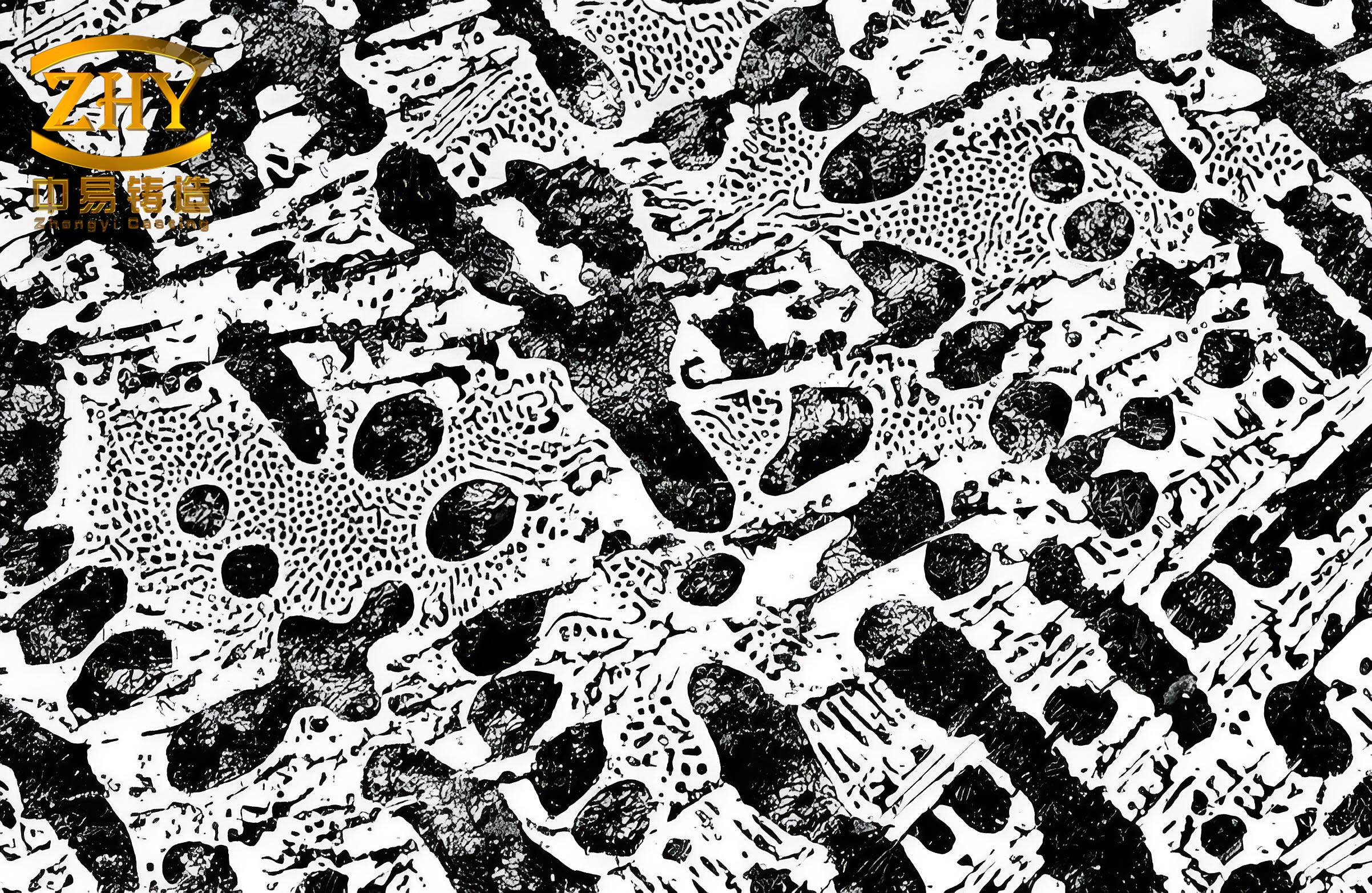
The chemical composition of this austenitic manganese white cast iron is critical for balancing properties. Carbon content directly influences the volume fraction of carbides. Higher carbon increases carbide content but can lead to networked distributions, severely reducing toughness. Tests show that with manganese around 7–9% and silicon around 1.0–1.5%, the carbon content must be below 3.5% to avoid continuous networks after normalizing. However, too low carbon (<2.5%) undermines wear resistance by reducing carbide volume. Therefore, the optimal carbon range is 2.5–3.5%. Silicon, which dissolves in austenite but not in cementite, affects carbon equivalent and hardness. While higher silicon increases hardness, too low silicon can promote needle-like carbides in austenite, degrading toughness. A silicon range of 1.0–1.5% is suitable. Sulfur and phosphorus are detrimental to toughness and wear resistance, so they are controlled below 0.05% each. The base composition can be summarized in Table 1.
| Element | Range | Role |
|---|---|---|
| Carbon (C) | 2.5–3.5% | Forms carbides for wear resistance; affects hardness and toughness |
| Manganese (Mn) | 7–9% | Stabilizes austenite; forms (Fe,Mn)3C carbides |
| Silicon (Si) | 1.0–1.5% | Influences carbon equivalent; prevents needle carbides |
| Sulfur (S) | <0.05% | Impurity; reduces toughness |
| Phosphorus (P) | <0.05% | Impurity; reduces toughness |
The effect of manganese on microstructure is complex. Increasing manganese shifts the eutectic point in the Fe-C phase diagram, altering carbide distribution. However, under non-equilibrium casting and normalizing conditions, kinetic factors dominate. Higher manganese reduces carbon and iron diffusion coefficients in austenite, slowing carbide precipitation and increasing austenite volume. This white cast iron with 7–9% Mn, combined with other elements, can adapt to medium- and low-impact, high-stress abrasion with high technical and economic efficiency.
Normalizing heat treatment is essential to refine the microstructure of this white cast iron. The process involves heating components above the Ac3 temperature (approximately 900–950°C), holding to dissolve part of the carbides into austenite, breaking the carbide network, and then cooling via air, wind, or mist depending on section size. During heating, supersaturated carbon in the as-cast austenite precipitates as secondary carbides, some growing on grain-boundary carbides and others dispersing as fine particles. At higher temperatures, carbides dissolve into austenite, with those on flat interfaces dissolving faster due to higher surface-to-volume ratios. Un-dissolved carbides at grain boundaries coalesce to reduce surface energy, thereby breaking the network. Upon cooling, with increased cooling rates, carbon diffusion slows, and only partial re-precipitation occurs, resulting in a microstructure of supersaturated austenite with non-network carbides. The dispersed carbides enhance wear resistance, while carbon supersaturation in austenite promotes work-hardening. Faster cooling reduces carbide precipitation, increases carbon and manganese in austenite, improves austenite stability, and boosts toughness, as shown in Table 2.
| Cooling Method | Impact Toughness (J/cm2) | Hardness (HB) | Microstructure Features |
|---|---|---|---|
| Furnace Cooling | 15–20 | 450–500 | Coarse carbides, some pearlite |
| Slow Air Cooling | 20–25 | 400–450 | Dispersed carbides, austenite matrix |
| Air Cooling | 25–30 | 380–430 | Fine carbides, high austenite stability |
| Water Quenching | 30–35 | 350–400 | Minimal carbides, highly stable austenite |
The influence of carbon, silicon, and manganese on mechanical properties before and after normalizing is significant. For impact toughness, carbon shows an inverse relationship: higher carbon reduces toughness due to increased carbide volume. This can be expressed empirically as:
$$ a_k \propto \frac{1}{[C]} $$
where \( a_k \) is impact toughness and [C] is carbon content. Similarly, manganese enhances toughness by stabilizing austenite, with a positive correlation up to 9%. Silicon’s effect is less pronounced but optimal in the 1.0–1.5% range. Hardness generally decreases after normalizing due to carbide dissolution and austenite softening, but wear resistance improves due to microstructural refinement. The hardness of this white cast iron typically ranges from 350 to 500 HB after normalizing, lower than the as-cast state (400–550 HB). The relationship between hardness and composition can be approximated by:
$$ \text{HB} = k_1 \cdot [C] + k_2 \cdot [Mn] – k_3 \cdot [Si] + \text{constant} $$
where \( k_1, k_2, k_3 \) are coefficients derived from regression analysis of experimental data. For instance, with carbon at 3.0%, manganese at 8%, and silicon at 1.2%, hardness after air cooling is around 400 HB.
Wear testing was conducted using a jaw crusher simulator with quartzite abrasive (hardness ~1200 HV) to simulate medium-impact conditions. The new austenitic manganese white cast iron was compared against standard Hadfield manganese steel (Mn13). Results showed a wear life improvement of 20–30% for the white cast iron, attributed to its combined hardness from carbides and toughness from austenite. Under multi-point contact, carbides directly resisted abrasion, while under single-point contact, carbides inhibited abrasive penetration, and the work-hardening austenite matrix (hardening from 350 HB to over 500 HB under strain) provided additional protection. The wear rate \( W \) can be modeled as:
$$ W = \frac{K \cdot P \cdot v}{H} $$
where \( K \) is a material constant, \( P \) is load, \( v \) is sliding velocity, and \( H \) is hardness. However, for impact abrasion, toughness plays a critical role, so a modified Archard-type equation incorporating toughness \( T \) is used:
$$ W = \frac{K’ \cdot P \cdot v}{H \cdot T^{0.5}} $$
where \( K’ \) is an empirical constant. For this white cast iron, with \( H \approx 400 \) HB and \( T \) (impact toughness) ≈ 25 J/cm2, the wear rate is lower than for Hadfield steel (\( H \approx 200 \) HB, \( T \approx 150 \) J/cm2) under medium impact due to better carbide support.
Applications of this austenitic manganese white cast iron extend beyond jaw crusher cheek plates to mining equipment, mill liners, and agricultural machinery components. For example, in cement plant crushers, it outperforms traditional white cast iron by 40–50% in service life. Its magnetic properties (due to 20–30% carbide volume) allow for iron removal from processed materials via electromagnetic separation, an advantage over non-magnetic manganese steel. In machining tests, tools made from this white cast iron showed improved durability when cutting hard materials like chilled cast iron, with tool life increasing by 2–3 times compared to conventional tools.
The economic benefits are notable. Production involves standard melting and casting techniques, with normalizing as the primary heat treatment—simpler than the water toughening required for manganese steel. Cost analysis indicates a 15–20% reduction in overall expense per ton compared to high-chromium white cast iron, while offering better toughness. Table 3 summarizes a comparison with other wear-resistant materials.
| Material | Hardness (HB) | Impact Toughness (J/cm2) | Wear Resistance Index* | Typical Applications |
|---|---|---|---|---|
| Ordinary White Cast Iron | 500–600 | 5–10 | 1.0 (baseline) | Low-impact abrasion |
| High-Chromium White Cast Iron | 600–800 | 10–15 | 3.0–4.0 | Low-impact, high-stress abrasion |
| Hadfield Manganese Steel | 200–250 (work-hardened to 500+) | 150–200 | 2.0–3.0 (under high impact) | High-impact, high-stress abrasion |
| Austenitic Manganese White Cast Iron | 350–500 | 20–35 | 2.5–3.5 (medium impact) | Medium-impact, high-stress abrasion |
*Wear Resistance Index: Relative life in abrasive wear tests, with ordinary white cast iron as 1.0.
Microstructural evolution during normalizing can be described using diffusion kinetics. The dissolution of carbides into austenite follows Fick’s law, where the concentration gradient drives carbon diffusion. The rate of carbide dissolution \( r_d \) is proportional to the diffusion coefficient \( D_C \) and inversely proportional to carbide size \( d \):
$$ r_d \propto \frac{D_C}{d} $$
For manganese-rich cementite, \( D_C \) decreases with higher manganese, slowing dissolution. During cooling, the re-precipitation of carbides is controlled by nucleation and growth. The number of carbide particles \( N \) per unit volume after normalizing can be estimated as:
$$ N = N_0 \exp\left(-\frac{Q}{RT}\right) $$
where \( N_0 \) is a pre-exponential factor, \( Q \) is activation energy, \( R \) is gas constant, and \( T \) is temperature. Faster cooling reduces \( N \), leading to finer dispersion.
In summary, this austenitic manganese white cast iron represents a significant advancement in wear-resistant materials for medium-impact conditions. By leveraging an austenitic matrix with dispersed (Fe,Mn)3C carbides, it achieves an optimal balance of toughness and hardness, outperforming traditional white cast iron and manganese steel in specific applications. The material’s design, rooted in microstructural control and heat treatment optimization, offers a cost-effective solution for industries battling abrasion wear. Future work could explore alloying variations, such as adding chromium or molybdenum, to further enhance properties for extreme conditions. Overall, this white cast iron exemplifies how tailored microstructure engineering can yield superior performance in demanding environments.