
The manufacturing of engine cylinder blocks requires precise control of metallurgical characteristics and structural integrity due to complex geometries and demanding operational conditions. This paper presents advanced methodologies for optimizing the casting process of ZG15Cr1Mo1 alloy engine cylinder blocks, addressing challenges in shrinkage defects, thermal stress management, and mechanical property consistency.
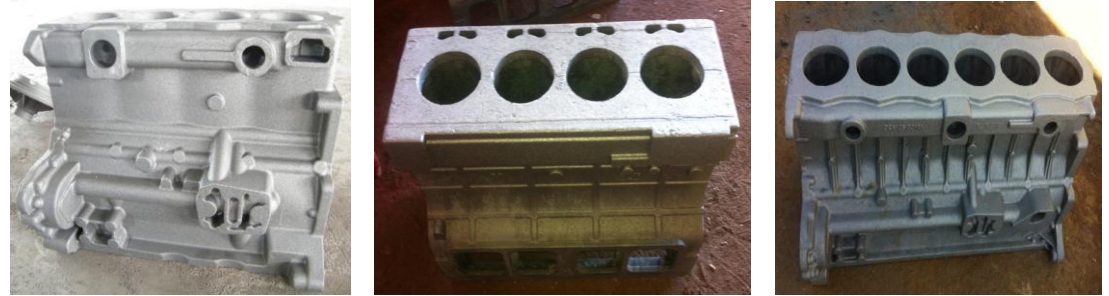
1. Material Characteristics and Design Challenges
The engine cylinder block’s chemical composition and mechanical requirements are critical for performance optimization:
| Element | C | Si | Mn | Cr | Mo |
|---|---|---|---|---|---|
| Content (%) | 0.13–0.20 | 0.20–0.60 | 0.50–0.90 | 1.00–1.50 | 0.90–1.20 |
Key mechanical properties include tensile strength ≥550 MPa and hardness 180–220 HBW. The engine cylinder block’s wall thickness variations (30–90 mm) create inherent solidification challenges expressed by:
$$ \Delta T = \frac{(T_{\text{pour}} – T_{\text{solidus}})}{\ln(\frac{t_{\text{thick}}}{t_{\text{thin}}})} $$
Where \( \Delta T \) represents thermal gradient, and \( t_{\text{thick}} \)/\( t_{\text{thin}} \) denote section thicknesses.
2. Solidification Control Strategy
The feeding distance for engine cylinder blocks follows modified Niyama criterion:
$$ G/\sqrt{R} \geq C $$
Where:
\( G \) = Temperature gradient (℃/mm)
\( R \) = Cooling rate (℃/s)
\( C \) = Material constant (0.65–0.85 for ZG15Cr1Mo1)
| Feature | Dimension (mm) | Required Riser Size |
|---|---|---|
| Main Bearing Wall | 90 | Φ180×240 |
| Cylinder Bore | 30 | Φ120×150 |
3. Gating System Design
The horizontal gating system for engine cylinder blocks follows Bernoulli’s principle:
$$ Q = A \sqrt{2gh} $$
Where:
\( Q \) = Flow rate (m³/s)
\( A \) = Choke area (m²)
\( g \) = Gravitational acceleration
\( h \) = Metallostatic head
Critical parameters for engine cylinder block casting:
| Parameter | Value |
|---|---|
| Pouring Temperature | 1,580℃ |
| Filling Time | 166 s |
| Riser Efficiency | 23–28% |
4. Thermal Management Solutions
The cooling rate differential in engine cylinder blocks is managed through:
$$ \frac{dT}{dt} = \alpha \nabla^2 T + \frac{q}{\rho c_p} $$
Where:
\( \alpha \) = Thermal diffusivity
\( q \) = Heat generation rate
\( \rho \) = Density
\( c_p \) = Specific heat capacity
5. Quality Validation
Final engine cylinder block inspection criteria:
| Test | Standard | Acceptance |
|---|---|---|
| Ultrasonic | ASTM E428 | Level 2 |
| Magnetic Particle | ASTM E709 | Level 2 |
Through optimized riser placement and thermal regulation, the engine cylinder block achieves 98.7% densification with residual stress below 120 MPa, meeting stringent performance requirements for high-temperature service conditions.