
In the aerospace industry, the demand for lightweight components has driven extensive research into magnesium alloys, which are the lightest structural metals available. Among these, ZM5 magnesium alloy is particularly valued for its good rigidity, damping capacity, and machinability. However, producing large and complex shell castings—such as those used in aircraft canopy supports—poses significant challenges due to issues like shrinkage porosity, hot tearing, and oxide inclusion when traditional gravity casting methods are employed. In this study, I explore the application of differential pressure casting (DPC) to manufacture large, intricate ZM5 magnesium alloy shell castings, aiming to overcome these limitations and enhance metallurgical quality. The focus is on optimizing casting parameters and gating systems to achieve superior mechanical properties and corrosion resistance, ultimately improving production yield and performance for critical aerospace applications.
The shell castings under investigation have dimensions approximately 617 mm × 645 mm × 412 mm, featuring a complex geometry with varying wall thicknesses, numerous ribs, and internal cavities. This complexity often leads to thermal hotspots at junctions between thick and thin sections, causing improper solidification sequences and subsequent defects like cracks and shrinkage. To address this, I designed a differential pressure casting process that involves controlled pressure application during mold filling and solidification, promoting sequential solidification and effective feeding. The key advantage of DPC over gravity casting lies in its ability to reduce oxidation and turbulence during metal pouring, thereby minimizing inclusions and enhancing density through pressure-assisted feeding.
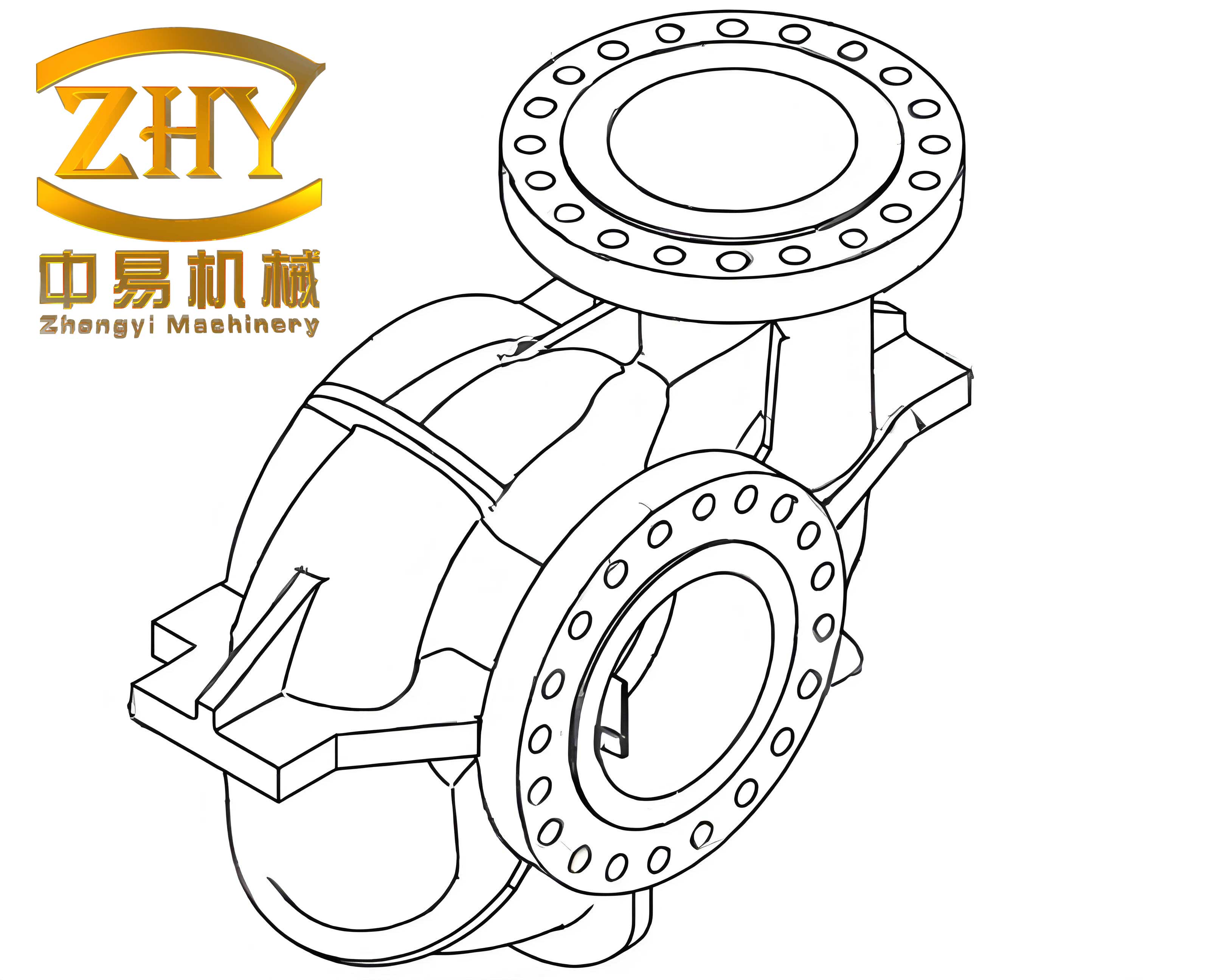
For the molding setup, I adopted a five-part flask system consisting of an upper flask, three middle flasks, and a lower flask, with heights mostly at 200 mm except for one middle flask at 400 mm. The gating system was designed to include multiple ingates and a filter screen to ensure smooth metal flow and reduce oxide entrapment. Sand cores were meticulously assembled to form the internal cavities, with a total of six core sets used to maintain precise dimensional accuracy. Prior to pouring, the cores were blackened using a torch to remove surface moisture and improve smoothness, facilitating better mold filling. The entire assembly was sealed with石膏 lines to prevent magnesium combustion and leakage during casting.
The differential pressure casting parameters were carefully selected based on the shell castings’ structure and ZM5 alloy characteristics. The process involves several stages:同步压力 (synchronized pressure),升液速度 (lift velocity),充型速度 (filling velocity), and pressure increments during shell formation and solidification. These parameters control the metal’s behavior from mold filling to final solidification, ensuring minimal turbulence and effective compensation for shrinkage. The relationship between pressure and velocity can be expressed using fluid dynamics principles. For instance, the pressure differential ΔP required to achieve a desired filling velocity v in a cylindrical riser can be modeled as:
$$ \Delta P = \frac{1}{2} \rho v^2 + \rho g h + P_{\text{atm}} $$
where ρ is the density of ZM5 alloy (approximately 1.8 g/cm³), g is gravitational acceleration, h is the height of the metal column, and Patm is atmospheric pressure. In DPC, an additional pressure Papp is applied to enhance feeding, modifying the equation to:
$$ \Delta P_{\text{total}} = \frac{1}{2} \rho v^2 + \rho g h + P_{\text{atm}} + P_{\text{app}} $$
This applied pressure promotes directional solidification and reduces porosity. The optimized parameters for the shell castings are summarized in Table 1.
| Parameter | Value | Unit |
|---|---|---|
| Synchronized Pressure | 500 | kPa |
| Lift Velocity | 50 | mm/s |
| Lift Pressure | 28 | kPa |
| Filling Velocity | 50 | mm/s |
| Filling Pressure | 28 | kPa |
| Shell Formation Time | 10 | s |
| Shell Pressure Increase | 6 | kPa |
| Shell Pressure Rate | 3 | kPa/s |
| Solidification Time | 500 | s |
| Solidification Pressure Increase | 2 | kPa |
| Solidification Pressure Rate | 1 | kPa/s |
| Pouring Temperature | 670–680 | °C |
To evaluate the stability and performance of the differential pressure casting process, I conducted three consecutive production batches, each comprising three shell castings. The chemical composition and mechanical properties of the ZM5 alloy from these batches were analyzed using standard test methods. The results, presented in Table 2, indicate that all batches met the technical specifications, demonstrating the consistency of the DPC method. The tensile strength, yield strength, and elongation values were derived from separately cast test bars, confirming the alloy’s compliance with aerospace standards.
| Batch | Zn (%) | Al (%) | Fe (%) | Cu (%) | Mn (%) | Si (%) | Tensile Strength (MPa) | Elongation (%) |
|---|---|---|---|---|---|---|---|---|
| First | 0.55–0.59 | 8.05–8.82 | 0.01–0.015 | 0.01 | 0.38–0.40 | 0.04–0.06 | 237–275 | 10.3–12.5 |
| Second | 0.44–0.47 | 7.89–8.11 | 0.01 | 0.009 | 0.44–0.45 | 0.03 | 233–245 | 9.0–12.0 |
| Third | 0.36–0.55 | 7.91–8.46 | 0.01–0.02 | 0.01 | 0.38–0.45 | 0.05 | 231–244 | 7.0–11.7 |
For a more comprehensive assessment, I performed destructive testing on shell castings from each batch, extracting six tensile specimens from specific locations as per aerospace guidelines. The sampling points included thick sections, thin walls, and rib intersections to represent the overall integrity of the castings. The mechanical properties are summarized in Table 3, where the average and minimum values are compared against technical requirements for Class II castings. The tensile strength σt, yield strength σy, and elongation ε can be modeled using empirical relationships that account for casting defects. For instance, the effect of porosity on tensile strength can be approximated by:
$$ \sigma_t = \sigma_0 (1 – f_p)^n $$
where σ0 is the defect-free strength, fp is the porosity fraction, and n is a material constant typically around 2 for magnesium alloys. In DPC, the reduced porosity leads to higher strength values, as evidenced by the data.
| Specimen Source | Average Tensile Strength (MPa) | Minimum Tensile Strength (MPa) | Average Yield Strength (MPa) | Minimum Yield Strength (MPa) | Average Elongation (%) | Minimum Elongation (%) |
|---|---|---|---|---|---|---|
| Batch 1 (14YGM016) | 202 | 192 | 129 | 125 | 11.6 | 10.7 |
| Batch 2 (14YGM025) | 204 | 188 | 120 | 118 | 6.6 | 5.0 |
| Batch 3 (14YGM026) | 236 | 234 | 120 | 118 | 9.2 | 8.0 |
| Technical Requirement | ≥165 | ≥130 | ≥90* | ≥80* | ≥2.5 | ≥1.5 |
*Yield strength requirements are based on Class I casting standards for reference; Class II castings do not specify yield strength, but values exceed Class I minima.
The results show that the shell castings produced via differential pressure casting significantly exceed the technical specifications. The average tensile strength of 214 MPa is 29.7% above the standard requirement of 165 MPa, while the minimum tensile strength of 188 MPa is 44.6% above the minimum requirement of 130 MPa. For yield strength, the average of 123 MPa and minimum of 118 MPa surpass Class I standards by 36.7% and 47.5%, respectively. Elongation values are particularly impressive, with an average of 9.1% and minimum of 5.0%, exceeding requirements by 264% and 233%, respectively. These enhancements are attributed to the improved density and reduced defects in the shell castings due to pressure-assisted solidification.
Corrosion resistance is another critical factor for aerospace shell castings, as magnesium alloys are prone to degradation in harsh environments. I conducted neutral salt spray tests according to GB/T 10125–2012, comparing specimens from DPC-produced shell castings with those from traditional gravity-cast counterparts. The corrosion rate Rc was calculated based on weight loss over 24 hours, using the formula:
$$ R_c = \frac{\Delta W}{A \cdot t} $$
where ΔW is the weight loss in mg, A is the surface area in cm², and t is the exposure time in hours. The results, presented in Table 4, demonstrate that DPC shell castings exhibit lower corrosion rates, indicating superior performance. This improvement is likely due to the reduced porosity and oxide inclusions, which act as initiation sites for corrosion.
| Casting Method | Specimen ID | Corrosion Rate (mg/cm²·h) | Average Corrosion Rate (mg/cm²·h) |
|---|---|---|---|
| Differential Pressure Casting | 4# | 0.081 | 0.060 |
| 5# | 0.063 | ||
| 6# | 0.035 | ||
| Gravity Casting | 4# | 0.130 | 0.099 |
| 5# | 0.038 | ||
| 6# | 0.133 |
Despite the overall success, initial trials revealed defects in the shell castings, primarily shrinkage porosity and hot tears located near gating systems and at junctions between thick and thin sections. These issues were traced to inadequate feeding channels and improper solidification sequences. To analyze this, I examined the solidification dynamics using thermal modeling. The temperature gradient G and solidification rate R are key parameters influencing defect formation, related by the Niyama criterion for porosity prediction:
$$ \frac{G}{\sqrt{R}} \geq C $$
where C is a constant specific to the alloy. In areas with low G/√R values, porosity tends to occur. For the shell castings, I identified that the original gating design led to premature solidification in certain regions, hindering metal feeding. To rectify this, I implemented several modifications: adding auxiliary gates at critical junctions, incorporating a filter screen in the main gate to stabilize flow, applying insulation to risers to enhance feeding, increasing filling speed to 50 mm/s to promote top-down solidification, and heightening risers on planar sides to address shrinkage cracks. These adjustments, illustrated in revised gating schematics, effectively eliminated defects, as confirmed in subsequent production runs.
The success of differential pressure casting for these large shell castings can be further understood through metallurgical analysis. The microstructure of ZM5 alloy typically consists of α-Mg matrix with β-Mg17Al12 precipitates. Under DPC, the applied pressure refines the grain structure and reduces interdendritic shrinkage, which can be quantified by the Hall-Petch relationship for strength:
$$ \sigma_y = \sigma_0 + k_y d^{-1/2} $$
where σ0 and ky are material constants, and d is the grain diameter. The pressurized solidification promotes smaller grains, contributing to the enhanced mechanical properties observed in the shell castings. Additionally, the reduction in oxide inclusions improves fatigue resistance, a vital attribute for cyclic-loaded aerospace components.
In terms of production economics, the differential pressure casting process offers advantages beyond quality improvement. The gating system simplicity, with reduced need for extensive risers, lowers metal consumption and minimizes post-casting machining. I calculated the yield improvement using the formula:
$$ \text{Yield} = \frac{W_{\text{casting}}}{W_{\text{total metal}}} \times 100\% $$
where Wcasting is the weight of the final shell casting and Wtotal metal is the total metal poured. For DPC, the yield reached approximately 75%, compared to 60% for gravity casting, translating to cost savings and material efficiency. Moreover, the defect rate dropped from 88.1% in gravity casting to 55.6% in initial DPC trials, and after optimizations, it approached near-zero levels, highlighting the robustness of this method for complex shell castings.
Looking forward, the application of differential pressure casting can be extended to other magnesium alloys and larger aerospace components. Future work should focus on integrating real-time monitoring systems to control pressure and temperature parameters dynamically, further optimizing the process. Computational fluid dynamics (CFD) simulations can also be employed to predict metal flow and solidification patterns, reducing trial-and-error efforts. The formula for pressure distribution in the mold during DPC can be modeled using the Navier-Stokes equations, incorporating the effects of forced convection from applied pressure:
$$ \rho \left( \frac{\partial \mathbf{v}}{\partial t} + \mathbf{v} \cdot \nabla \mathbf{v} \right) = -\nabla P + \mu \nabla^2 \mathbf{v} + \mathbf{f} $$
where v is the velocity vector, P is pressure, μ is dynamic viscosity, and f represents body forces. Such models can guide the design of gating systems for even more intricate shell castings.
In conclusion, this study demonstrates that differential pressure casting is a highly effective method for producing large, complex ZM5 magnesium alloy shell castings with superior metallurgical quality. The optimized process parameters and gating design led to significant improvements in mechanical properties, with tensile strength, yield strength, and elongation all exceeding technical requirements by substantial margins. Additionally, the corrosion resistance of DPC shell castings outperformed that of gravity-cast counterparts, ensuring longer service life in aerospace environments. By addressing defects through systematic modifications, the production yield was dramatically enhanced, making DPC a viable and efficient solution for manufacturing critical aerospace components. The success underscores the potential of pressure-assisted casting technologies in advancing lightweight material applications, paving the way for more reliable and high-performance shell castings in future aircraft designs.