
In the manufacturing industry, high carbon equivalent gray iron has gained significant attention due to its excellent properties, making it suitable for producing large and complex machine tool castings. However, the production process often faces challenges such as defects that impact quality and performance. Optimizing the manufacturing process is crucial for enhancing quality and driving technological advancements. The short-flow production method is key to improving efficiency and reducing costs by minimizing production steps and increasing material utilization, thereby offering superior quality and cost advantages for machine tool castings. This study focuses on exploring and refining the short-flow process for high carbon equivalent gray iron machine tool castings, addressing critical aspects from material selection to final treatment.
High carbon equivalent gray iron machine tool castings are primarily used for large components like machine tool beds and worktables, ensuring precision and durability in mechanical operations. These castings typically have a carbon equivalent exceeding 3.85%, which imparts unique characteristics such as excellent fluidity during casting, reducing defects, and providing high strength and toughness when combined with proper alloying and heat treatment. The graphite expansion during solidification helps minimize internal shrinkage and porosity, enhancing overall quality. However, sensitivity to heat treatment parameters requires strict control to prevent performance degradation and cracking. In our research, we have developed a comprehensive approach to optimize these properties for machine tool castings, leveraging advanced metallurgical techniques.
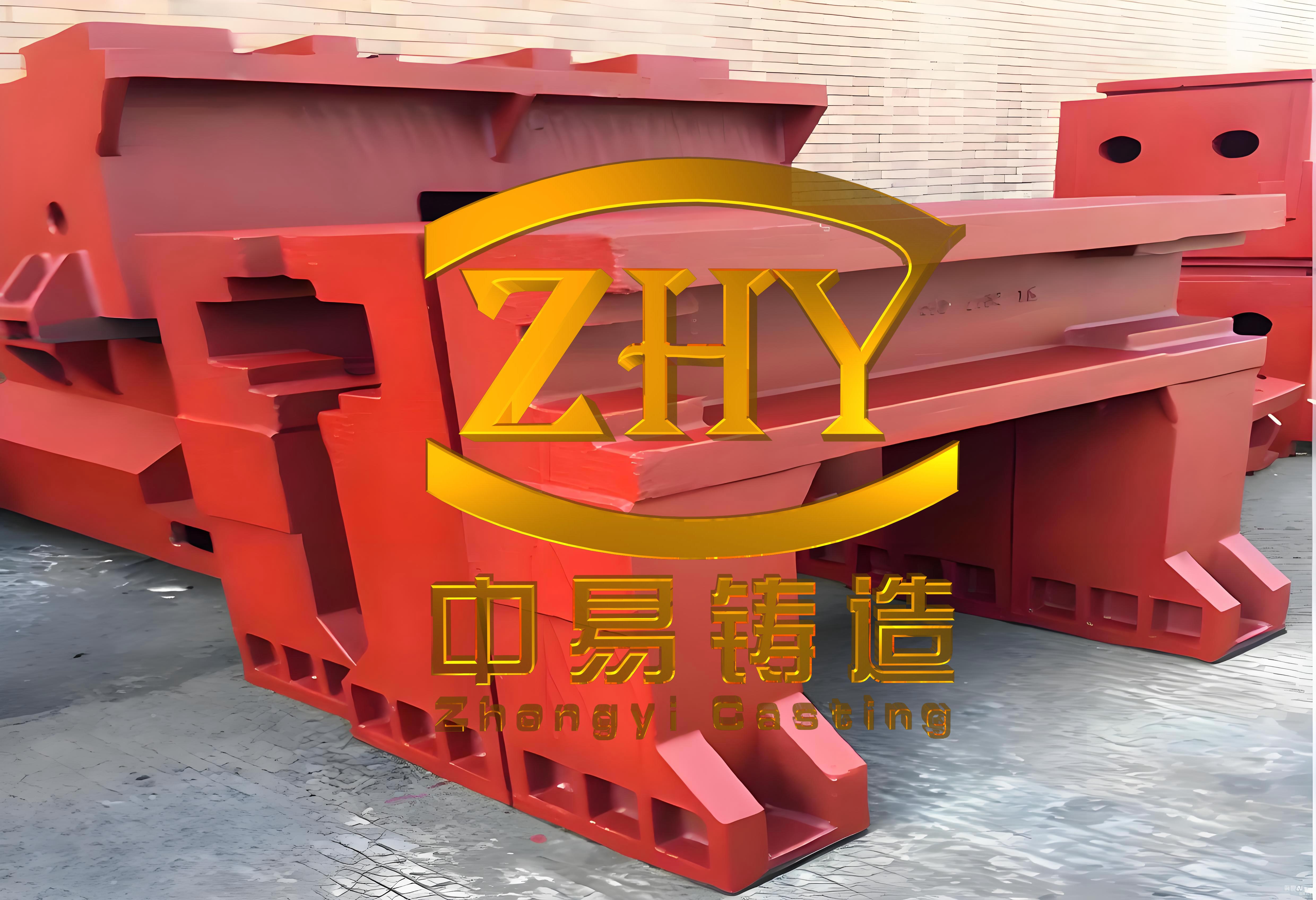
The short-flow production process for high carbon equivalent gray iron machine tool castings involves several key stages, including material selection, melting, molding, pouring, and post-processing. Each stage must be meticulously controlled to achieve the desired mechanical properties and metallurgical quality. For instance, in melting, precise temperature and composition control are essential, while molding techniques like 3D printed sand cores ensure dimensional accuracy and surface quality. Pouring parameters, such as temperature and time, directly influence the integrity of machine tool castings, preventing issues like gas porosity and inclusions. Through experimental validation and data analysis, we have demonstrated that optimizing these parameters can meet the high-performance requirements of machine tool castings, paving the way for mass production.
One of the critical aspects of producing high carbon equivalent gray iron machine tool castings is the control of carbon equivalent, which significantly affects the microstructure and properties. A high carbon equivalent enhances toughness and crack resistance but may lead to defects like graphite flotation if excessive. Therefore, precise calculation and control are necessary. The carbon equivalent (CE) can be expressed using the formula: $$CE = C + \frac{Si}{3} + \frac{P}{3}$$ where C, Si, and P represent the mass fractions of carbon, silicon, and phosphorus, respectively. In our process, we target a CE range of 3.80% to 3.85% for optimal performance in machine tool castings. Additionally, inoculation treatment is employed to refine graphite structures, improving strength and toughness. The selection and dosage of inoculants, such as silicon barium calcium, play a vital role in achieving the desired graphite morphology for machine tool castings.
Cooling speed is another decisive factor in the casting process for machine tool castings, as it influences the prevention of thermal and cold cracks. Thermal cracks occur on the surface due to uneven contraction, while cold cracks form internally and are related to the material’s thermal expansion coefficient and cooling rate. Excessively fast cooling can cause thermal cracks, whereas slow cooling may lead to cold cracks. Thus, controlling cooling temperature and selecting appropriate media are essential for uniform structure and defect avoidance. In our study, we have implemented scientific cooling control measures to enhance the quality of machine tool castings, ensuring they meet rigorous standards.
For the short-flow production of machine tool castings, we selected specific materials to ensure purity and consistency. Raw materials include high-purity pig iron with low sulfur and phosphorus content to reduce brittleness, scrap steel with controlled chemistry to maintain uniformity, and recycled material with a usage ratio of up to 20%. Additionally, blast furnace iron is pre-treated and heated to 1650–1720°C using oxygen blowing technology, accounting for 45% of the charge. Alloy elements like nitrogenized manganese, chromium, tin, and manganese are added to achieve the desired properties. The charge composition for machine tool castings typically consists of 30% scrap steel, 20% recycled material, 45% pre-treated iron, and 5% alloying elements, resulting in a high carbon equivalent of 3.8–3.9% and a silicon-to-carbon ratio above 0.75.
| Category | CE | C | Si | Mn | P | S | Cu | Sn | Cr | N |
|---|---|---|---|---|---|---|---|---|---|---|
| Target | 3.80–3.85 | 3.00–3.05 | 2.40–2.50 | 0.80–0.90 | < 0.04 | 0.04–0.08 | / | 0.04–0.05 | 0.10–0.20 | / |
| Base Iron | 3.410 | 3.041 | 1.070 | 0.509 | 0.023 | 0.029 | 0.044 | 0.0076 | 0.094 | 0.0033 |
| After Inoculation | 3.840 | 3.021 | 2.439 | 0.862 | 0.026 | 0.051 | 0.044 | 0.047 | 0.150 | 0.0119 |
The melting process for machine tool castings is conducted in medium-frequency induction furnaces, with temperatures carefully controlled between 1480°C and 1550°C. The tapping temperature is set at 1480°C, and the pouring temperature ranges from 1380°C to 1410°C. To enhance graphite nucleation, silicon carbide is added at 0.1% during pre-inoculation, with particle sizes of 0.2–1 mm. In-mold inoculation uses 0.4% silicon barium calcium, and stream inoculation employs 0.1% 75 ferrosilicon with particles of 0.2–0.7 mm. Regular sampling and analysis ensure that key elements like carbon, silicon, and manganese are within specified limits for machine tool castings. The addition of nitrogen up to 100 ppm, along with tin and chromium, helps maintain pearlite structure even at high silicon-to-carbon ratios, crucial for the strength of machine tool castings.
In the molding stage, resin sand 3D printing is utilized to create high-precision sand cores for machine tool castings, enabling complex cavities and reducing time and costs compared to traditional methods. A specialized coating with a viscosity of 38°Bé is applied uniformly to the sand mold surface to prevent metal penetration and improve surface quality. Key indicators in resin sand molding are strictly controlled, such as the resin-to-curing agent ratio (1.0–1.1% resin and 30–50% curing agent), mold strength (compressive strength of 0.8–1.2 MPa and tensile strength of 0.4–0.5 MPa), surface hardness (70–90 units), permeability (120–200), and density (1.6–1.8 g/cm³). Curing with furan resin and 28–35% toluene sulfonic acid curing agent achieves optimal hardening within 25–30 minutes at 20–30°C. Operator training and adherence to procedures are emphasized to avoid defects in machine tool castings.
The pouring system for machine tool castings is designed with sprue, runner, and ingate components to ensure smooth metal flow and avoid turbulence. A closed gating system is adopted, with cross-sectional area ratios of ΣS_sprue : ΣS_runner : ΣS_ingate = 1.2 : 1 : 0.9. Pouring temperature is maintained at 1380–1400°C, and pouring time is controlled between 60 and 90 seconds to ensure proper filling and minimize defects. Post-processing involves cleaning the castings to remove sand, burrs, and fins, followed by stress-relief annealing to enhance mechanical properties and machinability. Visual, dimensional, and performance inspections, including tensile and hardness tests, are conducted to verify the quality of machine tool castings.
Mechanical properties and metallurgical quality of high carbon equivalent gray iron machine tool castings are evaluated through residual stress measurements, hardness tests, and microstructural analysis. For instance, residual stress values are measured at multiple points on a casting, with results indicating low stress levels suitable for precision applications. Hardness measurements show values between 201 and 216 HBW, indicating good machinability. The metallurgical quality is assessed using parameters like eutectic saturation (Sc), maturity (RG), hardening degree (RH), and quality coefficient (Qi), which are calculated as follows: $$Sc = \frac{C}{4.26 – \frac{Si}{3} – \frac{P}{3}}$$ $$RG = \frac{R_m}{1000 – 800 \times Sc}$$ $$RH = \frac{HBW}{530 – 344 \times Sc}$$ $$Qi = \frac{RG}{RH}$$ where R_m is the tensile strength and HBW is the hardness. These parameters help in optimizing the production of machine tool castings for high performance.
| Point No. | ε1 (με) | ε2 (με) | ε3 (με) | σ1 (MPa) | σ2 (MPa) | θ (°) |
|---|---|---|---|---|---|---|
| 1 | 31 | 101 | 88 | -29.3 | -69.2 | 27.8 |
| 2 | 12 | 5 | 124 | -22.8 | -89.6 | -24.2 |
| 3 | -21 | 36 | 13 | 20.5 | -13.9 | 33.5 |
| 4 | 35 | 60 | 29 | -15.3 | -37.6 | -41.9 |
| 5 | 39 | 48 | 66 | -37.8 | -49.1 | -9.2 |
| 6 | -42 | -12 | 7 | 24.4 | 4.5 | 6.3 |
| 7 | 36 | 18 | 13 | -17.5 | -13.7 | -27.7 |
| 8 | 106 | 94 | 96 | -80.1 | -86.9 | 27.2 |
| 9 | 45 | 95 | 120 | -52.6 | -83.9 | 9.2 |
| 10 | 15 | 73 | 1 | 19.3 | -32.5 | -41.9 |
| 11 | 68 | 30 | 59 | -39.1 | -65.9 | 41.2 |
| 12 | -23 | -5 | -14 | 20.9 | 9.7 | 35.8 |
| Point No. | HBW | Point No. | HBW | Point No. | HBW |
|---|---|---|---|---|---|
| 1 | 209 | 5 | 203 | 9 | 201 |
| 2 | 214 | 6 | 215 | 10 | 206 |
| 3 | 207 | 7 | 202 | 11 | 209 |
| 4 | 216 | 8 | 202 | 12 | 208 |
The average hardness of the machine tool castings is 207 HBW, which falls within the desirable range for good machinability. Microstructural examination reveals that the graphite is predominantly type A (over 96%), with a size grade of 4, and the matrix consists of more than 98% pearlite, meeting the technical requirements for high-quality machine tool castings. The tensile strength of samples reaches 310.9 MPa, with an elastic modulus of 124 GPa, demonstrating the effectiveness of the optimized process for machine tool castings. The machinability coefficient, defined as $$m = \frac{R_m}{HBW}$$ is calculated to be 1.49, indicating excellent machining performance comparable to high-grade cast iron standards for machine tool castings.
| Parameter | CE (%) | Si/C | C (%) | Si (%) | Sc | RG | RH | Qi |
|---|---|---|---|---|---|---|---|---|
| Value | 3.84 | 0.81 | 3.02 | 2.43 | 0.88 | 1.05 | 0.91 | 1.19 |
The eutectic saturation (Sc) of 0.88 indicates low stress and good casting performance for machine tool castings, while the maturity (RG) of 1.05 and quality coefficient (Qi) of 1.19 reflect high metallurgical quality, unifying mechanical properties, castability, and machinability at an elevated level. The relationship between machinability and hardness is critical for machine tool castings; as hardness increases, machinability tends to decrease. However, with a machinability coefficient m of 1.49, our machine tool castings exhibit superior processability, aligning with international standards for high-performance applications.
| Hardness (HBW) | 160–190 | 190–220 | 220–240 | > 240 |
|---|---|---|---|---|
| Machinability | Easy to Machine | Smooth Cutting | Machinable | Difficult to Machine |
| Cast Iron Grade | GG20 | GG25 | GG30 | GG35 |
|---|---|---|---|---|
| Machinability Coefficient m | 0.95–1.18 | 1.04–1.39 | 1.15–1.50 | 1.25–1.37 |
In conclusion, the production of high carbon equivalent gray iron machine tool castings is a complex process that requires meticulous control across various stages. By optimizing parameters in melting, molding, pouring, and post-processing, we have achieved significant improvements in quality and efficiency for machine tool castings. The use of short-flow production, combined with advanced techniques like 3D printing and precise inoculation, has enabled the manufacture of machine tool castings with excellent mechanical properties, low residual stress, and superior machinability. The high carbon equivalent of 3.81% and silicon-to-carbon ratio of 0.81, supported by nitrogen, tin, and chromium additions, ensure a pearlitic matrix without increasing ferrite, reducing cracking tendencies in machine tool castings. Microstructural analysis confirms over 96% type A graphite and 98% pearlite, meeting premium standards for machine tool castings.
Looking ahead, the continued development of new materials and processes will further refine the production of high carbon equivalent gray iron machine tool castings, offering even greater benefits to the manufacturing industry. Future research should focus on enhancing the sustainability and cost-effectiveness of machine tool castings, exploring innovative alloy designs and digital manufacturing technologies. As demand for high-performance machine tool castings grows, our optimized short-flow process provides a solid foundation for mass production, driving innovation and competitiveness in the global market. The insights gained from this study underscore the importance of integrated metallurgical control in achieving high-quality machine tool castings that meet the evolving needs of precision engineering.