
Grinding operations constitute critical processes in mineral processing plants, where the reliable functioning of grinding equipment significantly influences overall production efficiency. Lining plates serve dual purposes: protecting mill cylinders from wear and participating in material comminution. As mill dimensions scale up, these components face intensified impact stresses and accelerated wear rates, creating operational bottlenecks. This research addresses these challenges through systematic optimization of material composition, mechanical properties, and manufacturing processes for Cr-Mo alloy steel lining plates.
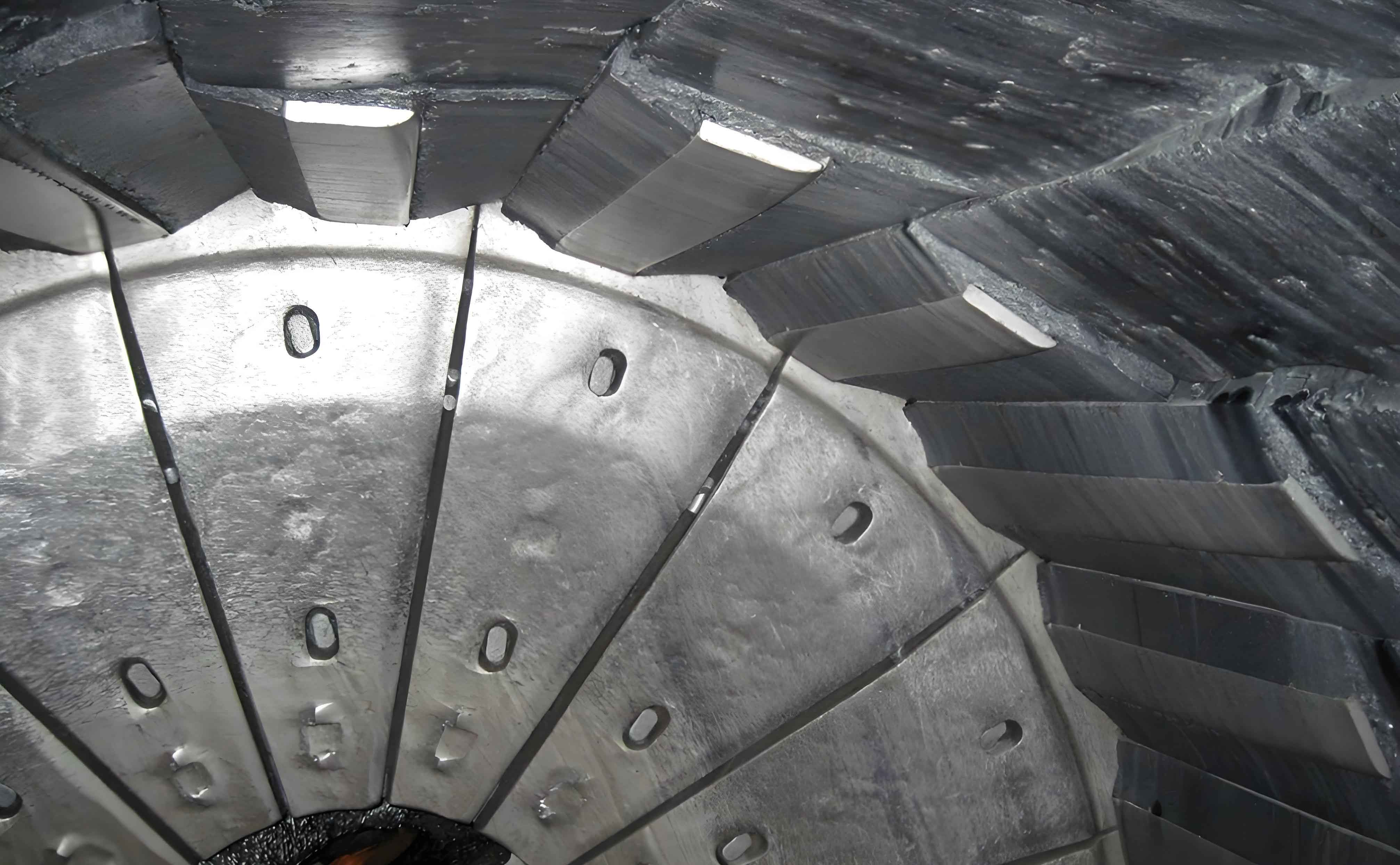
Working Principles of Ball Mills and Semi-Autogenous Mills
Ball mills feature horizontal cylinders containing grinding media (typically steel balls) that cascade and impact ore particles. The rotational motion generates centrifugal forces, creating a complex loading environment where the lining plate experiences both impact and abrasive wear. Semi-autogenous grinding (SAG) mills utilize ore itself as grinding media supplemented by 3-12% large steel balls (Ø80-Ø120mm), generating substantially higher impact energies than ball mills. The wear dynamics differ significantly between mill types:
$$E_k \propto D^{1.5}$$
where \(E_k\) represents kinetic impact energy and \(D\) denotes ball diameter. This relationship explains why SAG mill lining plates endure approximately 50% shorter service life than ball mill lining plates under comparable conditions.
Wear Mechanisms and Key Influencing Factors
Wear Mechanisms
Lining plate degradation results from three simultaneous processes: high-stress abrasive wear from ore particles, impact-induced fatigue cracking, and erosive wear in fine-grinding zones. Microscopic analysis reveals distinct damage modes: ball mills exhibit surface grooving and micro-cracking, while SAG lining plates show macroscopic deformation and spalling due to higher impact energies.
Theoretical Design of Chemical Composition
Optimized alloy design balances hardness, toughness, and wear resistance through precise elemental control:
| Element | Function | Optimal Range (%) |
|---|---|---|
| C | Forms carbides, increases hardness | 0.45 ± 0.05 |
| Cr | Enhances hardenability, corrosion resistance | 1.8 ± 0.2 |
| Mo | Refines grain structure, improves toughness | 0.25 ± 0.05 |
| Mn | Stabilizes austenite, enhances hardenability | 1.0 ± 0.1 |
| Si | Strengthens ferrite, reduces decarburization | 1.0 ± 0.1 |
The synergistic effect of these elements produces fine-grained martensitic microstructure with dispersed secondary carbides, crucial for lining plate longevity.
Hardness-Toughness Optimization
Material hardness must exceed ore hardness (\(H_a\)) to minimize wear while maintaining adequate fracture resistance. The optimal hardness ratio is expressed as:
$$\frac{H_m}{H_a} = 0.8 \sim 1.2$$
where \(H_m\) represents lining plate hardness. Performance requirements differ significantly between mill types:
| Mill Type | Hardness Requirement | Impact Toughness (J/cm²) |
|---|---|---|
| Ball Mill | 48-52 HRC | > 20 |
| SAG Mill | 325-335 HB | > 24 |
Exceeding these hardness thresholds without corresponding toughness compromises lining plate integrity through brittle fracture.
Deformation Control Strategies
Manufacturing-induced warping is minimized through three critical measures: precision-machined molding surfaces, specialized weighted flasks during cooling, and vertical oil quenching at controlled temperatures (60-80°C). These prevent thermal gradients that cause lining plate distortion.
Trial Production and Performance Validation
Heat Treatment Optimization
Critical phase transformations were controlled through tailored thermal processing. Ball mill lining plates underwent austenitization at 950±10°C followed by step-tempering, while SAG lining plates required lower hardening temperatures (860±10°C) with extended tempering to enhance toughness. Resultant mechanical properties:
| Lining Plate Type | Process | Hardness | Impact Toughness (J/cm²) |
|---|---|---|---|
| Ball Mill | Treatment 1 | 48 HRC | 23 |
| Treatment 2 | 50 HRC | 21 | |
| Treatment 3 | 52 HRC | 20 | |
| Treatment 4 | 60 HRC | 12 | |
| SAG Mill | Treatment 1 | 325 HB | 24 |
| Treatment 2 | 335 HB | 24 | |
| Treatment 3 | 345 HB | 20 | |
| Treatment 4 | 365 HB | 15 |
Optimal combinations were identified as Treatment 3 for ball mill lining plates and Treatment 2 for SAG lining plates.
Industrial Performance
Field trials demonstrated significant improvements: ball mill lining plate service life increased by 16.7% (14 months vs. previous 12 months), while SAG lining plates achieved 20-25% longer lifespans (10-12 months vs. 8-10 months). No premature failures through cracking or spalling were observed, validating the balanced mechanical properties of these lining plates.
Conclusions
Through comprehensive optimization of composition, hardness-toughness balance, and manufacturing protocols, high-performance Cr-Mo alloy steel lining plates demonstrate substantially extended service life in both ball and SAG mills. The key achievements include:
1. Precise chemical composition control enabling martensitic transformation with optimal carbide dispersion
2. Strategic hardness-toughness matching through differential heat treatment protocols
3. Deformation-minimized manufacturing ensuring dimensional accuracy
4. 16-25% service life extension validated in industrial operation
These lining plate advancements significantly reduce replacement frequency, maintenance costs, and resource consumption in mineral processing operations. Future work will focus on computational wear modeling and nanostructured surface modifications for further performance enhancement.