
White cast iron, particularly alloyed with chromium, is renowned for its excellent wear resistance due to the presence of hard, eutectic carbides within its microstructure. However, this very feature compromises its impact toughness, severely limiting its application under conditions involving significant mechanical shock. Recent studies have demonstrated that hot forging can dramatically improve the impact toughness of chromium white cast iron, thereby expanding its potential service range. The success of this thermomechanical processing route critically depends on the material’s hot workability, which is intrinsically linked to the behavior of the brittle carbide network at elevated temperatures. This study systematically investigates the hot plasticity of white cast iron with varying chromium content, elucidates the underlying mechanisms governing its high-temperature deformation behavior, and proposes a novel pre-forging heating process designed to maximize forgeability, especially for large deformation ratios.
1. Introduction and Experimental Methodology
The primary challenge in forging white cast iron lies in its low inherent ductility, which is a direct consequence of the continuous or semi-continuous network of eutectic carbides. During forging, stress concentrations readily develop at these carbide interfaces, leading to crack initiation and propagation. The degree of this embrittlement is profoundly influenced by the alloy composition, specifically the chromium content, which alters the type, morphology, quantity, and stability of the carbides. To develop effective forging practices, a fundamental understanding of the hot plasticity as a function of temperature and composition is essential. This research aims to map this relationship and design a thermal treatment that modifies the as-cast microstructure prior to deformation, enhancing the material’s ability to withstand plastic flow without fracture.
1.1 Materials and Specimen Preparation
Three representative grades of hypoeutectic white cast iron were selected for this investigation: low-chromium, medium-chromium, and high-chromium types. The alloys were prepared in a 150 kg medium-frequency induction furnace using raw materials including pig iron, steel scrap, ferrochromium, ferromanganese, and ferrosilicon. They were sand-cast into round bars of 30 mm diameter. The chemical compositions of the three test materials, designated as Specimens 01, 02, and 03, are detailed in Table 1.
| Specimen ID | C | Cr | Mn | Si | P | S | Fe |
|---|---|---|---|---|---|---|---|
| 01 (Low-Cr) | 2.62 | 4.01 | 0.59 | 0.70 | 0.021 | 0.036 | Bal. |
| 02 (Medium-Cr) | 2.57 | 8.24 | 0.54 | 0.73 | 0.018 | 0.031 | Bal. |
| 03 (High-Cr) | 2.59 | 15.12 | 0.62 | 0.61 | 0.018 | 0.044 | Bal. |
The cast bars were subsequently annealed and machined into cylindrical upsetting specimens with dimensions of Ø25 mm × 40 mm for hot plasticity testing.
1.2 Experimental Methods
1.2.1 Hot Plasticity Upsetting Test: The hot workability was assessed using the cylindrical free upsetting method. Specimens were heated to predetermined test temperatures according to the cycle shown in Figure 1, held for a specified time to ensure thermal uniformity, and then forged on a 65 kg air hammer. The test evaluates the material’s resistance to cracking during deformation. The hot plasticity is quantified by the critical height reduction, denoted as $\varepsilon$, at which the first macroscopic crack becomes visible on the specimen’s lateral surface. A higher $\varepsilon$ value indicates superior hot plasticity. The deformation degree is calculated as:
$$\varepsilon = \frac{H_0 – H_c}{H_0} \times 100\%$$
where $H_0$ is the original specimen height and $H_c$ is the height at the onset of cracking.
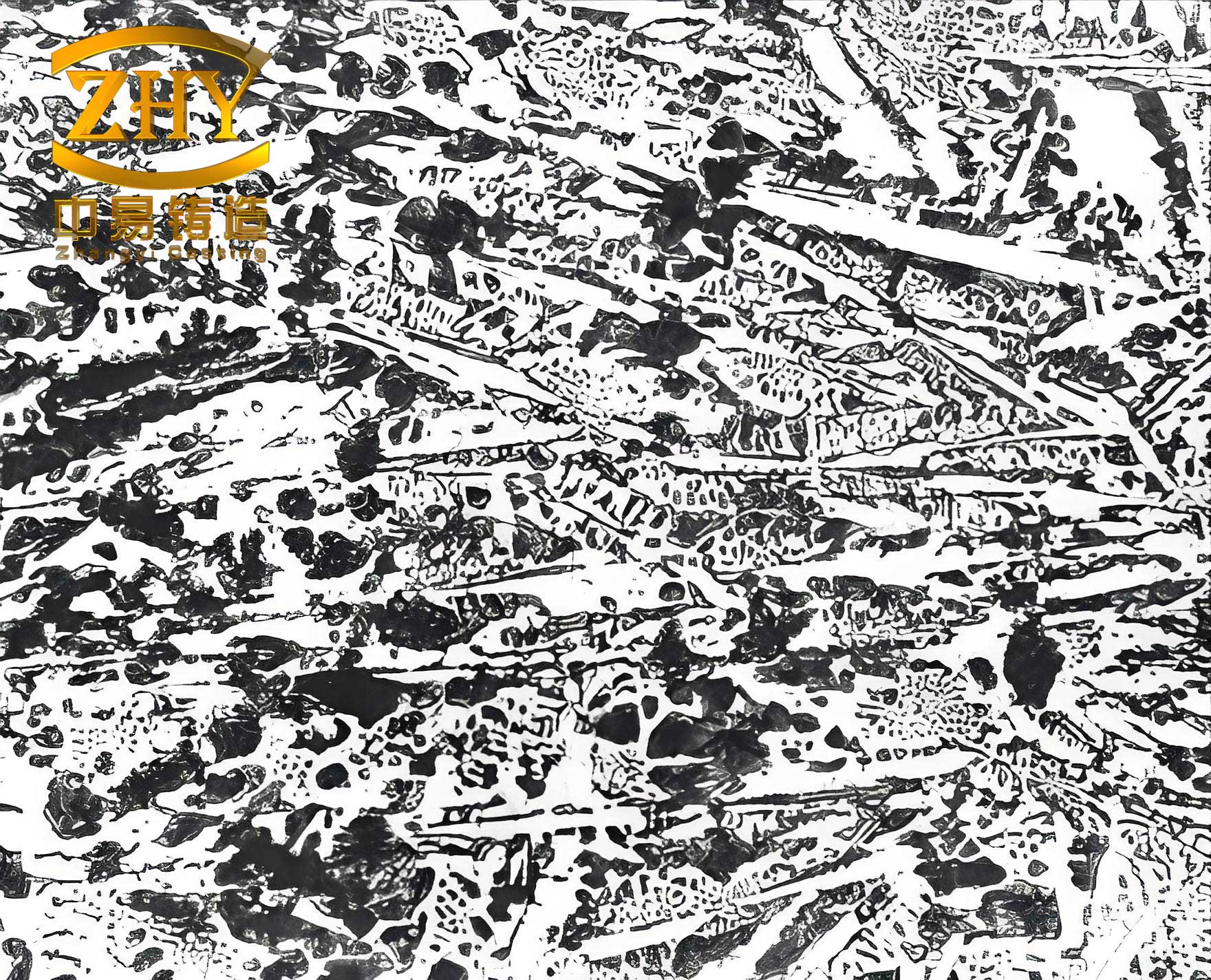
1.2.2 In-situ Observation of Eutectic Carbide Dissolution: To understand the microstructural evolution during heating, samples were heated to various temperatures, held for different durations, and then water-quenched to preserve the high-temperature microstructure. The dissolution behavior of the eutectic carbide network was meticulously examined using optical microscopy and scanning electron microscopy (SEM).
1.2.3 Chemical Analysis of Phases: Electron probe microanalysis (EPMA) was employed to determine the distribution of chromium between the metallic matrix and the eutectic carbides in the as-cast and heat-treated conditions. This data is crucial for analyzing the diffusion kinetics involved in carbide dissolution.
2. Results and Discussion: Hot Plasticity of Chromium White Cast Iron
2.1 Influence of Chromium Content and Temperature
The results of the hot plasticity upsetting tests for the three types of white cast iron are summarized in Figure 2. The curve for each specimen depicts the relationship between test temperature and the maximum achievable deformation ($\varepsilon$) before cracking.
The data reveals several key trends:
1. All specimens exhibit a significant increase in hot plasticity with rising temperature. This is a universal behavior for metallic materials as atomic mobility increases and yield strength decreases.
2. A distinct “hot plasticity peak” exists for each composition. Forging above or below this optimal temperature range leads to reduced workability.
3. Most critically, the hot plasticity of white cast iron decreases markedly with increasing chromium content. The low-chromium white cast iron (Specimen 01) demonstrates the best overall forgeability, achieving a peak $\varepsilon$ value exceeding 85%. The medium-chromium white cast iron (Specimen 02) shows intermediate plasticity. The high-chromium white cast iron (Specimen 03) possesses the poorest hot workability, with a significantly lower peak deformation capacity.
| Specimen | Cr Content (wt.%) | Peak Hot Plasticity ($\varepsilon_{max}$) | Corresponding Temperature Range |
|---|---|---|---|
| 01 (Low-Cr) | ~4 | > 85% | 1050-1100 °C |
| 02 (Medium-Cr) | ~8 | ~85% | 1100-1150 °C |
| 03 (High-Cr) | ~15 | Substantially lower than 01 & 02 | 1150-1200 °C |
The underlying reason for this composition-dependent behavior is rooted in the nature and stability of the eutectic carbides. In low-chromium white cast iron, the carbides are primarily of the M3C type (cementite), which are relatively less stable at high temperatures. In contrast, higher chromium levels promote the formation of more stable M7C3 and M23C6 type carbides. The stability can be conceptually related to the free energy of formation $\Delta G_f$:
$$\Delta G_f (M_xC_y) \approx \Delta H_f – T\Delta S_f$$
where $M$ represents metallic elements (Fe, Cr), and $C$ is carbon. Carbides with a more negative $\Delta G_f$ are more stable and resist dissolution. The chromium-rich carbides in high-chromium white cast iron have a more negative $\Delta G_f$, making them persistent obstacles to plastic flow at forging temperatures.
2.2 Mechanism: Role of Eutectic Carbide Dissolution
The divergence in hot plasticity, especially at elevated temperatures, is primarily governed by the dissolution kinetics of the eutectic carbide network into the austenitic matrix. Microstructural analysis provided clear evidence:
– For low-chromium white cast iron, holding at 1030°C initiated substantial dissolution of the carbide network after 1.5 hours. After 2 hours, the network was almost completely dissolved, transforming the microstructure into a nearly homogeneous austenite with isolated carbide particles.
– For medium-chromium white cast iron, a higher temperature of 1080°C was required to initiate noticeable dissolution after 1.5 hours. After 2 hours, the majority of the network was dissolved.
– For high-chromium white cast iron, even prolonged holding at 1150°C for 2.5 hours resulted only in localized “breaking” or thinning of the continuous carbide network, rather than complete dissolution.
This behavior can be explained by Fick’s laws of diffusion. The dissolution rate of a carbide is proportional to the diffusion flux $J$ of its constituent atoms (Cr and C) from the carbide/matrix interface into the austenite:
$$J = -D \frac{\partial C}{\partial x}$$
where $D$ is the diffusion coefficient and $\frac{\partial C}{\partial x}$ is the concentration gradient. Two factors impede dissolution in high-chromium white cast iron:
1. Higher Carbide Stability: The strong Cr-C bonds in M7C3 carbides lower the driving force (effective $\frac{\partial C}{\partial x}$) for decomposition.
2. Slower Diffusion Kinetics: Upon partial dissolution, the austenite adjacent to the carbide becomes highly enriched in Cr and C. Chromium, in particular, has a low diffusion coefficient in austenite. This creates a saturated layer that drastically reduces the concentration gradient, acting as a barrier to further dissolution. The process can be modeled as diffusion-controlled growth/dissolution with a time dependence often following a parabolic law:
$$r(t) \approx r_0 – k\sqrt{t}$$
where $r(t)$ is the carbide size at time $t$, $r_0$ is the initial size, and $k$ is a rate constant that is much smaller for Cr-rich carbides.
EPMA results confirmed that the chromium content within the eutectic carbides increases with the overall alloy chromium content. Consequently, at forging temperatures, low- and medium-chromium white cast iron can achieve a microstructure where the brittle network is largely eliminated, allowing the austenite matrix to deform freely with high plasticity. In contrast, the persistent, strong carbide network in high-chromium white cast iron continuously impedes dislocation motion and causes stress concentrations, leading to lower hot plasticity.
3. Development of a Novel Pre-Forging Heating Process
Conventional pre-forging heating for white cast iron focuses solely on achieving a uniform temperature throughout the workpiece, typically involving a short hold at the intended forging start temperature. Based on the insights gained from the dissolution studies, we proposed and tested a novel two-stage heating strategy aimed at actively modifying the microstructure before deformation.
The Novel Process Principle: Hold the workpiece at a temperature approximately 50°C below the intended start-forging temperature for an extended period (e.g., 2 hours). This extended “soaking” stage is designed to promote the maximum possible dissolution of the eutectic carbide network without risking excessive grain growth. Subsequently, the temperature is raised to the optimal start-forging temperature for a short time (e.g., 10 minutes) to ensure thermal homogeneity immediately before forging.
3.1 Comparison of Heating Methods
The effectiveness of this novel process was directly compared against the conventional short-hold process via hot plasticity upsetting tests. Figure 3 presents comparative curves for the medium- and high-chromium white cast iron.
The results were striking:
– For both medium-chromium (Specimen 02) and high-chromium white cast iron (Specimen 03), the novel heating process yielded higher $\varepsilon$ values across the tested temperature range compared to the conventional process.
– The improvement was most dramatic for low- and medium-chromium white cast iron. Using the novel process, these materials could be upset to high degrees of deformation without cracking, effectively moving their hot plasticity limit beyond the measurable range of the test for the upper temperature range.
– For high-chromium white cast iron, the improvement, while significant, was more modest due to the inherent resistance of its carbides to complete dissolution, as previously discussed.
The mechanism for this improvement is direct. The conventional process leaves the brittle carbide network largely intact. During forging, the soft austenite matrix must flow around these hard, undeformable phases, leading to high local stresses and cracking. The novel, prolonged-heating process dissolves a substantial portion of this network for low/medium-Cr irons, transforming the microstructure. Forging then primarily involves the plastic flow of a more homogeneous austenitic matrix, drastically reducing stress concentrators and enabling much greater deformation before failure. For high-chromium irons, even partial dissolution and “breaking up” of the network continuity enhances the matrix’s ability to flow, thereby improving hot workability.
3.2 Optimized Process Parameters
Based on the combined data from dissolution studies and hot plasticity tests with the novel heating method, we established the following optimized pre-forging heating schedules for each grade of white cast iron:
For Low-Chromium White Cast Iron (Specimen 01):
Heat to 1030°C → Hold for 2 hours → Ramp to 1080°C → Hold for 10 minutes → FORGE.
Optimal Start-Forging Temperature: 1080°C
For Medium-Chromium White Cast Iron (Specimen 02):
Heat to 1080°C → Hold for 2 hours → Ramp to 1130°C → Hold for 10 minutes → FORGE.
Optimal Start-Forging Temperature: 1130°C
For High-Chromium White Cast Iron (Specimen 03):
Heat to 1100°C → Hold for 2 hours → Ramp to 1150°C → Hold for 10 minutes → FORGE.
Optimal Start-Forging Temperature: 1150°C
This tailored approach ensures that each type of chromium white cast iron is heated in a manner that maximizes the dissolution of its specific carbide network, thereby granting it the highest possible hot plasticity for subsequent forging operations. The subsequent cooling after forging allows for the controlled re-precipitation of fine, dispersed secondary carbides, which can be further optimized through post-forging heat treatments to achieve an excellent combination of toughness and wear resistance.
4. Conclusions
This investigation into the hot deformation behavior of chromium white cast iron leads to the following principal conclusions:
1. The hot plasticity of white cast iron is inversely proportional to its chromium content. Low-chromium white cast iron exhibits the best forgeability, followed by medium-chromium white cast iron, with high-chromium white cast iron demonstrating the poorest hot workability under conventional heating conditions.
2. The fundamental mechanism responsible for this trend is the differing dissolution kinetics of the eutectic carbide networks during heating. The stability of chromium-rich carbides (M7C3) and the slower diffusion of chromium in austenite significantly retard network dissolution in high-chromium white cast iron, leaving a continuous brittle phase that impairs plastic flow at high temperatures.
3. A novel pre-forging heating process, characterized by a prolonged soak (e.g., 2 hours) at a temperature about 50°C below the optimal start-forging temperature, can dramatically enhance the hot plasticity of chromium white cast iron. This process actively promotes the dissolution of the eutectic carbide network prior to deformation.
– For low- and medium-chromium white cast iron, this improvement is particularly profound, enabling these materials to withstand large deformation ratios without cracking, which was not achievable with conventional short-hold heating.
– For high-chromium white cast iron, the novel process also provides a measurable improvement in hot workability by partially breaking up the carbide network continuity.
4. Optimized pre-forging parameters were established, defining specific soaking temperatures and subsequent start-forging temperatures for low- (1080°C), medium- (1130°C), and high-chromium (1150°C) white cast iron. Adopting this engineered thermal strategy before forging unlocks the potential for significant thermomechanical processing of chromium white cast iron, paving the way for producing components with a superior combination of toughness and wear resistance for demanding applications.