
In modern industrial applications, cast iron serves as a critical engineering material due to its excellent wear resistance, heat resistance, damping capacity, machinability, and cost-effectiveness. It is widely used in sectors such as light machinery, petrochemicals, automotive, and aerospace industries. However, certain components, like耐磨衬筒 subjected to repetitive spring wear, demand enhanced properties including high wear resistance and crack prevention, which conventional gray cast iron cannot achieve. This study focuses on developing HTCu1.8 alloy cast iron through advanced foundry technology to meet these rigorous requirements. Foundry technology plays a pivotal role in optimizing material performance by controlling composition, melting processes, and solidification conditions.
The primary objective was to achieve a microstructure comprising 100% pearlitic matrix with Type A graphite and fine eutectic cells, which significantly improves mechanical properties. Alloying elements, particularly copper, were incorporated to refine the pearlite and enhance strength. Early approaches used nickel and chromium in a 3:1 mass ratio to form sorbitic pearlite, but copper offers unique advantages in foundry technology by promoting graphite refinement and reducing phosphide eutectic networks. This research explores the interplay of chemical composition, carbon equivalent, and cooling methods in foundry technology to produce HTCu1.8 alloy cast iron with superior bending strength, hardness, and deflection.
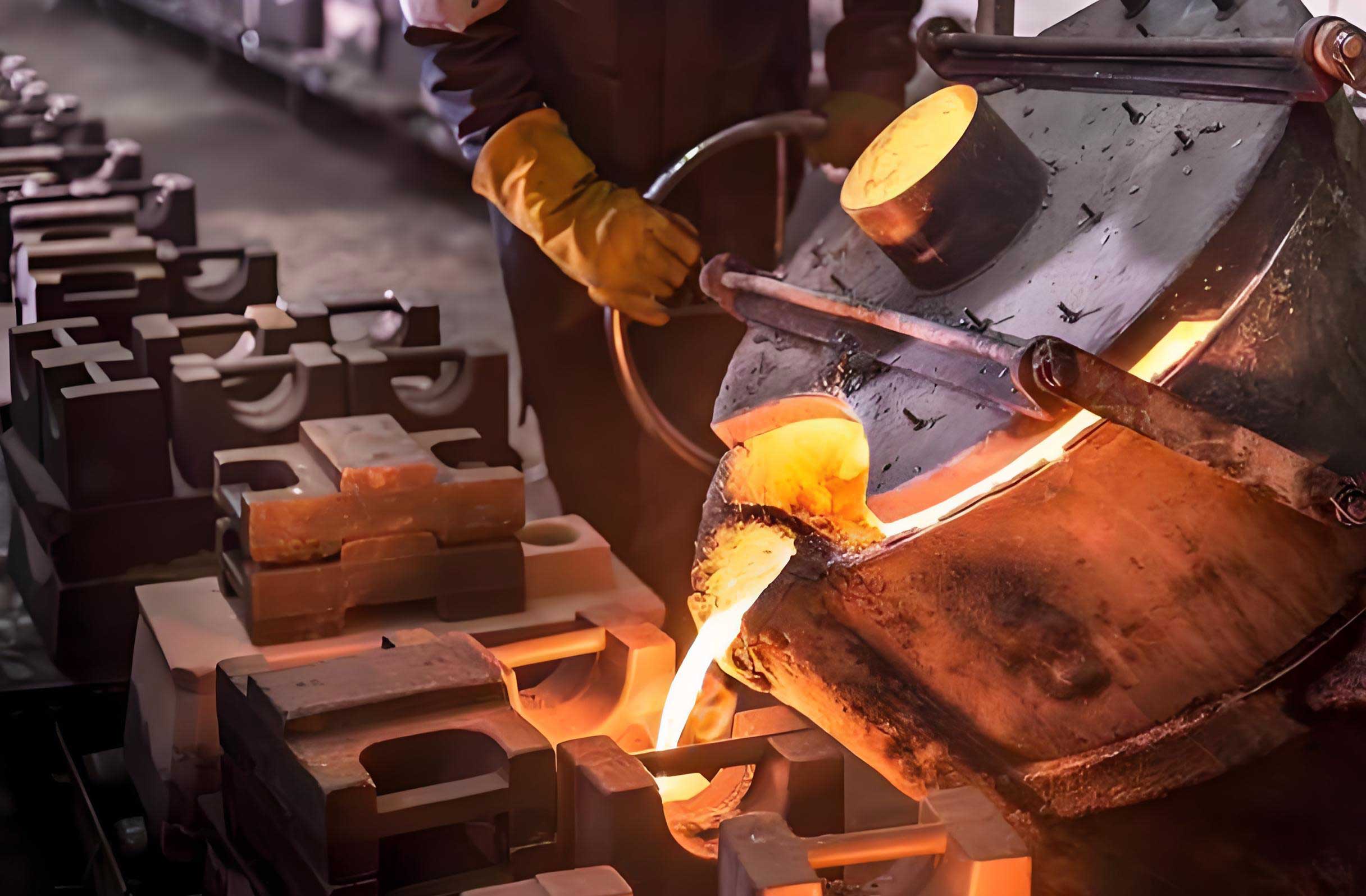
The chemical composition of HTCu1.8 alloy cast iron was designed based on iterative optimizations, targeting elements that influence graphite formation and matrix structure. Copper, with its mild graphitizing effect, accumulates at the austenite-graphite interface, hindering carbon diffusion and refining pearlite. This is crucial in foundry technology for achieving consistent mechanical properties. The specified composition ranges are summarized in Table 1, which served as the foundation for melting trials. Foundry technology emphasizes precise control over element ratios to avoid defects and ensure reproducibility.
| Element | Range |
|---|---|
| C | 2.80–3.60 |
| Si | 1.30–1.90 |
| Mn | 0.60–1.20 |
| Cr | 0.20–0.40 |
| Cu | 1.50–2.00 |
| S | ≤0.10 |
| P | ≤0.30 |
Microstructural analysis revealed that adding copper resulted in a uniform distribution of Type A graphite without coarse Type C graphite, alongside a matrix of lamellar pearlite and sorbitic pearlite. Phosphide eutectic was controlled to grades 1–2, and graphite size ranged from grades 3 to 5, with ferrite and eutectic graphite each limited to below 10%. This microstructure is vital in foundry technology for ensuring durability under cyclic loading. The carbon equivalent (CE) is a key parameter in foundry technology, calculated as: $$ CE = C + \frac{1}{3}(Si + P) $$ where CE influences graphite coarseness and phase formation. Lower CE values promote finer graphite and increased austenite dendrites, enhancing strength. To validate this, comparative experiments were conducted with varying carbon and silicon levels, as detailed in Table 2. Foundry technology leverages such formulations to tailor material behavior.
| Batch | Bending Strength (MPa) | Deflection at 300 mm (mm) | Hardness (HB) | Notes |
|---|---|---|---|---|
| HT15-1970-S2 | 437 | 5.12 | 177 | CE = 4.13% |
| HT15-1972-S2 | 407 | 4.96 | 183 | CE = 4.13% |
| HT15-1975-S2 | 409 | 4.59 | 183 | CE = 4.13% |
| HT15-1980-S2 | 419 | 4.89 | 180 | CE = 4.13% |
| HT15-1971-S2 | 620 | 4.82 | 245 | CE = 3.53% |
| HT15-1973-S1 | 636 | 4.99 | 239 | CE = 3.53% |
| HT15-1973-S2 | 609 | 4.92 | 250 | CE = 3.53% |
| HT15-1978-S2 | 617 | 4.68 | 234 | CE = 3.53% |
| Requirements | ≥353 | ≥3 | 207–262 | – |
The data show that at CE = 4.13%, hardness values fell below specifications, whereas CE = 3.53% yielded higher bending strength and compliant hardness. This aligns with foundry technology principles where reduced carbon equivalent enhances mechanical properties by refining microstructure. The relationship between hardness and carbon content can be expressed as: $$ H \propto \frac{1}{CE} $$ where H represents hardness, indicating that lower CE values correlate with increased hardness. Foundry technology applications often involve pre-control of CE to achieve desired outcomes in cast components.
Cooling methods significantly impact the as-cast structure in foundry technology, as they dictate the cooling rate during eutectic and eutectoid transformations. Slower cooling promotes coarser pearlite and ferrite formation, reducing hardness. Experiments evaluated three cooling approaches: cold shell (mold cooled to ambient before pouring), hot shell (mold used immediately after baking), and hot shell with sand filling (insulated cooling). Results in Table 3 demonstrate that faster cooling, such as cold shell without sand filling, preserves higher hardness by maintaining fine pearlite. Foundry technology optimizes these parameters to control phase transformations.
| Batch | Number of Samples | Hardness (HB) | Pouring Temperature (°C) | Cooling Method |
|---|---|---|---|---|
| HT15-1966-S1 | 3 | 193 | 1410 | Cold Shell |
| HT15-1966-S2 | 3 | 186 | 1410 | Hot Shell |
| HT15-1980-S3 | 3 | 167 | 1406 | Hot Shell with Sand |
The cooling rate effect can be modeled using the equation: $$ \frac{dT}{dt} = k (T – T_{\text{env}}) $$ where dT/dt is the cooling rate, k is a constant dependent on mold material, T is the temperature, and T_env is the environmental temperature. In foundry technology, faster cooling rates (higher dT/dt) suppress ferrite formation, thereby increasing hardness. This principle was applied in production trials using a 200 kg medium-frequency induction furnace, which offers precise temperature and composition control—essential in foundry technology for uniform melting. The charging sequence involved carbon enhancer, returns, steel scrap, pig iron, copper, and chromium, followed by ferromanganese and ferrosilicon additions. Pouring was conducted at 1400 ± 10°C with cold shell molds and spaced cooling to enhance solidification uniformity.
Production validation results, summarized in Table 4, confirm that HTCu1.8 alloy cast iron with 1.50–2.00 wt% Cu exhibits bending strengths exceeding 590 MPa, deflections over 5 mm, and hardness within 207–262 HB, meeting all design criteria. This success underscores the importance of integrated foundry technology in achieving high-performance castings. The optimization of element ratios, carbon equivalent, and cooling strategies exemplifies how advanced foundry technology can overcome limitations of conventional materials.
| Batch | Bending Strength (MPa) | Deflection at 300 mm (mm) | Hardness (HB) |
|---|---|---|---|
| HT15-2015 | 592.0 | 5.12 | 247 |
| HT15-2016 | 605.7 | 5.71 | 246 |
| HT15-2017 | 624.0 | 5.61 | 250 |
In conclusion, this research demonstrates that HTCu1.8 alloy cast iron, produced through refined foundry technology, offers superior mechanical properties compared to ordinary gray iron. The incorporation of 1.50–2.00 wt% copper strengthens the matrix, while a carbon equivalent of 3.53% ensures consistent hardness. Additionally, employing cold shell pouring without sand filling and spaced cooling in foundry technology yields high bending strength. These findings highlight the critical role of foundry technology in developing advanced cast iron materials for demanding applications, providing a framework for future innovations in the field. Foundry technology continues to evolve, enabling the production of components with enhanced reliability and performance.