
In the production of wear-resistant components for heavy industry, high manganese steel casting stands as a premier material choice. Its unique capacity for work hardening under intense impact loads grants it exceptional resistance to abrasion and deformation. This characteristic makes it indispensable in applications within mining, metallurgy, and material handling, where components are subject to severe mechanical stress. However, the very properties that make it desirable also present significant challenges in the foundry. The excellent fluidity of high manganese steel casting alloys, stemming from high carbon and manganese content, allows them to fill intricate molds easily, akin to cast iron. Yet, their wide solidification range and subsequent poor machinability necessitate that castings be used in their as-cast and heat-treated state, placing immense importance on achieving sound, dimensionally accurate, and defect-free castings directly from the mold. A primary obstacle in achieving this goal has historically been the effective control of shrinkage defects—specifically, macro-porosity (shrinkage cavities) and micro-porosity (shrinkage porosity)—which compromise the integrity and service life of the final part.
This article details my practical experience and research in tackling this persistent issue, specifically for a family of components like feed inlets. Traditionally, the feeding systems for these high manganese steel casting parts, often designed with large, top-mounted risers directly over thermal junctions, proved inadequate. Paradoxically, larger risers and thicker necks often led to more severe shrinkage defects at the junction between the riser and the casting. This counter-intuitive result prompted a fundamental re-evaluation of our gating and feeding philosophy. We abandoned traditional sequential solidification principles and instead adopted the Equilibrium Solidification and Limited Feeding Theory. This theory posits that for alloys with a wide freezing range, the casting’s own graphitization expansion (in cast iron) or a carefully balanced solidification front can offset a portion of the liquid and solidification shrinkage. The role of the riser is not to feed the entire solidification process from start to finish, but to provide limited, timely, and efficient feeding during the critical period when the casting’s internal liquid metal is no longer accessible. This shift in perspective was crucial for solving the problems in high manganese steel casting.
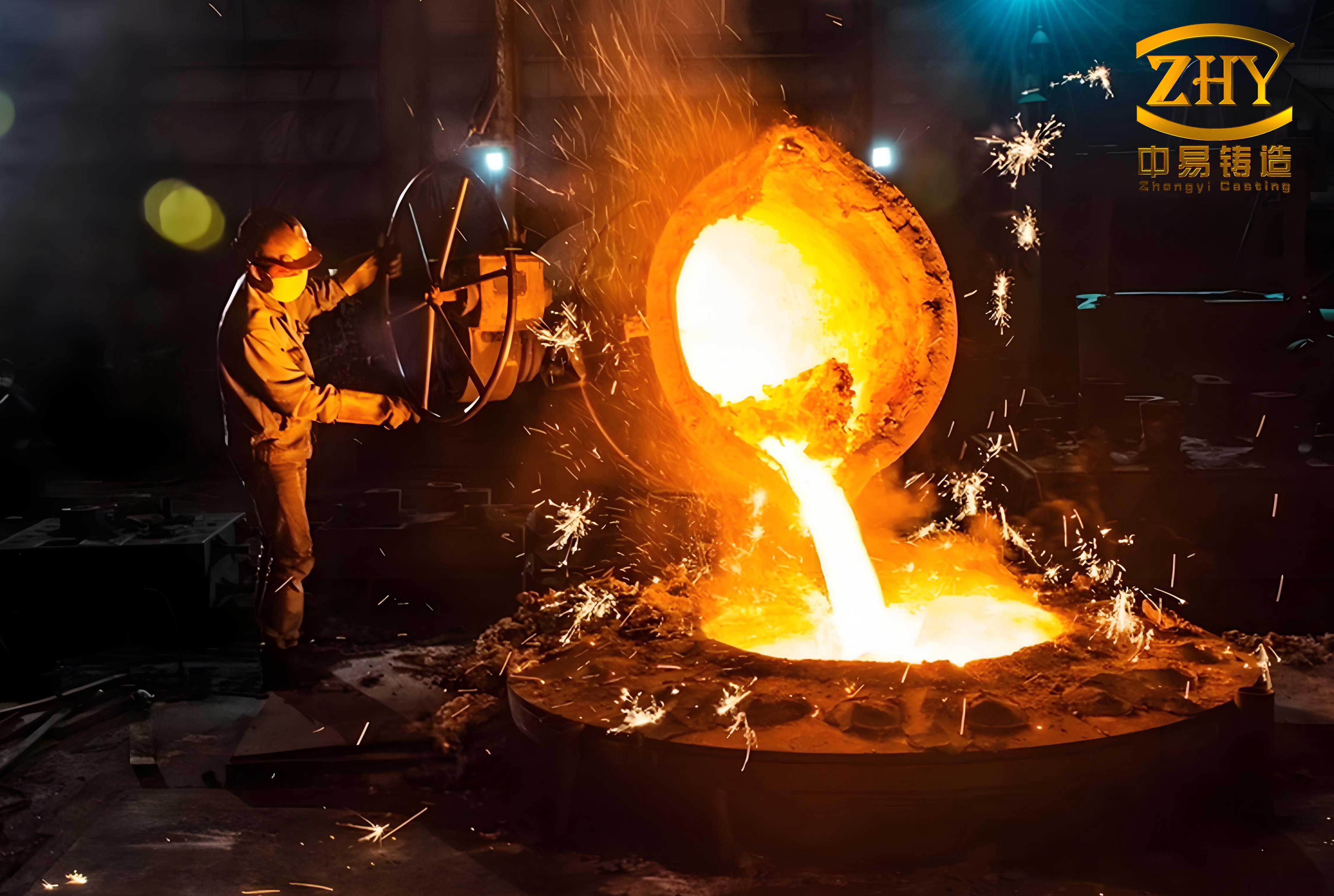
The casting in question was a feed inlet with a relatively uniform wall thickness but distinct thermal junctions at flange intersections. The original process, as mentioned, utilized a top riser. Our analysis using equilibrium solidification principles identified three core issues:
- Material Characteristics: From the Fe-C-Mn ternary phase diagram, the crystallization temperature interval for standard high manganese steel (e.g., ~1.2% C, ~12% Mn) is exceptionally wide. This promotes a pasty, or mushy, mode of solidification in sand molds. A large riser neck feeding directly into a hot spot acts as a massive reservoir of superheated metal, prolonging the local solidification time and exacerbating the tendency for concentrated shrinkage cavities.
- Geometric Thermal Junction: Even with a riser removed (an attempt to increase yield), the inherent geometry of the flange-body intersection creates a hot spot that solidifies last. Without any feeding source, this inevitably leads to surface shrinkage or internal porosity.
- Contact Hot Spot Creation: The original top riser, placed directly over the geometric hot spot, created an even more severe contact hot spot. The prolonged flow of hot metal through this channel during pouring overheated the mold in that region, worsening the local cooling conditions and ensuring the riser could not effectively compensate for the extended solidification shrinkage.
The key insight was recognizing that while high manganese steel casting lacks the graphite expansion of cast iron, its solidification behavior in a sand mold shares similarities in terms of needing controlled, not massive, feeding. The solution was to design a system that balanced heat dissipation and feeding pressure.
| Feature | Original Process | Improved Process (Equilibrium Theory) |
|---|---|---|
| Feeding Philosophy | Sequential Solidification: Large riser to feed entire solidification. | Equilibrium Solidification: Limited, efficient feeding to compensate for critical period shrinkage. |
| Riser Type & Location | Top riser, directly over main thermal junction. | Side riser (feeder) placed on the flange wall, away from the direct thermal junction. |
| Riser Neck Design | Thick, short neck promoting a severe contact hot spot. | Short, flat, and wide neck to minimize heat concentration while maintaining a feeding channel. |
| Primary Defect | Major shrinkage cavity/porosity at riser neck junction. | Elimination of major shrinkage; sound casting at the junction. |
| Process Yield | Lower (~65%) | Higher (~75%) |
The new design, therefore, employed side risers (feeders) positioned on the flange wall. This location avoids creating the worst overheating at the main body-flange corner. The riser itself was designed to be compact. The design process followed a systematic modulus-based approach, central to feeding calculations for high manganese steel casting.
First, the casting modulus \( M_c \) was calculated. For a plate-like section of the flange with thickness \( T \), the modulus is given by the volume-to-cooling-surface-area ratio. For a simple plate of thickness \( T \), neglecting minor edges, the modulus is:
$$ M_c \approx \frac{V}{A} = \frac{T \times A_{area}}{2 \times A_{area}} = \frac{T}{2} $$
For our casting with a flange thickness \( T = 70\, \text{mm} \), the approximate modulus was:
$$ M_c \approx \frac{70}{2} = 35\, \text{mm} = 3.5\, \text{cm} $$
According to the principle of feeding, the riser modulus \( M_r \) must be larger than the casting modulus to ensure the riser solidifies last. A common rule is:
$$ M_r = 1.2 \times M_c $$
Thus,
$$ M_r = 1.2 \times 3.5\, \text{cm} = 4.2\, \text{cm} $$
We selected an oval-shaped side riser for efficient space use and feeding. Based on standard riser sizing charts for a modulus of \( 4.2\, \text{cm} \), the riser dimensions were determined. A critical element was the riser neck. Its modulus \( M_n \) must satisfy a condition to control the solidification sequence: it should solidify after the casting hot spot but before the riser itself fully solidifies, creating a temporary “sealed system”. A typical relationship is:
$$ M_c < M_n < M_r $$
We designed a flat, wide neck with a modulus calculated from its dimensions (width \( W_n \), height \( H_n \), length \( L_n \)). For a neck with a rectangular cross-section, its modulus is approximately:
$$ M_n \approx \frac{W_n \times H_n}{2 \times (W_n + H_n)} \quad \text{(for a short neck, neglecting ends)} $$
By carefully choosing \( W_n \) and \( H_n \), we achieved \( M_n \approx 3.8\, \text{cm} \), fulfilling the inequality \( 3.5 < 3.8 < 4.2 \).
| Parameter | Symbol | Value | Calculation/Note |
|---|---|---|---|
| Casting Modulus | \( M_c \) | 3.5 cm | \( T/2 \) for 70 mm thick section |
| Target Riser Modulus | \( M_r \) | 4.2 cm | \( 1.2 \times M_c \) |
| Riser Type & Dimensions | – | Oval: ~180mm x 90mm x 150mm (H) | From foundry manuals for \( M_r = 4.2\, \text{cm} \). |
| Riser Neck Modulus | \( M_n \) | ~3.8 cm | Designed via \( M_n \approx \frac{W_n H_n}{2(W_n+H_n)} \) |
| Number of Risers | \( N \) | 2 | Based on feeding distance \( L_f \approx 4.5T \) and flange perimeter. |
| Process Yield (Theoretical) | – | ~75% | \( \frac{\text{Casting Wt.}}{\text{Casting Wt.} + \text{Riser Wt.} + \text{Gating Wt.}} \times 100\%\) |
The feeding mechanism of this side riser is distinct from the conventional pressure-fed top riser. Initially, the “washing effect” of metal flowing through the neck heats the surrounding mold, keeping the channel open. As the casting cools and begins to solidify, a sealed, isolated liquid zone forms between the casting’s hot spot and the riser. When shrinkage occurs in this zone, it creates a temporary vacuum or negative pressure. This vacuum actively draws liquid metal from the still-molten riser into the shrinking area, rather than relying solely on hydrostatic pressure. This “suction feeding” is highly efficient and is a direct application of the equilibrium solidification concept.
To verify the number of risers, the feeding distance was estimated. For a plate-like section of high manganese steel, the effective feeding distance \( L_f \) from a side riser can be approximated as a multiple of the section thickness \( T \). A conservative estimate is \( L_f = 4.5T \).
$$ L_f = 4.5 \times 70\, \text{mm} = 315\, \text{mm} $$
The total perimeter of the flange requiring feeding was approximately 600 mm. Therefore, the required number of risers \( N \) is:
$$ N = \frac{\text{Total Feeding Length}}{L_f} = \frac{600\, \text{mm}}{315\, \text{mm/riser}} \approx 1.9 $$
Thus, two risers were deemed sufficient for the high manganese steel casting.
The gating system was also redesigned to support this feeding approach. Using a bottom-pour ladle with a known nozzle diameter (\( d = 50\, \text{mm} \)), the pouring time \( t \) was calculated first based on the total poured weight \( W \) and the empirical mass flow rate \( Q \) from the ladle nozzle.
$$ t = \frac{W}{Q} $$
With \( W \approx 450\, \text{kg} \) and \( Q \approx 120\, \text{kg/s} \) for a 50mm nozzle, \( t \approx 3.75\, \text{s} \). The choke principle was applied, making the sprue base the controlling area \( A_{choke} \). Using the simplified Bernoulli’s equation for flow rate:
$$ Q = \rho \cdot A_{choke} \cdot v \quad \text{and} \quad v \approx \sqrt{2gh} $$
Where \( h \) is the metallostatic head. Solving for the required choke area and back-calculating the sprue diameter \( d_{sprue} \) confirmed the sizing. The final system used a sprue of diameter \( \phi 60\, \text{mm} \), with a runner and ingates sized to maintain a slight pressurization ratio \( \Sigma A_{sprue} : \Sigma A_{runner} : \Sigma A_{ingate} \approx 1 : 1.2 : 1.4 \). This ensured a relatively calm fill to avoid mold erosion and excessive turbulence, which is crucial for maintaining thermal consistency in the mold for high manganese steel casting.
The successful implementation of this new process completely eliminated the major shrinkage cavities and significant porosity that had plagued the production of these high manganese steel casting components. The internal soundness and density of the castings were markedly improved, as confirmed by non-destructive testing and sectioning of sample castings. An equally important benefit was the increase in the process yield from approximately 65% to over 75%, representing a substantial reduction in liquid metal consumption, cleaning, and riser-removal costs per good casting. The post-heat-treatment inspection revealed no cracking at the riser removal points, as the side riser design allowed for easier and thermally less stressful cutting compared to a massive top riser on a sensitive thermal junction.
In conclusion, the application of Equilibrium Solidification and Limited Feeding Theory to the process design of high manganese steel casting components, such as feed inlets, is not only viable but highly advantageous. This theoretical framework provides a coherent explanation for the failures of traditional heavy riser approaches and offers a practical methodology for designing efficient feeding systems. It accurately describes the interplay between solidification, shrinkage, and feeding in these wide-freezing-range alloys. The methodology, centered on modulus calculation, controlled neck design, and strategic riser placement, reliably produces sound castings while significantly enhancing metallurgical yield and overall economic efficiency in the production of high manganese steel casting.